Every system that collects personal data, from a signup form to a full-scale learning management system, makes a choice: bolt on privacy protections after the fact, or build them in from the start. That choice is exactly what privacy by design explained as a framework addresses. It’s a proactive approach to data protection that embeds privacy into the architecture of products, processes, and business practices before a single record is ever collected.
For organizations that train employees, customers, or partners through platforms like Axis LMS, this isn’t abstract theory. An LMS processes names, email addresses, assessment scores, completion records, and sometimes sensitive compliance data. How that information is handled, at a structural level, determines whether your organization meets regulatory expectations or scrambles to patch gaps after a breach or audit. Privacy by design gives you a blueprint for getting it right from the start.
This article breaks down the Privacy by Design framework in full: what it actually means, the seven foundational principles behind it, how it connects to GDPR and other regulations, and concrete examples of what implementation looks like in practice. Whether you’re evaluating software vendors, building internal training programs around data protection, or simply trying to understand your obligations, this guide gives you the clarity to act, not just comply on paper.
Why privacy by design matters now
The privacy landscape has shifted dramatically over the past decade. Data collection has scaled to a point where most organizations process tens of thousands or millions of personal records, and the consequences of mishandling that data have grown from reputational damage to criminal liability in many jurisdictions. With privacy by design explained as a foundational framework, the core message is clear: you cannot retrofit privacy onto a system that wasn’t built with it in mind, the same way you cannot add structural support to a building after the foundation has already been poured.
Data Volumes and Breach Risk Have Both Increased
Organizations collect more data today than at any point in history. Learning platforms alone routinely store learner profiles, progress records, assessment results, certification data, and communication logs across thousands or tens of thousands of users. Each additional data point you collect is a potential liability if your system architecture doesn’t protect it from the start.
The financial reality behind breaches is significant. IBM’s Cost of a Data Breach Report consistently places average breach costs in the multi-million dollar range globally, and those figures don’t include the regulatory fines that authorities in the EU, US, and elsewhere can layer on top of direct losses. If your platform collects personal data and that data is exposed, you face financial, legal, and reputational consequences at the same time, not in sequence.
Treating privacy as an add-on is not a cost-saving strategy; it is a deferred liability that compounds with every passing quarter.
Regulations Have Raised the Stakes for Every Organization
Privacy regulations have multiplied and strengthened significantly since the GDPR came into force in May 2018. The GDPR explicitly requires privacy by design as a legal obligation under Article 25, not as a best practice but as a binding requirement for any organization that processes data belonging to EU residents. California’s CPRA, Brazil’s LGPD, and Canada’s PIPEDA follow similar principles, and the list of US state-level privacy laws has expanded consistently in recent years with no sign of slowing.
For organizations running employee training, customer education, or compliance programs through an LMS, this regulatory environment is directly relevant. Every jurisdiction where your learners reside adds a layer of data protection obligations your systems must meet. Building your infrastructure around privacy from the beginning is the only scalable way to keep pace with regulations that are tightening, not loosening. Trying to patch your way into compliance after a platform is already deployed costs far more in time, money, and risk than designing it correctly upfront.
User Expectations Have Changed
Learners and employees are more aware of their data rights than they were even five years ago. High-profile breaches and sustained media coverage of data misuse have made people actively skeptical about how organizations handle their information. A training platform that demonstrates clear, built-in privacy controls earns more trust from users and reduces friction during onboarding and ongoing participation in learning programs.
Your organization’s reputation depends on more than delivering useful training content. People want to know that their personal data, completion records, and assessment results are handled with genuine care. Organizations that embed privacy into operations as a core value, rather than treating it as a compliance checkbox, build long-term trust with their workforce, their customers, and their partners. That trust is not easy to rebuild once it’s lost, and a single serious incident can undo years of effort spent establishing credibility as a responsible data handler.
Privacy by design vs privacy by default
These two concepts are often used together, and with good reason. They appear side by side in GDPR Article 25, and both address how organizations should handle personal data structurally. But they describe different dimensions of the same obligation, and conflating them leads to implementation gaps that auditors and regulators will find quickly. Understanding the distinction helps you apply both correctly rather than assuming one covers the other.
What privacy by default means
Privacy by default requires that your systems and processes automatically apply the most privacy-protective settings without any action from the user. It means that when someone signs up for your training platform, you don’t collect their job title, location, and manager’s name by default just because your system can store that information. You collect only what you actually need for the specific purpose at hand, and you set the system to that minimum from the start.
The distinction becomes concrete when you think about configuration choices. If your LMS allows administrators to enable detailed behavioral tracking, that feature should be off by default, not on. Users or administrators can choose to enable additional data collection when there is a clear, documented reason to do so. Privacy by default puts the burden of justification on expanded data collection, not on restricting it.
How the two concepts work together
Privacy by design explained as a framework covers the architecture and process level: how you build systems, structure data flows, and make engineering decisions before the platform is ever in users’ hands. Privacy by default operates at the configuration and operational level: what your system does automatically once it’s deployed. Both are necessary, and neither substitutes for the other.
A system built with strong privacy architecture but configured to collect everything by default fails GDPR Article 25 just as clearly as a system with no privacy architecture at all.
You can think of it this way: privacy by design determines what your system is capable of protecting, and privacy by default determines how it behaves until someone actively changes a setting. For LMS platforms processing learner data across multiple jurisdictions, both layers need to be intentional and documented. Regulators expect evidence of both when they review your data protection practices, and demonstrating only one is not sufficient.
The seven principles and what they mean
With privacy by design explained as a proactive framework, the actual mechanism is seven foundational principles developed by Dr. Ann Cavoukian, former Information and Privacy Commissioner of Ontario. These principles define how organizations should build privacy into systems, not layer it on afterward. Each principle addresses a different dimension of how data protection should work in practice, from the engineering stage through the full product lifecycle.

Principles one through four
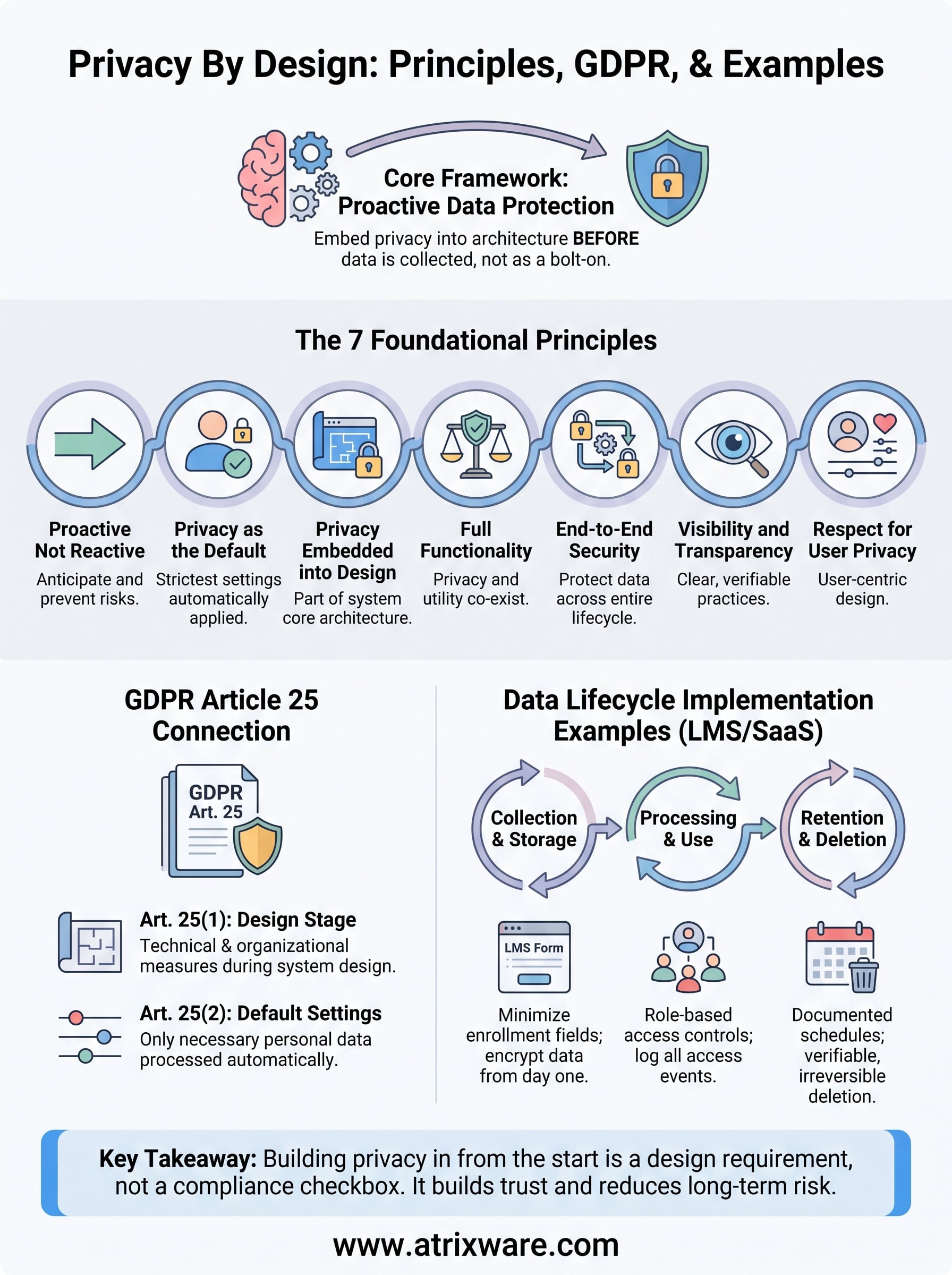
The first principle, proactive not reactive, means you anticipate privacy risks and address them before they materialize. You do not wait for a breach or regulatory inquiry to prompt action. The second principle, privacy as the default setting, requires that your system automatically applies the strictest data protection settings without users needing to opt in or configure anything. The third principle, privacy embedded into design, means privacy protection is part of the system’s core architecture, not a feature added after the fact. The fourth principle, full functionality, rejects the idea that privacy requires trading off usability or functionality. Your platform can collect the data it legitimately needs and still protect user privacy effectively at the same time.
Privacy is not a constraint on functionality; it is a design requirement that shapes how functionality gets built.
Principles five through seven
The fifth principle, end-to-end security, requires that your system protects personal data across its entire lifecycle: from the moment it’s collected through storage, processing, and secure deletion when it’s no longer needed. This means encryption, access controls, and retention policies are built in, not bolted on. The sixth principle, visibility and transparency, holds that your data practices must be open and verifiable. Users and regulators should be able to confirm that your system operates exactly as you claim it does, with clear documentation and auditable processes backing that claim. The seventh principle, respect for user privacy, keeps the individual at the center of every decision. Accurate data, strong consent mechanisms, and easy access or deletion options are not optional extras; they are built-in features that reflect genuine respect for the people whose data you handle. Together, these seven principles give you a complete framework for embedding data protection into every layer of your systems and operations.
How privacy by design maps to GDPR Article 25
With privacy by design explained as a framework developed in the 1990s, its formal legal status didn’t come until 2018 when the GDPR made it a binding obligation. Article 25 of the GDPR is the provision that transforms privacy by design from a voluntary best practice into a legal requirement for any organization that processes personal data belonging to EU residents. If your organization uses an LMS to train employees or customers in the EU, Article 25 applies to you directly, and understanding exactly what it demands is not optional.
What Article 25 actually requires
Article 25 breaks into two parts. The first part, Article 25(1), requires that data controllers implement appropriate technical and organizational measures at the time they design their systems and processes, not after deployment. You must account for privacy risk at the architecture stage, before any data flows through your platform. The second part, Article 25(2), is the privacy by default obligation: your systems must be configured to process only the minimum personal data necessary for each specific purpose, automatically, without users needing to intervene.
Your compliance window under Article 25 opens during system design, not after your platform goes live.
Both parts reinforce each other. You cannot satisfy Article 25(1) by building a structurally sound system if that system defaults to collecting more data than it needs. And you cannot satisfy Article 25(2) through default settings alone if the underlying system architecture stores, transmits, or processes data insecurely. Regulators expect both, and enforcement actions have specifically cited failures in one area even where the other appeared adequate.
What "appropriate measures" means in practice
The GDPR deliberately avoids prescribing a single technical checklist. "Appropriate" is assessed against the state of the art, implementation cost, the nature of the processing, and the risk level involved. For a high-volume LMS handling certification records or compliance training data, appropriate measures include data minimization at collection, encryption in transit and at rest, role-based access controls, documented retention schedules, and pseudonymization where feasible.
Supervisory authorities across EU member states have published guidance clarifying what they expect for different sectors and processing activities. Consulting that guidance for your specific context gives you a clearer benchmark than interpreting Article 25 in isolation, and documenting your implementation decisions shows regulators that your choices were deliberate and proportionate to your actual risk level.
How to implement privacy by design step by step
Putting privacy by design explained into practice requires more than policy documents. You need a structured sequence of decisions that happens before development starts, not during review cycles after your system is already built. The steps below give you a repeatable process that works whether you are configuring an existing LMS, building a new feature, or evaluating a third-party training tool.
Map your data flows before you build anything
The first step is understanding exactly what personal data your system collects, where it goes, and who can access it. A data flow diagram forces you to make these questions explicit before you write a single line of configuration. For an LMS, this means mapping every point where learner information enters your system: registration forms, assessment submissions, progress tracking, notification triggers, and third-party integrations like your CRM or HR platform.

Once you have a clear map, you can identify which data points are genuinely necessary for each processing purpose and which are collected out of habit or convenience. Remove what you do not need, and document why you kept what you kept. Every field you eliminate is a liability you no longer carry.
The data you never collect cannot be breached, misused, or subject to a deletion request.
Apply data minimization at every decision point
Data minimization is not a one-time cleanup task. You need to build it into every decision that involves personal data, from feature design to vendor contracts. When your team considers adding a new data field or enabling a new tracking feature, the default question should be whether you genuinely need that information to deliver the specific outcome you are building toward.
For vendor and integration decisions, data minimization means reviewing exactly what data each connected system receives and restricting access to the minimum required for the integration to function. This applies to your HR sync, your e-commerce layer, and any single sign-on provider your LMS connects to.
Document and test your controls before launch
Written documentation of your privacy controls serves two purposes: it gives your team a reference for consistent implementation, and it gives regulators evidence that your choices were deliberate. Before any system goes live, document your data retention schedules, access control policies, encryption standards, and the legal basis for each category of data you process.
Testing those controls before launch means running through realistic scenarios: what happens when a learner requests their data, when an administrator role changes, or when an integration sends more fields than expected. Finding gaps at this stage costs far less than discovering them after an incident.
Practical examples for SaaS and LMS platforms
Abstract principles only become useful when you can see them applied to real systems doing real work. Privacy by design explained as a framework is practical by nature, and the examples below show exactly how its principles translate into decisions you make when configuring or building SaaS tools and learning management systems. These are not edge cases; they reflect common architectural choices that most organizations face when standing up or scaling a training platform.
LMS enrollment and learner profile data
When a learner registers for a course on your LMS, your system can collect a wide range of fields: full name, work email, job title, department, manager name, location, and more. Privacy by design requires you to ask which of those fields you genuinely need to deliver the course, track completion, and issue a certificate, and then collect only those. If job title has no bearing on the training outcome, removing that field from the registration form eliminates a data point you would otherwise need to secure, retain, and eventually delete.
Access controls are equally important at this layer. Only the roles that have a legitimate need to view learner records should have permission to do so. A course author does not need to see a learner’s assessment scores from a different department’s compliance program. Building role-based access into your LMS configuration from the start, rather than granting broad access and restricting it later, is a direct application of the proactive principle.
The configuration decisions you make during LMS setup define your data exposure for the entire time the platform runs.
SaaS onboarding and feature tracking
SaaS platforms routinely track user behavior to improve the product: which features users click, how long sessions last, where users drop off. Behavioral analytics can be genuinely useful, but they also create a secondary dataset of personal information that many organizations never account for in their privacy policies or retention schedules. Applying privacy by design here means deciding upfront which behavioral signals you actually need, configuring your analytics tools to collect only those signals, and setting automatic purge schedules so that historical session data does not accumulate indefinitely.
For integrations between your LMS and your CRM or HR system, the same logic applies. Pass only the fields required for the sync to function, document which system holds the authoritative record, and review those data flows whenever either platform updates its schema or you add a new integration endpoint.
Privacy by design in the data lifecycle
Privacy by design explained as a framework covers the full arc of data, not just the moment of collection. Personal data moves through distinct phases from the instant your system captures it to the point where it is deleted, and each phase carries its own risks and obligations. Treating privacy as a lifecycle issue rather than a collection-point issue gives you control over data at every stage, which is exactly what regulators expect to see when they review your data protection practices.

Collection and initial storage
Your first opportunity to apply privacy by design is at the collection stage. When your LMS or SaaS platform receives personal data, the fields you capture and the storage structure you use both define your exposure from that point forward. Collecting only what you need and storing it in encrypted, access-controlled repositories from day one means you never have to reverse-engineer a compliant architecture from a non-compliant one.
At the storage layer, pseudonymization is worth considering for datasets where direct identification is not necessary for the processing purpose. Separating identifying fields from behavioral or assessment records reduces the harm that any single breach can cause, because an attacker who reaches one dataset cannot immediately link it to the other without additional access.
Processing and active use
While data is actively in use, your controls need to restrict who can read, modify, or export records and under what conditions. Role-based access permissions are the operational expression of privacy by design at this stage. Your training administrators should access learner records only within the scope of their specific responsibilities, and every access or export event should be logged so you can reconstruct a clear audit trail if questions arise later.
Data you process without adequate access controls is data you cannot fully account for during an audit or breach investigation.
Retention and secure deletion
Retention schedules are not optional. Every category of data your platform holds needs a documented retention period tied to a specific business or legal reason, and your system must actually enforce those periods rather than accumulating records indefinitely. When the retention period ends, deletion should be irreversible and verifiable, with a record confirming that the data was removed on schedule.
For an LMS, this applies to completed course records, assessment results, communication logs, and any cached integration data from connected HR or CRM systems. Scheduled deletion reviews built into your operational calendar keep retention from becoming a theoretical policy that nobody enforces.
Common pitfalls and how to avoid them
Even organizations that understand privacy by design explained as a concept often stumble when it comes to implementation. The gap between knowing the principles and applying them consistently across real systems is where most compliance failures actually originate. Recognizing the most common mistakes before you encounter them gives you a clear advantage when building or configuring your training platform.
Treating compliance as the finish line
Many organizations build toward a compliance checkpoint and then stop. They implement controls to pass an audit, earn a certification, or satisfy a regulatory review, and then treat privacy work as complete. Privacy by design is not a destination; it is an ongoing operational practice that requires review whenever your system changes, your vendor relationships shift, or your data volumes grow. An LMS that passes a GDPR review in one configuration can fall out of compliance the moment you enable a new integration or expand your learner population into a new jurisdiction.
Compliance at a point in time is not the same as a compliant system over time.
Schedule regular privacy reviews tied to your product roadmap, not just to audit cycles. Any significant system change should trigger a lightweight data protection impact assessment before it goes live.
Skipping the documentation step
Implementing strong technical controls without documenting them is one of the most common mistakes organizations make. Your encryption settings, access control policies, and retention schedules only protect you during a regulatory review if you can demonstrate that they were intentional and deliberate. Regulators do not take architectural choices on faith; they expect written evidence that your decisions were proportionate to your actual risk level.
Build documentation into your implementation process as a required output, not an afterthought. For each privacy control you put in place, record what it does, why you chose it, and when it was last reviewed.
Failing to involve the right people early
Privacy by design breaks down when legal, security, and engineering teams work in isolation. Developers make architecture decisions without input from your legal team, and your legal team sets policies without understanding what the system is technically capable of enforcing. That disconnect produces systems where policy and reality do not match, which is exactly what auditors look for when reviewing your data protection practices.
Bring all relevant stakeholders into design discussions at the earliest possible stage. A thirty-minute cross-functional review before a feature is built prevents weeks of remediation work after it ships.
Key takeaways
With privacy by design explained across principles, regulation, and real-world application, the core message is consistent: data protection built into your systems from the start costs less, performs better, and holds up under regulatory scrutiny far more reliably than controls added after deployment. The seven principles give you a complete framework, Article 25 gives those principles legal force, and the implementation steps give you a clear path from theory to practice.
Your LMS processes personal data at every stage of the learner journey, from registration through certification and retention. Every architectural and configuration decision you make determines how well that data is protected. Organizations that treat privacy as a design requirement, not a compliance checkbox, build platforms that earn trust and survive audits. If you are evaluating whether your current training setup is built on the right foundation, take the LMS readiness quiz to identify exactly where to focus next.
