A single data breach now costs companies an average of $4.88 million, according to IBM’s 2024 Cost of a Data Breach Report, and regulators aren’t slowing down. With enforcement actions climbing and new state-level privacy laws taking effect through 2026, having a data privacy compliance checklist isn’t optional anymore. It’s the difference between staying ahead of audits and scrambling after a violation notice lands on your desk.
The challenge? Privacy regulations like GDPR, CCPA/CPRA, and dozens of newer frameworks each come with their own requirements for how you collect, store, process, and delete personal data. For organizations managing employee records, customer information, and training data across multiple systems, the compliance surface area grows fast. Missing even one requirement, a forgotten consent form, an outdated retention policy, can trigger significant fines and reputational damage.
That’s exactly why we built this guide. At Atrixware, our Axis LMS platform handles sensitive learner and organizational data every day, so compliance isn’t theoretical for us, it’s built into how we operate. We’ve taken that hands-on experience and turned it into a practical, step-by-step checklist you can follow right now. Below, you’ll find actionable steps covering everything from data mapping and risk assessments to employee training and incident response planning, organized so you can work through them systematically and close gaps before they become problems.
What data privacy compliance covers in 2026
Data privacy compliance is not one law or one checklist. It’s a set of overlapping obligations across multiple jurisdictions, each requiring you to handle personal data in specific ways. By 2026, the regulatory landscape has expanded well beyond GDPR and CCPA. Organizations operating in the United States now contend with active privacy laws in 20+ states, including Virginia, Colorado, Texas, Montana, and Oregon, while global companies face additional requirements from the EU, UK, Canada, Brazil, and others. Understanding what compliance actually covers is the first step before you work through any data privacy compliance checklist.
The scope of modern data privacy law
At its core, privacy compliance means demonstrating control over personal data across its entire lifecycle. That includes how you collect it, where you store it, who accesses it, how long you keep it, and how you delete it. It also covers how you respond when something goes wrong, whether that’s a data breach, a subject access request, or a regulator inquiry. No single regulation owns this territory; instead, each one layers on requirements that often overlap but sometimes conflict.
The organizations that struggle most with compliance are those treating each law as a separate project. The ones that succeed build a unified privacy program that satisfies multiple frameworks at once.
Practically speaking, the major frameworks you’ll encounter in 2026 share a common set of building blocks:
| Requirement | GDPR | CCPA/CPRA | US State Laws (2024-2026) |
|---|---|---|---|
| Lawful basis for processing | Yes | Partial | Varies |
| Consent management | Yes | Yes (opt-out/opt-in) | Yes |
| Data subject rights (access, deletion, portability) | Yes | Yes | Yes |
| Data breach notification | 72 hours | Promptly | Varies (30-45 days) |
| Vendor/processor agreements | Yes | Yes | Yes |
| Privacy notice requirements | Yes | Yes | Yes |
| Data minimization | Yes | Partial | Partial |
What counts as personal data
Personal data covers far more than names and email addresses. Under most 2026 frameworks, it includes IP addresses, device identifiers, location data, biometric data, health information, financial records, and in many cases, inferred data generated by automated systems. If your organization runs an LMS, that means learner activity logs, assessment scores, and course completion records can all qualify as personal data depending on jurisdiction.
You need to treat any information that can reasonably be used to identify an individual as regulated data. This isn’t limited to customer-facing systems; employee training records, HR files, and vendor contact data fall under the same rules.
Why compliance requires ongoing effort
Many organizations treat compliance as a one-time project, but regulations change and your data environment changes with them. New vendors get added, new data types get collected, old systems get retired without proper data deletion, and new laws take effect. A compliance program that worked in 2023 may have gaps today because your data landscape shifted without a corresponding update to your policies.
Ongoing compliance requires three things: a live inventory of where personal data lives, documented processes that people actually follow, and regular training so that every employee who touches personal data understands their responsibilities. That third element, training, is where many programs fall short. It’s also where platforms like Axis LMS can close the gap by delivering, tracking, and documenting privacy training at scale across your entire workforce.
Step 1. Confirm which laws apply to you
Before you build anything else in your data privacy compliance checklist, you need to know exactly which laws govern your operations. Applicability isn’t just about where your company is headquartered; it also depends on where your customers, employees, and users are located. A Texas-based company serving California residents still needs to comply with CPRA. A US company with EU clients falls under GDPR. Getting this wrong at the start means building your entire program on a flawed foundation.
How jurisdiction triggers work
Most modern privacy laws apply based on who you collect data from, not where you’re incorporated. GDPR covers any organization that processes the personal data of EU residents, regardless of where that organization operates. CCPA/CPRA applies to for-profit businesses meeting specific thresholds: annual gross revenue over $25 million, data on 100,000 or more consumers or households, or deriving 50% or more of revenue from selling personal data. Many 2025-2026 US state laws use similar threshold-based triggers, typically covering organizations that handle data on 100,000 residents per year.
The biggest compliance mistake companies make is assuming that because they’re not "big tech," they don’t qualify. Threshold triggers catch mid-sized businesses regularly.
A quick applicability reference
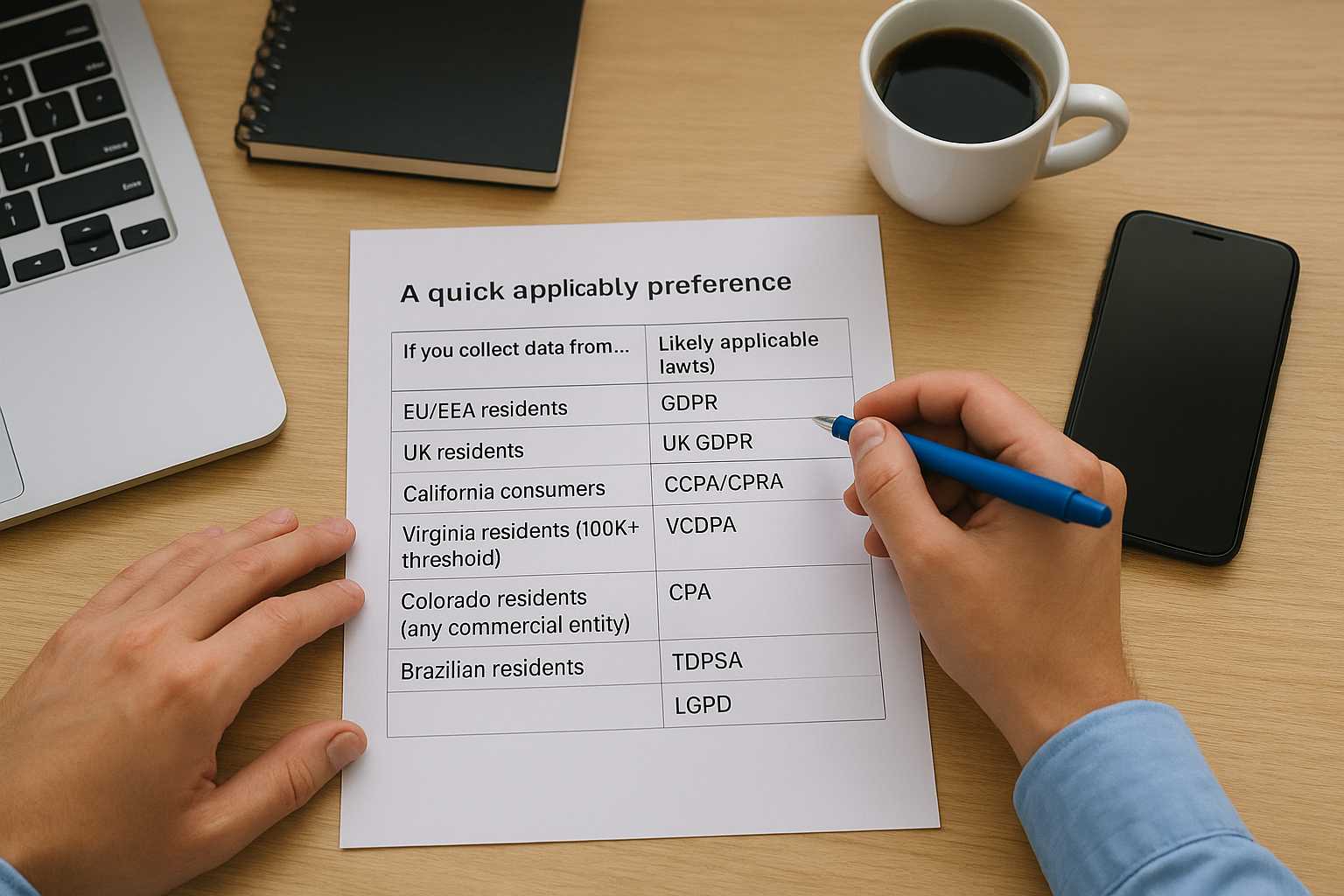
Use the table below to identify which frameworks likely apply to you based on your data subjects and business activities:
| If you collect data from… | Likely applicable law(s) |
|---|---|
| EU/EEA residents | GDPR |
| UK residents | UK GDPR |
| California consumers | CCPA/CPRA |
| Virginia residents (100K+ threshold) | VCDPA |
| Colorado residents (100K+ threshold) | CPA |
| Texas residents (any commercial entity) | TDPSA |
| Brazilian residents | LGPD |
| Employees in any US state | State breach notification laws |
Once you’ve identified your applicable frameworks, document each one in a central compliance register. This register should list the law, the specific obligations it creates, the data categories it covers, and the deadlines it sets for things like breach notification and subject rights responses. Treat this register as a living document that you update any time your business expands into new markets or new laws take effect in jurisdictions where you already operate.
Step 2. Inventory data and map data flows
You cannot protect data you don’t know exists. A data inventory is a structured record of every category of personal data your organization collects, where it lives, who owns it, and what happens to it over time. This step is the foundation of any working data privacy compliance checklist because every downstream requirement, from consent management to breach notification, depends on knowing your data landscape accurately.
How to build your data inventory
Start by identifying every system, application, and process that touches personal data. This includes your CRM, HR platform, LMS, marketing tools, customer support software, and any third-party integrations. For each system, document the data categories it holds, the legal basis for processing, the retention period, and who has access. Use the template below as your starting point:
| Data Category | System | Legal Basis | Retention Period | Data Owner | Third-Party Access |
|---|---|---|---|---|---|
| Employee training records | Axis LMS | Employment contract | Duration of employment + 3 years | HR Manager | None |
| Customer email addresses | CRM | Consent | 2 years after last interaction | Marketing | Email platform |
| Payment information | E-commerce platform | Contract | 7 years (tax compliance) | Finance | Payment processor |
| Website visitor IDs | Analytics tool | Legitimate interest | 13 months | IT | Analytics vendor |
Fill out one row for each distinct data type in each system. Involve department heads directly in this process because they know what data their teams collect better than IT does.
Mapping data flows
A data inventory tells you what you have. A data flow map tells you where it goes. For each data category, trace the full path from collection through processing to deletion or transfer. This matters most for cross-border data transfers, which trigger additional requirements under GDPR and several other frameworks.
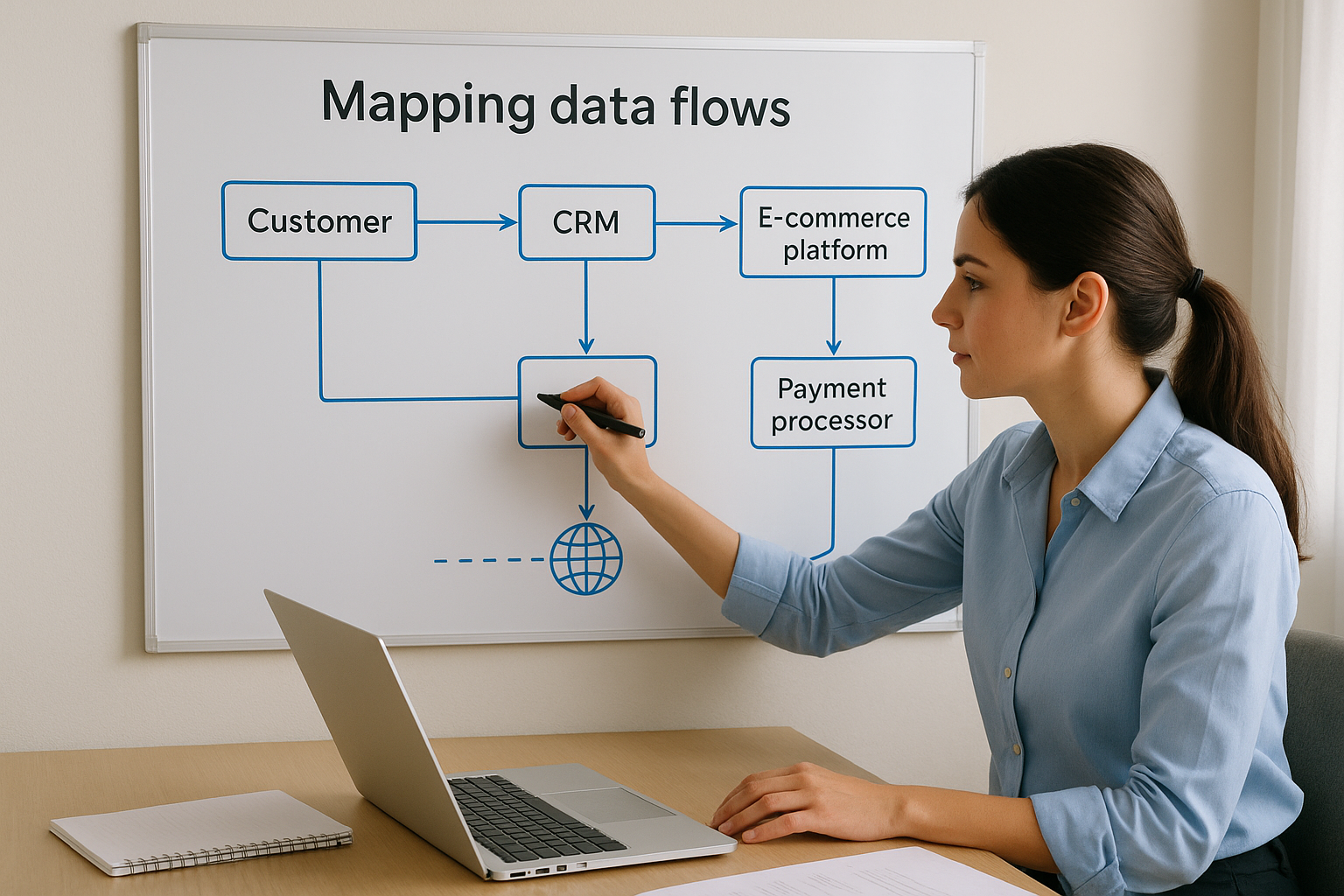
If you can’t draw a complete line from where personal data enters your organization to where it exits or gets deleted, you have a compliance gap.
For each data flow, document the source, the systems it passes through, any third parties it reaches, and whether it crosses international borders. You don’t need specialized software to do this; a well-structured spreadsheet works. What matters is that the map reflects your actual environment, not an idealized version of it, so update it every time you add a new vendor or change a process.
Step 3. Set rules for collection and consent
Once you know what data you hold and where it flows, you need to establish clear rules for what you collect and how you get permission to use it. This step is where many organizations get into trouble: they collect data opportunistically, without a defined legal basis or a consistent consent process. Regulators treat that as a fundamental violation, not a technicality. Locking down your collection and consent rules is one of the highest-impact items on any data privacy compliance checklist.
Define your lawful basis before you collect
Every piece of personal data you process needs a documented legal basis. Under GDPR, the six lawful bases are consent, contract, legal obligation, vital interests, public task, and legitimate interests. US state laws use different language but follow similar logic. The key rule is simple: choose your basis before collection begins, not after.
Picking the wrong legal basis is harder to fix retroactively than getting it right upfront, especially if you’ve already collected data from thousands of users.
For each data category in your inventory from Step 2, assign a lawful basis and document your reasoning. If you rely on legitimate interests, complete a Legitimate Interests Assessment (LIA) that weighs your purpose against the individual’s rights. If you rely on consent, you need a proper consent mechanism.
Build a consent management process
Consent must be freely given, specific, informed, and unambiguous under most modern frameworks. That rules out pre-ticked boxes, bundled consents, and vague language. Use the template below to structure compliant consent requests:
| Element | What it must include |
|---|---|
| Who is collecting | Your organization’s name |
| What you’re collecting | Specific data types, not general categories |
| Why you’re collecting it | The stated purpose, not a catch-all |
| How long you’ll keep it | A defined retention period or criteria |
| Their rights | How to withdraw consent or request deletion |
| Confirmation action | An affirmative opt-in, not a pre-checked box |
Apply this template anywhere you collect personal data: web forms, registration flows, training enrollment pages, and email sign-ups. Store a timestamped record of every consent interaction so you can prove compliance if a regulator or user challenges it. Consent records should include the date, the version of the consent language shown, and the action the user took.
Step 4. Secure data and manage vendors
Security and vendor oversight sit at the center of every serious data privacy compliance checklist. Regulations don’t just require you to protect personal data internally; they hold you accountable for what your vendors do with it too. If a third-party processor leaks data you shared with them, you still face enforcement action. This step covers the technical controls and contractual structures you need on both fronts.
Apply technical safeguards to personal data
Start with the basics and document everything you implement. Encryption at rest and in transit is non-negotiable under GDPR, CPRA, and most 2026 state laws. Use TLS 1.2 or higher for data in transit and AES-256 for data stored in databases or file systems. Beyond encryption, apply role-based access controls so that only the people who need specific data categories can reach them. Audit access logs quarterly and revoke credentials immediately when employees leave.

Run a short technical audit against this checklist for each system in your data inventory:
| Control | Status | Owner | Review Date |
|---|---|---|---|
| TLS encryption on all data transfers | Yes / No / Partial | IT | Quarterly |
| AES-256 encryption for stored personal data | Yes / No / Partial | IT | Quarterly |
| Role-based access controls configured | Yes / No / Partial | IT | Quarterly |
| Multi-factor authentication enforced | Yes / No / Partial | IT | Quarterly |
| Access logs retained and reviewed | Yes / No / Partial | IT | Quarterly |
| Pseudonymization applied where possible | Yes / No / Partial | IT | Quarterly |
Mark any "No" or "Partial" rows as open remediation items with assigned owners and deadlines.
Vet and contract your vendors
Every vendor that touches personal data on your behalf is a data processor under GDPR or a "service provider" under CPRA. Before you share any personal data with a new vendor, review their security practices, breach history, and sub-processor list. Require a completed security questionnaire or a current SOC 2 Type II report as a baseline.
Signing a contract with a vendor does not transfer your compliance liability. It shares it, and only if the contract includes the right terms.
For every vendor relationship involving personal data, put a Data Processing Agreement (DPA) in place. The DPA must specify the categories of data processed, the purpose, the retention period, security obligations, breach notification timelines, and the vendor’s obligation to delete data when the relationship ends. Keep a signed copy of each DPA in your compliance register alongside the vendor’s most recent security attestation.
Step 5. Operationalize privacy rights and DSARs
Privacy rights are not just listed in your policy document; they have to actually work when someone invokes them. Under GDPR, CPRA, and most 2026 US state laws, individuals have the right to access, correct, delete, and port their personal data. If your organization cannot respond to these requests within the required timeframe, you are non-compliant regardless of how strong your technical controls are. This step in your data privacy compliance checklist is about building the process that makes rights real.
Know which rights you must honor
The specific rights you must support depend on your applicable laws from Step 1, but most frameworks share a common core. Map your response obligations before you build your intake process so you know exactly what each request type requires from your team.
| Right | What it requires | Common deadline |
|---|---|---|
| Access (DSAR) | Provide a copy of all personal data held | 30-45 days |
| Deletion | Remove personal data unless retention laws apply | 30-45 days |
| Correction | Fix inaccurate personal data | 30-45 days |
| Portability | Deliver data in a machine-readable format | 30-45 days |
| Opt-out of sale/sharing | Stop selling or sharing data with third parties | 15 business days (CPRA) |
| Restrict processing | Limit how data is used while a dispute is resolved | 30 days |
Identify a single owner for each right in your organization, typically someone in legal, HR, or operations, who is responsible for coordinating the response across departments.
Build a DSAR response workflow
A Data Subject Access Request (DSAR) workflow is the internal process you follow from the moment a request arrives to the moment you close it. Without a documented workflow, requests get lost, deadlines get missed, and your team scrambles to pull data from systems they forgot existed.
A missed DSAR deadline is one of the most common triggers for formal regulatory complaints, and it’s entirely preventable with a documented process.
Use this template to structure every DSAR from intake to closure:
- Log the request in a central tracker with the date received, the requester’s identity, and the type of right being exercised.
- Verify identity using a consistent verification method before releasing any data.
- Search all systems from your data inventory, including your LMS, CRM, HR platform, and any active integrations.
- Compile the response in plain language with a complete record of data held or an explanation of deletion completed.
- Deliver within the legal deadline and log the response date for your compliance records.
- Close and retain the full request record for at least three years as evidence of compliance.
Wrap-up and next steps
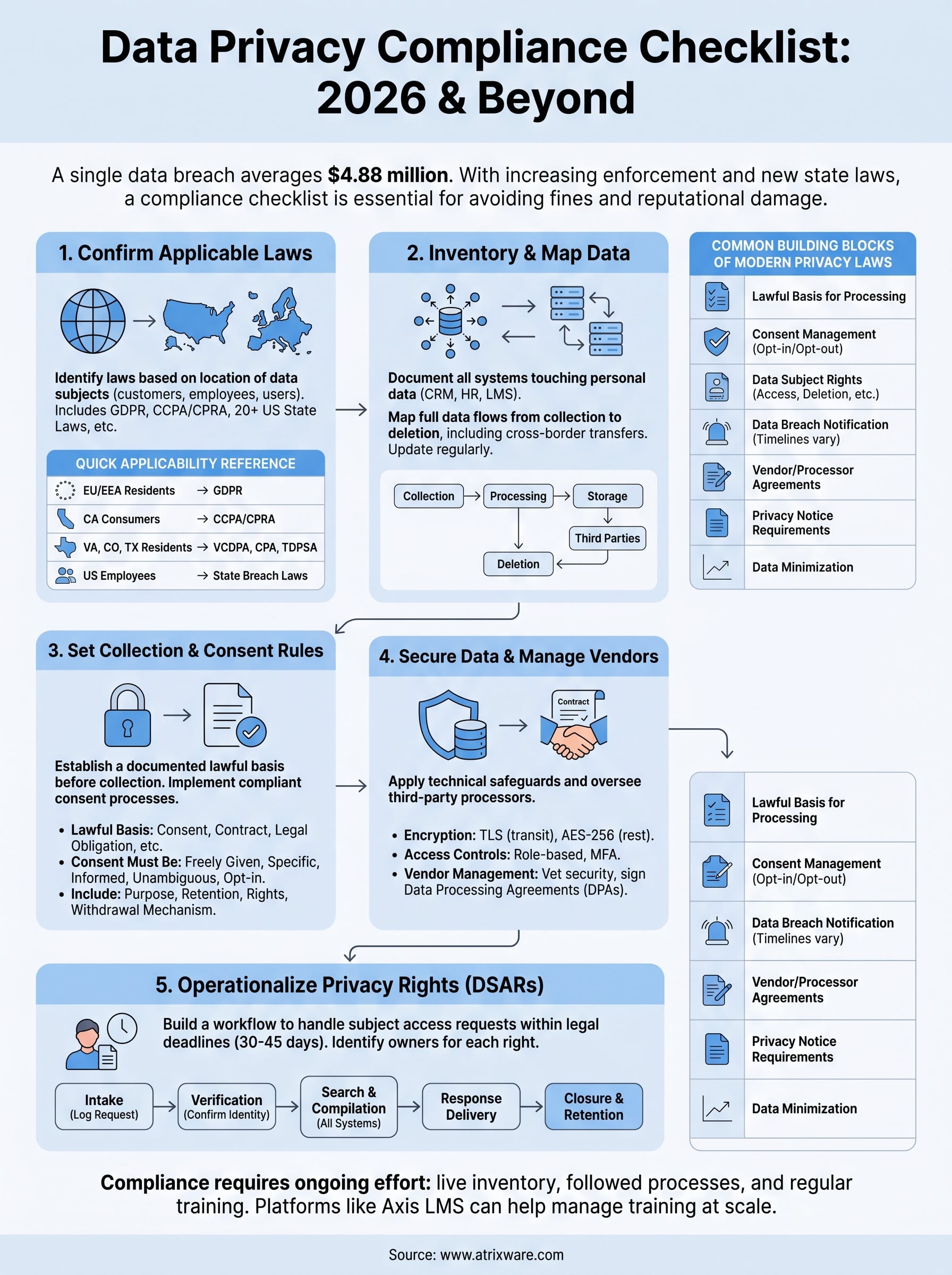
Working through this data privacy compliance checklist gives you a structured path from scattered obligations to a program you can actually defend in front of a regulator. You’ve confirmed your applicable laws, mapped your data, locked down consent rules, secured your systems and vendors, and built a working DSAR process. Each step builds on the last, so gaps you close early reduce the work at every stage that follows.
Compliance doesn’t stop once you complete this list. Your data environment shifts constantly, and your program needs to shift with it. That means scheduled reviews, updated training for every employee who handles personal data, and documentation that stays current. If you’re looking for a practical way to deliver and track that training at scale, explore what Axis LMS can do for your compliance training program and see how it fits into your organization’s workflow.
