Search for an experience API definition and you’ll run into a problem: the term means two completely different things depending on who’s talking. One camp uses it to describe the topmost layer of an API-led connectivity architecture, the layer that shapes raw data into something a specific app or user interface can actually use. The other camp means xAPI (formerly Tin Can API), an e-learning specification that tracks and records how people interact with training content.
Both definitions matter if you’re building or managing training programs. At Atrixware, our Axis LMS relies on these kinds of technologies to deliver, track, and report on learning experiences across organizations. Understanding where each "experience API" fits helps you make smarter decisions about your training tech stack, whether you’re evaluating LMS integrations, connecting systems through APIs, or looking to capture richer learner data beyond basic SCORM completion scores.
This article breaks down both definitions side by side, explains how each one works, and clarifies which version applies to your situation.
Why "experience API" can mean two things
Naming collisions happen when two separate communities use the same phrase to describe unrelated technologies. That’s exactly what occurred here. When you search for an experience API definition, results pull from two entirely different domains at once, and neither community borrowed the term from the other. Understanding the original context behind each use of the phrase is the fastest way to figure out which one actually applies to your situation.
The e-learning side: xAPI
xAPI traces its origins to the Advanced Distributed Learning (ADL) Initiative, a U.S. Department of Defense research program that also produced SCORM. In 2013, ADL released xAPI (also called Tin Can API) as a next-generation specification for tracking learning. The core idea was to record any learning activity regardless of where it happened: inside an LMS, in a mobile app, on a simulator, or even in the physical world. The spec uses short "actor-verb-object" statements, like "Sarah completed the safety module," to log these events in a Learning Record Store (LRS).
xAPI shifted the focus from tracking course completions inside one platform to recording learning experiences across every system a learner touches.
The architecture side: API-led connectivity
MuleSoft’s API-led connectivity model introduced the architecture version of the experience API. This model divides APIs into three layers: system, process, and experience. The experience layer sits at the top and takes data assembled by the process layer to reformat it for a specific consumer, such as a mobile app, a web dashboard, or a third-party service. This has nothing to do with e-learning. It’s a structural pattern for managing how enterprise systems communicate with each other.
In practice, you may already have experience layer APIs in your systems without using that name. Any time you’ve built a dedicated endpoint to serve a mobile app differently than a web dashboard, you’ve created one. The pattern is about shaping data to fit the consumer rather than exposing raw backend outputs directly.
Your context determines which definition you need. Both concepts deal with how data reaches an end user or system, which is where the naming overlap comes from. Pick up the e-learning version when you’re working with training technology and learner tracking. Reach for the architecture version when you’re designing how your business systems connect and share data across an enterprise integration stack.
xAPI definition for tracking learning experiences
When people in the learning and development space reference an experience API definition, they almost always mean xAPI, the technical specification maintained by the Advanced Distributed Learning Initiative. xAPI defines a standard format for recording learning activities as simple statements that any compliant system can read, store, and report on. Unlike SCORM, which ties tracking to a single LMS session, xAPI captures learning events from anywhere: a mobile app, a video platform, a simulator, or a live coaching session.
xAPI lets you track learning that happens outside the walls of your LMS, which is something SCORM was never designed to do.
How xAPI statements work
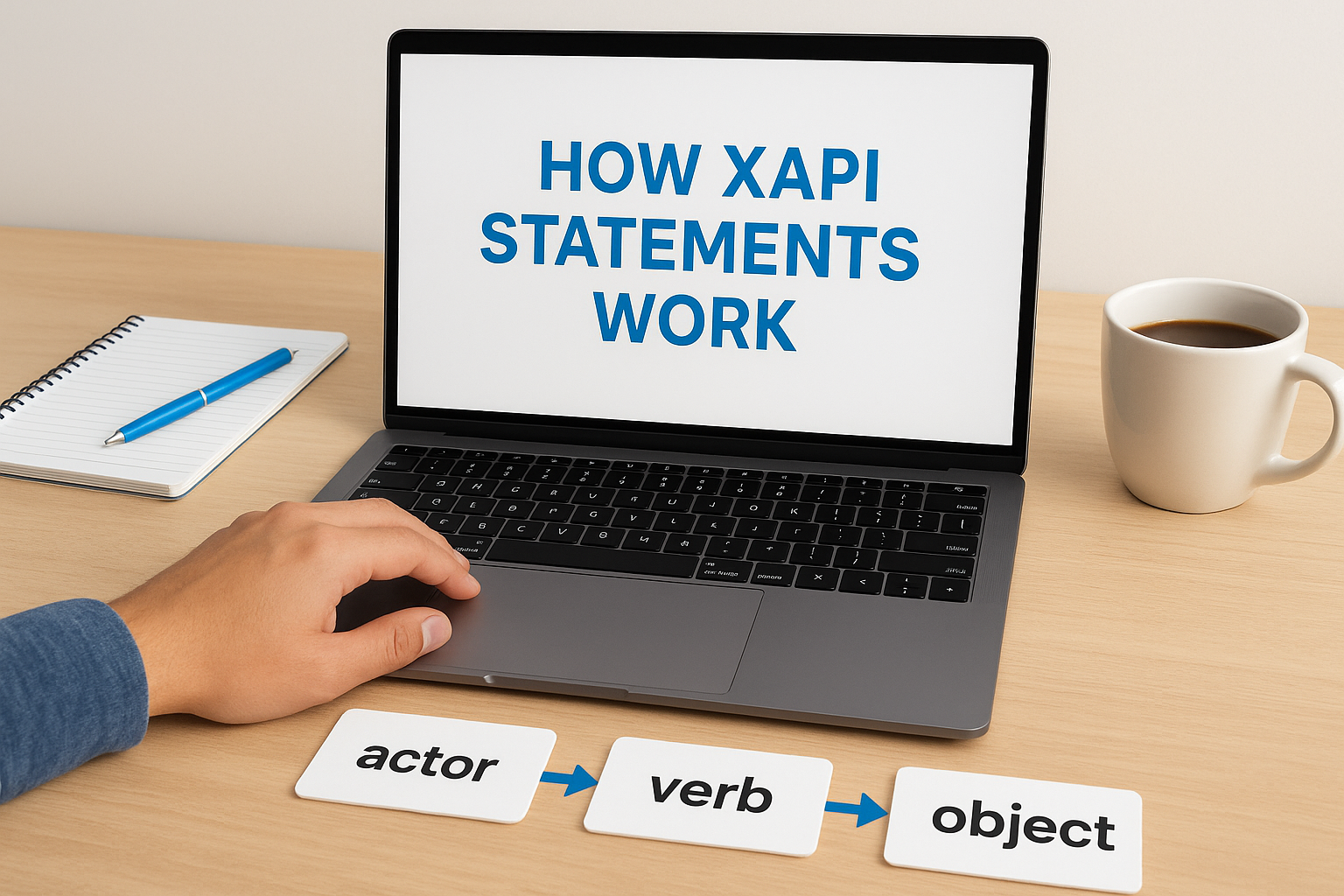
Every xAPI statement follows a three-part structure: actor, verb, and object. The actor is the learner, the verb describes the action they took, and the object identifies what they interacted with. For example: "Maria passed the compliance assessment" or "James watched the onboarding video." These statements are lightweight and flexible, which means you can record almost any learning behavior without needing a rigid course structure.
Here are common verb examples you’ll see in xAPI implementations:
- completed
- passed
- failed
- attempted
- experienced
- answered
What xAPI needs to function
xAPI statements do not store themselves inside the LMS by default. You need a Learning Record Store (LRS), a dedicated database that collects and organizes those statements. Some LMS platforms, including Axis LMS, include built-in LRS functionality so you do not need a separate system. Your LRS becomes the single source of truth for learner activity across every tool and platform in your training environment.
Your reporting capabilities depend directly on how well your LRS captures and surfaces this data.
Experience layer APIs in API-led connectivity
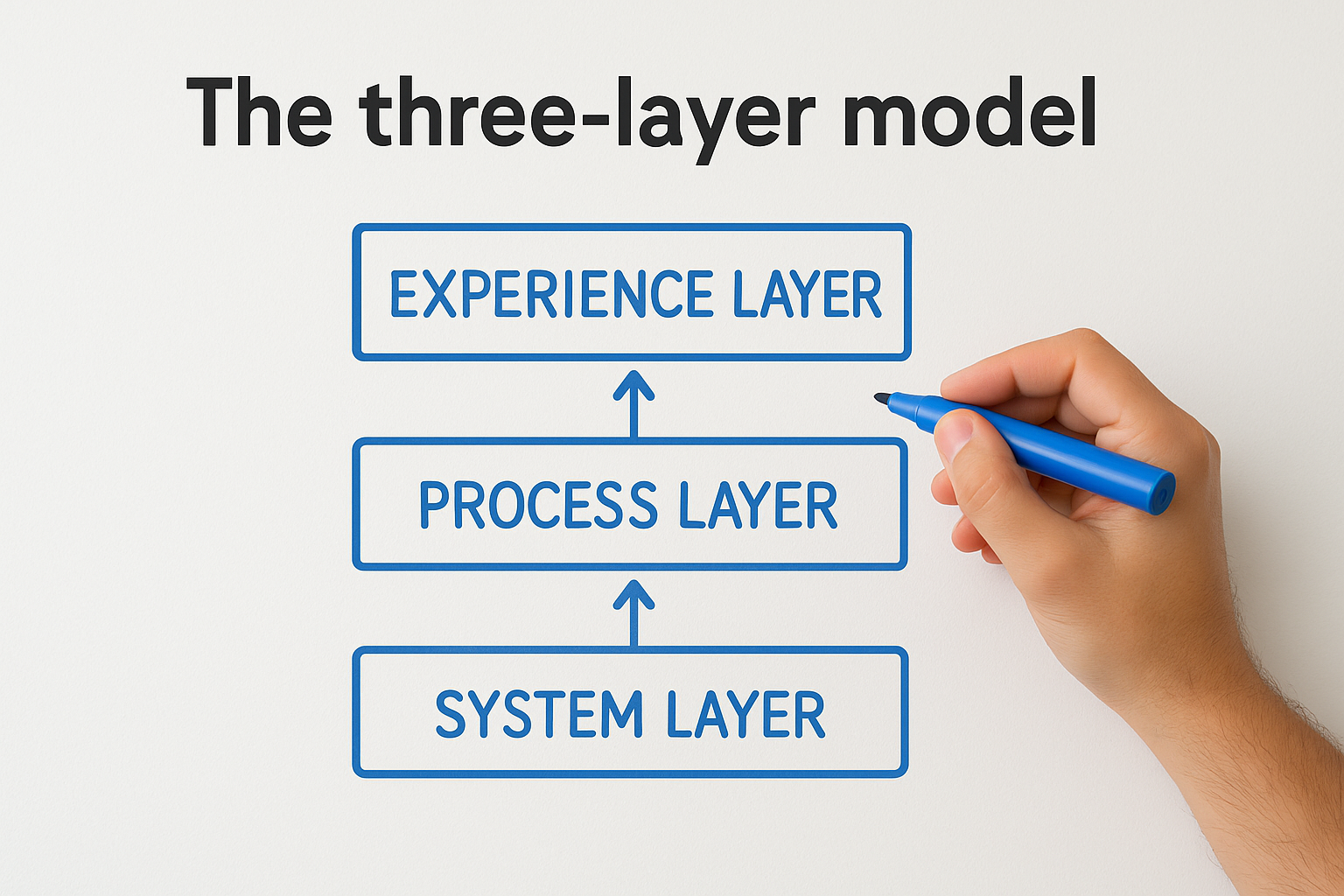
When architects and developers reference an experience API definition in the context of enterprise software, they are talking about a specific layer in MuleSoft’s API-led connectivity model. This model organizes APIs into three tiers: system, process, and experience. Each tier has a distinct responsibility, and the experience layer is the one that faces the end consumer directly, whether that consumer is a mobile app, a browser-based dashboard, or an external partner system.
The experience layer does not connect to your databases or run business logic. Its sole job is to shape and present data in the format a specific consumer needs.
The three-layer model explained
The system layer handles direct connections to core backend systems like databases, ERPs, and HR platforms. The process layer combines and transforms data from those system APIs into meaningful business operations. The experience layer then takes that processed data and reformats it for a particular audience. You might expose the same underlying employee record in three different ways: one format for a mobile app, one for a web portal, and one for a third-party reporting tool.
What the experience layer actually does in practice
Your experience layer APIs handle consumer-specific formatting, authentication handling, and response shaping without touching core data logic. If your mobile app needs a leaner payload than your desktop dashboard, the experience API solves that gap cleanly. This separation keeps your backend systems stable while giving frontend developers and integration partners exactly what they need without overexposing raw data structures.
How to choose the right approach for your system
The simplest way to resolve an experience API definition question is to ask yourself what problem you are actually trying to solve. If your goal involves tracking how learners engage with training content across multiple platforms, you need xAPI. If your goal involves formatting and delivering backend data to specific applications in an enterprise integration architecture, you need experience layer APIs. These are separate tools built for separate problems.
Your use case, not the terminology, should drive every decision about which type of experience API belongs in your system.
Choosing xAPI for learning environments
If you run training programs through an LMS, xAPI belongs in your toolkit whenever you need to track learning activity beyond basic course completions. This includes mobile learning, video engagement, simulation results, and performance data from tools outside your LMS. Confirm that your LMS either includes a built-in LRS or connects to a standalone one before you commit to an xAPI-based tracking strategy.
Your LMS vendor should clarify which xAPI statement profiles their platform supports and what reporting capabilities you can build from that stored data.
Choosing experience layer APIs for integrations
If you are designing how multiple enterprise systems share data, experience layer APIs give you a clean separation between your backend data logic and the format each consuming application needs. This approach works well when different teams or partners consume the same underlying data in different ways.
Map out your consumers first, then design each experience API endpoint around what that specific consumer actually needs rather than what your backend naturally produces. This keeps your system APIs stable while giving frontend developers and integration partners purpose-built interfaces without overexposing raw backend structures.
Common comparisons and pitfalls
When you research an experience API definition, two misunderstandings come up repeatedly. The first is treating xAPI and SCORM as interchangeable. The second is applying architecture terminology to an e-learning conversation, or the reverse. Both mistakes can derail integration planning before you write a single line of code.
xAPI vs. SCORM: what actually differs
Many training teams assume xAPI simply replaces SCORM with a newer version of the same idea. That assumption misses a critical point. SCORM requires a learner to launch content directly inside an LMS and restricts tracking to that session. xAPI removes that constraint entirely, letting you record learning activity from any connected system and store it in an LRS that operates independently of your LMS.
xAPI does not replace SCORM in every situation; some content libraries still deliver better consistency through SCORM depending on your authoring tools and LMS version.
Switching to xAPI without confirming LRS support in your LMS is one of the most common implementation mistakes. Verify your platform’s xAPI conformance level and which statement profiles it recognizes before you build a tracking plan around it.
Applying the wrong definition to your project
If you walk into a conversation with an integration architect and reference experience APIs meaning xAPI, you will create immediate confusion. These two concepts share no technical overlap and exist in completely separate specification frameworks. Labeling them clearly from the start saves your team significant rework.
A simple mental check helps: if the conversation involves learner behavior or training data, think xAPI. If it involves how applications consume data from backend systems, think experience layer APIs. They solve different problems in entirely different domains.
Quick recap
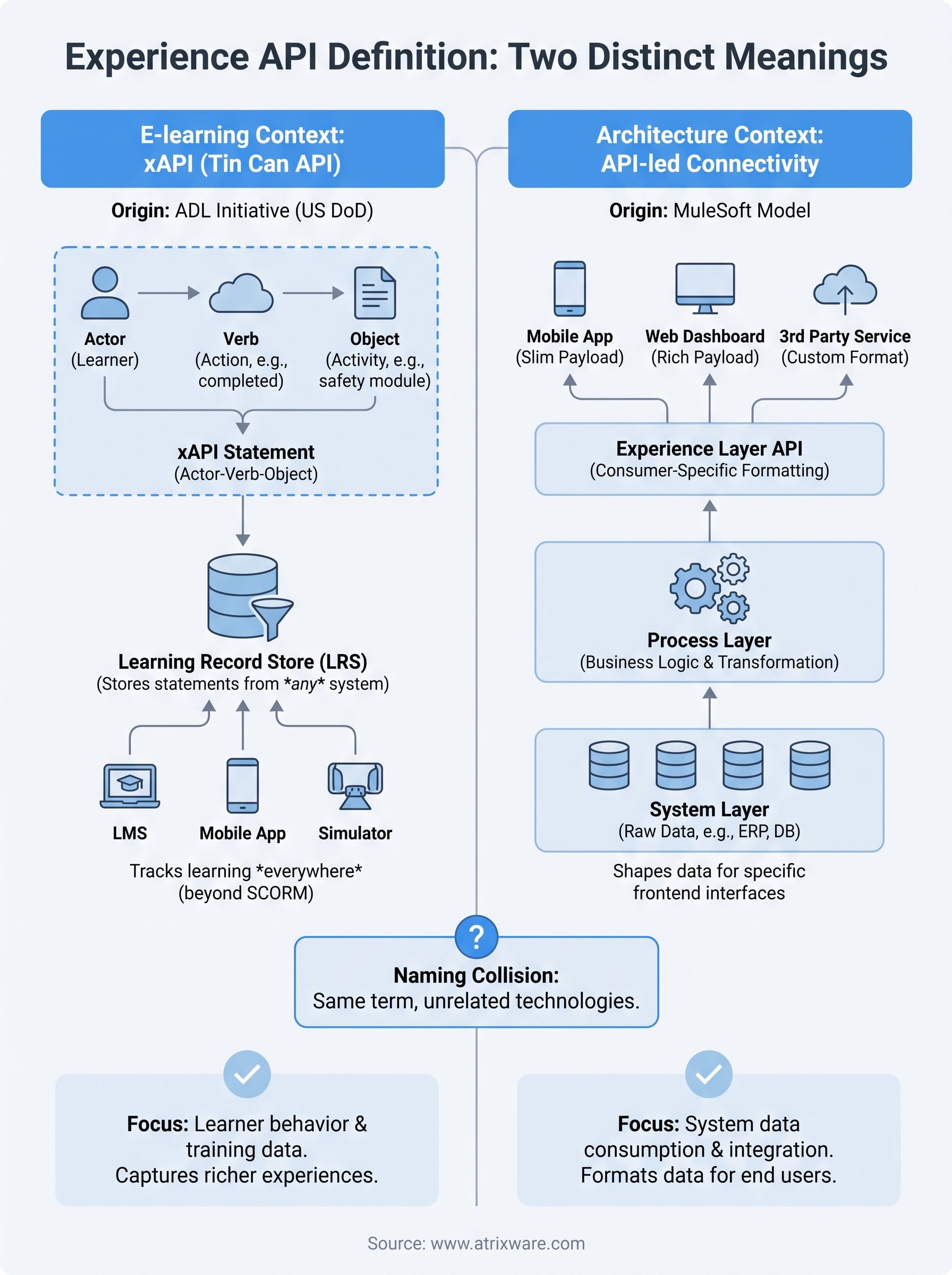
The experience API definition you need depends entirely on your context. In e-learning, xAPI is a tracking specification that records learner activity as actor-verb-object statements and stores them in an LRS, giving you visibility into learning that happens across every platform, not just inside your LMS. In enterprise integration architecture, experience layer APIs sit at the top of a three-tier model and format backend data for specific consuming applications like mobile apps or dashboards. These two technologies share a name and nothing else.
Knowing the difference prevents wasted planning time and keeps your integrations clean from the start. If you run training programs and want to track richer learner data, xAPI is the right tool. If you need to deliver data to multiple applications efficiently, the experience layer model solves that problem. Ready to see how a modern LMS handles these capabilities in practice? Start your free Axis LMS admin demo and explore the platform firsthand.
