
Ask five employees what your company’s continuing education policy covers, and you’ll probably get five different answers. That gap causes real problems: HR fields the same reimbursement questions every quarter, managers approve requests inconsistently, and finance can’t forecast training spend. A clear continuing education policy for employees fixes this before it becomes a bigger headache.
This policy is a written document that spells out eligibility rules, reimbursement caps, approved course types, and what happens if someone leaves shortly after you fund their degree or certification. Done right, it protects your budget, keeps compliance-driven training on track, and gives employees a straightforward path to grow their skills without guessing at the rules.
Below, you’ll get a full breakdown of what belongs in the policy, sample language you can adapt, and the employer obligations worth understanding before you roll anything out. We’ll also cover how tracking tools like a learning management system make enforcing and reporting on the policy far less of a manual chore.
Why a continuing education policy matters
Skipping a formal policy might feel harmless when your company is small, but the cracks show fast once headcount grows or a regulator comes asking questions. Without documented rules, every reimbursement request becomes a one-off negotiation, and that inconsistency opens the door to favoritism claims, budget overruns, and missed compliance training deadlines. A written policy replaces guesswork with a repeatable process that HR, managers, and finance can all point to.

Reducing legal and compliance exposure
Certain industries, healthcare, finance, and manufacturing among them, tie continuing education directly to licensing and safety requirements. If your organization can’t prove employees completed mandated hours, you risk fines or lost accreditation. The Equal Employment Opportunity Commission has also flagged inconsistent training benefits as a potential source of discrimination claims when policies aren’t applied evenly. A documented policy gives you a defensible paper trail and applies the same standard to everyone.
A written continuing education policy turns a legal liability into a predictable, auditable process.
Controlling training spend
Unstructured tuition reimbursement programs tend to balloon quietly. One manager approves a $6,000 MBA course, another denies a $200 certification, and nobody notices the pattern until the annual budget review. A written policy sets caps, defines what counts as job-related, and requires pre-approval, which keeps spending predictable and easy to forecast.
| Without a policy | With a policy |
|---|---|
| Approvals vary by manager | Consistent eligibility rules |
| No spending cap | Defined annual reimbursement limit |
| Hard to track compliance hours | Centralized records tied to job roles |
| Risk of favoritism claims | Documented, defensible process |
Improving retention and engagement
Employees notice when a company invests in their growth. LinkedIn’s own workplace research has repeatedly found that learning opportunities rank among the top reasons people stay in a job. A clear policy signals that professional development is a real benefit, not a favor granted at a manager’s discretion, and that visibility alone can reduce turnover among your strongest performers.
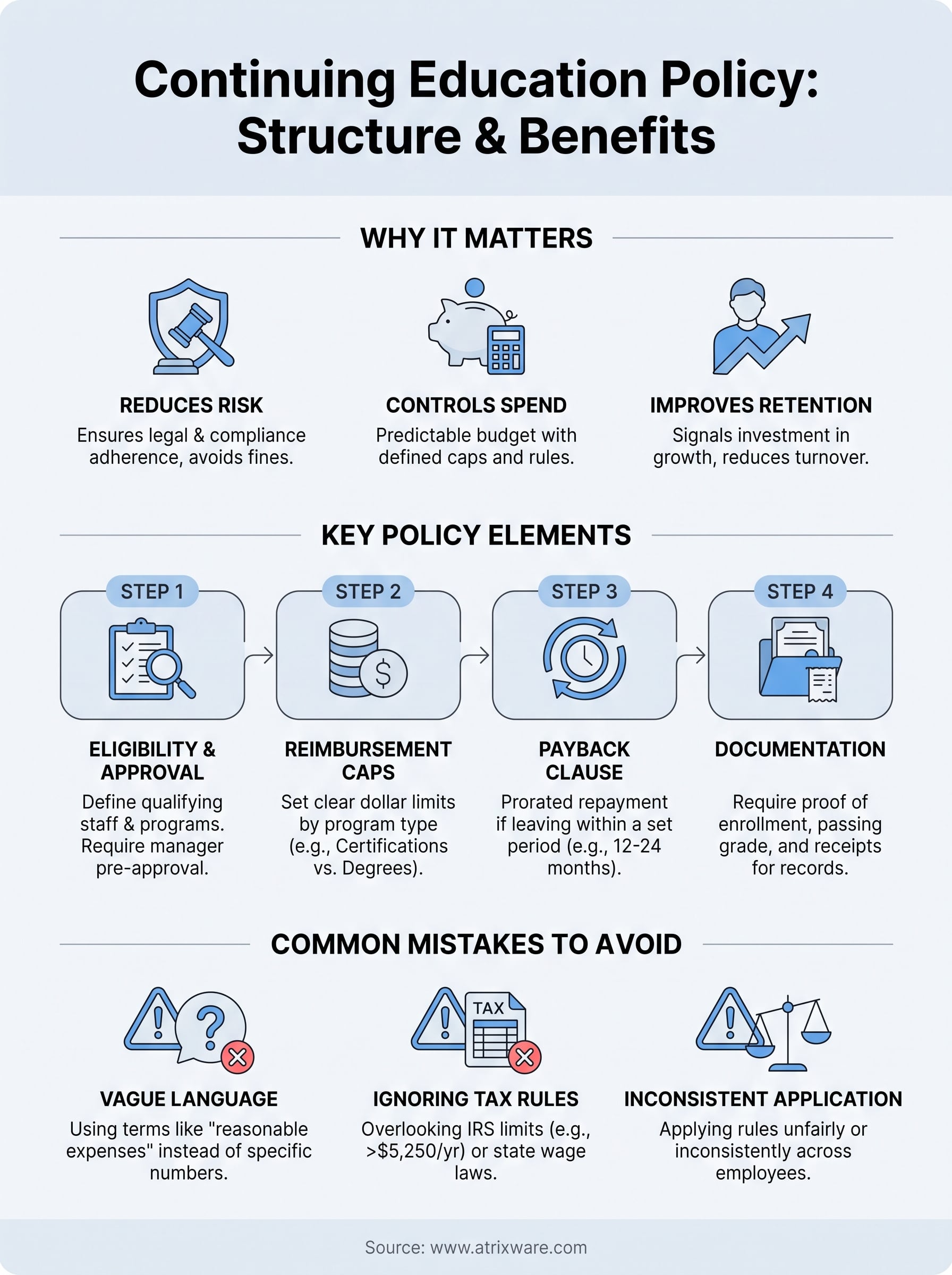
Taken together, these three benefits explain why a continuing education policy isn’t just paperwork. It protects the company legally, keeps spending in check, and gives employees a tangible reason to build their careers with you instead of somewhere else. The next section walks through exactly how to put one together.
How to build a continuing education policy for employees
Building this policy starts with a conversation, not a template. Pull together HR, finance, and a couple of department managers before you draft a single line, because each group cares about different risks: HR worries about fairness, finance worries about budget, and managers worry about staffing gaps while someone’s in class. Cross-functional input at the start saves you from rewriting the whole thing three months later.
Start with your goals and budget
Decide what you’re actually trying to accomplish. Are you closing skill gaps in a specific department, meeting mandatory licensing hours, or simply competing for talent in a tight labor market? Once the goal is clear, set an annual budget ceiling, either as a flat dollar amount per employee or a percentage of payroll, so the policy has real financial guardrails from day one.
Draft, review, and pilot
Write the first draft using plain language, then run it past legal counsel, especially if you operate in multiple states with different wage and reimbursement laws. Before rolling it out company-wide, pilot the policy with one department for a quarter.
A policy tested on a small team catches problems before they become company-wide complaints.
Here’s a simple sequence to follow:
- Interview stakeholders across HR, finance, and operations.
- Define goals, eligible programs, and annual budget.
- Draft the policy in plain, specific language.
- Get legal review for wage and tax implications.
- Pilot with one team and collect feedback.
- Finalize, publish, and train managers on approvals.
Gathering feedback after the pilot matters as much as the pilot itself. Ask employees whether the approval process felt clear, and ask managers whether the reimbursement caps matched real course costs. Adjust before you publish the final version company-wide, then build the specific elements covered next.
Key elements to include in your policy
Every solid continuing education policy answers the same core questions: who qualifies, what’s covered, how much the company pays, and what happens if someone leaves. Missing any one of these invites confusion later, so treat this list as your minimum checklist before publishing anything.
Eligibility and approval criteria
Spell out who can apply, whether that’s full-time employees after 90 days, part-time staff, or only certain job families. Require that courses tie directly to the employee’s current role or a documented career path, and route every request through a manager approval step before enrollment, not after.
Reimbursement structure and caps
Define dollar limits clearly instead of leaving them open to interpretation. A tiered structure keeps the policy fair across job levels while protecting your budget:

| Program type | Typical annual cap |
|---|---|
| Certifications and short courses | $1,000-$2,500 |
| Undergraduate coursework | $3,000-$5,000 |
| Graduate coursework | $5,000-$7,500 |
The clearest policies put a number next to every promise, not a vague reference to "reasonable expenses."
Payback and service commitment clauses
Include a repayment clause requiring employees to reimburse tuition if they leave within a set window, usually 12 to 24 months after course completion. Prorate the amount owed so it decreases the longer someone stays, which feels fairer and holds up better if challenged.
Documentation and reporting requirements
Require proof of enrollment, a passing grade, and receipts before reimbursement goes out. Centralizing this paperwork matters more than it sounds, since scattered spreadsheets and email approvals are exactly what create the compliance gaps discussed earlier. This is where a learning management system earns its keep, tracking completions, deadlines, and reimbursement status in one place instead of across a dozen inboxes.
Sample policy language you can adapt
Writing policy language from scratch is harder than editing something that already works, so start with the template below and adjust the numbers, job titles, and windows to match your organization. Keep the tone plain and specific, since vague phrases like "reasonable expenses" are exactly what create disputes later. This sample policy language covers eligibility, reimbursement, and repayment in one block you can drop straight into an employee handbook.
A policy that reads clearly to a new hire on day one will hold up just as well in a legal dispute five years later.
Copy-and-edit template
Use this as a starting draft, then route it through legal review before publishing:
Continuing Education Policy

Eligibility: Full-time employees who have completed 90 days
of employment are eligible to apply for tuition reimbursement.
Courses must relate directly to the employee's current role
or an approved career development path.

Approval: Employees must submit a Continuing Education
Request Form to their manager and HR before enrolling.
Approval or denial will be provided within 10 business days.

Reimbursement: The company will reimburse up to $5,000 per
calendar year for approved coursework, contingent on a
passing grade of C or higher and submission of receipts
within 30 days of course completion.

Repayment: Employees who voluntarily resign within 12 months
of reimbursement will repay a prorated portion of the funds,
decreasing by 1/12 for each completed month of service
following course completion.
Adjusting the template to your business
Modify the eligibility window, dollar caps, and repayment period to match your industry and budget, since a healthcare employer covering licensing hours will need different language than a tech company funding certifications. Test the wording with your pilot group before finalizing, and confirm that your repayment clause and reimbursement caps align with wage laws in every state where you have employees.
Common mistakes to avoid
Even a well-intentioned continuing education policy for employees can backfire if you skip a few critical details. Most failures trace back to the same handful of oversights, and catching them before launch saves you from an awkward rewrite six months in.
Leaving terms too vague
Phrases like "job-related coursework" or "reasonable reimbursement" sound flexible but invite disputes the first time two managers interpret them differently. Spell out dollar amounts, eligible program types, and approval timelines in plain numbers, not adjectives.
Vague language doesn’t protect the company, it just delays the argument.
Forgetting state and tax rules
Reimbursement above $5,250 per year becomes taxable income under IRS rules for educational assistance programs, and several states impose their own wage-deduction limits on repayment clauses. Skipping legal review here is one of the fastest ways to turn a benefit into a payroll headache.
Applying the policy inconsistently
A policy only works if every manager follows it the same way. Watch for these red flags during rollout:
- Approvals granted informally over email instead of through the official form
- Reimbursement caps quietly stretched for favored employees
- Repayment clauses enforced for some departures but waived for others
- No central record of who applied, who was approved, and who repaid
Treating the policy as a one-time document
Organizations that publish a policy and never revisit it end up with outdated dollar caps and course lists within a couple of years. Review the terms annually, checking that reimbursement limits still match tuition costs and that eligible programs reflect current skill gaps across the business.
Putting your policy into practice
A continuing education policy for employees only pays off once it moves from document to daily practice. That means publishing it where staff can actually find it, training managers on the approval steps, and setting a calendar reminder to review dollar caps and eligible programs every year. Skip any of those steps and you’re back to the inconsistent approvals and budget surprises that started this whole process.
Tracking enrollment, completions, and reimbursement status by hand works for a handful of employees, but it breaks down fast as your team grows. A learning management system handles that reporting automatically, giving HR and finance the audit trail a manual spreadsheet never will.
If you’re not sure whether your current setup can support that kind of tracking, take the LMS readiness quiz to see where you stand before you invest in new software.
