You’ve got a training budget, a deadline, and a room full of stakeholders debating instructor-led training vs e-learning. One camp wants a live facilitator who can read the room and answer questions on the spot. The other wants something scalable that doesn’t require flying people to a hotel conference room. Both have a point, and that’s exactly why this decision trips up so many training teams.
The short answer: instructor-led training wins for complex, high-stakes skills that need real-time feedback, while e-learning wins for consistency, cost control, and reaching people across time zones. Neither format is universally better. The right call depends on your content, your audience size, and how fast you need people trained.
This article breaks down what separates the two approaches, where each one falls short, and how a blended training strategy often beats picking just one. You’ll also see how the right learning management system removes the tradeoff altogether, letting you run live sessions and self-paced courses from the same platform without juggling separate tools.
Why the right training method matters for your team
Picking a training format isn’t a paperwork exercise. Get it wrong and you’ll see it in your numbers: dropped completion rates, disengaged employees, and a training budget that delivers nothing but a checked box. Training format decisions ripple through your entire operation, from how fast new hires become productive to whether your compliance program holds up under an audit.
The real cost of a mismatched format
Sending fifty regional managers to a two-day workshop sounds thorough until you tally the flights, hotel rooms, catering, and lost billable hours. A live instructor-led session can run into the thousands per participant once travel and facility costs are included, a pattern well documented by workforce researchers at the U.S. Bureau of Labor Statistics. E-learning flips that math: build the course once, deploy it to five hundred people, and your per-learner cost drops toward pennies on the dollar after the first delivery.

Cost cuts both ways, though. Rushing a nuanced topic, like handling a difficult customer escalation or operating specialized machinery, into a self-paced module because it’s cheaper often backfires. Learners click through slides without absorbing the material, then repeat the same mistakes on the job that the training was supposed to prevent.
Choosing the cheaper format for the wrong content costs more than choosing the pricier one for the right reasons.
Engagement and retention differences
Retention varies sharply by delivery method and by how the content gets structured, not just by label. Instructor-led training benefits from real-time questions, group discussion, and the social pressure of a live room, which keeps attention high during the session itself. E-learning depends more heavily on design: microlearning chunks, knowledge checks, and spaced repetition drive retention, while a forty-five-minute talking-head video usually doesn’t.
Neither format guarantees learning sticks. A bored instructor reading slides aloud produces the same disengagement as a poorly designed e-learning module. Format sets the ceiling for what’s possible, but execution decides whether you ever reach it.
Compliance, risk, and audit trails
For regulated industries, the stakes go beyond engagement scores. Compliance training often needs documented proof that a specific employee completed specific content on a specific date, with a passing assessment score attached. E-learning delivered through a learning management system produces that trail automatically. Instructor-led sessions require someone to manually track attendance sheets, sign-in forms, and quiz results, which introduces room for error exactly when accuracy matters most.
Organizations training under standards like FDA 21 CFR Part 11 or data handling rules tied to GDPR need that documentation to hold up during an audit. Regulators expect verifiable, timestamped records, not a filing cabinet of paper sign-in sheets. That single difference pushes many compliance-heavy programs toward e-learning even when the subject matter would otherwise favor a live instructor.
Speed to competency
Time matters too. New hires who need to be productive within two weeks can’t wait for the next scheduled workshop to open enrollment. Self-paced e-learning lets them start on day one, working at their own speed, without waiting for a cohort to fill. Instructor-led training, by contrast, often requires scheduling around trainer availability, travel, and room capacity, which can push onboarding out by weeks.
Get this decision right and training becomes a lever for productivity, retention, and risk reduction. Get it wrong, and you’re paying for a program that looks good on paper but doesn’t change behavior on the floor.
How to choose between ILT and e-learning
Most teams default to whatever format they used last time, which isn’t a strategy. A better approach starts with three questions: what’s the content, who’s the audience, and how fast do you need results. Answer those honestly and the format usually picks itself.
Start with the content, not the budget
Skills that require hands-on practice, real-time correction, or reading body language belong in a live room. Think sales negotiation, equipment operation, or leadership coaching where a facilitator needs to catch a mistake before it becomes a habit. Procedural knowledge, like software navigation, policy updates, or product features, transfers just fine through a screen because there’s a right answer and a clear path to it. If you can write a step-by-step guide for the skill, e-learning can likely teach it.
If the skill needs a human to correct it in the moment, put a human in the room.
Weigh audience size and location
A fifteen-person team in one office can gather for a workshop without much friction. A four-hundred-person sales force spread across three continents cannot, at least not without a travel budget that dwarfs the training itself. Audience distribution often decides the format before content complexity even enters the conversation.
Run through this checklist before committing:
- Group size: Under 20 learners favors ILT; 50+ favors e-learning or a hybrid rollout.
- Geography: Single site supports live sessions easily; multiple time zones push toward self-paced content.
- Urgency: Need training live next week? E-learning deploys faster than scheduling a facilitator.
- Repeat need: One-time training suits ILT; recurring or evergreen content pays off more as e-learning.
- Skill type: Hands-on or judgment-based skills lean ILT; rule-based or procedural skills lean e-learning.
Factor in trainer availability and cost
Even when content and audience point toward instructor-led training, check whether you actually have the trainers to deliver it consistently. A single subject matter expert can’t run twenty live sessions a month without burning out or letting quality slip on the tenth repeat. E-learning solves the scaling problem by capturing that expert’s knowledge once and deploying it indefinitely, though it can’t replace the judgment a live facilitator brings to a room full of pushback.
Budget matters here too, but not in isolation. Compare the true cost of both options, including facilitator time, travel, and platform fees, before assuming one is automatically cheaper. Teams that skip this comparison often discover mid-year that their "cheaper" e-learning rollout still needed a facilitator on standby for questions the modules couldn’t answer, quietly erasing the savings they budgeted for.
Instructor-led training vs e-learning: key differences
You’ve seen the tradeoffs scattered across the sections above. Here’s the side-by-side view that puts them in one place, so you can point to a single table instead of re-explaining the logic every time a stakeholder asks why you picked one format over another.
The comparison at a glance
Delivery mechanics separate these two formats more than anything else. Instructor-led training happens in real time, whether in a physical classroom or a virtual meeting room, and depends on a facilitator being present and prepared. E-learning gets built once and runs on its own, available whenever a learner logs in, with no scheduling required after launch.
| Factor | Instructor-Led Training | E-Learning |
|---|---|---|
| Delivery timing | Fixed schedule, live | On-demand, self-paced |
| Cost per learner | Higher, scales with headcount | Lower after initial build |
| Scalability | Limited by trainer capacity | Scales to thousands instantly |
| Feedback | Real-time, personalized | Delayed or automated |
| Consistency | Varies by facilitator | Identical every time |
| Documentation | Manual sign-in sheets | Automatic tracking via LMS |
| Best for | Complex, judgment-based skills | Procedural, rule-based skills |
The format that scales isn’t automatically the format that teaches best, and the format that teaches best isn’t automatically the one you can afford to repeat.
Where each format actually wins
Facilitator-led sessions win when the content demands judgment calls that a screen can’t replicate. A sales manager coaching a rep through objection handling needs to hear tone, catch hesitation, and redirect on the spot. That kind of real-time correction has no equivalent in a self-paced module, no matter how well it’s designed. Live sessions also build relationships and trust between trainer and learner, something that matters heavily in leadership development and team-building programs.
Self-paced courses win on reach and repeatability. Once you’ve built a module covering a policy update or a software walkthrough, you can push it to every employee across every location without booking a single room. The content stays identical for every learner, which matters when consistency is the goal, like in safety procedures where one trainer’s shortcut version shouldn’t differ from another’s.
Where each format falls short
Neither approach is free of weak spots. Instructor-led training struggles with scale, consistency across facilitators, and the sheer logistics of getting everyone in the same room at the same time. Quality also drifts: a great trainer delivering session one and a mediocre one delivering session ten produce different outcomes from the same curriculum.
E-learning struggles with anything requiring nuance or immediate human judgment. A learner stuck on a tricky concept in a self-paced module often has no one to ask, and completion rates for poorly designed courses can drop sharply once the novelty wears off. Recognizing these limits upfront, rather than discovering them after rollout, is what separates a training plan that works from one that just looks good in a proposal.
Blending instructor-led training and e-learning
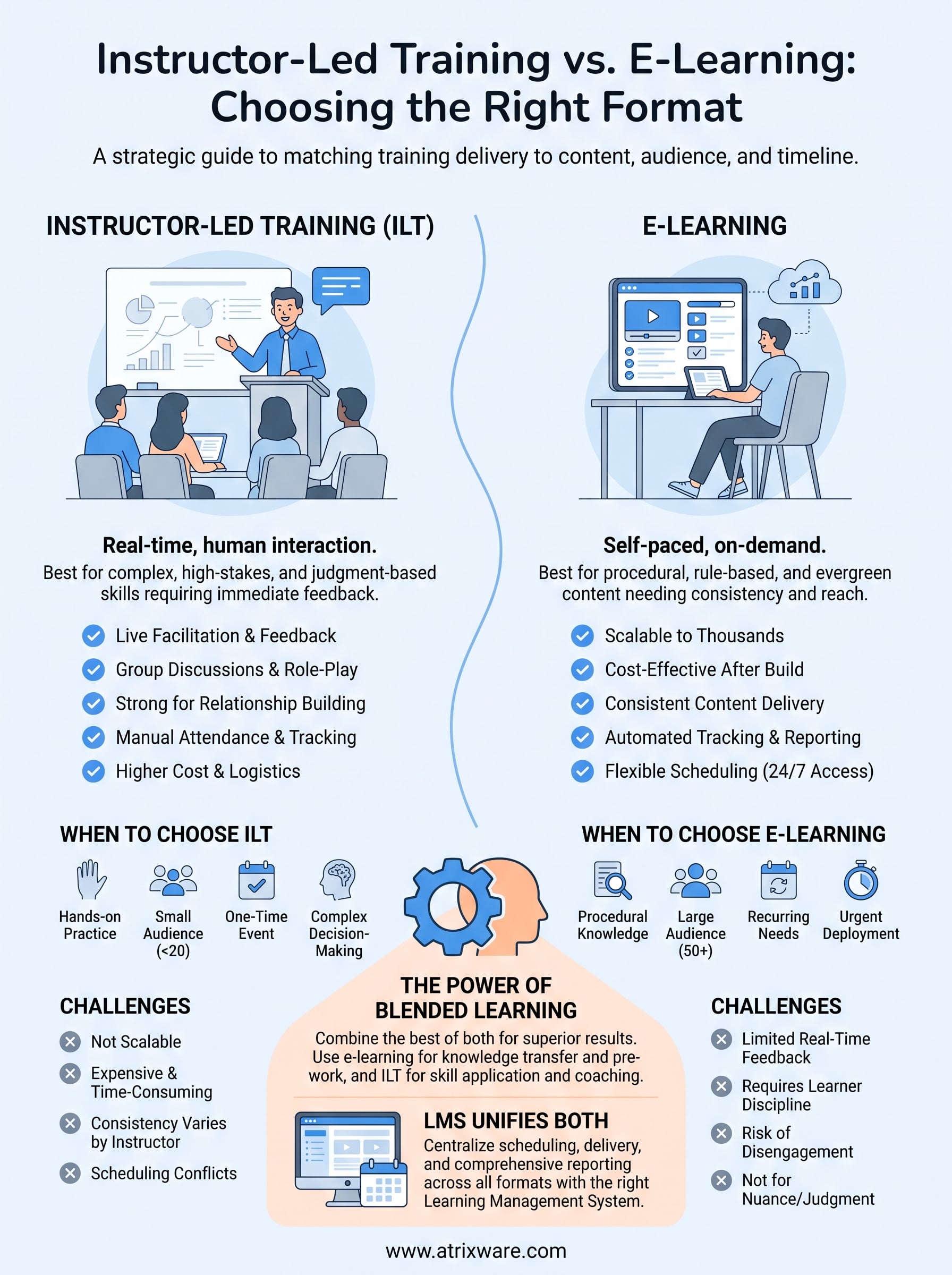
Most successful training programs don’t pick a side. They run a blended learning model that pairs the scale of e-learning with the judgment and interaction of a live facilitator, using each format for what it does best instead of forcing one to cover everything. Blended programs consistently outperform single-format rollouts on both completion and retention, because learners get structured self-paced content to absorb at their own speed, plus a live session to ask questions and practice under real conditions.
What a blended rollout actually looks like
A common pattern: assign e-learning modules that cover foundational knowledge, policy details, or product specs before the live session even starts. Learners arrive at the workshop already familiar with the material, so the facilitator skips the lecture and spends the time on discussion, role-play, or hands-on practice instead. This flips the classic classroom model, where a trainer spends half the session just transferring information that a well-built module could have delivered days earlier.
Use e-learning to deliver knowledge and instructor-led sessions to build skill; mixing up which one does which job is where blended programs fail.
A typical sequence for onboarding a new sales rep might look like this:
- Pre-work module (e-learning): product catalog, pricing structure, CRM basics, completed before day one.
- Live workshop (ILT): objection handling, role-play scenarios, manager Q&A, run in a small cohort.
- Follow-up microlearning (e-learning): short refreshers on specific objections, pushed out over the following weeks.
- Coaching check-in (ILT): a brief one-on-one to confirm the skill transferred to real calls.
Where blending pays off most
Compliance training benefits heavily from this split. Assign the regulatory content, like GDPR data-handling rules or safety procedures, as tracked e-learning modules that generate the documentation an audit will demand. Then reserve live sessions for scenario walkthroughs where employees practice applying those rules to messy, real-world situations a checklist alone can’t cover. Onboarding programs follow a similar logic: policies and tools through e-learning, culture and manager relationships through live interaction.
Sales enablement and leadership development lean on blending too. Reps and new managers absorb frameworks through short modules, then bring questions to a live coaching session instead of sitting through a lecture that repeats what they already read. This approach respects trainer time, since the facilitator isn’t reteaching material that a module handles more efficiently, and it respects learner time, since nobody sits through a live session for content they could have finished in ten minutes on their own.
The catch is logistics. Running both formats well means tracking completions across two different delivery methods, scheduling live sessions around module deadlines, and reporting on the whole sequence as one program rather than two disconnected pieces. That’s exactly the coordination problem the right platform is built to solve.
How an LMS supports both training methods
Coordinating a blended program with spreadsheets and email reminders falls apart fast once you’re running more than a handful of cohorts. A learning management system built for both formats removes that friction by giving you one place to schedule live sessions, host self-paced modules, and pull a single completion report that covers everyone regardless of how they trained. This is where the instructor-led training vs e-learning debate stops being an either-or choice and becomes a question of which tool runs both without forcing your team to stitch together separate systems.
Centralizing scheduling and delivery
Platforms like Axis LMS let administrators post a virtual classroom session, cap enrollment, and send automated reminders in the same dashboard where they upload a self-paced module. Learners see both on one calendar instead of checking a workshop sign-up sheet in one tool and a course library in another. Automated communication handles the reminders and follow-ups that used to eat an administrator’s afternoon, freeing that time for actual content review instead of chasing no-shows.
Tracking completions across formats
Reporting is where most blended programs either prove their value or quietly fall apart. A capable LMS logs attendance from a live session, quiz scores from an e-learning module, and certification status from both, then rolls it all into one learner record. That single record is what an auditor wants to see for compliance training under standards like GDPR or FDA 21 CFR Part 11, and it’s what a training manager wants when a VP asks whether the new onboarding sequence is actually working.
A blended program only works if the reporting treats it as one program, not two separate training efforts running in parallel.
Consider what unified reporting actually replaces:
- Manual attendance sheets for live sessions, prone to lost paperwork and illegible signatures.
- Separate spreadsheets tracking e-learning completions that never sync with classroom records.
- Delayed compliance reports built by hand right before an audit deadline.
- No visibility into which learners finished pre-work before showing up to a live session.
Virtual classroom features bridge the gap
Even the live half of a blended program benefits from LMS support. Built-in virtual classroom tools let a facilitator run a session, record it for anyone who missed the live date, and attach that recording to the same course record as the pre-work module. Virtual classroom integration means a missed session doesn’t derail the whole sequence, since the learner can catch up asynchronously and still generate the same completion data as everyone who attended live.
Integrations extend that reach further. Connecting the LMS to HR systems like BambooHR or CRM platforms like Salesforce means enrollment happens automatically when someone joins a team or takes on a new account, instead of an administrator manually adding names to two different rosters for two different formats.
Finding the right fit for your team
The instructor-led training vs e-learning debate was never about picking a winner. It’s about matching format to content, audience, and timeline, then letting a blended approach cover whatever gaps a single method leaves behind. Complex, judgment-heavy skills still need a live facilitator in the room. Procedural knowledge, compliance documentation, and anything you need to scale to hundreds of learners still belongs in self-paced modules.
What actually determines success is whether your platform can run both without forcing your team to reconcile two disconnected systems every reporting cycle. That’s the real decision point, not the format itself. If you’re still weighing where your organization stands on that front, take the LMS readiness quiz to see whether you’re ready to unify your training under one system, or still building the case internally.
