You know the gap when a manager can run a team but freezes when asked to defend a market-entry decision or reallocate budget across product lines. That’s a strategy gap, not a leadership gap, and it’s the kind of skills gap you close with structured training, not soft-skills coaching. Corporate strategy training teaches the frameworks, like Porter’s Five Forces, scenario planning, and portfolio analysis, that turn managers into people who can actually shape business direction instead of just executing someone else’s plan, and it works differently than soft skills training in the workplace.
This list answers a direct question: which courses and programs actually build strategic thinking skills you can use in a real board meeting or planning cycle, not just theory you forget by Friday. We looked at curriculum depth, instructor credentials, and whether each program produces work you can apply immediately, not just a certificate.
Below you’ll find eight programs for 2026, ranging from executive-education intensives at top business schools to focused online courses built for busy managers. We break down who each course fits best, what it costs, and what you’ll walk away able to do. If you’re also responsible for rolling this training out across a team or department, pay attention to how each program handles training reporting and analytics, since that’s where a good course either scales or stalls.
Enter your search intent
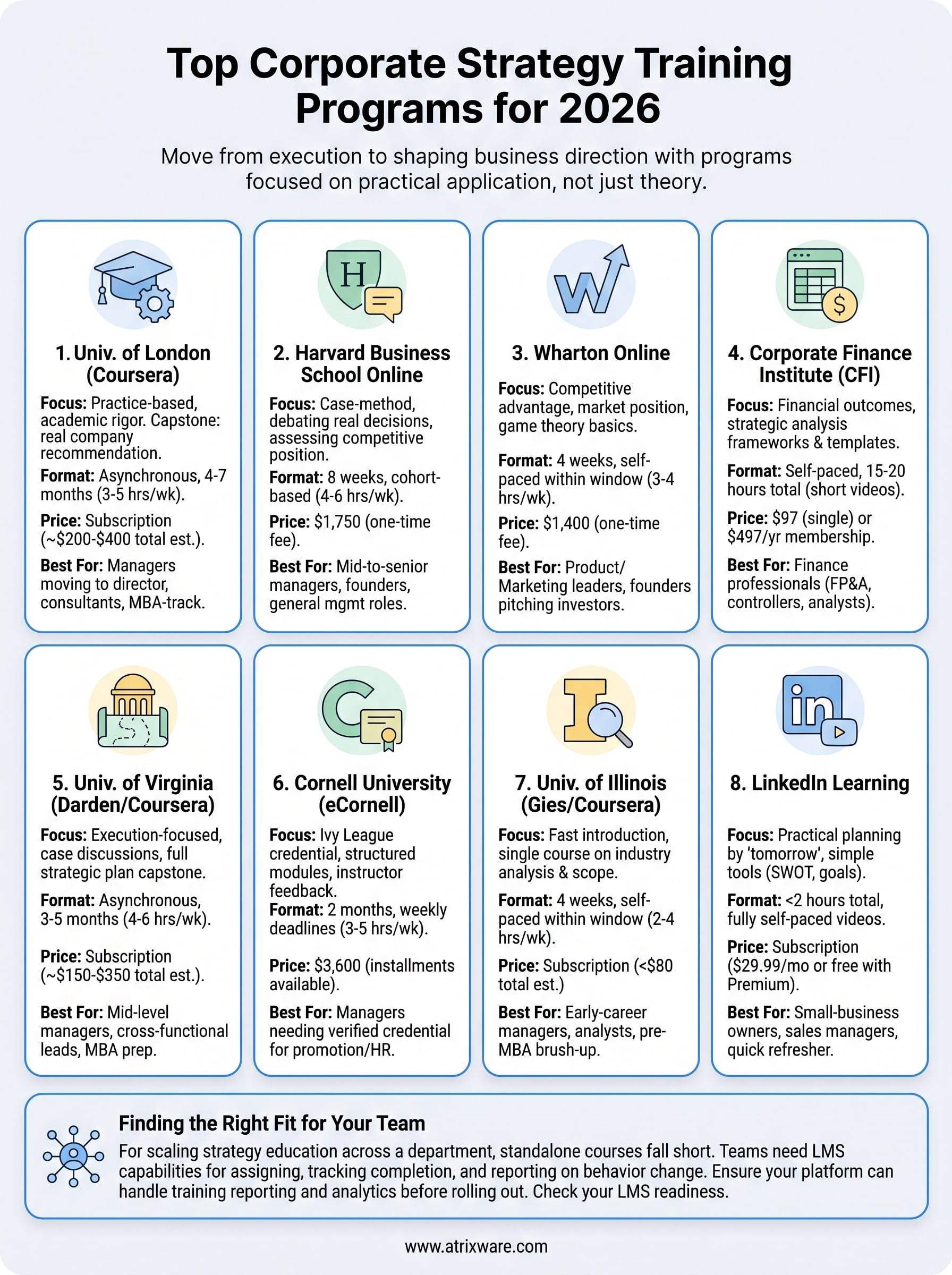
1. Corporate Strategy by the University of London
The University of London, in partnership with Coursera, built this program around a simple premise: strategy is a discipline you practice, not a slogan you memorize. It’s one of the most recognized names in corporate strategy training because it comes from an actual academic institution rather than a corporate training vendor repackaging generic content, and the coursework reflects that rigor.
What you’ll learn
Students work through five courses covering corporate strategy fundamentals, industry and competitor analysis, mergers and acquisitions, and how to align business units around a coherent strategic direction. Each course builds toward a capstone project where you analyze a real company and produce a strategy recommendation, which is the part that separates this program from ones that stop at multiple-choice quizzes.
A strategy course only matters if it forces you to build a real recommendation, not just recite a framework.
Who it’s for
Managers moving into director-level roles benefit most here, especially those who need to justify strategic decisions to a board or leadership team for the first time. Consultants and MBA-track professionals also use this program to fill gaps in formal strategy education without committing to a full degree, since the specialization mirrors what you’d cover in a graduate-level strategy elective.
Format and duration
Everything runs asynchronously through Coursera’s platform, so you watch video lectures, complete peer-reviewed assignments, and submit the capstone on your own timeline. Most learners finish the full specialization in four to seven months at roughly three to five hours per week, though nothing stops you from moving faster if you clear a weekend for it.
Price
Coursera prices this through its subscription model, typically $49 to $79 per month depending on current promotions, and you pay only for the months you’re actively enrolled. Because the specialization takes several months for most people, expect a total cost somewhere between $200 and $400, which is inexpensive compared to executive-education programs charging that much per day.
2. Business Strategy by Harvard Business School Online
Harvard Business School Online built this course around the case-method teaching style that HBS is known for, which means you spend less time watching lectures and more time debating decisions that real executives actually made. It’s a shorter, more concentrated take on corporate strategy training than the University of London program, aimed at people who want the Harvard name and rigor without a multi-month commitment.

What you’ll learn
You’ll work through frameworks for assessing competitive position, valuing a business, and deciding where a company should compete versus where it shouldn’t. The course leans heavily on cases like Netflix, Uber, and Nintendo, asking you to argue for a strategic direction and defend it against classmates in structured discussion boards, which mimics the pressure of a real strategy meeting better than a quiz ever could.
A course built on real corporate decisions teaches judgment in a way that theory alone never does.
Who it’s for
Mid-to-senior managers headed toward general management roles get the most value here, along with founders who need a faster way to sharpen strategic decision-making before a fundraising round or board meeting.
Format and duration
The course runs eight weeks, cohort-based, with weekly modules and a mix of pre-recorded video and asynchronous discussion posts. Expect four to six hours per week.
Price
Harvard Business School Online prices this course at $1,750, with occasional bundle discounts if you enroll in multiple HBS Online courses within the same year.
3. Business Strategy: Competitive Advantage by Wharton Online
Wharton Online built this course around a single question: why do some companies sustain profits for decades while competitors chase them and fail? Taught by Wharton professor David Reibstein, it’s a tighter package than the Harvard course, focused almost entirely on competitive advantage rather than the broader sweep of corporate strategy.
What you’ll learn
You’ll dig into frameworks for measuring market position, analyzing customer value versus competitor value, and building a defensible advantage that doesn’t erode the moment a rival copies your pricing. The course also covers game theory basics, useful for predicting how competitors will react before you actually make a move.
Competitive advantage isn’t a slogan, it’s a number you can measure against your closest rival.
Who it’s for
Product managers and marketing leaders get outsized value here, since the course centers on customer-facing competitive dynamics rather than internal operations. It also suits founders who need strategic frameworks for pitching investors on why their advantage will hold up over time.
Format and duration
The course runs four weeks, self-paced within that window, through Wharton’s online learning platform. Plan for three to four hours weekly, including two short assignments that ask you to apply the frameworks to a company of your choosing.
Price
Wharton Online prices this course at $1,400, occasionally discounted to around $1,150 during promotional enrollment periods, payable as a single upfront fee rather than a subscription.
4. Corporate & Business Strategy by Corporate Finance Institute
Corporate Finance Institute built this program for people who already live in spreadsheets and need strategy skills that connect directly to financial outcomes. It’s a more numbers-driven take on corporate strategy training than the academic offerings above, aimed squarely at finance professionals who need to speak the language of strategy without abandoning their analytical roots.
What you’ll learn
You’ll cover strategic analysis frameworks, business model evaluation, and how to translate a strategic plan into financial projections that hold up under scrutiny. The course pairs each concept with a downloadable template, so you leave with tools you can reuse on the job rather than notes you’ll never open again.
Strategy training only sticks when it hands you a template you’ll actually reuse next quarter.
Who it’s for
Financial analysts, FP&A managers, and controllers moving into strategy-adjacent roles get the most value here. It also suits accountants pursuing CFI’s broader certification path, since this course counts toward several of their credential bundles.
Format and duration
The course is fully self-paced, delivered through short video modules averaging 10 to 15 minutes each, with quizzes after every section. Most learners finish in 15 to 20 hours total, spread across two to three weeks of part-time study.
Price
CFI offers this course individually for $97, though most learners access it through CFI’s full membership at $497 per year, which unlocks their entire course library and certification tracks.
5. Business Strategy Specialization by the University of Virginia
The Darden School of Business at the University of Virginia built this Coursera specialization around a practical question: how do you turn strategic analysis into a plan your team can actually execute? Darden’s reputation for case-based teaching carries over here, giving this corporate strategy training program more real-world texture than a typical MOOC.

What you’ll learn
Across four courses, you’ll work through strategic thinking fundamentals, financial analysis for strategic decisions, and marketing strategy, before finishing with a capstone that asks you to build a full strategic plan for a company. The specialization pairs each concept with short case discussions, so you’re constantly testing frameworks against messy, real situations instead of clean textbook examples.
A strategic plan only counts as learning once you’ve defended it against a real business case.
Who it’s for
Mid-level managers stepping into cross-functional leadership roles get the most out of this program, especially those who need financial fluency alongside strategic judgment. It also suits professionals preparing for an MBA who want a preview of Darden’s teaching style before committing to a full degree.
Format and duration
The specialization runs asynchronously through Coursera, with most learners finishing in three to five months at four to six hours per week. Each course within the specialization can also be taken individually if you only need one piece of the curriculum.
Price
Coursera bills this through its standard subscription, around $49 to $79 per month, putting total cost in the $150 to $350 range depending on your pace.
6. Business Strategy Certificate Program by Cornell University
Cornell’s eCornell platform packages this program for managers who want an Ivy League credential without sitting in a classroom for weeks. Unlike the academic specializations above, this corporate strategy training program leans on short, structured modules built by Cornell’s Johnson Graduate School faculty, aimed at people who need a credential that reads well on a resume alongside practical skills.
What you’ll learn
You’ll work through five courses covering strategic analysis, business model design, competitive positioning, and how to communicate a strategic plan to stakeholders who weren’t in the room when you built it. Each course ends with a project you submit for instructor feedback, which keeps the program from feeling like a passive video series.
A certificate only means something when someone actually reviews your work before you get it.
Who it’s for
Managers pursuing a verified credential for internal promotion cases benefit most, along with HR and L&D professionals who need to justify a training budget with a recognized university name attached, or who need to align corporate learning with bottom-line performance. It also suits people who prefer structured deadlines over fully self-paced formats.
Format and duration
The program runs two months, with weekly deadlines for assignments and discussion posts, requiring three to five hours per week. Cohorts start monthly, so you’re never waiting long to enroll.
Price
eCornell prices this certificate at $3,600, payable in installments, which places it above most Coursera specializations but below single Harvard or Wharton courses.
7. Corporate Strategy by the University of Illinois
The Gies College of Business at the University of Illinois built this Coursera course around a straightforward goal: give working professionals a fast, credible introduction to corporate strategy training without the multi-course commitment other specializations demand. It’s a single course rather than a bundle, which makes it one of the quicker entry points on this list for anyone testing whether formal strategy education is worth the time.
What you’ll learn
You’ll cover industry analysis, resource-based strategy, and how companies decide whether to diversify, integrate vertically, or stay focused on a core business. The course wraps up with a short written assignment where you apply these frameworks to a company you choose, giving you a small but real deliverable instead of just quiz scores.
A single well-taught course can cover more real strategy than three padded ones.
Who it’s for
Early-career managers and analysts who need a foundational grounding in strategic frameworks before tackling something denser like the Harvard or Wharton courses fit well here. It also suits professionals brushing up before an MBA application or interview.
Format and duration
The course runs four weeks, self-paced within that window, at roughly two to four hours per week through Coursera’s standard video-and-quiz format.
Price
Coursera bills this through its subscription model at $49 to $79 per month, and most learners finish within a single billing cycle, keeping total cost under $80.
8. Business Development: Strategic Planning on LinkedIn Learning
LinkedIn Learning built this course for the person who needs a working grasp of corporate strategy training by tomorrow’s meeting, not a certificate to frame. Taught by a business development instructor rather than an academic, it strips strategy down to what a manager needs to draft a plan this week, skipping the case-study depth you get from Harvard or Wharton.
What you’ll learn
You’ll cover how to set strategic priorities, map out a business development plan, and align sales and partnership goals with broader company direction. The course also touches on SWOT analysis and goal-setting frameworks, kept intentionally simple so you can apply them the same day without translating academic language into office language first.
Sometimes the strategy course you need is the one that gets you a usable plan by Friday, not a framework you’ll study for months.
Who it’s for
Small-business owners, sales managers, and early-career professionals who need practical strategic planning without a business-school vocabulary lesson get the most from this course. It also works well as a refresher for anyone who took a deeper program years ago and needs the basics back quickly.
Format and duration
The course runs under two hours total, broken into short video segments you can watch in any order, fully self-paced.
Price
LinkedIn Learning bundles this course into its subscription, priced around $29.99 per month or $239.88 annually, and it’s also included free with many LinkedIn Premium plans.
Finding the right fit for your team
Picking one of these eight programs comes down to matching the format to your actual constraints, not just the name on the certificate. A solo manager prepping for a promotion case might grab the Cornell or Illinois option, while a learning and development team rolling out corporate strategy training to fifty people needs something else entirely: the must-have corporate LMS capabilities to assign courses, track completion, and prove the training actually changed behavior on the job.
That’s where most of these standalone courses fall short once you move past a single learner. If you’re responsible for scaling strategy education across a department, you need a system built for tracking and reporting at that level, not a personal Coursera login. Find out whether your team is ready for an LMS and start managing strategy training the way it deserves to be managed.
