
If you’ve ever renewed a professional license or maintained a certification, you’ve already encountered what is continuing education, even if you didn’t call it that. It’s the structured learning that happens after your formal education ends, designed to keep your skills current and your credentials active. For millions of professionals across healthcare, finance, education, and dozens of other fields, it’s not optional, it’s required.
But continuing education isn’t just about checking a compliance box. Done right, it sharpens expertise, opens doors to career advancement, and helps organizations build teams that actually know what they’re doing. The challenge for many businesses is tracking all of it, who completed what, when certifications expire, and whether training meets regulatory standards. That’s exactly the kind of problem Axis LMS by Atrixware solves, giving organizations the tools to deliver, manage, and track continuing education at scale.
This article breaks down the full picture: what continuing education means, the most common types of CE activities, how continuing education units (CEUs) work, and why it all matters, whether you’re a learner maintaining your credentials or an organization managing compliance across an entire workforce.
What continuing education includes and excludes
Understanding what is continuing education requires knowing where the boundaries are. Not every learning activity qualifies, and most licensing boards apply strict criteria to what they’ll accept toward credit hours or renewal requirements. Knowing the difference saves you from completing training that won’t count when it matters.
What counts as continuing education
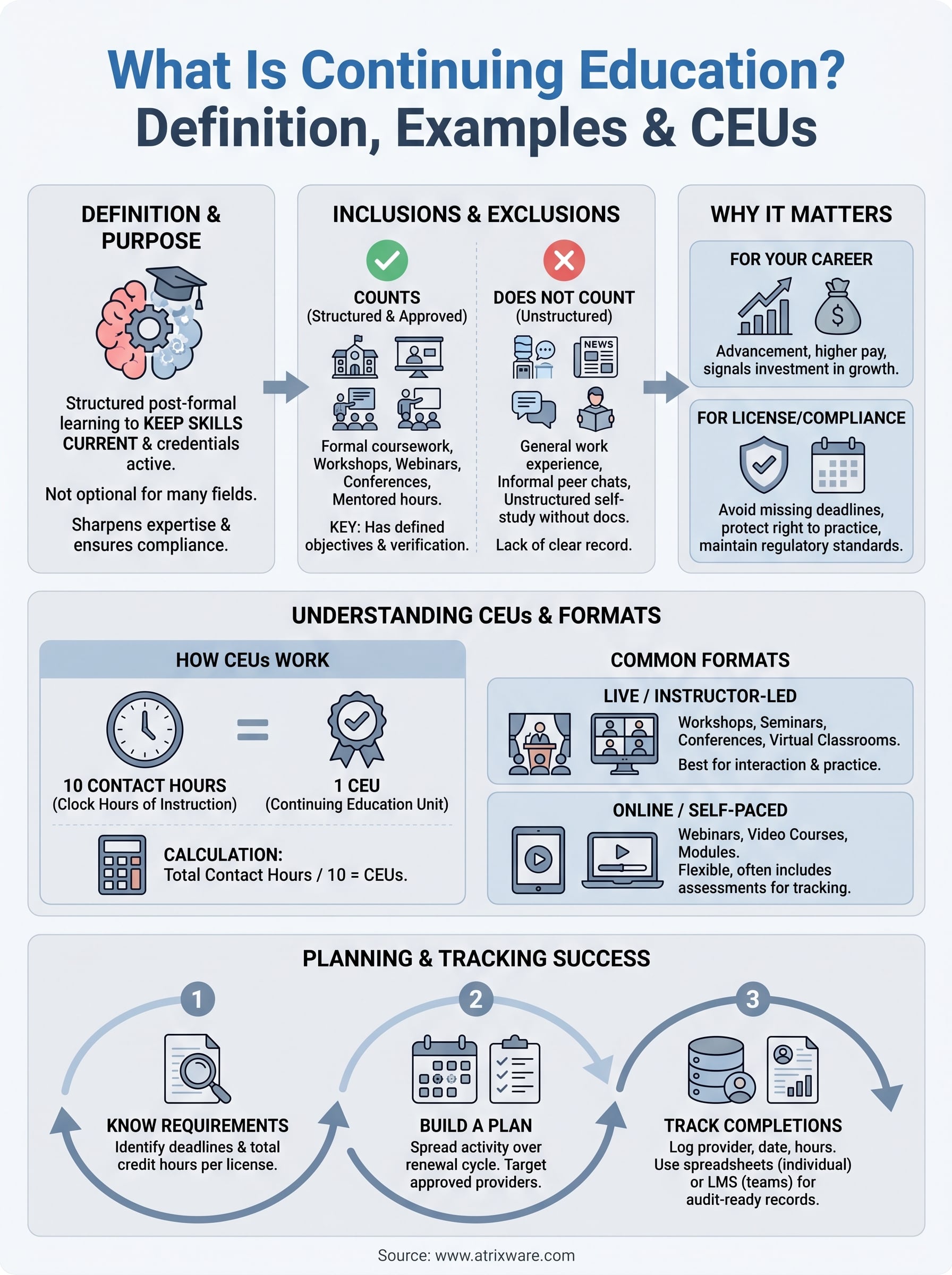
Continuing education covers any structured, post-formal learning activity that carries credit, ties to a professional development goal, and is provided or approved by a recognized accrediting body. That includes formal coursework at universities, professional development workshops, webinars, online courses, seminars, conferences, and even mentored clinical hours in fields like healthcare or social work.

The key distinction is structure: if an activity has defined learning objectives, a set format, and a way to verify completion, it most likely qualifies as continuing education.
Some fields also accept self-directed learning when it’s properly logged and documented, such as reading peer-reviewed journals, as long as the relevant licensing board recognizes that format. The activity types vary widely, but the common thread is that they all build on existing professional knowledge rather than introducing it for the first time.
What does not count as continuing education
General on-the-job experience, informal peer conversations, and unstructured self-study without documentation typically do not qualify for CE credit. Reading industry news or browsing professional forums may keep you informed, but those activities won’t satisfy a licensing board’s renewal requirements unless a specific, approved framework is in place.
Training that lacks a clear completion record or is not tied to an accredited provider also falls outside what most boards accept. This is where many professionals run into trouble: they complete genuinely useful training but can’t produce the documentation to prove it, which creates a compliance gap that puts their credentials at risk.
Why continuing education matters for careers
Understanding what is continuing education is one thing; recognizing why it matters for your career is another. Whether you’re in a licensed profession or not, staying current with industry knowledge signals to employers and clients that you take your work seriously and invest in your own growth.
Career advancement and earning potential
Professionals who actively pursue continuing education consistently stand out during promotions, hiring decisions, and salary reviews. When two candidates have similar experience, the one with recent, relevant training carries more weight. Many industries have also tied specific credentials and designations directly to higher pay grades, making CE credits a practical investment rather than just a requirement.
Continuing education is one of the few career levers entirely within your control, you decide how much to pursue and in which direction.
Your employer benefits too. Teams with up-to-date skills make fewer errors, adapt faster to change, and require less supervision. That’s why many organizations now fund CE activity as a standard part of employee development.
License renewal and regulatory compliance
For licensed professionals, missing renewal deadlines can mean losing the right to practice entirely. Fields like nursing, accounting, law, and real estate each set their own CE requirements, and regulators take non-compliance seriously. Staying on top of your renewal calendar and required credit hours protects both your career and the people you serve.
How CEUs work and how to calculate them
Once you understand what is continuing education, the next logical question is how the credit system actually functions. A Continuing Education Unit (CEU) is the standard measurement most licensing boards use to quantify participation in approved learning activities. Knowing how CEUs work keeps you from falling short at renewal time.
What a CEU represents
One CEU equals 10 contact hours of participation in an accredited continuing education activity. A contact hour is one clock hour of instruction, not a semester credit or a course grade. So if you complete a two-day workshop running 8 hours per day, that’s 16 contact hours, which equals 1.6 CEUs.

Most licensing boards publish their renewal requirements in either CEUs or contact hours, so confirm which unit your board uses before you register for any training.
How to calculate your CEUs
Calculating your total is straightforward: divide your contact hours by 10. If your board requires 3.0 CEUs per renewal cycle, you need 30 contact hours of approved training completed within that period. Some fields, like nursing, track contact hours directly rather than converting to CEUs, so the math stays the same but the label changes.
Keeping a running log of every completed activity, including the provider name, date, and hours earned, makes the calculation automatic and gives you documentation ready for any audit or renewal submission.
Common continuing education formats and examples
Part of understanding what is continuing education is knowing the range of formats available to you. The format you choose affects how you learn, how much time you commit, and whether the activity fits your schedule. Most licensing boards accept several different delivery methods, so you have real flexibility in how you earn your credit hours.
Instructor-led and live formats
Live formats put you in direct contact with instructors or peers, which works well for topics that benefit from real-time discussion and hands-on practice. Common examples include in-person workshops, professional conferences, seminars, and virtual classroom sessions. Many professional associations run annual conferences that pack multiple CEU-eligible sessions into a single event, making them an efficient way to meet a large portion of your renewal requirement in a short window.
If your field requires supervised practice hours, live formats often satisfy those requirements where self-paced options cannot.
Online and self-paced formats
Online continuing education has grown significantly and now covers nearly every licensed profession. You can complete accredited webinars, video-based courses, and self-paced modules on your own schedule without traveling or adjusting your work calendar. Many providers also offer scenario-based assessments and knowledge checks built into the course, so you finish with documented proof of completion that satisfies most licensing board submission requirements. For organizations managing CE across large teams, online formats also make tracking and reporting far more straightforward.
How to plan and track continuing education
Knowing what is continuing education is only useful if you act on it before a deadline catches you off guard. The most common mistake professionals make is waiting until the final months of a renewal cycle to scramble for credit hours. A proactive plan removes that pressure and keeps you in control of your credentials year-round.
Build a renewal calendar
Start by identifying your exact renewal deadline and total credit hour requirement for each license or certification you hold. Then break that total into smaller chunks spread evenly across the full renewal period. A simple planning checklist covers:
- Renewal deadline for each credential
- Total contact hours or CEUs required
- Approved providers and accepted formats for your licensing board
- Quarterly targets to stay on pace
Spreading your CE activity across the renewal cycle also gives you more time to seek out higher-quality training rather than accepting whatever fits the deadline.
Track completions with the right tools
Every completed activity needs a complete record that includes the provider, date, topic, and hours earned. A basic spreadsheet works well for individual professionals managing one or two licenses.
Organizations tracking CE for large teams need a more structured system that ties completion records to individual learner profiles, automates renewal reminders, and generates reports on demand for audits or regulatory submissions. Without that infrastructure, compliance gaps appear fast, especially when renewal windows overlap across a workforce.
Next steps for your continuing education plan
Now that you understand what is continuing education, the next move is putting that knowledge into action. Start by pulling up every license or certification you hold and writing down each renewal deadline and total credit hour requirement. That single step gives you a clear picture of what you need and when. From there, identify approved providers and formats your licensing boards accept, then map out a realistic schedule across your full renewal cycle rather than cramming activity into the final months.
For organizations managing continuing education across a team, the tracking challenge grows fast. Spreadsheets break down quickly when you’re monitoring dozens of learners, multiple credentials, and overlapping renewal windows at the same time. A dedicated LMS gives you completion records, automated reminders, and audit-ready reports all in one place. If you’re ready to see how that works in practice, explore the Axis LMS admin demo and find out what the right system looks like for your organization.
