
If you’ve ever renewed a professional license or looked into certification requirements, you’ve probably run into the term CEU. So, what is a CEU, exactly? A Continuing Education Unit is a standardized measure used across industries to document and verify ongoing professional learning. One CEU equals ten contact hours of participation in an approved educational program, but there’s more to it than a simple formula.
CEUs exist because most professions don’t stop at an initial license or credential. Nurses, accountants, real estate agents, engineers, regulatory boards and professional organizations require proof that practitioners keep their knowledge current. Failing to earn the right number of CEUs within a renewal cycle can mean a lapsed license, lost credentials, or even legal consequences depending on the field.
For businesses managing training programs, CEU tracking adds a layer of complexity that spreadsheets and manual processes can’t reliably handle. That’s where a platform like Axis LMS from Atrixware fits in, it’s built to deliver, track, and manage continuing education so organizations can keep their teams compliant without the administrative headache. Whether you’re training employees internally or selling accredited courses externally, having a system that automates CEU tracking makes the difference between staying compliant and scrambling at renewal time.
This article breaks down everything you need to know about CEUs: how they’re defined, how contact hours translate into credits, which professions require them, and how the license renewal process actually works from start to finish.
What a CEU is and what it is not
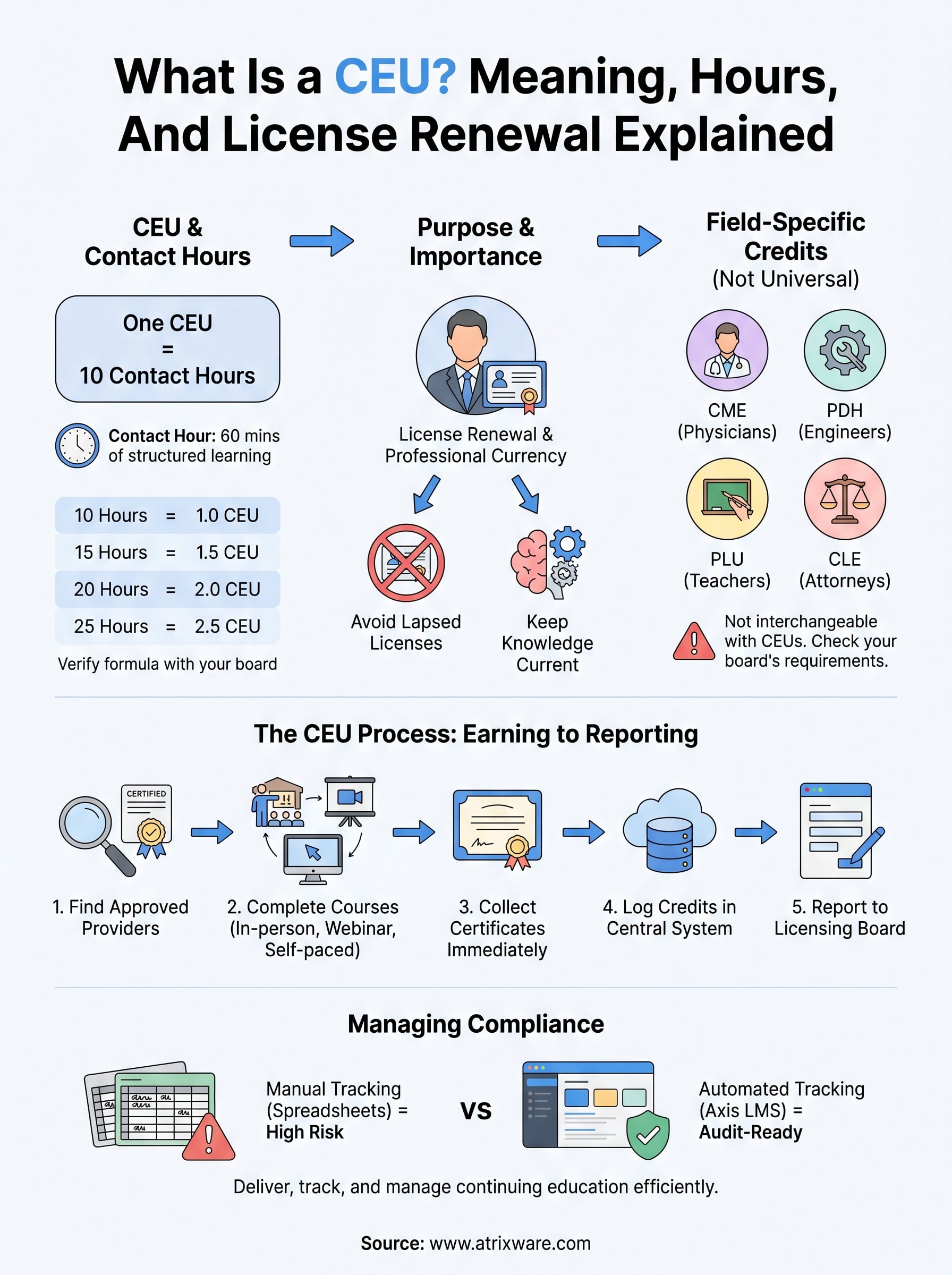
When people ask what is a CEU, the most accurate answer starts with a standard established by the International Association for Continuing Education and Training (IACET). A Continuing Education Unit is a nationally recognized unit of measurement that documents an individual’s participation in non-credit educational activities. One CEU equals exactly ten contact hours of instruction in a qualified program, giving licensing boards and professional organizations a consistent benchmark they can rely on when evaluating renewal applications.
How the contact hour formula works
A contact hour is one clock hour of supervised, instructor-led, or structured learning. So if you attend a two-day workshop that runs five hours each day, you accumulate ten contact hours, which equals exactly one CEU. Most licensing boards publish their renewal requirements in contact hours, in CEUs, or sometimes both, so you need to confirm which unit your specific credentialing body accepts before enrolling in any course. Registering for a program without checking that detail first is one of the most common reasons renewal applications get rejected.
Always verify with your licensing board whether they count credits in CEUs, contact hours, or a combination before registering for any continuing education course.
What a CEU is not
Despite how often the terms appear together, a CEU is not a college credit. Continuing education units do not count toward academic degrees, and you cannot transfer them to a university transcript. Some professionals get confused because universities often offer CEU-eligible courses through their continuing education departments, but completing those courses does not earn you undergraduate or graduate standing.
CEUs are also not a universal standard across every profession. Some fields use entirely different terminology: physicians earn Continuing Medical Education (CME) credits, engineers log Professional Development Hours (PDH), and teachers accumulate Professional Learning Units (PLU). These credits all serve the same general purpose of documenting ongoing learning, but they operate under separate approval systems, carry different hour equivalencies, and answer to different governing bodies. Treating them as interchangeable with standard CEUs can result in a rejected renewal application, which means starting the documentation process over from scratch.
Why CEUs matter for license renewal
Understanding what is a CEU matters most when your license comes up for renewal. Most licensing boards and professional associations treat CEU requirements as non-negotiable: meet the threshold within the renewal window or risk losing your credential. Consequences range from late fees and grace periods to a full lapse that forces you to reapply from scratch.
The renewal cycle and your compliance window
Every licensing body sets its own renewal period, typically one to three years depending on the profession. During that window, you must earn a specific number of CEUs and submit documentation before the deadline. Missing the cutoff can suspend your legal ability to practice, directly affecting your income and your standing with your employer.

If your license lapses, reinstatement often requires additional coursework, fees, and sometimes a full re-examination.
Your state’s licensing board publishes its exact CEU requirements and renewal deadlines online, so verifying those details at the start of each renewal cycle prevents last-minute surprises and rejected applications.
What happens when employers track compliance
For organizations managing teams of licensed professionals, individual renewal gaps create real operational risk. One lapsed license in a regulated environment can trigger an audit or expose the business to liability. Tracking CEU completion across staggered renewal cycles manually is exactly where errors accumulate fast.
Automated platforms that flag upcoming deadlines and log completed credits catch problems before they surface. When compliance data sits in one system, administrators can pull renewal reports on demand rather than chasing paper trails. That visibility turns license management into a routine, auditable process instead of a last-minute scramble.
How CEUs convert to contact hours
Once you understand what is a CEU at a conceptual level, the math itself is straightforward: one CEU equals ten contact hours. A contact hour represents one clock hour of structured, supervised learning where an instructor or facilitated content guides your participation. That definition holds whether the format is an in-person seminar, a live webinar, or an approved self-paced online course with a defined seat-time requirement.
The Basic Conversion Formula
The formula works in both directions. If your licensing board requires 1.5 CEUs, you need to complete 15 contact hours of approved instruction. If a course provider lists a program as 20 contact hours, that program awards 2.0 CEUs. Knowing how to move between the two units prevents enrollment mistakes and ensures every hour you spend in training counts toward your renewal.

| Contact Hours | CEUs Awarded |
|---|---|
| 10 | 1.0 |
| 15 | 1.5 |
| 20 | 2.0 |
| 25 | 2.5 |
Always confirm with your licensing board that a course’s contact hours are approved before you enroll.
When Fractions Apply
Most licensing requirements do not land on a round number. Your board might require 1.2 CEUs or 0.6 CEUs for a specific topic area, meaning 12 contact hours or 6 contact hours respectively. Providers offering shorter workshops commonly issue credit in fractions, so reading the course description tells you exactly what the provider certifies.
Tracking fractional credits carefully throughout your renewal cycle matters more than most professionals expect. A small rounding error or a missing record can leave you short of your threshold right before a deadline, forcing a last-minute course search under real time pressure.
How to earn, document, and report CEUs
Part of understanding what is a CEU is knowing that earning one is only half the task. You also need to document your participation correctly and report those credits to your licensing board in the format it accepts. Skipping either step can invalidate hours you already completed.
Finding approved providers
Your licensing board maintains a list of approved continuing education providers for your specific credential. Enrolling in a course outside that list, even an excellent one, typically means those hours do not count toward renewal. Check the board’s website before you register and confirm that the provider holds current accreditation.
A course’s topic relevance does not guarantee its approval status. Always verify accreditation directly with your licensing board.
Most professions accept a mix of formats including in-person workshops, live webinars, and self-paced online courses, as long as the provider is accredited and the course meets the required seat-time or contact hour standards. Some boards also cap the percentage of hours you can earn online, so read the fine print before you build your renewal plan entirely around digital options.
Keeping your documentation current
After completing a course, collect your certificate of completion immediately and store it in a dedicated folder rather than waiting until renewal time. Most boards audit a random sample of renewal applicants and require original documentation, so a missing certificate can hold up your entire application.
Logging each course in a central tracking system as you go prevents the scramble that happens when renewal deadlines approach and records are scattered across emails, desktops, and physical files.
CEU vs CE vs CME and other common credits
When you research what is a CEU, you quickly run into a cluster of similar abbreviations that professional training programs use inconsistently. CE (Continuing Education) is the broadest term, referring to any structured learning completed after your initial credential. CEUs are a specific, standardized unit of measurement within that broader CE category, so while every CEU involves continuing education, not every continuing education activity awards CEUs.
Confusing CE with CEU can lead you to enroll in a course that your licensing board does not recognize, wasting both your time and your money.
Field-Specific Credit Types
Different professions use entirely separate credit systems, and each one carries its own conversion formula, governing body, and reporting requirements. Knowing which system your profession uses before you enroll in any course prevents rejected renewal applications.
| Credit Type | Profession | Governing Body | Hours Per Unit |
|---|---|---|---|
| CME | Physicians | ACCME | 1 hour = 1 CME credit |
| PDH | Engineers | State licensing boards | 1 hour = 1 PDH |
| PLU | Teachers | State education agencies | Varies by state |
| CLE | Attorneys | State bar associations | 60-minute increments |
Why the Distinction Matters
Submitting the wrong credit type on a renewal application is a fast path to rejection, even if you completed more than enough hours of qualified learning. Your licensing board specifies exactly which credit type it accepts, and that specification is non-negotiable. Before you register for any course, confirm that the credits it awards match what your specific board requires, not just that the subject matter is relevant to your field.
Next steps to stay audit-ready
Now that you know what is a CEU, how contact hours convert, and which credit type your profession requires, the real work is building a system that keeps you prepared before an auditor asks for records. Start by pulling your current renewal deadline and calculating exactly how many credits you still need. Then verify that every course on your plan comes from an approved provider your licensing board recognizes.
Document every completed course immediately. Store certificates in one location and log credits as you earn them rather than waiting until the end of your renewal cycle. For organizations managing licensed professionals across multiple teams, manual tracking creates gaps that surface at the worst possible time.
Axis LMS handles CEU delivery, tracking, and reporting in one place, so your team stays audit-ready and compliant without extra paperwork. Take the LMS readiness quiz to find out where your training program stands today.
