
Continuing education meaning can vary depending on who you ask, a nurse renewing a license, a project manager earning a new credential, or an accountant staying current with tax law. But at its core, continuing education refers to any structured learning that happens after your initial degree or certification, designed to keep professionals competent and qualified in their field.
Understanding what continuing education actually involves, the different types, how Continuing Education Units (CEUs) work, and where it overlaps (or doesn’t) with professional development, matters if you’re responsible for training within your organization. Mismanaging it can mean expired certifications, compliance gaps, or wasted budget.
At Atrixware, we built Axis LMS with CEU tracking and compliance training management baked in, so organizations can deliver and monitor continuing education without spreadsheets or guesswork. This article breaks down exactly what continuing education means, the forms it takes, how CEUs are earned and tracked, and real examples across industries.
Why continuing education matters
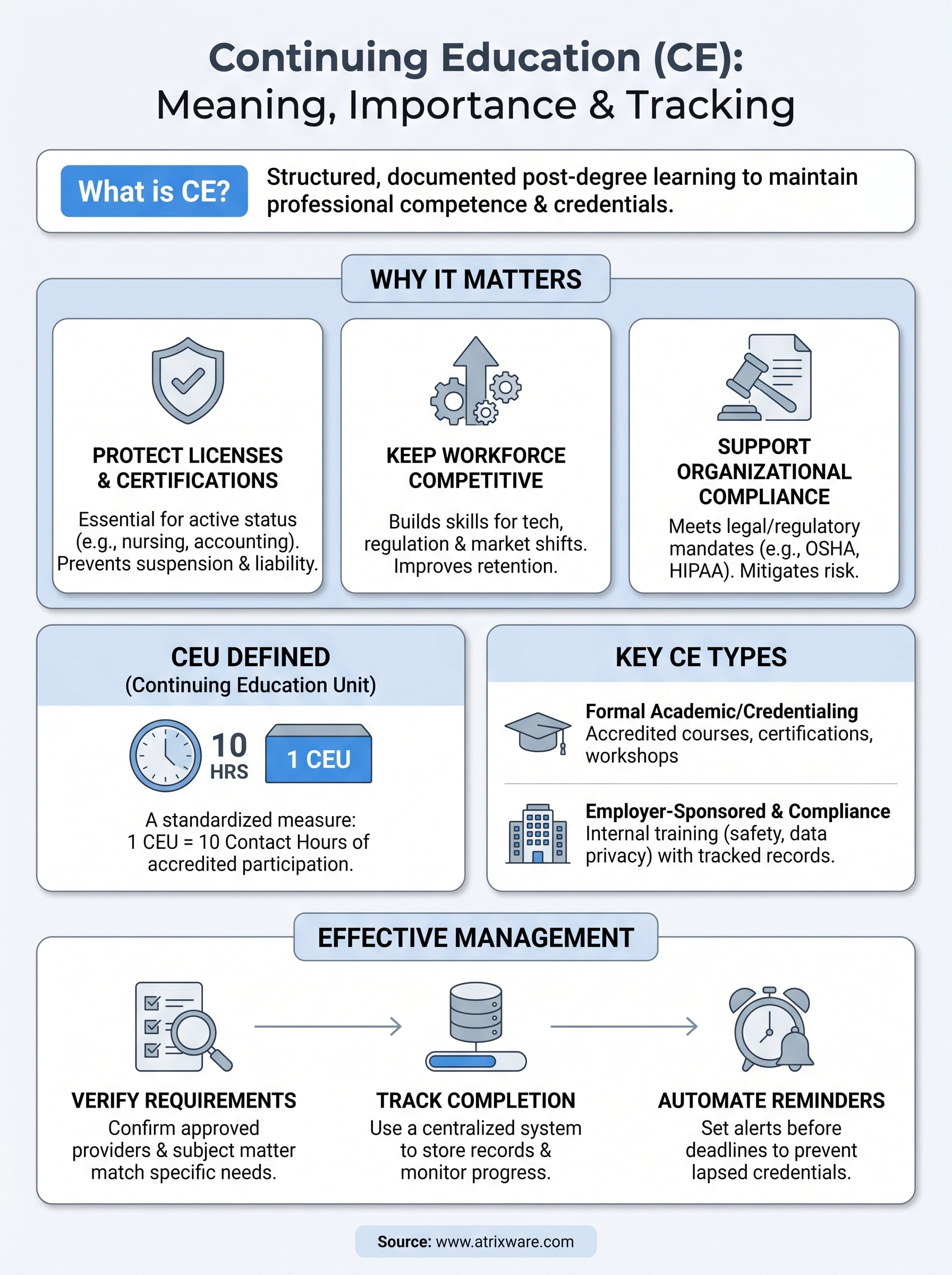
The continuing education meaning extends beyond personal growth. In many industries, completing a required number of hours or credits is a condition of keeping a license active, maintaining a certification, or staying compliant with regulations. If the professionals on your team let those credentials lapse, that creates real risk for your organization, not just for the individual.
It protects professional licenses and certifications
Many licensed professions, including nursing, accounting, law, and real estate, require practitioners to complete continuing education on a defined schedule. Regulatory bodies set these requirements to confirm that professionals stay current with changes in practice, law, or technology. If your organization employs licensed professionals, tracking their completion status is part of managing operational risk, not just an administrative task.
Letting a required continuing education deadline slip can mean a suspended license, which pulls your team member out of their role until they catch up.
A lapsed credential also creates liability exposure for your organization, particularly in regulated industries like healthcare and financial services. Staying ahead of renewal deadlines protects both the individual professional and the business they represent.
It keeps your workforce competitive
Beyond licensing, ongoing learning keeps your workforce capable of handling shifts in technology, regulations, and market conditions. Fields like cybersecurity, data management, and clinical care are changing constantly. Employees who don’t continue building skills fall behind in both knowledge and the practical tools their roles require.
From your perspective as a training or HR professional, supporting continuing education also affects retention. Research from Gallup has consistently shown that learning and development opportunities rank among the top factors employees consider when deciding whether to stay with an employer.
It supports organizational compliance
Some continuing education requirements exist at the organizational level, not just the individual level. OSHA safety training, HIPAA compliance, and FDA-regulated procedures all require documented, periodic training for your workforce. When a regulatory audit occurs, you need verifiable proof that the right people completed the right training at the right time, and that proof needs to be readily accessible.
- Track completion dates against renewal deadlines
- Store certificates and records in a centralized system
- Automate reminders before expiration dates hit
What counts as continuing education
Not every learning experience qualifies. The continuing education meaning in a professional context usually requires that the learning be structured, documented, and approved by a relevant accrediting or licensing body. Attending an industry webinar counts in some fields but not others. Reading a book on your own almost never qualifies.
Structured and accredited learning
To count toward a professional requirement, continuing education must typically come from an approved provider and result in documented proof of completion. This includes formal coursework, workshops, conferences, seminars, and online courses delivered by accredited institutions or recognized industry organizations.
If the program doesn’t come with a certificate of completion tied to a verified provider, it likely won’t satisfy a regulatory or licensing requirement.
Common formats that qualify as continuing education include:
- Instructor-led classes (in-person or virtual)
- Accredited online courses
- Industry conferences with documented attendance
- Employer-sponsored compliance training with verified records
What does not count
Activities like reading industry articles or attending informal team meetings are valuable, but they don’t qualify as continuing education in most professional contexts. The defining factor is verifiability: a regulator or certifying body needs a paper trail confirming what was completed, who delivered it, and when.
Your organization’s training records need to reflect this distinction clearly. Mixing informal learning with formally required training creates confusion during audits and puts your team at risk of appearing non-compliant even when the actual work has been done.
Types of continuing education and examples
The continuing education meaning shifts slightly depending on the setting, but the formats it takes are fairly consistent across industries. Understanding the different types helps you match the right learning format to your team’s specific requirements, whether those requirements come from a licensing board, a regulatory agency, or an internal skills gap.

Formal academic and credentialing programs
Formal continuing education comes through accredited universities, professional associations, and certification bodies. These programs award credits or credentials upon completion and are recognized by licensing boards. Examples include a registered nurse completing a pharmacology course through an accredited provider, or a CPA finishing a tax law update course approved by a recognized professional body.
Formal programs are the most likely to satisfy licensing renewal requirements because they come with verifiable credentials tied to recognized institutions.
- Graduate-level certificate programs
- Board-approved professional development courses
- Industry certification renewals (such as PMP, SHRM, or CPA recertification)
Employer-sponsored and compliance training
Your organization can also deliver continuing education directly, particularly for compliance-related requirements. OSHA safety training, HIPAA awareness updates, and FDA-regulated procedure training all fall under this category. These programs need documented delivery, tracked completion, and stored records to hold up under regulatory scrutiny.
Common examples in this category include:
- Annual harassment prevention training
- Food safety certification renewals
- GDPR and data privacy refresher courses
Both types require a reliable system to deliver, track, and report on completion so nothing slips through when audits or renewal deadlines arrive.
CEUs explained and when you need them
A Continuing Education Unit, or CEU, is a standardized measure used to quantify and document completed continuing education. Understanding the continuing education meaning in terms of units helps you manage compliance requirements systematically, rather than tracking hours and credits in an inconsistent way across different team members or programs.
What one CEU represents
One CEU equals 10 contact hours of participation in an organized, accredited continuing education program. So if a team member completes a 20-hour compliance course, they earn two CEUs. This standardization exists so that licensing boards, employers, and regulatory agencies can evaluate training completion using a consistent, universally recognized measure rather than comparing loosely defined "hours" across different providers.

The contact-hour standard means that only structured, supervised learning time counts toward your CEU total, not preparation, self-study, or informal review.
When your team needs to track CEUs
Your team needs formal CEU tracking whenever licenses or certifications have specific renewal requirements tied to documented learning hours. Nurses, pharmacists, social workers, engineers, and educators all face these requirements on fixed renewal cycles, typically every one to three years.
Even in industries where CEUs are not legally mandated, many professional certification programs, such as PMP or SHRM credentials, require a defined number of CEUs to maintain active status. If your organization manages employees holding these credentials, tracking their CEU progress against renewal deadlines protects both their certifications and your organization’s ability to operate without gaps in qualified staff.
How to choose and track continuing education
Choosing the right program starts with understanding what your specific requirements actually are. The continuing education meaning in your context depends on which licensing boards, regulatory agencies, or certifying bodies your team answers to, so verify those requirements directly before committing budget to any program.
Match the program to the requirement
Not every accredited course satisfies every licensing requirement. Before enrolling your team in a program, confirm the provider is approved by the relevant board or agency and that the course covers the required subject matter. A compliance training course that earns CEUs from one body may not transfer to another.
- Check the licensing board’s approved provider list
- Confirm the number of CEUs or hours the course awards
- Verify the subject matter aligns with the specific renewal requirement
Build a system for tracking completion
Tracking completion manually creates gaps. A centralized training system lets you store records, monitor progress, and automate reminders before renewal deadlines arrive. When an audit happens, you need instant access to documented proof of completion for every team member, not a folder of scanned certificates scattered across email inboxes.
Automating deadline reminders reduces the risk of a credential lapsing simply because a renewal date was overlooked.
Set up your tracking system to capture the program name, provider, completion date, hours or CEUs earned, and the credential it supports for each learner. That structure makes reporting fast and keeps your team’s compliance status visible at all times.
Final takeaways
The continuing education meaning is straightforward once you break it down: structured, accredited learning that keeps professionals qualified, licensed, and current in their fields. What gets complicated is managing it across a team, especially when renewal deadlines, approved providers, and CEU requirements differ by role, license, and regulatory body.
Your organization needs more than general awareness of what continuing education is. You need a system that tracks completion, stores records, and alerts your team before credentials lapse. Spreadsheets and manual follow-up create the exact gaps that audits expose.
Axis LMS gives you the tools to deliver, track, and report on continuing education from one platform, with CEU tracking and compliance reporting built in. If you’re ready to see how it fits your training program, start your free Axis LMS admin demo and explore the features your team needs.
