Someone in your organization owns the LMS, whether that’s official or not. Courses need building, learner data needs tracking, integrations break, and compliance deadlines don’t wait. If you’ve been asked to fill that role, or you’re hiring for it, you need a clear picture of what a learning management system administrator actually does day to day, not just a job title on paper.
At its core, a learning management system lms administrator manages the platform that delivers, tracks, and reports on training across a company. That means configuring courses, managing user accounts, running compliance reports, troubleshooting SSO or integration issues with tools like Salesforce or BambooHR, and making sure learners actually complete what they’re assigned. The role sits somewhere between IT, HR, and instructional design, and the exact mix depends on the organization.
This article breaks down the responsibilities you’ll own, the technical and soft skills that separate a good administrator from a struggling one, and the career path if you’re looking to grow into or beyond this role. We’ll also cover how the right LMS, like Axis LMS, can make this job easier rather than harder.
Why the LMS administrator role matters
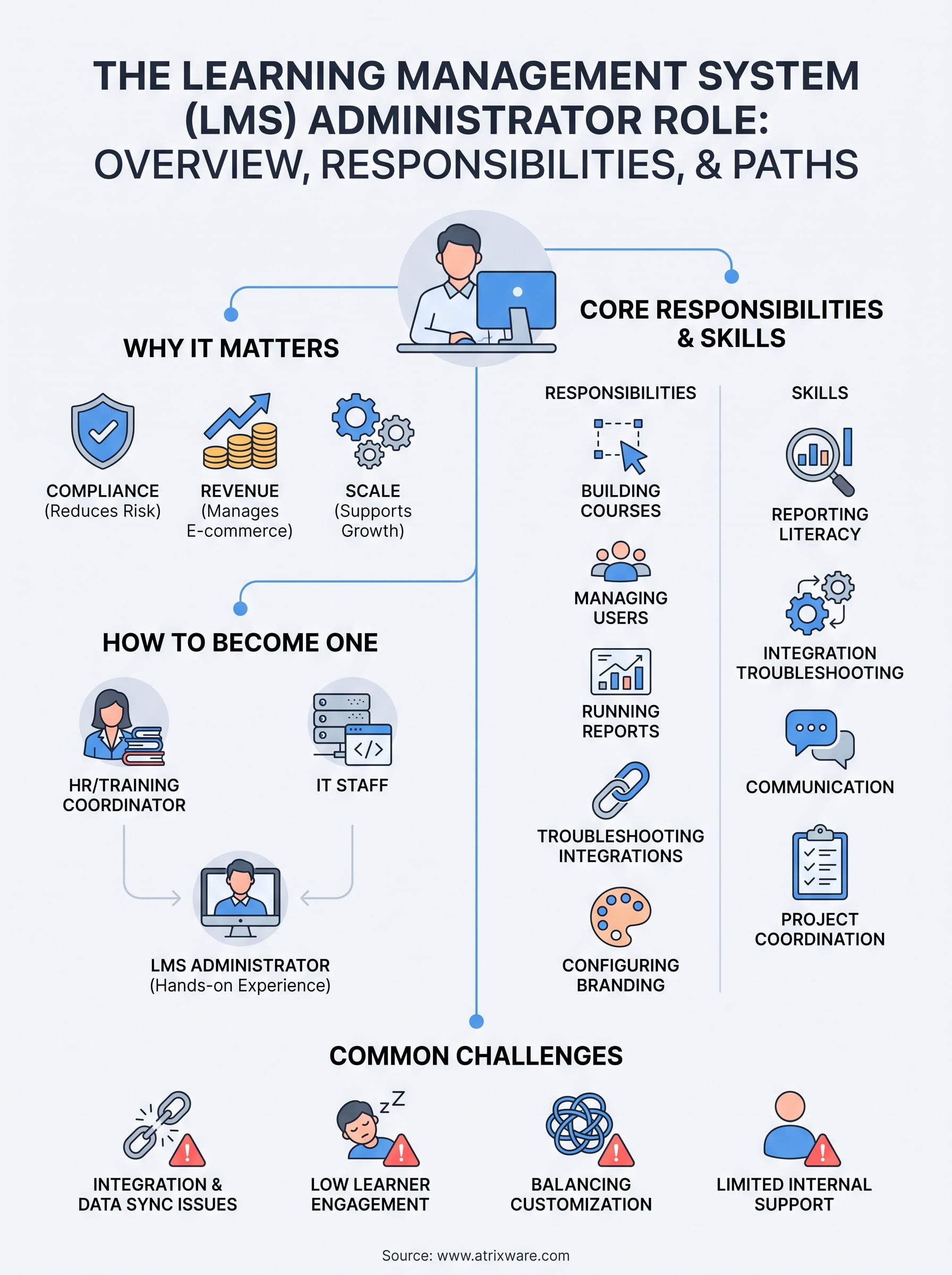
Organizations lose money when training breaks down, and it usually breaks down quietly. A course nobody updates, a compliance certification that expires without anyone noticing, a new hire who never gets assigned onboarding modules. These aren’t dramatic failures, but they add up to lost productivity, compliance exposure, and frustrated employees. The learning management system administrator is the person who catches these problems before they become expensive.
Compliance is where this becomes obvious fastest. If your company operates under regulations like GDPR or FDA 21 CFR Part 11, someone has to prove that specific employees completed specific training by specific dates. Auditors don’t accept "we think everyone did the training." They want reports, timestamps, and completion records pulled directly from the system. An administrator who understands the reporting tools inside a platform like Axis LMS can generate that proof in minutes. Without that person, compliance tracking falls apart into spreadsheets and email chains, and that’s exactly the kind of gap regulators flag. The SHRM guidance on training compliance makes clear how much liability sits on accurate recordkeeping, not just on running the training itself.
Revenue depends on this role too, more than most people realize. Companies that sell training to customers or channel partners need someone managing the e-commerce side: seat licenses, pricing tiers, access permissions. A misconfigured course catalog can mean lost sales or, worse, paying customers who can’t access what they bought. Administrators handle that plumbing so the business side keeps running.
An LMS without a dedicated administrator is a system that slowly drifts out of sync with the business it’s supposed to serve.
Scale is the other piece. A company with 50 employees might manage fine with someone splitting attention between the LMS and other HR duties. A company with 5,000 employees across multiple departments, each with different training requirements, integrations to Salesforce or BambooHR, and SSO through Okta or Azure, needs a dedicated administrator or a small team. The bigger the organization, the more the LMS becomes infrastructure, not just software, and infrastructure needs someone accountable for keeping it running.
How to become an LMS administrator
Nobody grows up dreaming of becoming a learning management system administrator. Most people land here sideways, from HR, IT, or training coordination, and pick up the platform-specific skills on the job. There’s no single degree that qualifies you, which means the path is more about accumulating the right experience than checking boxes on a resume.
Common entry points
HR generalists and training coordinators often move into this role because they already understand the training content and compliance requirements; they just need to learn the software layer. IT staff take the opposite route, arriving with technical skills like SSO configuration and API troubleshooting, then learning the instructional side. Either background works, but hands-on platform experience matters more than where you started.
Building the right skill set
If you’re aiming for this role deliberately, focus on:
- Getting comfortable inside an actual LMS, not just reading about one. Ask your current employer for admin access to a sandbox environment.
- Learning basic reporting and data export, since every LMS administrator job leans heavily on producing compliance and completion reports.
- Understanding integrations at a conceptual level, even if you’re not the one writing API calls.
- Picking up project management fundamentals, since rolling out new courses or system updates requires coordinating across departments.
You don’t need a certificate to become an LMS administrator, you need proof you can keep a training system running without anyone noticing the effort.
Some professionals pursue credentials through organizations like the Association for Talent Development to formalize their expertise, but employers generally value demonstrated experience over formal certification.
Core responsibilities and skills of an LMS administrator
Every learning management system administrator juggles a mix of technical upkeep and people-facing support. On a typical day that means building courses, assigning them to the right groups, fixing a broken SSO login, and pulling a completion report for a manager who needs it by noon. The job rewards someone who can move between a spreadsheet and a support ticket without losing focus.
Day-to-day responsibilities
Administrators own a predictable set of tasks, even though the urgency changes daily:
- Building and updating courses using drag-and-drop tools
- Managing user accounts, groups, and permissions
- Running and scheduling compliance and progress reports
- Troubleshooting integration issues with HR or CRM systems
- Configuring branding and the learner-facing interface
- Supporting e-commerce settings for sold or licensed training
Skills that matter most
Good administrators blend technical fluency with communication skills, since they explain system problems to people who don’t think in system terms.
| Skill area | Why it matters |
|---|---|
| Reporting and data literacy | Proves compliance and tracks learner progress |
| Integration troubleshooting | Keeps SSO and HR/CRM connections working |
| Communication | Translates technical issues for non-technical staff |
| Project coordination | Manages course rollouts across departments |
The best LMS administrators aren’t the most technical people in the room, they’re the ones who keep the system invisible to everyone else.
Strong administrators also develop a habit of documenting fixes. Undocumented workarounds create bottlenecks the moment that person takes a vacation.
Common challenges LMS administrators face
Even experienced administrators run into problems that don’t show up in a job description. Knowing these ahead of time helps you plan for them instead of getting blindsided.

Integration and data sync issues
Broken connections between the LMS and HR or CRM systems cause more support tickets than anything else. An employee changes departments in BambooHR, but the LMS doesn’t reflect it, so they lose access to required courses. A learning management system administrator has to catch these sync failures fast, since they often go unnoticed until someone misses a compliance deadline. Regularly auditing integration logs, rather than waiting for complaints, keeps small glitches from turning into audit findings.
Low learner engagement
Courses sitting unfinished in someone’s queue is a constant headache. Reminder emails only go so far. Administrators who dig into completion data can spot patterns, like a course with a confusing first module, and fix the content rather than just nagging learners harder.
Most LMS problems aren’t technical failures, they’re gaps between what the system can do and what anyone bothered to configure.
Balancing customization with maintainability
Branding and workflow customization make a platform feel like it belongs to your organization, but heavy customization without documentation creates a mess for whoever inherits the system later. According to NIST’s guidance on system documentation, undocumented configuration changes are a leading cause of operational risk in any managed software system, not just training platforms.
Limited internal support
Many organizations still treat this as a part-time responsibility bolted onto someone’s existing job. That leaves one person accountable for compliance, integrations, and learner experience, with no backup when they’re out sick or on vacation.
The path ahead for LMS administrators
The role keeps growing in scope as companies lean harder on training for compliance, revenue, and employee retention. A learning management system administrator who once managed course uploads now handles integrations, e-commerce, and reporting that executives actually read. That trajectory isn’t slowing down, and organizations that treat this as a real position, not an afterthought, get more value out of their training investment.
Whether you’re stepping into this role or building out your team, the platform you administer determines how much of your day gets eaten by workarounds versus actual improvement. A system built for administrators, with clear reporting, real integrations, and manageable customization, changes what this job looks like day to day.
If you want to see what that looks like in practice, sign up for an Axis LMS admin demo and walk through the tools yourself before you commit to anything.
