Someone completes a compliance training module, signs off electronically, and moves on. But if that signature were ever challenged in court, would it actually hold up? The question are electronic signatures legally binding surfaces constantly, especially for organizations that depend on them for training acknowledgments, policy agreements, and regulatory certifications.
The short answer is yes. Federal legislation like the ESIGN Act and the Uniform Electronic Transactions Act (UETA) give electronic signatures the same legal standing as handwritten ones. But that legal weight comes with conditions. Specific criteria around consent, intent, and record keeping must be met, or an e-signature can be disputed and potentially thrown out.
At Atrixware, our Axis LMS supports compliance workflows, including those aligned with FDA 21 CFR Part 11, where electronic sign-offs on training completions and policy acknowledgments are routine. That’s exactly why this topic hits close to home for us and for the organizations we serve. This article covers the laws behind electronic signature validity, what makes one enforceable, the types of e-signatures that exist, and how to build a paper trail that holds up when it matters most.
What counts as an electronic signature
The legal definition is broader than most people expect. Under the ESIGN Act, an electronic signature is defined as any electronic sound, symbol, or process that is attached to or logically associated with a contract or record and executed by a person with the intent to sign. That single sentence covers a wide range of digital actions, which is exactly why understanding the definition matters when you are building compliance workflows or managing training acknowledgments across your organization.
The legal definition in practice
When courts and regulators evaluate whether a signature qualifies, intent is the central factor, not the format. A person clicking "I Agree," typing their name into a form field, or drawing a signature on a touchscreen can all demonstrate valid intent to sign. What matters is that the action was deliberate and connected to the specific record being signed, not performed accidentally or out of context. The technology used to capture the signature is secondary to the evidence that a real person chose to sign.
The ESIGN Act does not require a specific technology or format. Any electronic process that captures a person’s intent to sign can legally serve as a valid signature.
Common forms of electronic signatures
Electronic signatures appear in many formats across business workflows. Understanding the range helps you choose the right method for each use case and ensures your records can withstand scrutiny if a signature is ever challenged. When organizations ask whether are electronic signatures legally binding, part of the answer depends on whether the format used actually captures and preserves that intent.
Here are the most common forms you will encounter:
- Typed name: The signer types their full name into a designated signature field at the end of a digital form or document.
- Drawn signature: The signer uses a mouse, stylus, or finger to replicate a handwritten signature on screen.
- Clicked acceptance: The signer selects a checkbox or clicks a button such as "I Agree" to confirm consent to specific terms.
- Uploaded image: The signer attaches a scanned image of their handwritten signature to a digital document.
- One-time passcode confirmation: The signer receives a code via email or SMS, then enters it to authenticate their identity and confirm the signature action.
Signature tiers: simple, advanced, and qualified
Not all electronic signatures carry the same level of security or verification. Three distinct tiers exist, and the right choice depends on the sensitivity of the document and the regulatory requirements your organization must meet.

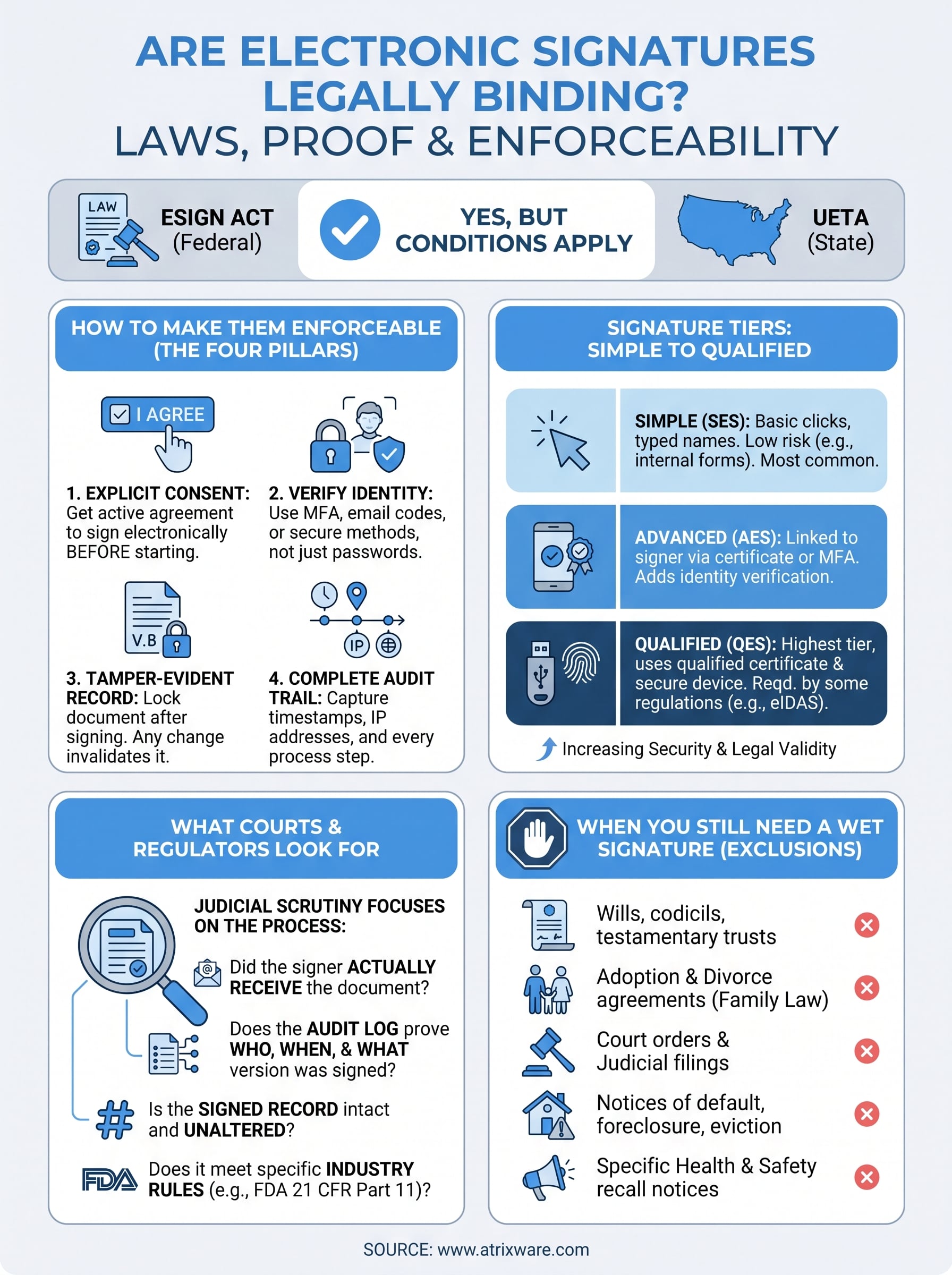
Simple electronic signatures (SES) are the most common type. They include typed names, checkboxes, and basic click-to-sign actions, and they work well for internal training acknowledgments, onboarding forms, and routine policy agreements where the risk of a legal dispute is relatively low. Most day-to-day corporate training records fall into this category.
Advanced electronic signatures (AES) add a layer of identity verification by linking the signature to the signer through a certificate or multi-factor authentication process. Qualified electronic signatures (QES) represent the highest tier, created using a qualified certificate and a secure signature creation device. QES carries the strongest legal presumption of validity and is required by certain regulations, including the EU’s eIDAS framework. While QES is less common in standard US business workflows, organizations operating internationally or under strict data regulations may need to account for it when designing their signing processes.
Why electronic signature validity matters
When your organization collects hundreds or thousands of digital sign-offs each year, the legal standing of each one is not a theoretical concern. A single disputed signature on a training acknowledgment, policy agreement, or compliance certification can expose your organization to penalties, litigation, or failed audits. Understanding whether are electronic signatures legally binding in your specific context is what separates a defensible compliance record from a liability.
The risk of a disputed signature
A signature gets challenged when a party claims they never signed, did not understand what they were agreeing to, or that the process itself was flawed. If your organization cannot produce clear evidence of who signed, when, and under what conditions, you lose the ability to enforce the agreement or defend your compliance position. That puts contracts, employment agreements, and regulatory certifications all at risk simultaneously.
A disputed e-signature does not just threaten one document. It can call into question your entire signing process and every record produced by it.
Courts look at the totality of the signing process, not just the signature itself. Audit trails, identity verification steps, and consent records become the difference between a signature that holds and one that gets thrown out. Organizations that treat e-signatures as a formality rather than a legal record often find themselves unable to prove basic facts when a dispute arises.
Compliance and recordkeeping consequences
Regulated industries face an additional layer of exposure. In sectors governed by FDA 21 CFR Part 11, HIPAA, or financial regulations, electronic signatures on training records are not optional formalities. They are legally required proof that employees received, understood, and acknowledged specific training content. A signature that cannot be validated means the training record itself may not satisfy the regulatory requirement, even if the training was completed.
Your recordkeeping system needs to capture more than the signature image. Timestamps, IP addresses, user authentication data, and document version information all contribute to the integrity of a signed record. Without these supporting details, even a technically valid signature can fail to meet the evidentiary standards that regulators and courts apply.
US e-signature laws: ESIGN Act and UETA
Two overlapping legal frameworks answer the core question of are electronic signatures legally binding in the United States. The Electronic Signatures in Global and National Commerce Act (ESIGN Act), signed into federal law in 2000, established that electronic signatures carry the same legal weight as handwritten signatures in interstate and foreign commerce. The Uniform Electronic Transactions Act (UETA), adopted by 47 states and the District of Columbia, covers intrastate transactions and mirrors the ESIGN Act’s core principles. Together, these two laws form the backbone of e-signature legality across the country.
The ESIGN Act: what it actually says
The ESIGN Act applies to contracts and transactions in interstate commerce, meaning any agreement that crosses state lines. It prohibits courts and agencies from denying legal effect to a signature simply because it exists in electronic form. The law also requires that consumers actively consent to receive documents electronically before a business can initiate an e-signature process with them. That consent requirement is frequently overlooked, but it is a direct condition of validity under the statute.
Failing to obtain consumer consent before collecting an electronic signature can invalidate the entire signing process under the ESIGN Act.
The law also gives your organization flexibility. It does not mandate a specific technology, platform, or signature format. Any electronic process works, provided it captures the signer’s intent and preserves the integrity of the associated record throughout its lifecycle.
How UETA fills in the gaps
UETA covers transactions that occur entirely within a single state, filling the jurisdictional space the ESIGN Act does not reach. While the two laws are closely aligned, UETA places additional emphasis on the mutual agreement of both parties to conduct business electronically. If one party has not agreed to use electronic records or signatures, UETA does not force the process on them, which means your workflow needs to confirm that agreement upfront.
States that have not adopted UETA, including New York, Illinois, and Washington, maintain their own standalone electronic signature statutes. If your organization operates across multiple states, you need to confirm which law governs each transaction to ensure your signing process meets the correct legal standard in every jurisdiction where you operate.
How to make e-signatures enforceable
Knowing that are electronic signatures legally binding is a settled legal question does not automatically protect you. The law gives e-signatures validity in principle, but enforceability depends on the process you build around them. Four specific practices determine whether your signatures will hold up in a contract dispute, a regulatory audit, or litigation.
Capture explicit consent before the signing process begins
Consent is not optional under the ESIGN Act. Before you collect a signature electronically, the signer must actively agree to conduct the transaction electronically. A passive assumption that someone accepts electronic documents because they are using your platform does not satisfy this requirement. Your process should present a clear, separate consent step where the person confirms they are willing to sign digitally, and your system should log that confirmation with a timestamp.
Skipping the consent step does not just weaken the signature. It can invalidate it entirely under federal law.
Verify the signer’s identity at the point of signing
A signature only holds up if you can prove who actually signed the document. Basic username and password authentication is often insufficient for high-stakes records. Layer in multi-factor authentication, one-time passcodes, or email verification so your records show that the person who signed is the person your account data identifies. This step becomes especially important for training acknowledgments in regulated industries, where the signer’s identity is as important as the signature itself.
Connecting the authentication method directly to the signature event in your system logs strengthens your position considerably. Your records should show the authentication step, the time it occurred, and its direct link to the specific document signed.
Lock the document and preserve the full record
After someone signs, the document must be tamper-evident. Any modification to the signed document after the fact, without a clear versioning trail, can give a challenging party grounds to dispute the entire record. Your platform should generate a finalized, locked version of the document at the moment of signing and store it alongside the complete audit log. Timestamps, IP address data, and document hash values all contribute to a record that reflects exactly what was signed and when.
How to prove an e-signature in court
If a signed document is ever disputed, your signing process becomes the evidence. Knowing are electronic signatures legally binding in principle is not enough. You need a complete, verifiable record of every step that led to the signature, because courts evaluate the process behind the signature just as closely as the signature itself.
Build an audit trail that tells the full story
Your audit trail is the most important asset you have in a court challenge. It needs to capture the signer’s identity, the exact timestamp, the IP address, the authentication method used, and the document version that was signed. Each of these data points answers a specific question a judge or opposing counsel is likely to raise: Was this the right person? Did they sign this specific version? When did it happen?

An audit trail without timestamps and identity verification is not a defense. It is a gap that opposing counsel will exploit.
Store the audit log separately from the document itself so that a modification to the document does not compromise the integrity of the log. Your records should be exportable in a format that can be presented clearly to a court or regulatory body without requiring technical interpretation.
What courts look for beyond the signature itself
Courts do not evaluate an e-signature in isolation. Judges look at the surrounding context, including whether the signer received a copy of the signed document, whether they had a reasonable opportunity to review it before signing, and whether your platform gave them a clear way to withdraw consent.
Two additional factors carry significant weight. First, evidence that the signer received and opened the document before signing, such as an email delivery receipt or a platform access log, strengthens your position by showing the person had actual notice. Second, a finalized, [tamper-evident version of the document](https://www.training-central.net/2026/05/13/google-docs-electronic-signature/) with a hash value or equivalent integrity check demonstrates that nothing changed after the signature was applied. Courts treat these records as proof that the signed version matches what your system stored, which closes the most common line of attack in signature disputes.
When you still need a wet signature
Even though are electronic signatures legally binding is settled law for the vast majority of transactions, both the ESIGN Act and UETA carve out specific document categories where electronic signatures carry no legal weight at all. Knowing these exclusions before you build any signing workflow prevents you from collecting records you cannot enforce, and discovering that gap only when something goes wrong.
Categories the law explicitly excludes
The ESIGN Act lists certain document types that fall entirely outside its scope, regardless of how sophisticated your electronic signing platform is. Checking your document type against this list should be the first step in any signing process design, not an afterthought.
The most common excluded categories include:
- Wills, codicils, and testamentary trusts: Courts require wet signatures to establish authenticity and prevent fraud in estate documents.
- Adoption and divorce agreements: Family law documents, including those related to child custody and guardianship, typically require handwritten signatures under state law.
- Court orders and judicial filings: Official documents issued by or submitted to courts remain outside the scope of electronic signature law in most jurisdictions.
- Notices of default, foreclosure, or repossession: Consumer protection rules require these notices in formats that leave no ambiguity about delivery or acknowledgment.
- Health and safety recall notices: Product recall communications tied to consumer safety must follow notification standards that currently require physical documentation in most states.
If your document falls into any of these categories, no electronic signature platform makes it enforceable. The law does not bend on these exclusions.
When regulators and counterparties require wet signatures
Some transactions are not technically excluded by federal law but still carry practical expectations of wet signatures from regulators, government agencies, or foreign counterparties. Organizations working with international partners or federal procurement contracts should confirm signing requirements directly rather than assuming their standard electronic process applies across every context.
Real estate transactions also occupy complicated legal ground. While many states now permit electronic signatures on purchase agreements, notarized documents and recorded deeds often still require a wet signature alongside the notary’s physical stamp. The specific requirement depends on the state where the property is located, so verifying local rules before using a digital process for high-value property transactions is essential. Building a short review step into your contract workflow that flags document type and jurisdiction catches these exceptions before they become problems.
Conclusion
The answer to are electronic signatures legally binding is yes, but the strength of that legal standing depends entirely on how you build and document your signing process. Federal law under the ESIGN Act and UETA gives digital signatures the same weight as handwritten ones, provided you capture consent, verify identity, and maintain a complete audit trail. Skip any of those steps, and a valid signature can become a disputed one.
For organizations managing training acknowledgments, compliance certifications, and policy agreements, getting this right is not optional. Your records need to prove who signed, what they signed, and when, so that every signature you collect holds up when it counts.
If you are evaluating whether your current training platform supports the recordkeeping requirements that make e-signatures enforceable, take our LMS readiness quiz to find out where you stand.
