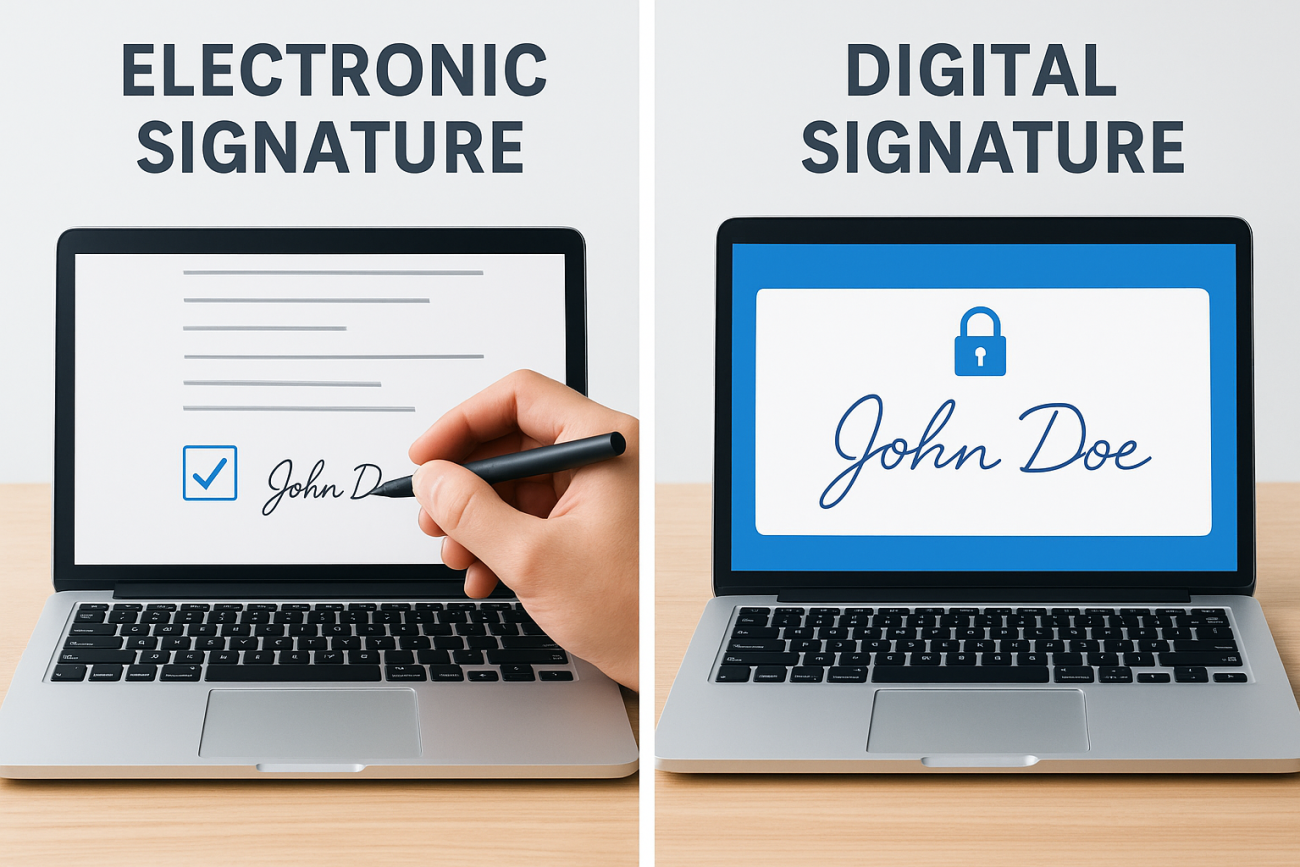
The terms electronic signature vs digital signature get used interchangeably all the time, but they’re not the same thing. One is a broad category; the other is a specific, cryptography-based technology. Mixing them up can create real problems, especially when regulatory compliance and legal validity are on the line.
For organizations managing training programs, certifications, and compliance workflows, the kind we build Axis LMS to support, knowing which signature type applies to which situation matters. A training completion acknowledgment might only need a simple electronic signature, while an FDA 21 CFR Part 11 compliance record could demand the stronger verification a digital signature provides.
This article breaks down the core differences between electronic and digital signatures, covering how each works, where each one fits in a business context, and what to consider when choosing between them.
Why the difference matters for business and compliance
Most people treat the electronic signature vs digital signature distinction as a minor technical detail, but for compliance-driven organizations, it directly affects legal enforceability and audit readiness. Regulators, courts, and auditors don’t all accept every type of signature equally. Choosing the wrong one for a high-stakes document can invalidate records, expose your organization to liability, or cause you to fail a regulatory audit outright.
The type of signature you use determines more than convenience. It determines whether your records hold up under scrutiny.
Legal and regulatory implications
Different industries operate under different legal frameworks that specify what counts as a valid signature. In the United States, the ESIGN Act and UETA broadly permit electronic signatures for most commercial transactions, but neither mandates a specific technology. That means a typed name in an email might qualify in one context and fall short in another. Regulated industries like pharmaceuticals, finance, and healthcare often require signatures that carry stronger authentication and tamper-evidence, which is where digital signatures become necessary rather than optional.
Your compliance team needs to identify which regulations apply to each document type before deciding on a signature method. A training acknowledgment for general onboarding sits in a very different risk category than a batch release record governed by FDA 21 CFR Part 11. Getting this right upfront saves significant remediation work later.
Business risk and audit trails
Beyond legal requirements, audit trails and non-repudiation are practical concerns for any organization that handles sensitive records. If a dispute arises over whether an employee completed a required training or acknowledged a policy change, the strength of your signature evidence determines how defensible your position is.
Weak signature records create gaps that auditors and opposing counsel will notice immediately. Picking the right method from the start means your records are defensible by design, not patched together after the fact.
What an electronic signature is
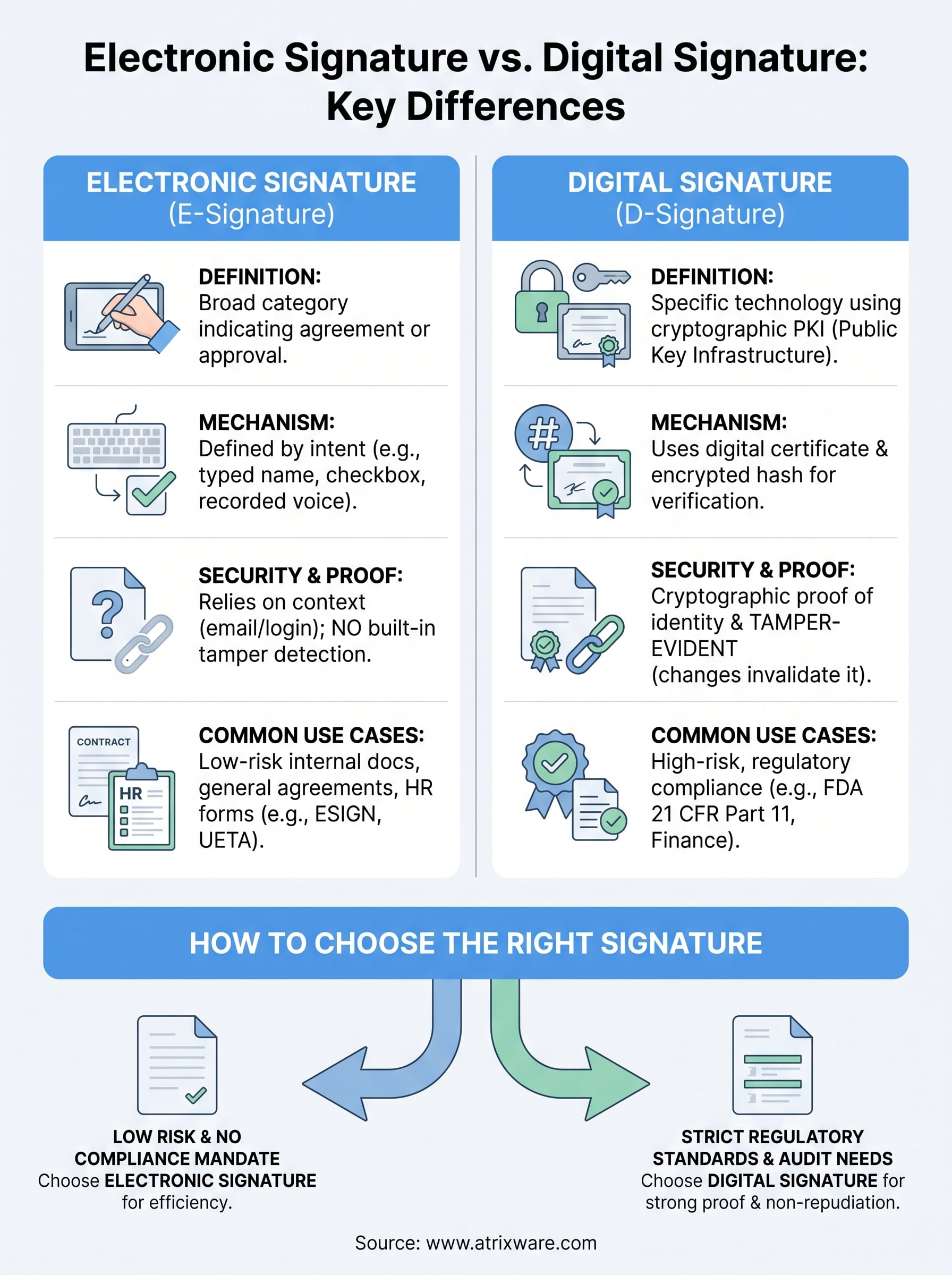
An electronic signature is any digital method a person uses to indicate agreement or approval on a document. That covers a wide range. A typed name at the bottom of a form, a finger-drawn signature on a tablet, a checked checkbox, or even a recorded voice consent can all qualify as an electronic signature under laws like the ESIGN Act. The defining characteristic is intent: the signer deliberately uses that action to signal agreement.
Electronic signatures are defined by intent, not by the technical mechanism behind them.
Common forms and practical uses
When you compare electronic signature vs digital signature options for your organization, you’ll find that electronic signatures handle the majority of everyday business needs well. Signing HR onboarding forms, vendor contracts, training acknowledgments, and policy confirmations all fall within the scope of a standard electronic signature. Most e-signature platforms capture a timestamp and IP address as basic supporting evidence, which is enough for many routine documents.
Electronic signatures fit best in lower-risk situations where the signer’s identity is already confirmed through another verification method, such as a login to your learning management system or a verified email account.
What a digital signature is
A digital signature is a specific type of electronic signature that uses public key infrastructure (PKI) cryptography to verify the signer’s identity and confirm a document hasn’t been altered after signing. Unlike a basic electronic signature, a digital signature generates a unique encrypted fingerprint, called a hash, that ties directly to both the document and the signer’s certificate. If anyone changes even a single character after signing, that hash becomes invalid immediately.
A digital signature doesn’t just record intent, it provides cryptographic proof of who signed and whether the document was tampered with.
How digital signatures work in practice
When you apply a digital signature, a trusted Certificate Authority (CA) issues a digital certificate that validates your identity before you sign anything. That certificate, combined with the encrypted hash, creates a verifiable chain of evidence that auditors and courts can independently verify.

Regulated industries rely on digital signatures because they meet strict standards like X.509, which underpin enterprise and government authentication systems. In the electronic signature vs digital signature comparison, this cryptographic verification layer is what separates a basic acknowledgment from a fully auditable, tamper-evident record.
Key differences: security, identity, and proof
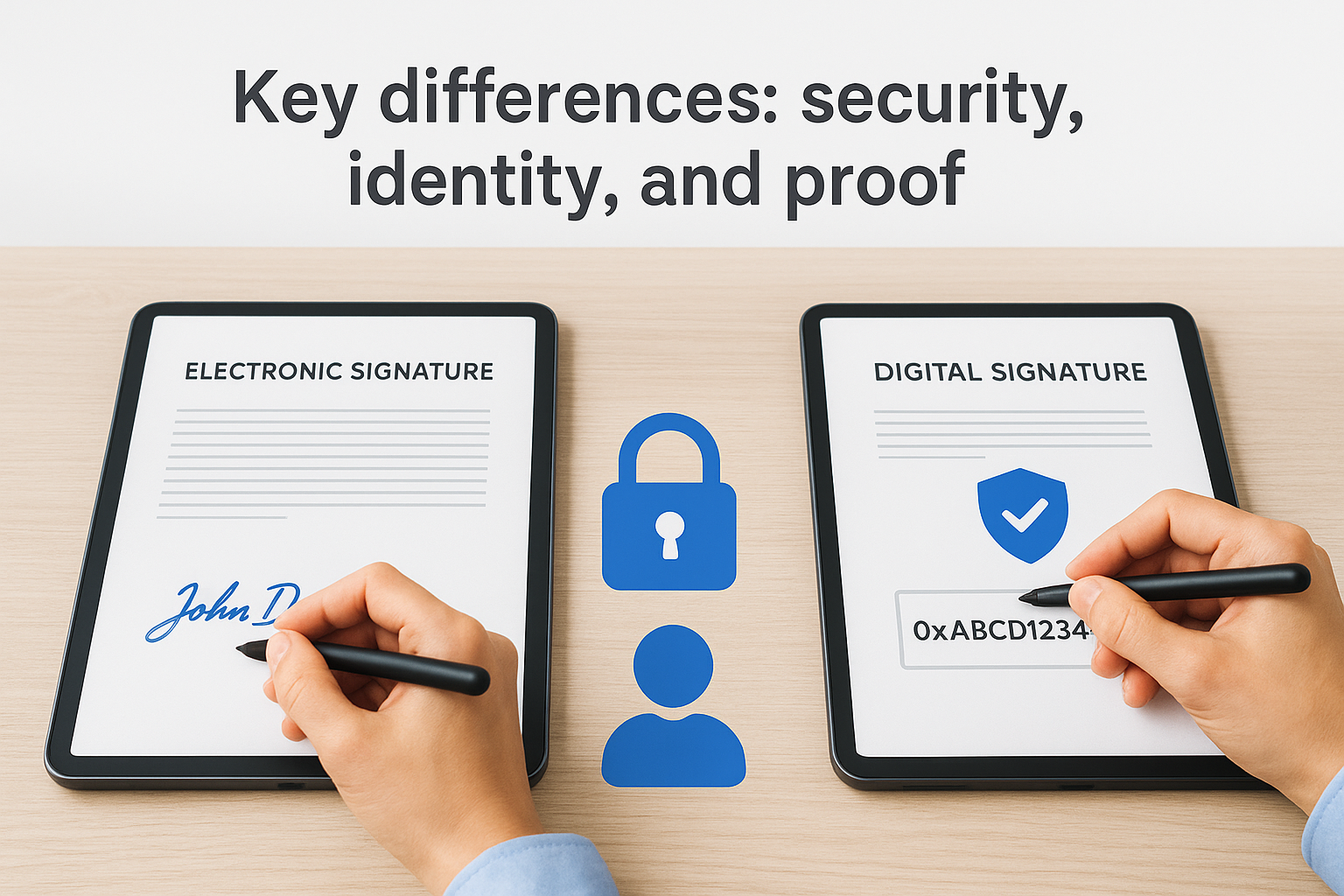
When you stack electronic signature vs digital signature side by side, three factors separate them clearly: how each handles security, how each confirms identity, and what kind of proof each produces for auditors or courts.
Security and tamper detection
A basic electronic signature provides no built-in mechanism to detect document changes after signing. If someone edits a signed PDF, the signature remains visually present but carries no technical alarm. A digital signature, by contrast, uses cryptographic hashing to invalidate itself the moment the document content changes.
This tamper-detection gap is the single biggest technical difference between the two.
Identity verification
Electronic signatures rely on contextual evidence like email confirmation or platform login to establish who signed. Digital signatures attach a Certificate Authority-issued credential directly to the signature itself, so the signer’s verified identity travels with the document permanently.
Legal proof and non-repudiation
Your ability to prove authenticity in a dispute depends heavily on which method you used. Digital signatures support non-repudiation, meaning the signer cannot credibly deny having signed because the cryptographic certificate is tied to their verified identity. Electronic signatures satisfy legal requirements in many situations but may require supplementary evidence to reach the same standard of proof.
How to choose the right signature for each document
Your starting point in the electronic signature vs digital signature decision should be the risk level and regulatory requirements tied to each document. Low-risk documents with no specific compliance mandate, like internal policy acknowledgments or routine vendor agreements, rarely need more than a basic electronic signature. Documents subject to strict regulatory oversight need the stronger guarantees a digital signature delivers.
Match the signature method to the document’s regulatory exposure, not to the easiest option available.
When an electronic signature is enough
If your document sits in a low-risk category and your organization already confirms signer identity through a verified login or email, an electronic signature provides adequate legal coverage. Good examples include training completion acknowledgments, general HR forms, and standard commercial contracts governed by the ESIGN Act or UETA.
- Internal policy acknowledgments
- Employee onboarding forms
- Non-regulated training completion records
- Standard vendor agreements
When you need a digital signature
Documents subject to strict regulatory standards, like FDA 21 CFR Part 11 records, financial disclosures, or government contracts, require the cryptographic verification that only a digital signature provides. If your audit trail must prove both signer identity and document integrity as independent, verifiable facts, a digital signature is the correct choice and often a legal requirement.
Final takeaways
The electronic signature vs digital signature distinction comes down to how much proof your document actually requires. Electronic signatures cover the majority of everyday business transactions well, especially when signer identity is already confirmed through a login or verified account. Digital signatures add a cryptographic layer that makes them the right choice whenever regulations, audit requirements, or legal risk demand tamper-evident, independently verifiable records.
Your decision should always start with the document, not the tool. Match the signature method to the regulatory exposure each record carries, and you will avoid both over-engineering low-risk processes and under-protecting high-stakes ones. Getting this right protects your organization from failed audits and disputes before they happen.
For organizations managing compliance training and certification records, this distinction directly affects your audit readiness and long-term risk posture. Take the Axis LMS readiness quiz to see how your current training workflows measure up and where stronger controls might make sense.
