
If you’ve ever renewed a professional license, you’ve probably encountered the term, but what are CE credits, exactly? They’re the units professionals earn by completing approved training or coursework after their initial certification. Most licensing boards and regulatory agencies require them for license renewal, making them non-negotiable for anyone in healthcare, finance, real estate, education, and dozens of other regulated fields.
But CE credits aren’t just a box to check. They keep professionals current on industry standards, regulations, and best practices, which directly protects both the professional and the people they serve. The terminology can get confusing, though. CE credits, CEUs, and contact hours all sound similar, and they’re often used interchangeably even when they shouldn’t be.
This article breaks down what CE credits are, how they differ from CEUs, how they’re calculated, and what earning them actually looks like. We’ll also cover how organizations use platforms like Axis LMS from Atrixware to deliver, track, and manage CE credit programs, so both learners and administrators stay compliant without the spreadsheet headaches.
Why CE credits matter for licensing and careers
Understanding what are CE credits means understanding what keeps professional licenses valid. Most licensing boards set a renewal cycle, typically one to three years, and require you to complete a set number of credits before your license expires. If you miss that deadline, your license can lapse, which in many regulated professions means you cannot legally practice until you resolve the gap.
Missing CE credit requirements does not just delay your renewal; in regulated industries, it can end your ability to work entirely until you catch up.
The role CE credits play in license renewal
Licensing boards across industries use CE credits to confirm that professionals stay current with evolving standards and regulations. A registered nurse in most states must complete 30 or more contact hours per renewal cycle. A licensed financial advisor must satisfy FINRA’s continuing education requirements on an annual basis. These are not suggestions; they are conditions of licensure, and your board holds you fully accountable for meeting them on time.
Renewal requirements also vary by specialty within the same field. A general practice attorney may face different CE credit rules than one specializing in tax law or elder care. Knowing your specific requirements early in a renewal cycle gives you time to plan coursework strategically, rather than rushing through whatever is available right before your deadline.
How CE credits affect your career trajectory
CE credits do more than keep your license active. Completing advanced coursework in your field builds demonstrable expertise that employers and clients notice, and it signals that you take professional development seriously. That credibility can translate directly into promotions, higher rates, and access to leadership roles.
Many employers also factor CE credit completion into performance reviews, especially in compliance-heavy fields like healthcare and financial services. Staying ahead of your requirements, rather than scrambling at the last minute, marks you as someone proactive and reliable, and that reputation carries real weight over the course of a career.
CE credits vs CEUs vs contact hours
When people ask what are CE credits, they often encounter three terms that seem identical but aren’t always interchangeable. CE credits function as a broad umbrella term covering any unit of continuing education, while CEUs and contact hours each carry more specific definitions that affect how your licensing board evaluates your submission.
What a CEU actually represents
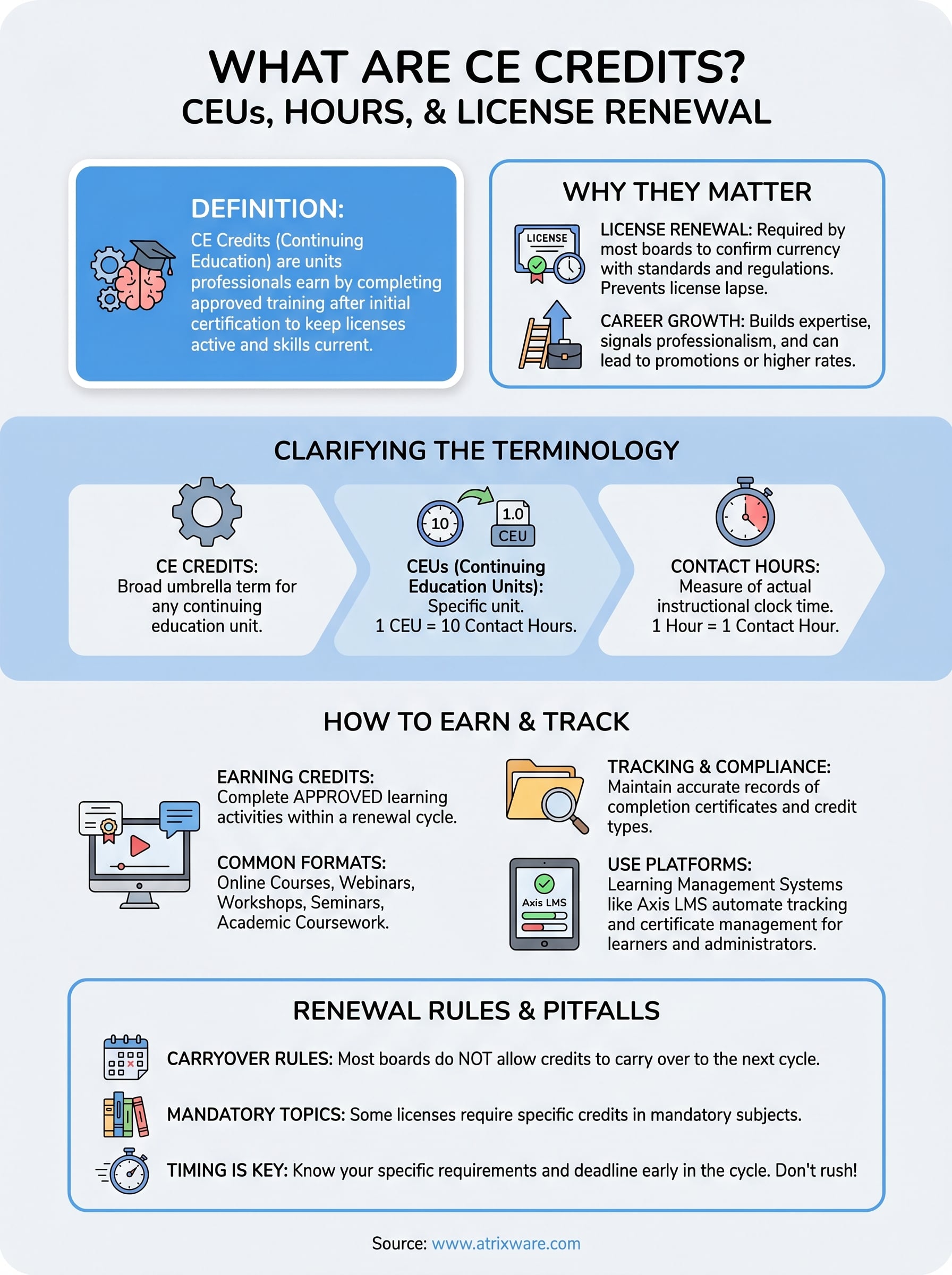
One CEU (Continuing Education Unit) equals 10 contact hours of participation in an organized learning experience, a standard established by the National Task Force on the Continuing Education Unit. That ratio tells your licensing board exactly how much instructional time you completed, so getting the conversion right matters.

Here’s how the conversion works in practice:
- 10 contact hours = 1.0 CEU
- 20 contact hours = 2.0 CEUs
- 5 contact hours = 0.5 CEUs
Contact hours and their relationship to CE credits
Contact hours measure the actual clock time you spend in instruction, with one contact hour equaling one hour of learning. Licensing boards in nursing and allied health fields commonly use contact hours rather than CEUs because they provide a direct, straightforward measure of time spent in training.
Always confirm which unit your specific licensing board accepts before enrolling, since submitting the wrong type can invalidate your entire submission.
Your board’s website will list accepted unit types and their conversion requirements for each renewal cycle.
How professionals earn CE credits
Earning CE credits comes down to completing approved learning activities within your renewal cycle. Most licensing boards publish an approved provider list, so before you enroll in any course, confirm that the provider carries official recognition in your state or industry. Submitting credits from a non-approved source is the same as submitting nothing at all.
Common formats for earning CE credits
Your licensing board typically accepts several delivery formats, each carrying the same credit value when the provider is approved. Online courses and webinars dominate because they give you schedule flexibility, but in-person options remain fully valid.
Common approved formats include:
- Online self-paced courses with end-of-module assessments
- Live webinars and virtual instructor-led sessions
- In-person workshops, conferences, and seminars
- Self-study programs backed by a proctored exam
Check your licensing board’s approved format list before enrolling, since not every delivery method qualifies for every license type.
Workplace and academic options
Some boards allow employer-sponsored training or on-the-job learning programs to count toward your total, provided the training meets specific documentation standards. Teaching or presenting at an approved conference can also earn you CE credit hours in several professions.
Academic coursework at accredited institutions typically qualifies as well, which gives you flexibility when figuring out what are ce credits requirements and how to meet them efficiently within a busy work schedule.
How to calculate and track CE credits
Part of understanding what are ce credits is knowing how to calculate them accurately. Most boards state requirements in total contact hours or CEUs per renewal cycle, so your first step is always checking the board’s official renewal page. Knowing exactly how many credits you need on day one of a new cycle lets you distribute coursework evenly rather than rushing at the end.
Keep a running log of completed credits from the first day of your renewal cycle, not just the weeks before your deadline.
Converting hours to CEUs
If your board requires CEUs, divide your total contact hours by 10 to get your CEU count. For example, completing 25 contact hours gives you 2.5 CEUs. Always save your completion certificates immediately after finishing a course, since boards frequently audit submissions and expect documentation to match every credit you claim.
Using a platform to track CE credits
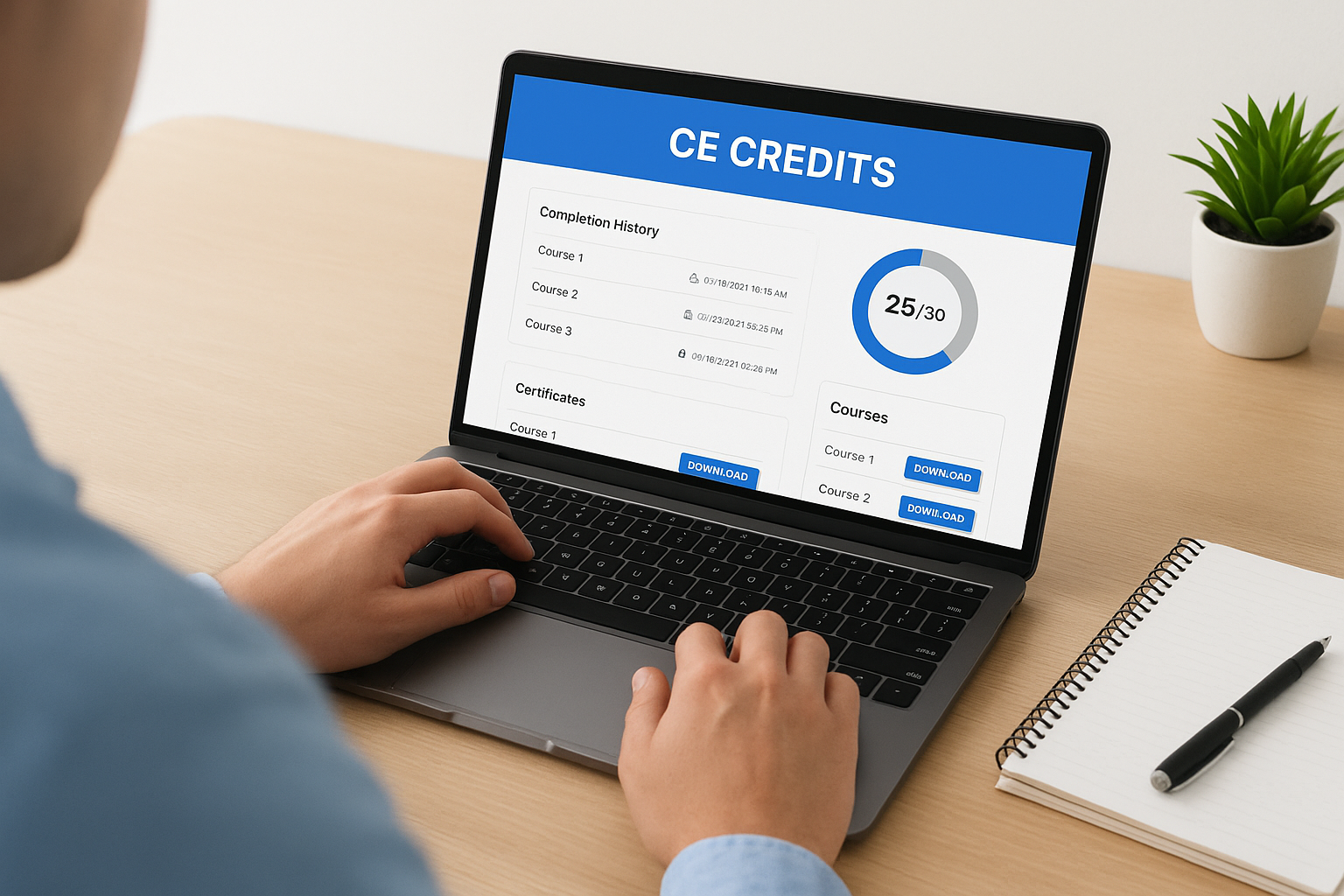
Tracking credits manually across multiple courses creates real risk of errors and missing documentation. Learning management systems like Axis LMS solve this by automatically recording completion data, certificates, and timestamps in one place. Administrators can run reports on learner progress at any point in the renewal cycle, and individual users pull their own training records without contacting HR. When your board asks for proof, you have everything ready immediately.
Common license renewal rules and pitfalls
Understanding what are ce credits helps, but renewal still trips professionals up through timing mistakes and documentation gaps. Every licensing board sets its own rules on carryover credits, mandatory topic requirements, and submission deadlines, so assuming your previous cycle’s rules still apply can cost you your license.
Watch your carryover rules
Most licensing boards do not allow carryover credits from one renewal cycle into the next. Credits you complete beyond your required total simply disappear at cycle’s end. A few boards permit limited carryover, so check your board’s written policy before banking extra credits as a safety net for your next renewal period.
Common renewal pitfalls to avoid:
- Completing credits after your renewal deadline but before submitting your application
- Relying on a provider that lost its approved status mid-cycle
- Forgetting mandatory topic requirements within your total credit count
- Losing completion certificates before an audit request arrives
Mandatory topic requirements
Many boards require a set number of credits in specific subjects, not just a total credit count. A licensed pharmacist, for example, may need credits in patient safety or controlled substance regulations regardless of how many general credits they complete. Missing a mandatory topic means your renewal is incomplete, even when your overall credit count looks sufficient.
Confirm your mandatory topic requirements at the start of each renewal cycle, not after you have already completed your courses.
Quick recap
Now you understand what are CE credits and why they matter to your professional future. CE credits are the units professionals earn through approved training to keep their licenses active and their skills current. Your licensing board sets the exact requirements, and missing your deadline can put your license at risk.
Terminology like CEUs and contact hours carries real differences that affect how your board evaluates your submissions. Earning credits through approved providers and formats protects your renewal from being rejected on a technicality. Tracking every completion certificate from day one keeps you audit-ready without last-minute scrambles.
If your organization delivers CE credit training, managing it manually creates unnecessary risk. Axis LMS from Atrixware gives administrators full visibility into learner progress and certificate records throughout the entire renewal cycle. Take the LMS readiness quiz to find out if a dedicated platform fits where your training program stands today.
