Not every training program fits neatly into a single format. Some skills are best taught face-to-face, while others stick better through self-paced online modules. That tension is exactly what led to blended learning, and getting the blended learning definition right matters more than most people think. It’s not just "some online, some in-person." It’s a deliberate instructional strategy that combines the strengths of both delivery methods to produce better outcomes for learners and organizations alike.
At its core, blended learning gives companies the flexibility to train employees, customers, and partners without forcing everything into a single mold. When it’s done well, learners stay more engaged, retain more information, and actually complete their training. When it’s done poorly, it becomes a disjointed mess of Zoom calls and forgotten coursework. The difference almost always comes down to structure, having clear models, the right technology, and a platform that ties it all together. That’s where a system like Axis LMS from Atrixware earns its place, giving organizations the tools to build, deliver, and track blended programs from one central hub.
This article breaks down what blended learning actually means, walks through the most common models with real examples, and explains the practical benefits that make it worth adopting. Whether you’re building a training program from scratch or rethinking how your current one is structured, you’ll leave with a clear framework to move forward.
What blended learning is and is not
Before you can build a blended program or evaluate one you already have, you need a precise understanding of what the term actually means. The blended learning definition is not a loose license to mix a few online resources into an otherwise unchanged training schedule. It describes a structured instructional approach where both online and in-person learning are intentionally designed to work together, each format doing the work it does best.
The actual definition
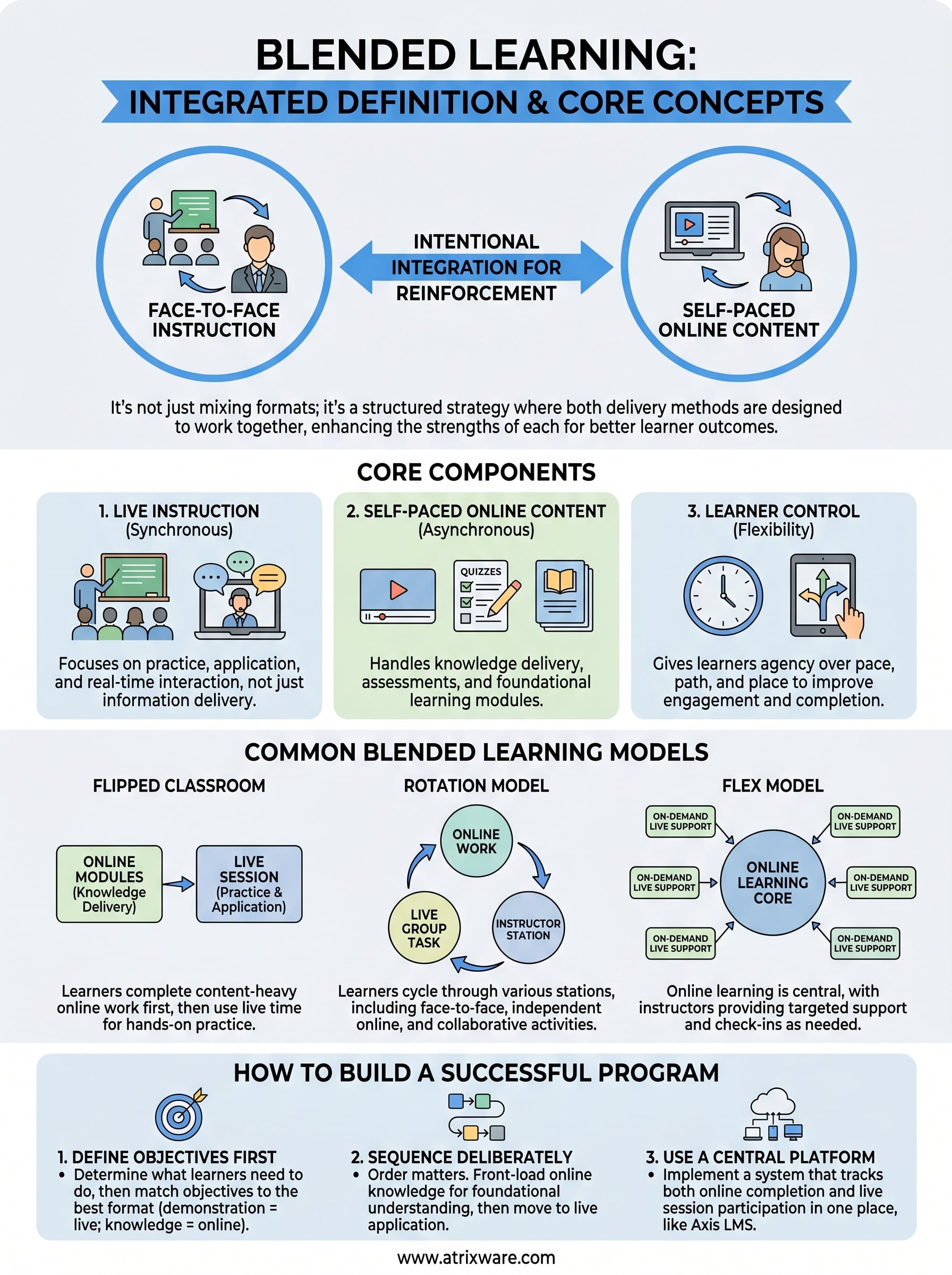
Blended learning is a formal training strategy that integrates face-to-face instruction with online learning activities in a way that gives learners some control over the pace, path, or place of their learning. The key word is "integrates." The two formats don’t just coexist on a calendar. They are designed to reinforce each other. An instructor might use live sessions to apply, discuss, or practice concepts that learners first encountered in an online module, for example. The result is a single, cohesive learning experience rather than two separate tracks running in parallel.
Blended learning only works when both formats are designed around each other, not developed in isolation and stitched together afterward.
This approach gained traction first in higher education, but corporate training teams have widely adopted it because it solves a real operational problem: not all learning goals require the same delivery method. Skills that involve hands-on practice, real-time feedback, or team collaboration often need a live environment. Knowledge transfer, assessments, and reference materials, on the other hand, fit well into self-paced online formats. Blended learning lets you assign each goal to the format that serves it best, rather than forcing everything into one mold.
What blended learning is not
Blended learning is often confused with a few related but distinct concepts, and those misunderstandings lead to weak program designs. The most common one is equating blended learning with hybrid learning. Hybrid learning typically means some learners attend a session in person while others join remotely at the same time. That is a logistical arrangement, not a learning design strategy. Blended learning, by contrast, involves deliberately different activities across formats, not the same activity delivered through two channels simultaneously.
Another common misconception is that any combination of online tools and in-person time qualifies as blended learning. Sending employees a PDF before a workshop and calling it "blended" doesn’t meet the standard. True blended learning requires intentional design where each component carries specific instructional weight, and learners move through a sequence that builds understanding progressively. Dropping a video into a training day doesn’t transform it into a blended program.
Finally, blended learning is not the same as fully self-paced e-learning. E-learning removes the in-person element entirely, which works well for certain content but eliminates the real-time interaction and social learning that blended programs preserve. If your program has no structured face-to-face or live component at all, it’s e-learning, not blended learning. Knowing the difference helps you set realistic expectations for what each format can and cannot deliver on its own.
Core components of blended learning
Every blended learning definition worth using points back to the same structural building blocks. You can swap out platforms, adjust the ratio of online to in-person time, or redesign the sequence, but three core components appear in every well-built blended program: live instruction, self-paced online content, and deliberate learner control. Understanding each one helps you make smarter decisions when you design or evaluate a program.
Live instruction
Live instruction is the face-to-face or synchronous element of a blended program. It includes instructor-led workshops, virtual classroom sessions, coaching calls, or collaborative group activities where learners and facilitators interact in real time. This component carries the work that online formats handle poorly: practice with immediate feedback, discussion, demonstration, and the kind of social learning that builds shared understanding across a team.
Live instruction works best when it focuses on application and interaction, not information delivery. Save the content transfer for the online component.
Your live sessions should not simply repeat what learners already covered online. They should build on that foundation and push learners to do something with what they learned, whether that’s a role-play exercise, a case study, or a guided Q&A that surfaces gaps in understanding.
Self-paced online content
The online component handles knowledge delivery, assessments, and reference materials that learners can access independently, on their own schedule. This includes video lessons, readings, quizzes, interactive scenarios, and any pre-work or follow-up activities that learners complete outside a live session.
Self-paced content works well when it carries specific learning objectives that don’t require real-time interaction. Structured online modules also give you a reliable way to track completion and comprehension before learners arrive at a live session, which makes your instructor-led time far more productive.
Learner control
Learner control is the element that separates blended learning from a rigid, scheduled training schedule. It gives learners some agency over how, when, or where they engage with the online portion of a program. This might mean completing modules before or after a workshop, revisiting content at their own pace, or choosing a learning path based on their existing skill level.
Giving learners that flexibility improves completion rates and engagement, because learners fit training into their real work schedules rather than fighting against them.
Common blended learning models
No single blended learning definition captures every format a program can take. In practice, several distinct models have emerged, each one allocating the balance between online and in-person time differently. Knowing which model fits your goals helps you design a program that actually works, rather than one that blends formats without purpose.
The flipped classroom
The flipped classroom is the most widely recognized model. Learners complete content-heavy online modules before attending a live session, so the in-person time focuses entirely on practice, discussion, and application. This works especially well when your content is conceptual and your live sessions are short.
The flipped classroom reverses the traditional sequence: content delivery happens online first, and the live session becomes the place where learners actually do something with what they learned.
By front-loading knowledge transfer online, your instructors spend live session time on the tasks that genuinely require a human in the room, such as coaching, facilitated discussion, and real-time problem-solving. That shift makes your training hours far more productive.
The rotation model
In the rotation model, learners cycle through a set of learning stations on a fixed or flexible schedule. Some stations involve face-to-face instruction, others involve independent online work, and some involve collaborative group tasks. Corporate training teams use this model when they need to serve multiple learners with different skill levels at the same time, since each station can target a specific learning objective without everyone moving in lockstep.
This model scales well in environments where you have limited instructor availability. You distribute your live instruction strategically across the rotation so that instructors focus on the learners who most need direct support at any given moment.
The flex model
The flex model places online learning at the center of the program, with in-person support available on demand rather than on a fixed schedule. Learners move through a self-paced digital curriculum, and instructors step in when a learner needs clarification or a structured check-in. This model gives you the most scheduling flexibility.
For organizations with distributed teams or inconsistent availability across shifts, time zones, or locations, the flex model removes the pressure of coordinating everyone around a shared calendar while still keeping live support in the mix when it matters.
Examples of blended learning in workplace training
Understanding the blended learning definition at a theoretical level is one thing. Seeing it in action across real training scenarios is what makes it click. These three examples show how organizations apply blended learning to solve specific, common training challenges, and each one illustrates a different way to balance online and in-person elements around a practical goal.
New employee onboarding
Onboarding is one of the most natural fits for a blended approach. New hires need to absorb a significant amount of foundational information quickly, from company policies and tools to team workflows and role-specific procedures. The online component handles the content-heavy material, such as compliance requirements, system walkthroughs, and role overviews, which employees can complete at their own pace before their first live sessions.
When you front-load the information transfer online, your live onboarding sessions can focus entirely on relationship-building, Q&A, and hands-on practice rather than reading slides aloud.
Live sessions then bring in managers, team leads, or HR to connect with new hires, answer questions in context, and run through real scenarios that require direct feedback and human interaction.
Compliance training
Compliance programs run into a familiar problem: the content is mandatory, but learner engagement tends to be low. A blended approach helps here because you can use self-paced online modules to deliver the regulatory content, run assessments, and document completion for audit purposes, while adding live sessions that address gray areas, department-specific scenarios, or policy updates that require discussion.
Organizations with compliance obligations under frameworks like FDA 21 CFR Part 11 or GDPR need both verifiable completion records and demonstrated understanding, and blended learning gives you both. Your LMS tracks the online component, while live sessions build the judgment that compliance requires.
Sales enablement training
Sales teams benefit from blended learning because the skills involved in closing deals and managing client relationships are not learned by reading documentation alone. Online modules can introduce product knowledge, sales methodology, and objection-handling frameworks. Your live sessions then simulate actual sales conversations, giving reps the chance to practice their delivery, receive coaching, and refine their approach before they face a real customer.
How to build a blended learning program
Building a blended program is less about picking tools and more about making deliberate design decisions before anything goes into production. The core of the blended learning definition is intentional integration, and that integration has to start at the planning stage. If you define your learning objectives first, the right delivery mix tends to become clear without much guesswork.
Start with learning objectives, not delivery formats
Every decision in your program design should trace back to a specific learning objective. What do learners need to be able to do after completing this program, and how will you verify they can do it? Once you answer that question for each objective, you can assign each one to the format that serves it best rather than defaulting to whichever option feels most familiar or convenient.
Designing around objectives first prevents you from building a program where the format drives the content instead of the other way around.
A practical way to organize this is to list your learning objectives in one column and your available delivery formats in another. Objectives that require demonstration, real-time feedback, or peer interaction belong in your live sessions. Objectives involving knowledge transfer, policy review, or self-assessment fit the online component.
Sequence the components deliberately
Once you know which content belongs in each format, the order matters as much as the format split. Most effective blended programs front-load information delivery through the online component so that live sessions move directly into application. Learners who arrive at a workshop already grounded in the core concepts make better use of your instructor’s time, and your instructors spend less of the live session covering basics that could have been handled asynchronously.
Structure your sequence as a clear progression: online modules build foundational knowledge, live sessions develop competency through practice, and follow-up online activities reinforce or assess retention after the fact.
Build on a platform that connects both sides
Your program needs a single system that tracks both online completion and live session participation, generates reports across both formats, and gives learners a consistent place to access everything. Without that infrastructure, your blended program becomes fragmented and hard to manage. Axis LMS centralizes your online modules, virtual classroom tools, and reporting in one place so nothing gets lost between formats.
Next steps
The blended learning definition comes down to one principle: match your delivery method to your learning objective, then connect both sides into a single, coherent program. When you design with that principle in mind, you stop defaulting to either full e-learning or all-day workshops, and you start building training that actually changes learner behavior and sticks long after the session ends. The models, examples, and design steps covered here give you a repeatable framework to apply across any training scenario your organization faces.
Your next move is finding a platform that supports both the online and live components without forcing you to manage two separate systems. Axis LMS gives you the tools to build, deliver, and track blended programs from one place, whether you’re onboarding new hires, running compliance training, or developing your sales team. Take the LMS readiness quiz to find out where you stand and what your program needs to move forward.
