Combining online modules with in-person sessions sounds straightforward, until you actually try to pull it off. Without a clear strategy, blended learning programs tend to become disjointed experiences where neither the digital nor the face-to-face components reach their potential. That’s why understanding blended learning best practices matters: they give your training program a structure that keeps learners engaged across both formats.
At Atrixware, we’ve spent years building Axis LMS to help businesses deliver exactly this kind of training, online courses, virtual classrooms, and tracking tools that work together under one roof. We’ve seen what separates a blended program that drives real skill development from one that just checks a box. Based on that experience, here are five practices that consistently lead to stronger outcomes when you’re designing corporate blended learning programs.
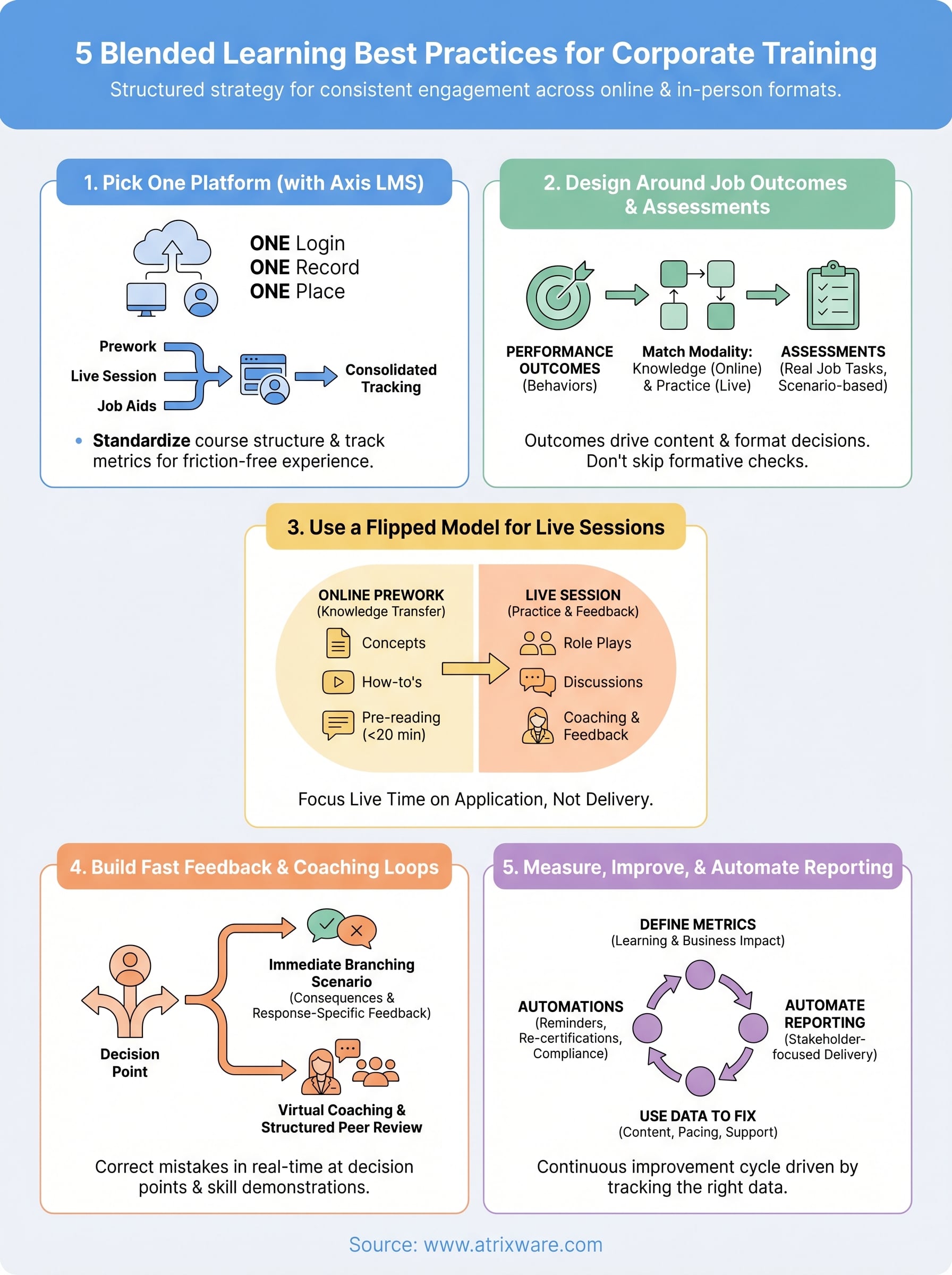
1. Pick one platform to run the blend with Axis LMS
Platform fragmentation kills blended programs. When learners jump between three different systems to complete prework, attend a virtual session, and access job aids afterward, they lose time and momentum. Axis LMS keeps every component in one place, so your blended learning best practices actually stick instead of getting lost in the friction.
What this best practice means in corporate training
One platform means one login, one learner record, and one place for administrators to see everything. In corporate training, that consolidation matters because your team needs to track completion across both online and live components without manually stitching data together from separate tools.
How to implement it in a real program
Start by mapping every touchpoint in your program: prework, live sessions, assessments, and follow-up resources. Then build all of them inside Axis LMS using its course builder, virtual classroom integrations, and document library. Resist the urge to host content on external drives or separate apps.
Consolidating your program into a single LMS before launch is far easier than migrating learners mid-program.
What to standardize so learners never feel lost
Set a consistent course structure across every module: same navigation layout, same naming conventions, and the same location for resources. Learners should not have to figure out where anything is. Use Axis LMS branding tools to make the environment feel familiar every time someone logs in.
Metrics to watch to confirm it works
Track login frequency and module completion rates in the first two weeks. If learners drop off early, the platform experience is likely the cause, not the content. Axis LMS reporting lets you isolate exactly where learners stop engaging so you can fix it fast.
2. Design around job outcomes and assessments
Most blended programs fail because they start with content. Someone lists topics, assigns modalities, and calls it a program, with no connection to what learners need to actually do on the job. Applying blended learning best practices means starting with performance outcomes and letting those outcomes drive every content and format decision that follows.
Start with performance, not content
Write down the specific behaviors a learner must demonstrate after training ends. If they cannot perform those tasks, the program failed, regardless of completion rates. Your outcome list becomes the filter for every subsequent design decision.
Match each outcome to the best modality
Each outcome tells you which format fits. Knowledge and recall work well in online modules, while practice and peer feedback belong in live sessions.

Match the modality to the outcome, not the other way around.
Build assessments that prove competence
Your assessments need to reflect real job tasks, not just multiple-choice quizzes. Use scenario-based evaluations that require learners to apply skills in realistic, contextualized situations.
Common design mistakes to avoid
Avoid building all content first and assessments last. That sequence guarantees you cover the wrong things. Also watch for these two patterns that undermine even well-intentioned programs:
- Using the same format for every outcome regardless of skill type
- Skipping formative checks mid-program and only assessing at the end
3. Use a flipped model for live sessions
The flipped model is one of the most reliable blended learning best practices for corporate training. Instead of using live time to deliver information, you move all foundational content online beforehand so your live sessions can focus entirely on application and discussion.
What to move online before the session
Push knowledge transfer to asynchronous modules before any live event. Good candidates include:
- Concepts and terminology
- Process walkthroughs and how-to demonstrations
- Pre-reading or short video overviews
Keep online prework under 20 minutes to protect completion rates.
How to run live time for practice and feedback
Use the live session for role plays, case studies, and scenario discussions where learners apply what they reviewed online. Facilitators should spend most of the session coaching and giving feedback, not lecturing.
Live time is too valuable to spend on content delivery that a well-built online module can handle.
How to keep attendance and participation high
Communicate the purpose clearly before each session so learners know they need prework done to participate. Tie live sessions to assessments or team activities that require attendance to complete.
What to do when learners do not complete prework
Do not restart the session for those who skipped preparation. Send automated reminders through Axis LMS before each session, and hold a brief catch-up resource ready for stragglers to review after.
4. Build fast feedback and coaching loops
Delayed feedback breaks the learning cycle. When learners finish a module or practice a skill without knowing how they performed, they move forward with gaps intact. Fast feedback loops are a core element of blended learning best practices because they keep learners correcting mistakes in real time rather than weeks later.
Where learners need feedback most
Learners need feedback at decision points and skill demonstrations, not just at final assessments. Focus your feedback strategy on moments where a wrong assumption can compound into a larger performance problem on the job. Common places to build in feedback:
- After scenario-based choices in online modules
- During live practice activities
- At assessment submission
How to deliver instant feedback in online modules
Build branching scenarios into your online modules so learners see the consequences of their choices immediately. Use response-specific feedback rather than generic "correct" or "incorrect" messages.
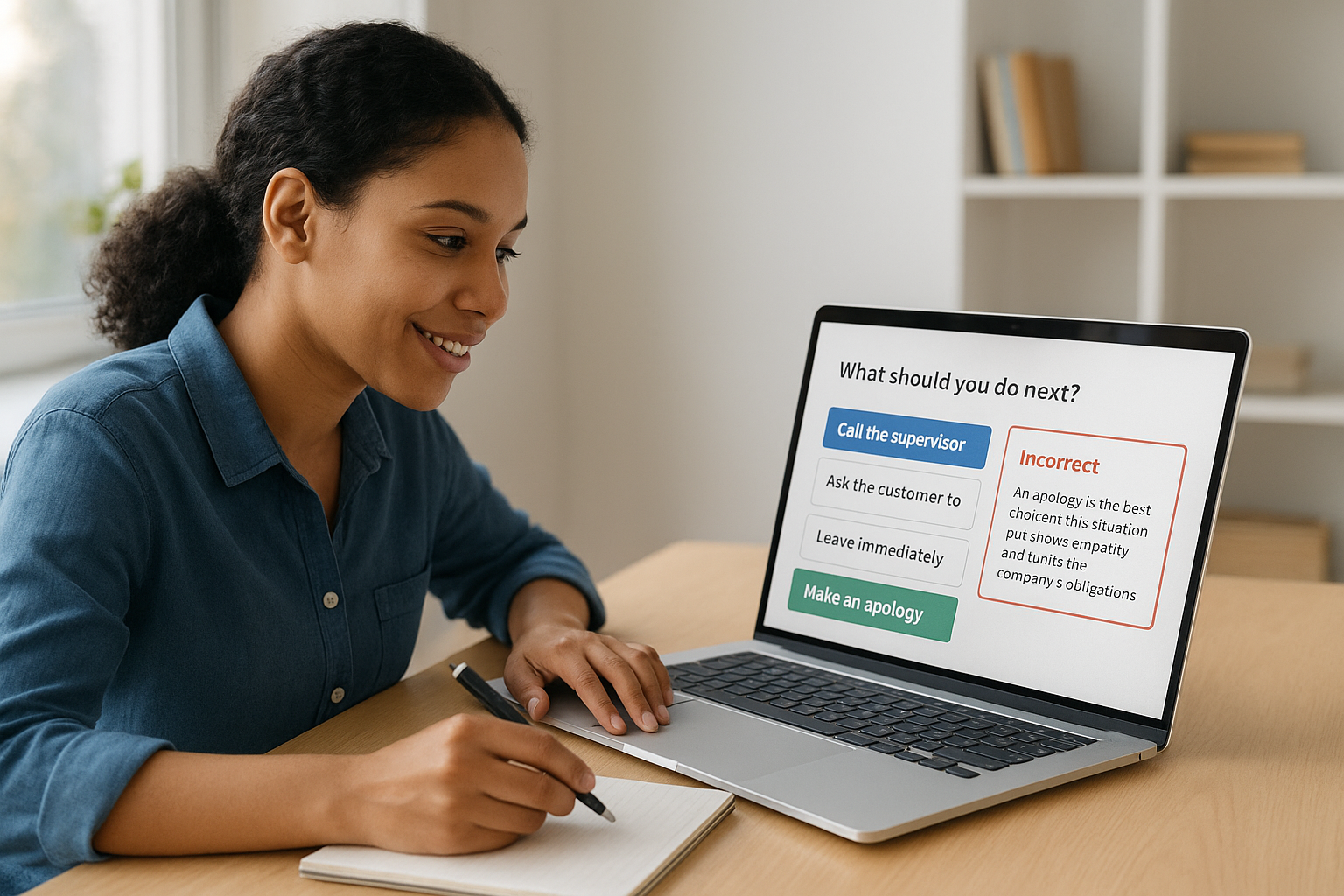
Specific feedback that explains why an answer is right or wrong does more for retention than a score alone.
How to run online office hours and manager coaching
Schedule short, recurring virtual sessions where managers or subject-matter experts answer questions directly. Keep your sessions focused on application, not re-teaching content already covered online.
How to use peer interaction without losing control
Assign structured peer review tasks with clear criteria so discussion stays on topic. Use Axis LMS discussion tools to moderate conversations and keep the group moving toward shared learning goals.
5. Measure, improve, and automate reporting
You cannot improve a program you cannot see clearly. Tracking the right data turns your blended learning best practices into a continuous improvement cycle rather than a one-time launch.
Define success metrics for learning and business impact
Set specific, measurable targets before your program launches, not after. Tie each metric directly to a business outcome:
- Reduced onboarding time
- Fewer compliance incidents
- Improved post-training assessment scores
Set up reporting that stakeholders will actually use
Build reports around the questions your managers and executives actually ask. Axis LMS lets you schedule automated report delivery so decision-makers get the data they need without logging into the system manually.
Simple reports that answer real questions get read. Complex dashboards that no one asked for get ignored.
Keep your report formats consistent across programs so stakeholders can compare results over time without relearning a new layout each quarter.
Use data to fix content, pacing, and support
Watch for drop-off points and low assessment scores as your first signals that something needs attention. Adjust content length, pacing, or learner support based on what the numbers show, not assumptions.
Automations to reduce admin work and keep compliance tight
Use Axis LMS automation tools to trigger reminders, assign re-certifications, and flag overdue completions. These automations keep your compliance records accurate without adding manual tasks to your team’s workload.
Next steps
These five blended learning best practices give you a solid framework to build from, but reading about them and applying them are two different things. The difference between programs that stick and programs that fade usually comes down to how well the underlying platform supports the design, not just the design itself.
Start by auditing your current training setup. Look at where learners drop off, where data goes missing, and where your team spends the most manual effort. Those gaps point directly to where your program needs the most attention.
Axis LMS is built to handle every component of a blended program, from automated reminders and virtual classroom integrations to compliance tracking and custom reporting. If you want to see how it fits your specific situation before committing, take the LMS readiness quiz to figure out exactly where you stand and what your next move should be.
