The terms get tossed around interchangeably, but blended learning vs hybrid learning actually describe two distinct approaches to training delivery. Mixing them up can lead to misaligned strategies, confused learners, and wasted resources, especially when you’re building out a corporate training program that needs to scale.
Both models combine online and in-person elements, which is where the confusion starts. But the way they structure those elements, the flexibility they offer learners, and the logistics behind each approach differ in meaningful ways. Understanding these differences matters when you’re choosing how to deliver training that actually sticks, whether that’s for employee onboarding, compliance, or customer education.
At Atrixware, we build Axis LMS to support organizations running exactly these kinds of training programs. We’ve seen firsthand how choosing the right delivery model shapes learner engagement and administrative workload. This article breaks down what blended and hybrid learning actually mean, where they overlap, where they diverge, and how to decide which approach fits your organization’s goals.
Blended vs hybrid learning at a glance
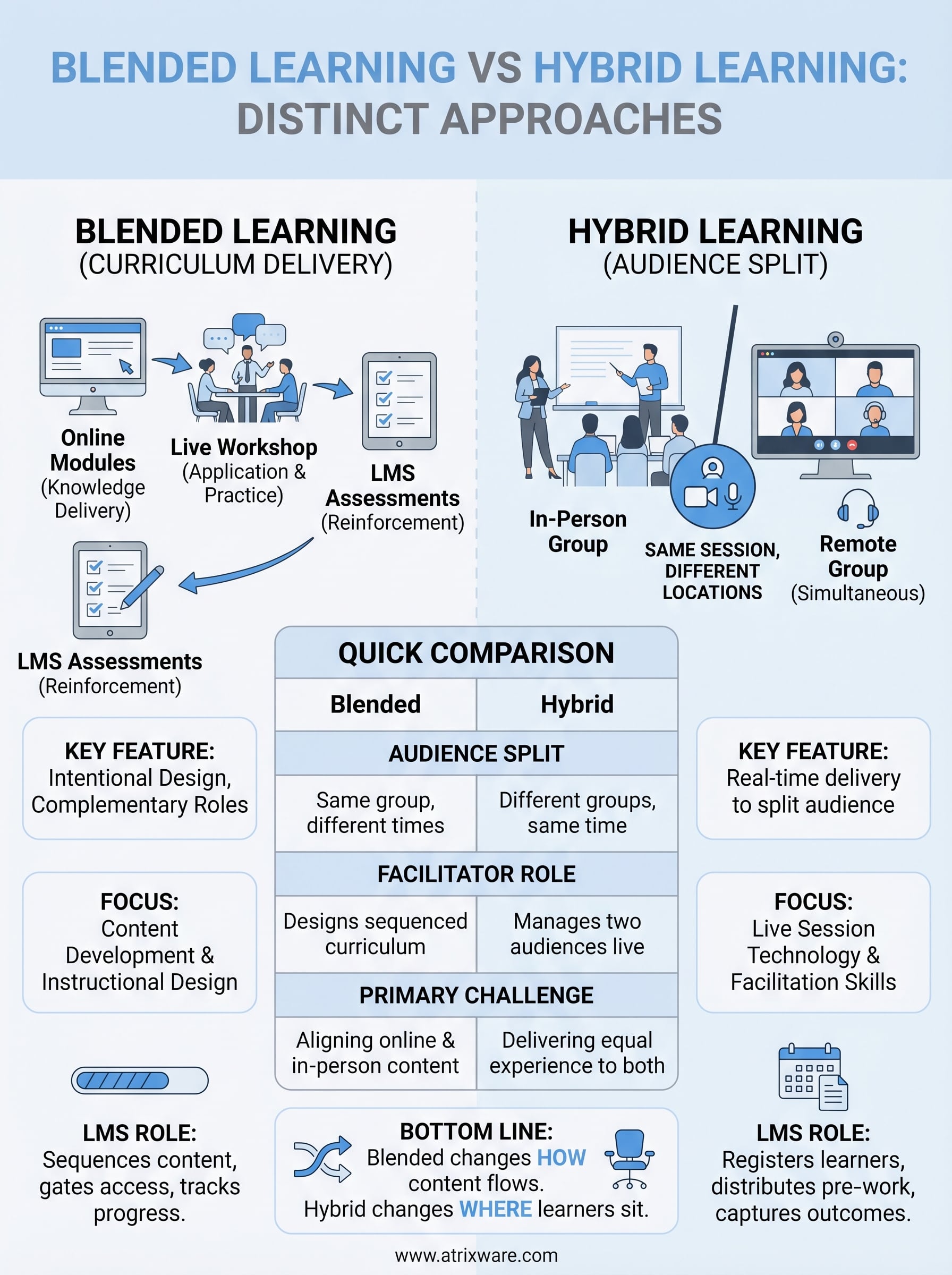
When you look at blended learning vs hybrid learning side by side, the clearest distinction is this: blended learning changes how a curriculum is delivered, while hybrid learning changes who is physically present during any given session. Both models combine digital and in-person elements, but the logic behind each one is fundamentally different.
What blended learning looks like
Blended learning integrates online activities and face-to-face instruction so that each mode reinforces the other. Every learner in the program goes through both components, there is no split audience. A common example in corporate training is a setup where employees complete an online module before attending a live workshop, then return to the LMS to finish assessments and practice exercises.
The key feature of blended learning is intentional design: the online and in-person pieces are built to work together, not just layered on top of each other. Online content handles knowledge delivery while the live session focuses on application, discussion, or skills practice. You’re structuring a deliberate sequence, not just offering two formats and hoping learners connect them.
Blended learning works best when the two modes serve distinct, complementary roles rather than simply duplicating each other.
What hybrid learning looks like
Hybrid learning splits the audience, not the curriculum. Some participants attend a live session in person while others join the same session remotely at the same time. The instructor delivers one experience to two groups simultaneously, which is where most of the logistical complexity lives.
This model became widespread during the shift to remote work, when teams needed a way to run training for employees who couldn’t be in the same room. The challenge with hybrid delivery is that remote participants can easily feel like second-tier attendees if session design doesn’t account for both groups with equal intentionality.
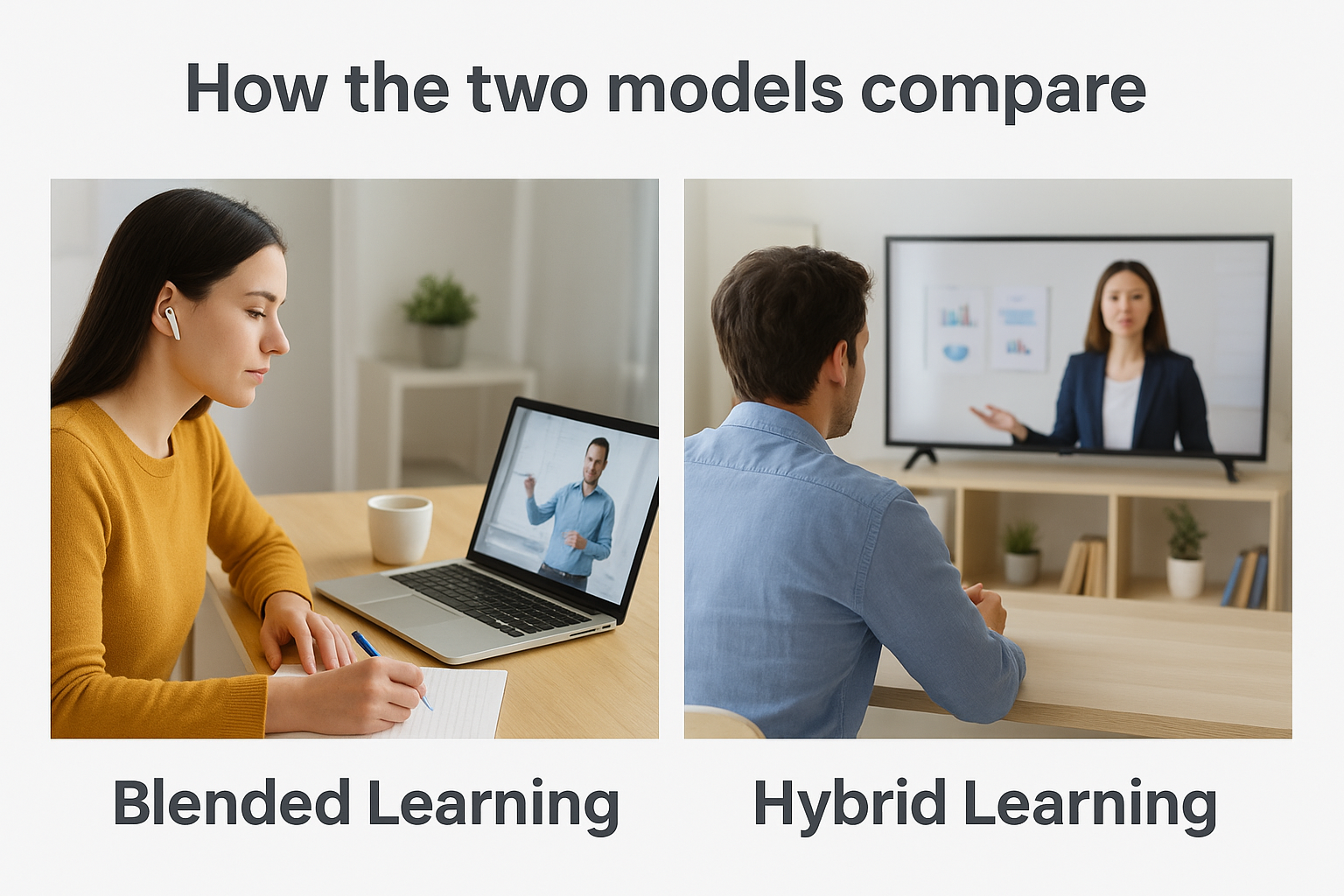
How the two models compare
Both approaches acknowledge that modern learners don’t always learn the same way in the same place. But where they differ matters for planning, technology setup, and facilitator skills.
| Factor | Blended Learning | Hybrid Learning |
|---|---|---|
| Audience split | Same group, different modes at different times | Different groups, same session at the same time |
| Technology focus | LMS, self-paced content, assessments | Video conferencing, live facilitation tools |
| Facilitator role | Designs a sequenced curriculum | Manages two audiences simultaneously |
| Learner flexibility | Structured but self-paced online components | Location flexibility during live sessions |
| Primary challenge | Keeping online and in-person content aligned | Delivering an equal experience to both groups |
The table above shows why the two models require different preparation. Choosing the wrong model for your context doesn’t just create friction; it can actively undermine learner engagement and your overall training outcomes.
Why the difference matters for training teams
Confusing blended learning vs hybrid learning leads to real operational problems. When training teams design a curriculum for one model but deliver it under the assumptions of another, they end up with misaligned technology setups, confused facilitators, and learners who don’t know what to expect from session to session. The difference isn’t just academic; it shapes every decision you make about scheduling, tools, and content structure.
Budget and resource planning look different
Blended learning requires upfront investment in content development: authoring tools, LMS configuration, video production, and the time to design a sequenced curriculum that works both online and in person. Most of those costs are front-loaded, and the course runs repeatedly without much additional overhead once it’s built.
Hybrid learning shifts the budget toward live session technology: reliable video conferencing, room equipment, cameras that capture both remote and in-person participants, and facilitators skilled enough to manage both audiences at once. You also carry ongoing costs each time you run a session, because the live delivery requires active management every single time.
Underestimating the technology requirements for hybrid delivery is one of the most common reasons organizations struggle to make it work.
Facilitator skill requirements vary
Running a blended program asks your facilitators to design a coherent learning journey and ensure the online components actually prepare learners for the in-person work. The primary skill set involves instructional design and curriculum sequencing, not live performance under pressure. A facilitator who excels here can build a strong blended course once and run it repeatedly without major rework.
Managing a hybrid session requires your facilitators to handle two distinct groups in real time, monitor chat, engage remote participants, and prevent in-person attendees from dominating the experience. That demands a different kind of facilitation skill that many trainers haven’t fully developed. Before you commit to hybrid delivery, honestly assess whether your team has the live facilitation capacity to pull it off well.
How to choose the right model
Deciding between blended learning vs hybrid learning comes down to a few concrete factors: how your learners are distributed, what your facilitators can handle, and what outcomes you’re actually trying to drive. There’s no universally correct answer, but there are clear signals that point toward one model over the other.
Consider your audience’s location flexibility
If all your learners go through the same program at different points in time, and you want self-paced components to carry real instructional weight, blended learning is the stronger fit. It lets you build a structured sequence once and run it repeatedly without relying on live sessions to hold everything together.
Hybrid learning makes more sense when your learners are geographically distributed but need to participate in the same live event simultaneously. Think of a company-wide training launch, a product update session, or a compliance briefing where timing matters. Hybrid keeps everyone aligned in real time without requiring anyone to travel.
If your primary challenge is scheduling, not content delivery, hybrid learning solves a logistics problem more than a learning design one.
Assess your facilitation and technology capacity
Before you commit to either model, take stock of what your team can realistically execute. Blended learning requires strong instructional design upfront but relatively simple facilitation once the course is live. If your trainers are better at building content than managing live group dynamics, blended is the lower-risk choice.
Hybrid delivery demands more from your facilitators and your infrastructure every single time you run a session. You need reliable video conferencing, room setups that capture both audiences, and a facilitator who can engage two groups without letting either one fall behind. If that capacity doesn’t exist yet, launching hybrid training before you’re ready will frustrate both your learners and your team.
How to implement each model in an LMS
Your LMS is the operational backbone for either approach, but blended learning vs hybrid learning each use the platform differently. Knowing how to configure your system for each model saves setup time and helps you avoid building a course structure that doesn’t match how your learners actually move through content.
Setting up blended learning in an LMS
Blended learning lives almost entirely inside your LMS. You’ll use it to sequence content modules, gate access to in-person sessions based on completed online prerequisites, and track all learner activity in one place. A straightforward setup looks like this:
- Upload self-paced content (videos, readings, quizzes) as pre-work
- Schedule the live or in-person session as a separate course event
- Add post-session assessments or practice modules to reinforce the material
Automated progress tracking handles reporting across all three phases, so you can see exactly where each learner stands without chasing completions manually. Everything runs through the same platform, which keeps your completion data clean and centralized with no manual reconciliation between systems.
Setting up hybrid learning in an LMS
Hybrid learning requires your LMS to work alongside a video conferencing platform, not replace it. Use the LMS to register learners, send session reminders, and distribute pre-read materials ahead of the live event. After the session, bring participants back into the LMS to complete follow-up assessments or acknowledgment forms that confirm their participation.
The LMS holds hybrid training together before and after the live session. It doesn’t run the live component.
Your live session happens inside your conferencing tool, and the LMS captures outcomes once it ends. Keeping those two roles clearly separated prevents you from trying to force real-time delivery functionality out of a platform not designed for it. Blur that boundary, and you’ll end up with gaps in completion records that are frustrating to resolve after the fact.
Common pitfalls and how to avoid them
Even when training teams understand the core differences between blended and hybrid approaches, execution often breaks down in predictable ways. Knowing where these programs typically go wrong gives you a head start on building something that actually works.
Treating the two models as interchangeable
One of the most common mistakes is running a blended learning program under a hybrid delivery structure, or vice versa. This usually happens when organizations adopt whichever model sounds familiar without fully mapping out the learner journey in advance. If you design a blended course but then split your audience into in-person and remote groups during the live session, you’ve created an unintentional hybrid setup that your content wasn’t built to support.
Before you finalize your delivery structure, write out the exact learner journey step by step and confirm that your content design matches it.
The fix is straightforward: lock in your model before you build your content. Define who attends what and when, then design your modules, sessions, and assessments around that specific structure rather than adapting on the fly.
Underbuilding your follow-up components
Both models in the blended learning vs hybrid learning comparison share a common failure point: weak post-session work. Training teams often invest heavily in live or online components but leave follow-up assessments and reinforcement activities underdeveloped. Learners finish the main event without a clear next step, and retention drops quickly as a result.
For blended programs, that means building substantive post-session modules into the LMS, not just a single quiz. For hybrid programs, it means giving both your in-person and remote participants the same structured follow-up experience through the LMS. If your in-person group gets a hands-on activity after the session and your remote group just logs off, you’ve created an uneven learning experience. Closing that gap requires designing your follow-up work before you run the first session, not after.
Final takeaways
The blended learning vs hybrid learning distinction comes down to one core question: are you redesigning how content flows, or are you managing where your learners sit during a live session? Blended learning sequences online and in-person components so each mode does a specific job. Hybrid learning runs a single live session for two groups at once, one in the room and one remote. Both models work, but only when you build your content, technology setup, and facilitator training around the model you actually chose.
Your biggest advantage going in is clarity before you build. Lock in your delivery structure, design your follow-up components with the same care you give your main sessions, and configure your LMS to support the model rather than fight against it. If you want to see how Axis LMS handles both approaches in practice, start a free admin demo and explore the platform yourself.
