Training professionals often use the terms gamification vs game-based learning interchangeably, but they describe two fundamentally different approaches to engaging learners. One adds game elements like points and badges to existing training content. The other builds the learning experience inside an actual game. Mixing them up can lead to mismatched strategies, wasted budgets, and underwhelming results.
The distinction matters because each method serves different goals and works best in different contexts. Choosing the wrong approach can mean the difference between learners who retain information and learners who click through content just to earn a badge. Understanding where each strategy shines helps you design training programs that actually stick.
At Atrixware, we build Axis LMS to support both approaches, giving training teams the tools to create engaging learning experiences without guesswork. This article breaks down what separates gamification from game-based learning, walks through real-world examples of each, and helps you decide which one fits your training goals.
What gamification and game-based learning mean
Understanding the gamification vs game-based learning debate starts with getting each definition right. Both approaches use game concepts to boost engagement, but they apply those concepts in very different ways. One wraps game elements around existing training content, while the other makes the game the actual vehicle for delivering knowledge.
Gamification: game mechanics applied to real content
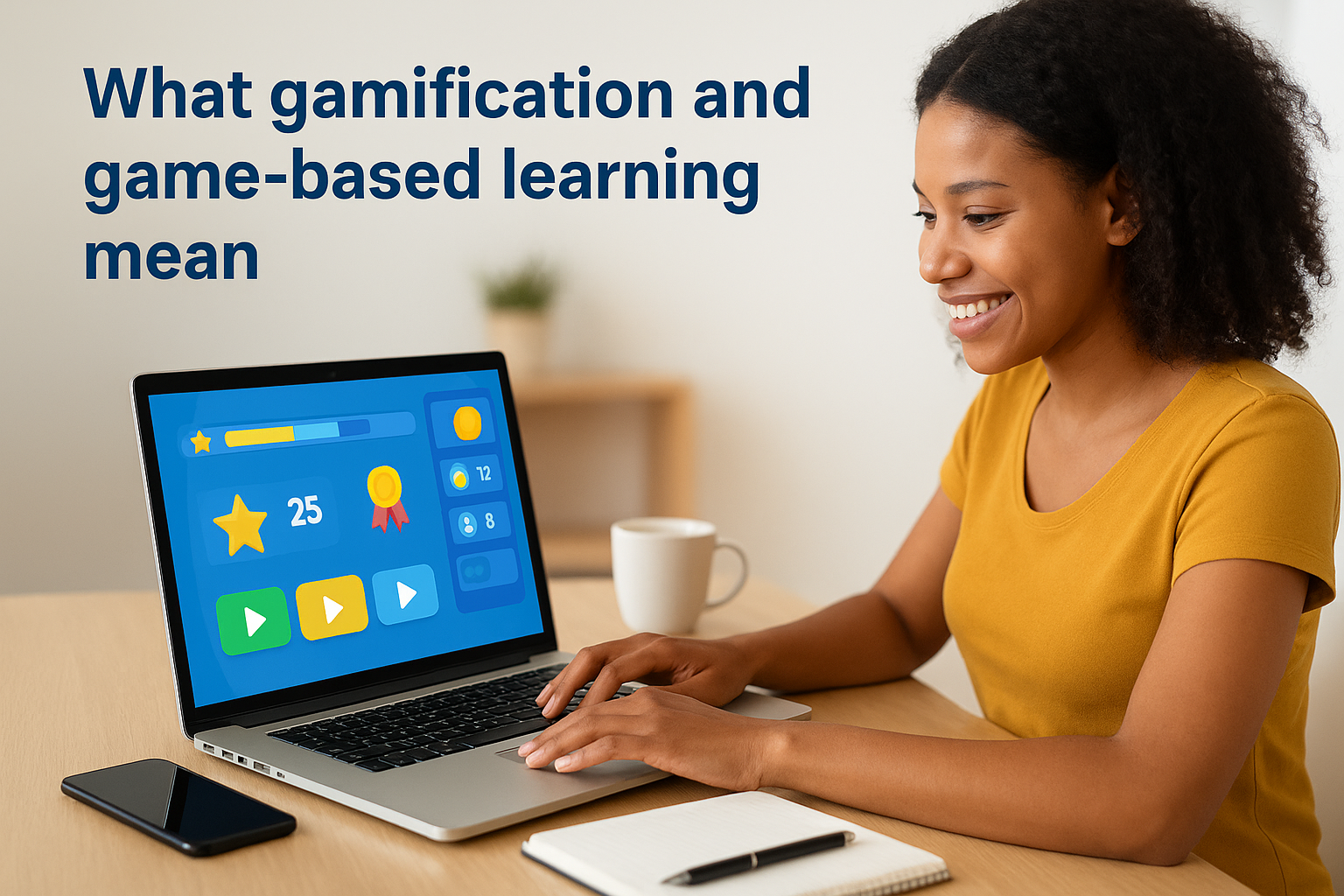
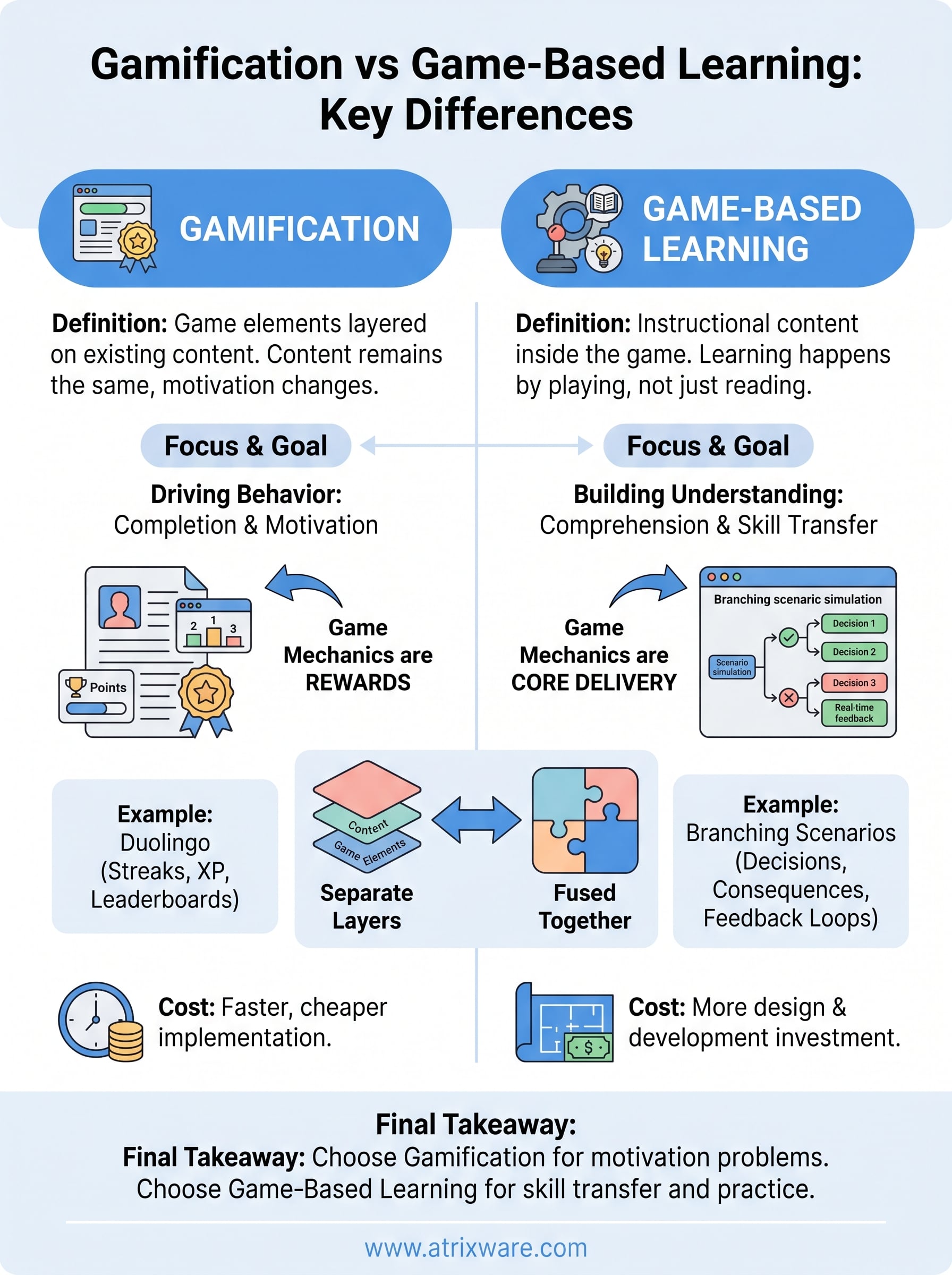
Gamification takes game-like elements such as points, badges, leaderboards, progress bars, and streaks and layers them on top of existing learning content. The content itself stays the same. What changes is how you motivate learners to move through it. A sales onboarding module with a leaderboard showing who completed the most lessons is a straightforward example: the training content drives the learning, but the competition drives the behavior.
Gamification works because it taps into motivators like achievement and recognition without requiring you to redesign your entire curriculum.
Platforms like Duolingo use this model heavily. Language lessons are structured learning sequences, but streaks, experience points, and level-ups keep learners returning daily. The underlying content is not a game; the reward system sitting on top of it is.
Game-based learning: the game IS the lesson
Game-based learning places the instructional content inside a game itself. Learners acquire knowledge and skills by playing, not by reading a module and then earning a badge for finishing it. The game mechanics are not rewards layered on top of content; they are the core delivery mechanism for the content.
A simulation where a new manager must navigate a difficult employee conversation, make real-time decisions, and see consequences play out is game-based learning in action. The scenario, the choices, and the feedback loop are all built into the game structure, so you learn by doing rather than by clicking through slides.
The key differences that matter in practice
When you put gamification vs game-based learning side by side, the clearest difference is where the game lives in relation to the content. With gamification, the content and the game mechanics are separate layers. With game-based learning, they are fused together, and you cannot remove one without dismantling the other.
Purpose shapes the structure
Gamification focuses on driving behavior through rewards. It pushes learners to complete existing content by attaching external motivators like points or progress bars. Game-based learning focuses on building understanding through experience. The game creates a context where learners must apply knowledge to move forward, not just consume it.
The goal of gamification is completion and motivation; the goal of game-based learning is comprehension and skill transfer.
Development cost and complexity differ significantly
Gamification is faster and cheaper to implement because you layer mechanics onto content you already have. Game-based learning requires more design and development investment because the instructional content and the game experience must be built together from the start. That gap in effort is a practical factor your team must weigh before committing to either path.
Examples you can classify fast
Concrete examples make the gamification vs game-based learning divide easier to spot. Once you see what each approach looks like in an actual training context, you can categorize almost any tool or method in seconds.
Gamification examples
Duolingo’s daily streaks and XP points are gamification. Kahoot’s competitive quiz format is gamification. An LMS leaderboard that tracks course completions is gamification. In every case, the learning content exists independently, and the game mechanics sit on top to drive behavior.
Kahoot is worth calling out specifically because training teams frequently misclassify it. The game format feels immersive, but the instructional content existed before you opened the tool. You built questions around material learners already studied, so the competition reinforces recall rather than delivering knowledge.
Game-based learning examples
A compliance scenario where your choices trigger branching consequences is game-based learning. A sales negotiation simulation where you must read a customer’s reactions and adapt in real time is game-based learning. In both cases, the content and the game are the same thing.
Strip out the game structure and you remove the lesson itself. That single test separates game-based learning from everything else.
These examples share one defining trait: the game mechanics and the instructional content are inseparable. You cannot lift a badge off the top because the decisions are the curriculum.
How to choose the right approach for training goals
Your training objective is the first filter you should apply. In the gamification vs game-based learning decision, the core question is whether you want learners to complete existing content more consistently or build real skills by practicing them. That single question narrows your options significantly.

Choose gamification when motivation is the problem
Gamification fits best when your training content is solid but engagement and completion rates are low. If learners stop returning to required modules or rush through them without absorbing much, adding points, leaderboards, or streaks can restore momentum without rebuilding your curriculum from scratch.
Gamification is a behavioral tool first and an instructional tool second.
Choose game-based learning when skill transfer is the goal
Game-based learning works when knowledge alone is not enough and learners need hands-on practice with judgment, decisions, or complex procedures in a safe environment. Compliance training, leadership simulations, and customer interaction scenarios are strong candidates because real-world mistakes in those areas carry serious consequences.
Budget and timeline also shape the decision. Game-based learning demands more upfront investment in design and content development, while gamification can often be layered onto training materials you already own. If you have a tight deadline, gamification is almost always the faster path to improved engagement.
How to implement each approach in an LMS
An LMS gives you a practical environment to run both approaches without managing separate platforms. The difference in the gamification vs game-based learning decision comes down to which native features you configure versus what custom content you build and upload.
Adding gamification to your LMS
Most LMS platforms let you activate points, badges, and leaderboards directly in admin settings. Map specific completion actions (finishing a module, passing a quiz, logging in consistently) to point values, then enable a leaderboard so learners can see their standing relative to peers.
The fastest wins in gamification come from tying point rewards to behaviors you already want learners to repeat.
Common gamification elements to configure in your LMS:
- Points for module completions and quiz passes
- Badges tied to specific learning milestones
- Leaderboards scoped to individual teams or groups
Building game-based learning into your LMS
Game-based learning requires you to create or source interactive content such as simulations or branching scenarios before uploading anything. Build your scenario in an authoring tool that exports to SCORM or xAPI, then upload the package so your LMS tracks completion and scores automatically.
Axis LMS supports both formats, so the LMS handles the data while the game handles the instruction. You retain full reporting visibility without juggling a separate system alongside your core training platform.
Final takeaway for L&D teams
The gamification vs game-based learning decision comes down to one practical question: what does your training actually need to fix? If low completion rates are the problem, gamification gives you a fast, cost-effective lever to pull. If learners need to build real skills through practice and decision-making, game-based learning is the better investment despite the higher upfront effort.
Your LMS is the foundation that makes both approaches work at scale. You do not need separate tools or platforms to run either strategy effectively. Pick the approach that matches your training objective, configure your platform to support it, and measure whether learner behavior actually changes. That last step matters more than which approach you choose.
If you want to see how Axis LMS supports both strategies in a real environment, start a free admin demo and explore the features yourself.
