Every new hire walks through the door with a mix of excitement and uncertainty. What is onboarding training, exactly? It’s the structured process that turns that uncertain new employee into a confident, productive team member, and it goes far beyond a stack of HR paperwork and a quick office tour. Done right, onboarding training reduces early turnover, accelerates time-to-competency, and gives people a real foundation for long-term success at your organization.
Still, many companies confuse onboarding with orientation, skip critical steps, or rely on disconnected processes that leave new hires to figure things out on their own. The difference between a strong onboarding program and a weak one often comes down to how intentional and organized your approach is, and whether you have the right tools to deliver it consistently. That’s exactly why we built Axis LMS at Atrixware: to give businesses a centralized platform for building, delivering, and tracking training from day one.
This guide breaks down the core components of onboarding training, walks through practical steps and real examples, and covers best practices you can apply immediately. Whether you’re building a program from scratch or fixing one that isn’t working, you’ll leave with a clear framework to onboard new hires the right way.
What onboarding training is and what it is not
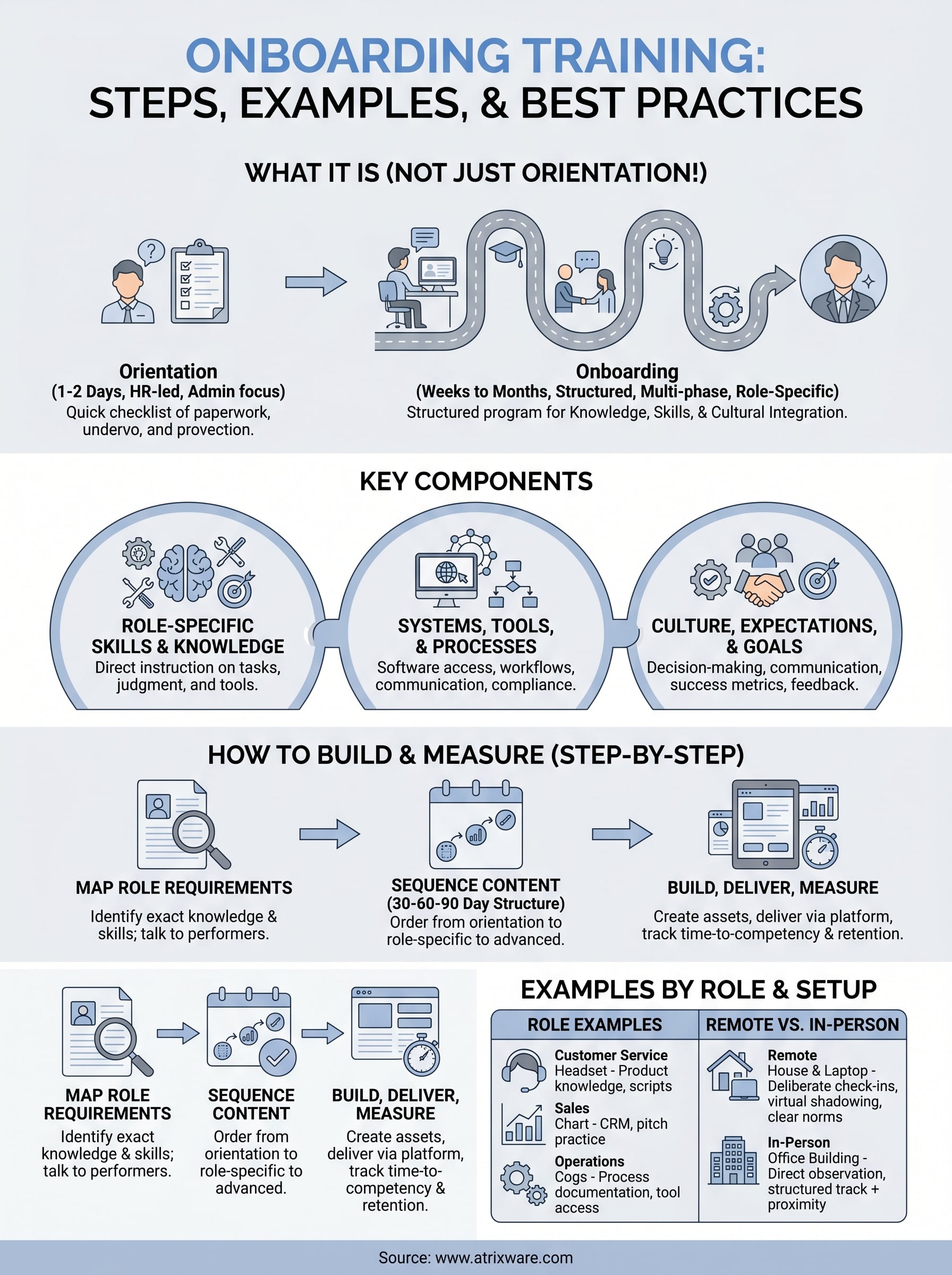
Onboarding training is a structured, multi-phase learning program that helps new hires understand their role, your company’s culture, the tools they’ll use, and the skills and behaviors expected of them. It can begin before the first day and extend for weeks or even months, depending on the complexity of the position. The key word here is structured: effective onboarding is intentional and designed around specific learning outcomes, not left to chance or informal conversation between colleagues.
What onboarding training actually is
When you ask "what is onboarding training," the answer goes deeper than a welcome packet or a manager walkthrough. At its core, onboarding training gives new employees the knowledge, skills, and organizational context they need to contribute quickly and confidently. This covers role-specific technical skills, an understanding of how internal processes work, and clarity on how each person’s work connects to broader team and business goals. A well-designed program answers the questions every new hire has but may be reluctant to ask out loud.
Strong onboarding training also addresses cultural integration. New hires need to understand how decisions get made, how teams communicate, and what success actually looks like at your organization. When you provide this context early, you reduce confusion, cut down on early mistakes, and build employee confidence faster than any improvised approach can.
Onboarding training that covers both technical skills and cultural context produces employees who contribute faster and stay longer.
How onboarding training differs from orientation
Orientation is a single event, usually spanning a day or two, focused on administrative tasks: completing paperwork, setting up system access, and getting a physical or virtual tour of the workplace. Onboarding training is a longer, deliberate program that builds real capability over time, not just surface-level familiarity on day one. Conflating the two is one of the most costly mistakes organizations make, and it shows up directly in early turnover numbers and slow ramp times.
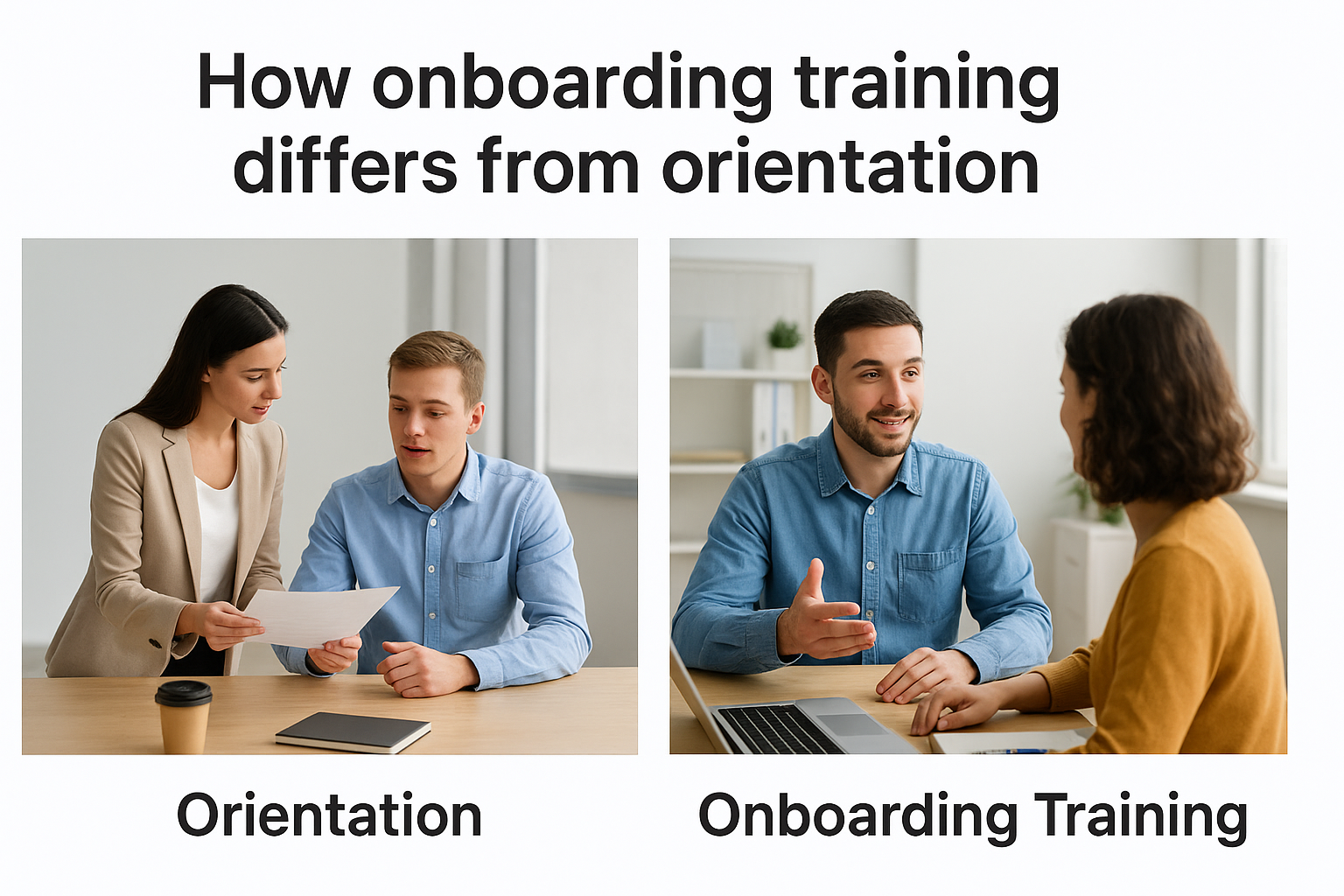
Here’s a straightforward comparison:
| Orientation | Onboarding Training | |
|---|---|---|
| Duration | 1-2 days | Weeks to months |
| Focus | Administrative setup | Skills, culture, performance |
| Outcome | Paperwork complete | Employee ready to contribute |
| Format | Event-based | Structured, sequential learning |
| Owner | HR | HR, managers, L&D team |
What onboarding training is not
Handing a new hire a 40-page employee handbook and calling it training does not give them what they need to perform. Onboarding training is not a document dump, a passive video library no one finishes, or a two-hour all-hands session that covers company history. Each of these elements can play a supporting role, but none of them alone constitutes a training program. Calling them onboarding sets new employees up to fail and sets your organization up to repeat the hiring process far sooner than you want.
Effective onboarding is also not something you design once and forget. Role requirements change, tools evolve, and team structures shift. Your onboarding program should be a living resource that you update regularly based on what new hires actually struggle with and what your best performers attribute their early success to.
Why onboarding training matters for retention and performance
Most organizations spend significant time and money recruiting new hires, then underinvest in the first 90 days that determine whether that hire stays or leaves. Understanding what is onboarding training, and treating it as a business priority rather than an HR formality, directly protects that investment. When new employees receive structured, role-relevant training from day one, they build confidence faster and connect to the organization in a way that informal processes simply cannot replicate.
The retention cost of poor onboarding
New hires who go through a disorganized or incomplete onboarding experience are significantly more likely to leave within the first year. Research from the Society for Human Resource Management indicates that replacing an employee can cost between 50% and 200% of their annual salary when you factor in recruiting, lost productivity, and the time required to train a replacement. A weak onboarding program does not just frustrate new employees; it signals that your organization lacks the structure and investment that people want in a long-term employer.
Poor onboarding is one of the fastest ways to lose a new hire you just spent months recruiting.
Turnover within the first six months is almost always preventable. When you give people clear role expectations and accessible training resources from the start, you remove the primary reasons most early departures happen: confusion, isolation, and feeling unprepared for the job.
How onboarding accelerates performance
A structured onboarding program cuts the time it takes for a new hire to reach full productivity, which directly impacts your team’s output and your bottom line. When employees understand their role requirements, know how internal systems work, and have practiced the core skills they need, they stop relying on colleagues for basic guidance and start contributing independently much sooner.
Performance outcomes also compound over time. Employees who receive strong onboarding training are more likely to hit targets in the first quarter, engage with ongoing development, and model the behaviors your culture values. That early alignment between expectations and demonstrated capability sets the trajectory for long-term performance and career growth within your organization.
Key components of onboarding training
When people ask what is onboarding training, they often picture a single training module or a day of shadowing. In practice, a complete program pulls together several distinct components, each addressing a different gap a new hire brings to the role. Skip any one of them and you leave your new employee with a blind spot that will cost time, errors, or early turnover down the road.
Role-specific skills and knowledge
Every new hire needs direct instruction on the technical skills and knowledge required to perform their specific job. This is not generic company training; it targets the exact tasks, tools, and judgment calls that define success in that position. A customer support rep needs call handling skills and product knowledge. A sales hire needs your pitch, your CRM, and your objection-handling process. Tailoring this component to the actual role is what separates effective onboarding from generic programming that applies to no one in particular.
Role-specific training closes the gap between what someone knew before joining and what they actually need to contribute in your environment.
This component should include practice opportunities, not just passive content. Simulations, role-plays, and observed task completion all build confidence faster than reading documentation alone.
Systems, tools, and processes
Your new hire needs to know which tools your team relies on and how your internal processes flow before they can work independently. This covers software access, communication platforms, file management conventions, approval workflows, and any compliance-related procedures tied to their role. Without this foundation, even a highly skilled employee will slow down your team by constantly asking for guidance on basic operational tasks.
Culture, expectations, and goals
Cultural integration and clear performance expectations are the components most organizations underinvest in, yet they directly shape how quickly a new employee finds their footing. This means explaining how decisions get made, how feedback flows, what good performance looks like at 30, 60, and 90 days, and how your team communicates under pressure. Giving someone explicit context about how your organization operates removes the guesswork that drives early disengagement and preventable mistakes.
How to build onboarding training step by step
Building onboarding training from scratch feels manageable once you break it into clear, sequential steps. Before you design a single module, you need to understand what is onboarding training supposed to accomplish for this specific role, not for employees in general. That clarity shapes everything that follows, from the content you create to the sequence you deliver it in and the metrics you use to measure success.
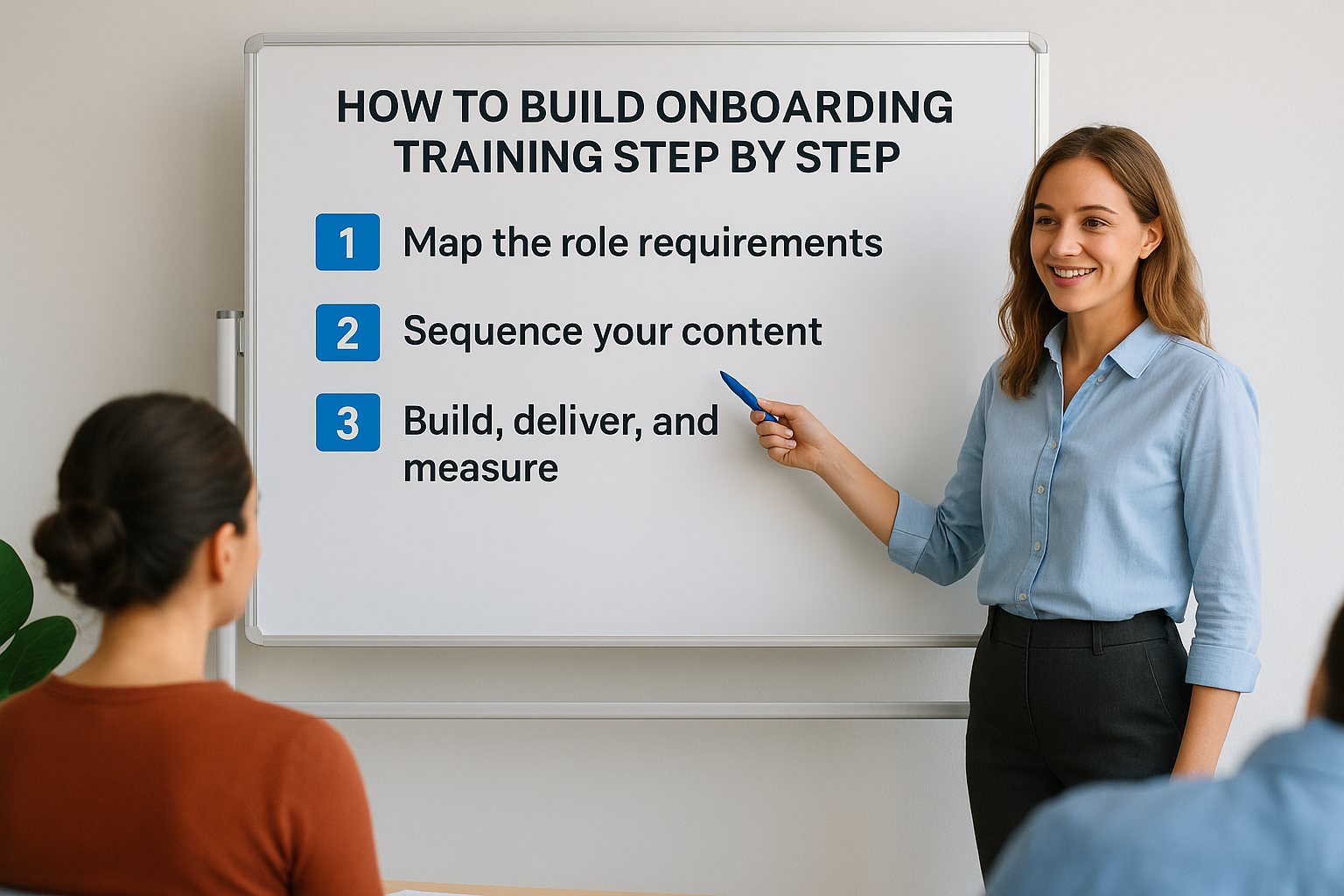
Step 1: Map the role requirements
Start by identifying the exact knowledge, skills, and behaviors a new hire needs to perform their role independently. Talk to top performers in that position and their managers. Ask what took the longest to learn, what mistakes happen most in the first 90 days, and what context made the biggest difference early on. This gap analysis gives you a concrete list of training objectives rather than a vague outline you fill in later.
Step 2: Sequence your content
Once you know what to cover, order your content intentionally. New hires need orientation-level context first (company structure, tools, processes), then role-specific skills, then more nuanced judgment and culture content as they settle in. Dumping advanced material on someone in week one creates cognitive overload and wastes good content. A 30-60-90 day structure gives you a natural framework for spreading material across the onboarding period without overwhelming anyone.
Sequencing your onboarding content around how people actually absorb information is what separates a program that works from one that just exists.
Step 3: Build, deliver, and measure
With your content mapped and sequenced, you can build the actual training assets: video walkthroughs, interactive modules, knowledge checks, and job aids. Deliver them through a platform that tracks completion and assessment results so you can identify where new hires consistently struggle. Then measure time-to-competency and early retention rates against a baseline, because those two metrics tell you faster than anything else whether your program needs adjustment.
- Track module completion rates by role and cohort
- Monitor assessment scores to spot recurring knowledge gaps
- Collect 30 and 90-day manager feedback on new hire readiness
- Flag content with low completion or high failure rates for revision
Onboarding training examples by role and work setup
Understanding what is onboarding training in theory is useful, but seeing how it plays out across different roles and work environments makes it actionable. The structure of your program will look different depending on whether you’re onboarding a frontline employee, a remote knowledge worker, or a mid-level manager stepping into a team that’s already established.
Role-based onboarding examples
Every role brings a different set of knowledge gaps and skill priorities that your onboarding program needs to address directly. A customer service representative needs product knowledge, tone guidelines, and call-handling practice before they take their first interaction. A software developer needs environment setup, codebase orientation, and your team’s code review standards before they contribute a single line. A sales hire needs your pitch, your CRM workflow, and your objection-handling process within the first two weeks, or they’ll waste early pipeline opportunities.
The closer your onboarding content maps to the actual day-to-day work of a specific role, the faster that person reaches full productivity.
Here are examples across three common roles:
- Customer service: Product training, call scripts, escalation procedures, tone and response guidelines
- Sales: CRM setup, pitch practice, competitive positioning, quota structure and tracking
- Operations or admin: Process documentation, tool access, approval workflows, compliance requirements specific to their function
Remote and in-person onboarding differences
Remote employees face a specific challenge that in-person hires often don’t: they have fewer informal opportunities to absorb culture, ask quick questions, or observe how their team operates. Your remote onboarding program needs to build those touchpoints deliberately, through structured check-ins, virtual shadowing sessions, and clear communication norms delivered early in the program. Leaving remote hires to figure out team culture on their own is one of the fastest ways to lose them before the 90-day mark.
In-person onboarding can rely more on direct observation and proximity, but it still needs a formal learning track alongside those informal moments. Whether your team works in an office, remotely, or in a hybrid model, the core framework stays consistent: define the skills, deliver structured training, and give your new hires repeated opportunities to practice before they’re expected to perform independently.
Next steps
You now have a complete picture of what is onboarding training: a structured, multi-phase program that closes skill gaps, builds cultural context, and gives new hires the foundation they need to perform independently. The gap between knowing this and executing it well usually comes down to consistency and tooling, specifically whether your organization has a reliable way to build, deliver, and track training across every new hire, regardless of role or location.
Your next move is to audit your current onboarding process against the framework in this guide. Identify the components you’re missing, the roles where your content isn’t role-specific enough, and the points where new hires consistently fall off. If your current setup makes that difficult to track, it’s worth looking at a platform built for exactly this purpose. Start an Axis LMS admin demo to see how you can centralize and scale your onboarding training from day one.
