GDPR fines, CCPA lawsuits, and a growing list of state privacy laws mean one thing: tracking consent, data requests, and compliance training on spreadsheets is no longer an option. If you’re evaluating data privacy management software, you already know the stakes. One missed data subject request or one gap in employee training can turn into a six figure penalty and a damaged reputation with customers and regulators alike.
This guide answers the question directly: which tools actually hold up in 2026, and which features matter most for your specific compliance needs. We compare pricing, integrations, and reporting depth across nine platforms, so you can match a tool to your team size, industry, and the regulations you’re subject to, rather than picking based on marketing copy.
You’ll also notice that privacy management doesn’t stop at policy documents and consent tracking. Regulators increasingly expect proof that staff understand the rules, which is where compliance training platforms like Axis LMS fit into the bigger picture. We’ll flag where a dedicated LMS complements your privacy software so you’re covering the human side of compliance, not just the technical side.
1. OneTrust
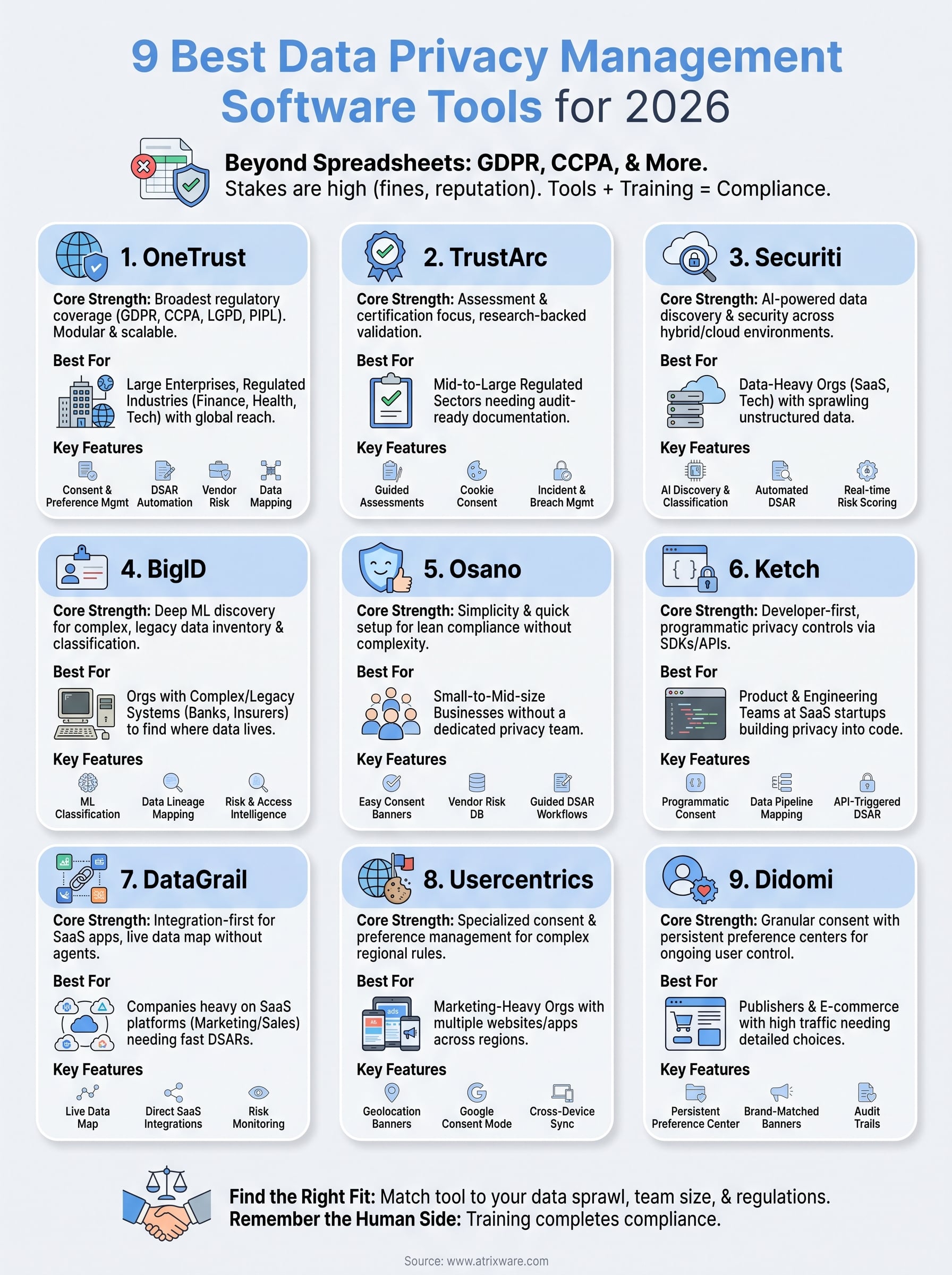
OneTrust dominates the privacy management conversation for a reason: it built its platform before most competitors even existed, and it has spent over a decade adding modules for consent, data mapping, and third-party risk. Enterprise buyers gravitate toward it because it covers nearly every privacy regulation on the books, from GDPR and CCPA to Brazil’s LGPD and China’s PIPL. If your organization operates across multiple jurisdictions, this breadth matters more than almost any other factor.
Key features
The platform’s core strength is its modular architecture, letting you buy only what you need and expand later.
- Data mapping and inventory automation that scans your systems and classifies personal data
- Consent and preference management with cookie compliance banners
- Data subject request (DSAR) automation with configurable workflows
- Vendor and third-party risk assessments tied directly to privacy obligations
- Policy and notice management with version control and audit trails
A platform that can scale from cookie banners to full enterprise risk management is rare, and that scalability is exactly why OneTrust leads this list.
Best for
OneTrust suits large enterprises and regulated industries like finance, healthcare, and tech companies with global user bases. Legal and compliance teams that need one system covering privacy, security, and third-party risk together will find the integration between modules genuinely useful rather than just marketing language. Smaller companies, though, often find the platform more than they need, both in complexity and in cost.
Pricing
OneTrust doesn’t publish flat pricing, and quotes vary widely based on which modules you select and your data volume.
| Factor | Typical Range |
|---|---|
| Starting tier (small teams) | Custom quote, often $10,000+/year |
| Mid-market bundle | $25,000-$75,000/year |
| Enterprise, multi-module | $100,000+/year |
Planning matters here because sales cycles run long and implementation can take months. Request a detailed module breakdown before signing, since add-ons for DSAR automation or vendor risk assessments can double your initial quote. Reference the FTC’s guidance on data privacy enforcement priorities when scoping which modules you actually need, rather than buying based on what a sales rep recommends.
2. TrustArc
TrustArc built its reputation on privacy assessments and certifications long before consent management became a checkbox item for every website. Companies pursuing frameworks like the TRUSTe certification or preparing for regulatory audits often start here, since TrustArc’s roots are in third-party validation rather than software alone. That heritage still shapes the platform today, giving it a research-backed feel that some newer competitors lack.
Key features
Unlike pure consent tools, TrustArc pairs software with guided assessments that map your practices against specific regulations.
- Privacy assessment automation with regulatory templates for GDPR, CCPA, and LGPD
- Cookie consent management with geolocation-based banner rules
- Data mapping tied to risk scoring, not just inventory
- Incident and breach management workflows
- Vendor risk tracking with periodic reassessment reminders
TrustArc’s assessment-first approach suits teams that need documented proof of due diligence, not just a working consent banner.
Best for
Mid-size to large organizations in regulated sectors like healthcare and financial services tend to get the most value here, especially those needing audit-ready documentation. Teams without dedicated privacy counsel also appreciate the guided assessment templates, since they reduce the guesswork around what regulators actually expect.
Pricing
TrustArc quotes custom pricing based on module selection and company size, with no public price list available. Expect entry packages to start in the $15,000 to $30,000 per year range for small to mid-size deployments, climbing well past $50,000 for full assessment and consent suites at enterprise scale. Ask for a scoped demo before committing to a full assessment bundle.
3. Securiti
Securiti built its platform around a bold idea: privacy, security, and data governance shouldn’t live in separate tools. It calls this the Data Command Center approach, using AI to discover and classify sensitive data across cloud, on-premise, and SaaS environments, then applying privacy controls automatically. If your organization is drowning in unstructured data across dozens of systems, Securiti’s discovery engine solves a problem most consent-focused tools never touch.

Key features
Securiti leans heavily on automation, cutting down the manual work that eats up privacy teams’ time elsewhere.
- AI-powered data discovery and classification across structured and unstructured sources
- DSAR automation with workflow orchestration across connected systems
- Consent management paired with universal opt-out signal handling
- Data risk assessments tied to real-time exposure scoring
- Breach management and incident response workflows
Automated data discovery turns privacy compliance from a manual audit into an ongoing, self-updating process.
Best for
Data-heavy organizations with sprawling cloud infrastructure, think tech companies, SaaS providers, and enterprises running hundreds of connected applications, get the most value from Securiti. Privacy teams that lack the headcount to manually track where sensitive data lives will find the discovery automation particularly worth the investment.
Pricing
Securiti doesn’t publish standard pricing, and quotes depend heavily on data volume and the number of modules activated. Expect starting packages around $20,000 per year for smaller deployments, with full platform access for enterprise data environments often exceeding $60,000 annually. Request a data discovery scan before committing, since actual data volume often changes the final quote significantly.
4. BigID
BigID made its name in data discovery and classification, using machine learning to find personal data wherever it hides, across databases, file shares, cloud storage, and even legacy systems nobody remembers building. Privacy teams often bring BigID in specifically to answer one question: what personal data do we actually have, and where does it live? That question sounds simple until you try answering it across a company with fifteen years of accumulated data sprawl.
Key features
BigID’s catalog approach treats data inventory as the foundation everything else builds on, rather than a one-time project.
- Machine learning classification that identifies personal, sensitive, and regulated data types automatically
- Data lineage mapping showing where information moves across systems
- DSAR fulfillment automation connected directly to the data catalog
- Risk and access intelligence flagging over-permissioned data stores
- Retention and minimization tools that flag data past its lawful retention window
BigID answers the question every privacy program eventually has to face: where does our sensitive data actually live, and who can touch it?
Best for
Organizations with complex, legacy data environments, especially banks, insurers, and large enterprises with decades of accumulated systems, get the clearest value from BigID. Security and privacy teams that need to satisfy both regulators and internal risk committees benefit from having one accurate data map instead of competing spreadsheets.
Pricing
BigID doesn’t list public pricing, and quotes scale with data volume and connected sources. Expect entry-level engagements to start around $25,000 per year, with full enterprise deployments across hundreds of data sources often running past $80,000 annually. Ask vendors for a scoped proof-of-concept before signing a multi-year contract.
5. Osano
Osano started as a consent management tool and has grown into a fuller privacy platform, but it never lost its focus on accessibility. Where competitors like OneTrust and Securiti aim at enterprise buyers with dedicated privacy staff, Osano built its pricing and onboarding for lean teams who need compliance coverage without a six-figure budget or a six-month implementation. That focus shows up in how quickly you can get a working consent banner and vendor risk tracker live.
Key features
Simplicity drives Osano’s product decisions, and it shows in how few clicks separate signup from a functioning compliance program.
- Consent management platform with automated cookie scanning and banner deployment
- Vendor risk assessments with a database of pre-scored third-party vendors
- Data subject request automation for GDPR and CCPA workflows
- Data mapping tools that document processing activities for audit purposes
- Ongoing regulatory monitoring that flags new laws affecting your business
Osano proves that solid privacy compliance doesn’t require enterprise pricing or a dedicated legal department to manage it.
Best for
Small to mid-size businesses without a dedicated privacy team find Osano’s guided setup and vendor database especially useful, since it removes much of the manual research other platforms leave to you. Marketing and legal teams sharing compliance duties also benefit from the platform’s straightforward interface.
Pricing
Osano publishes more pricing transparency than most competitors on this list, with published starting tiers around $199 per month for small businesses. Mid-size plans with vendor risk and DSAR automation typically run $500 to $1,500 monthly, scaling up for larger data volumes.
6. Ketch
Ketch positions itself as the developer-first option on this list, built around the idea that privacy controls should live in your code and infrastructure, not bolted on as a separate admin panel. Engineering teams at fast-growing SaaS companies often choose Ketch because it ships with SDKs and APIs designed for programmatic consent and data rights management, rather than relying purely on a web dashboard. That technical orientation makes it a strong fit for companies where privacy decisions need to sync directly with product and data pipelines.

Key features
Ketch’s architecture treats privacy infrastructure as something you build into your stack, not a bolt-on tool your legal team manages alone.
- Programmatic consent management with SDKs for web, mobile, and server-side implementation
- Data mapping that connects directly to your data warehouse and pipelines
- Automated DSAR fulfillment triggered through API calls
- Preference management syncing consent choices across connected systems in real time
- Policy orchestration that enforces data use rules at the infrastructure level
Ketch turns privacy compliance into code, which is exactly why engineering-led companies pick it over dashboard-only tools.
Best for
Product and engineering teams at SaaS companies and data-driven startups get the most from Ketch, particularly organizations already comfortable working through APIs rather than clicking through admin panels. Companies with complex data pipelines feeding multiple downstream systems will appreciate how Ketch enforces consent decisions automatically instead of relying on manual audits.
Pricing
Ketch doesn’t publish flat pricing, and quotes depend on API call volume and the number of connected data destinations. Expect starting packages near $15,000 per year for smaller implementations, with enterprise-scale API usage pushing costs past $40,000 annually. Request usage estimates before signing, since API-based pricing can grow faster than dashboard-based competitors.
7. DataGrail
DataGrail built its platform around a simple premise: privacy teams shouldn’t need engineers to map their data. It connects directly to the SaaS applications you already use, like Salesforce, Marketo, and Snowflake, through pre-built integrations rather than agents or crawlers. This integration-first approach means DataGrail can show you a live view of where personal data lives across your tech stack without the lengthy discovery projects other vendors require, which matters if your data privacy management software needs to work fast during an active DSAR deadline.
Key features
Speed defines DataGrail’s product philosophy, particularly around fulfilling requests before regulatory deadlines pass.
- Live Data Map showing real-time data flows across connected SaaS applications
- DSAR automation with direct data retrieval from integrated systems
- Risk monitoring that flags new data sources as they’re added to your stack
- Compliance reporting mapped to CCPA, CPRA, and GDPR requirements
- Vendor data processing agreements tracked alongside integration status
DataGrail’s integration-first design means your data map updates itself instead of going stale the moment you add a new tool.
Best for
Companies running heavily on SaaS platforms rather than legacy on-premise systems get the most from DataGrail, especially marketing and sales-driven organizations with dozens of connected cloud tools. Privacy teams that need fast DSAR turnaround without a data engineering background will appreciate how little setup the integrations require.
Pricing
DataGrail keeps pricing quote-based, tied to the number of integrated systems and request volume. Expect starting packages around $15,000 per year for small to mid-size teams, with enterprise integration counts pushing costs toward $50,000 annually. Ask for a live demo mapped to your actual tech stack before comparing quotes.
8. Usercentrics
Usercentrics grew out of the consent management space in Europe, and that heritage shows in how seriously it treats cookie compliance across dozens of jurisdictions. The platform focuses tightly on consent and preference management rather than trying to be a full privacy suite, which makes it a leaner option for companies whose main compliance headache is website and app tracking rather than enterprise-wide data governance. Websites, mobile apps, and connected TV platforms all get native SDK support, so it works well beyond just browser cookies.
Key features
Usercentrics built its platform to handle consent complexity across regions with wildly different rules, from the EU’s ePrivacy directive to Brazil’s LGPD.
- Consent management platform with geolocation-based banner customization
- Google Consent Mode integration for advertising and analytics tags
- Cross-device and cross-app consent syncing for mobile and web properties
- Automated scanning that detects new trackers and cookies as they’re added
- Consent audit logs for regulatory proof of compliance
Usercentrics treats consent as infrastructure, syncing choices across every touchpoint instead of just the homepage banner.
Best for
Marketing-heavy organizations running multiple websites, apps, or ad campaigns across regions get the clearest value from Usercentrics, since it’s built specifically around consent rather than broader privacy program management. Companies already using Google’s advertising stack appreciate the native Consent Mode support, which reduces the manual tagging work marketing teams usually handle themselves.
Pricing
Usercentrics offers published starting tiers around $60 per month for single-website consent management, scaling to custom enterprise quotes for multi-domain and multi-app deployments. Larger organizations with complex consent requirements across regions should expect quotes in the $10,000 to $25,000 per year range.
9. Didomi
Didomi comes out of France with a sharp focus on consent and preference management that goes deeper than most CMP-only tools on this list. Rather than treating consent as a one-time banner click, Didomi builds a persistent preference center that lets users adjust their choices anytime, which regulators increasingly expect under GDPR’s evolving interpretation. European retailers and publishers were early adopters, and that base still shapes the product’s priorities toward granular, revisitable consent rather than blanket accept-or-reject banners.
Key features
Didomi’s preference center sits at the core of the platform, giving users ongoing control instead of a single locked-in decision.
- Consent management platform with fully customizable, brand-matched banners
- Persistent preference center allowing users to update choices post-consent
- Google Consent Mode v2 support for advertising and analytics compliance
- Multi-regulation templates covering GDPR, CCPA, and emerging state laws
- Consent proof storage with exportable audit trails for regulator requests
Didomi treats consent as an ongoing relationship with users, not a single checkbox you collect and forget.
Best for
Publishers and e-commerce companies with high website traffic across European and US audiences get the most value from Didomi, particularly teams that need granular consent options rather than simple accept-all banners. Marketing teams juggling multiple ad tech vendors also benefit from the platform’s tag management integrations.
Pricing
Didomi publishes tiered pricing starting around $60 per month for single-domain consent management, with mid-tier plans covering multiple domains running $500 to $1,500 monthly. Enterprise quotes for multi-brand, multi-region deployments typically exceed $15,000 per year.
Finding the right fit for your organization
No single tool on this list wins outright, because your regulatory exposure, data sprawl, and team size all point to different answers. Enterprise buyers juggling multiple jurisdictions lean toward OneTrust or Securiti, while lean teams without dedicated privacy staff often get further with Osano or Usercentrics. Match the platform to your actual workflows, not the vendor with the flashiest demo.
Remember that software alone doesn’t satisfy regulators. Consent tracking and data mapping cover the technical half of compliance, but auditors also want proof your staff actually understands the rules they’re working under. That’s the gap a dedicated learning platform closes, turning policy documents into tracked, verifiable training records.
If you’re building that human side of compliance now, take the free LMS readiness quiz to see where your organization stands and what to tackle next.
