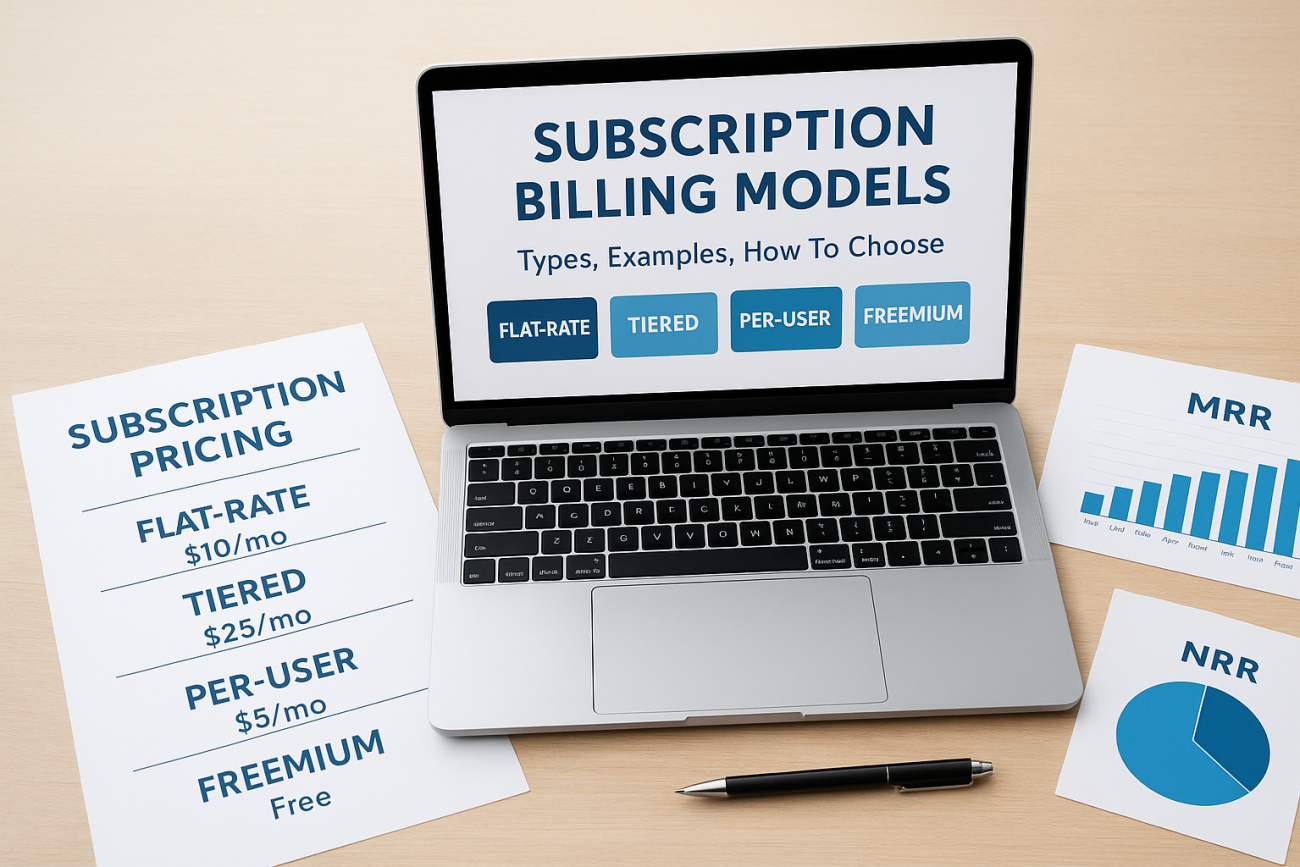
Whether you’re selling online training, SaaS tools, or membership access, the way you charge customers on a recurring basis shapes everything, from cash flow to retention to growth. Subscription billing models define the structure of that recurring relationship, and picking the wrong one can quietly undermine an otherwise strong product. At Atrixware, we’ve seen this firsthand: businesses using our Axis LMS to sell training courses often face this exact decision when setting up their e-commerce and licensing options.
The challenge isn’t a lack of choices. It’s the opposite. Flat-rate, tiered, usage-based, per-user, freemium, each model carries distinct trade-offs that affect how customers perceive value and how predictably revenue flows in. What works for a 10-person startup won’t necessarily work for an enterprise rolling out compliance training to thousands of learners. The right billing model aligns your pricing with how customers actually use and benefit from your product.
This article breaks down the most common subscription billing models, explains how each one works with real examples, and gives you a practical framework for choosing the model that fits your business. No jargon-heavy theory, just the information you need to make a confident, informed decision about how to bill your customers on a recurring basis.
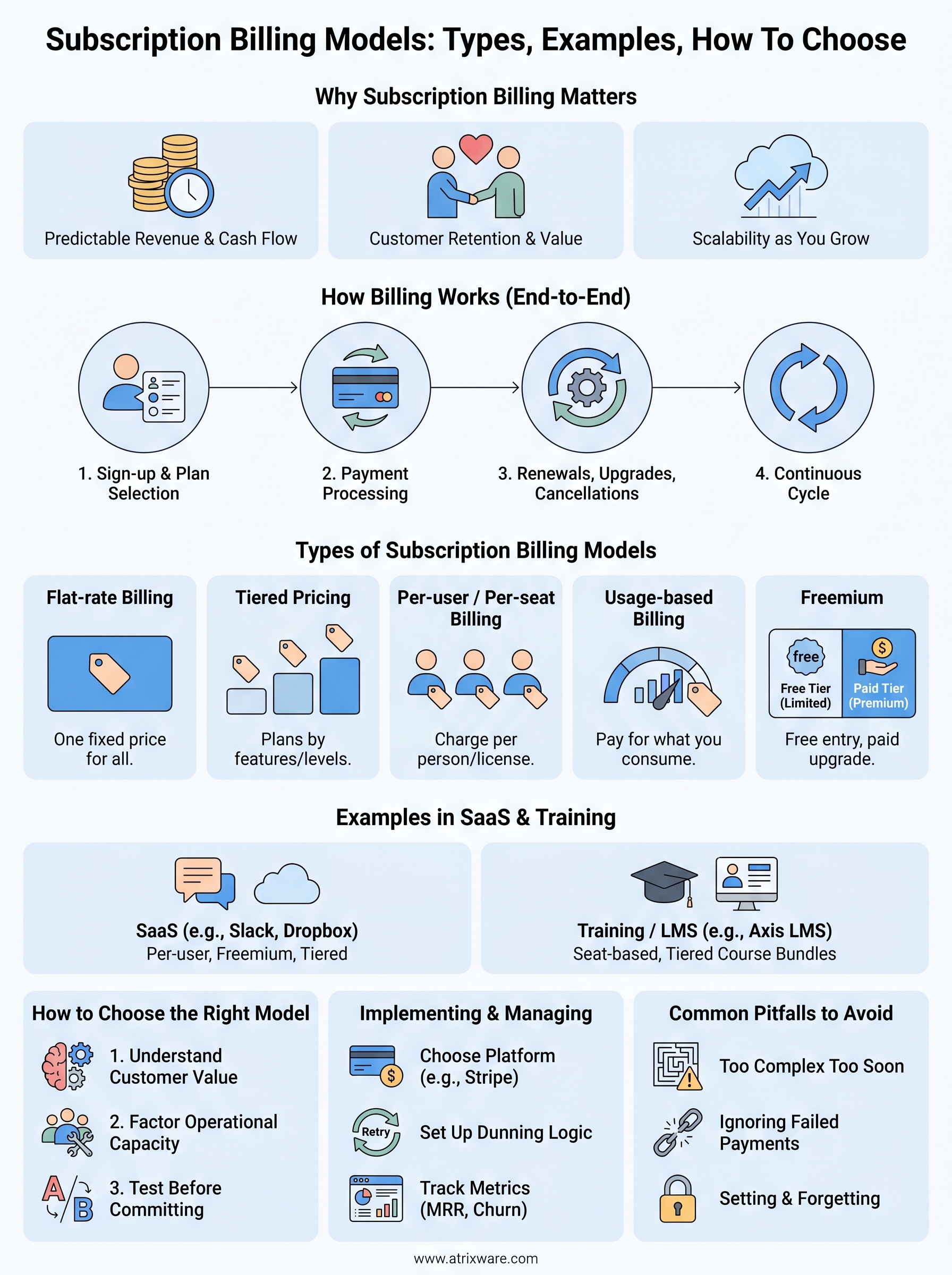
Why subscription billing models matter
The billing model you choose isn’t just a payment detail. It determines how predictably money comes in, how customers perceive the value they’re getting, and whether your business can grow without constantly restructuring its pricing. Subscription billing models sit at the intersection of product strategy and customer psychology, and getting that combination right has measurable consequences for your bottom line.
Revenue predictability and cash flow
When you lock in recurring revenue, you gain visibility into future income that one-time sales simply cannot provide. A flat monthly subscription from 500 customers gives you a reliable baseline to plan hiring, infrastructure, and marketing spend. Without that predictability, you make decisions based on hope rather than data, which leads to either under-investing in growth or over-extending your resources.
Predictable recurring revenue doesn’t just make accounting easier; it makes your entire business strategy more defensible.
Contrast this with a project-based or one-time fee model. Your revenue resets to zero at the start of each period, and every dollar requires fresh sales effort. Subscription billing removes that reset and gives your finance team something concrete to work with when planning for the months ahead.
Customer retention and perceived value
The billing model you choose signals what kind of relationship you intend to have with your customers. A per-user model tells customers that you grow alongside them. A flat-rate model signals simplicity and predictability. Customers respond to these signals, and the wrong model can create friction even when your product is excellent.
When customers feel like the billing structure rewards their usage pattern, they stay longer. Training organizations that sell seat licenses through a platform like Axis LMS, for instance, understand that enterprise buyers want to pay for a defined number of learners rather than face unpredictable consumption charges. That alignment between how customers use a product and how they’re charged for it directly reduces churn and makes renewal conversations much easier.
Scalability as your business grows
Your billing model either supports or constrains your growth trajectory. A model that works well at 50 customers may collapse operationally or lose its appeal when you reach 5,000. Usage-based models, for example, scale naturally with customer activity but require more sophisticated metering and billing infrastructure to manage reliably. Flat-rate models scale simply but can leave significant revenue on the table as your heaviest users extract more value than lighter ones.
Thinking about scalability means asking whether your pricing structure can handle both ends of the spectrum: a small business buying a single plan and an enterprise customer managing thousands of seats. If the answer is no, you’ll face a pricing overhaul at the worst possible time, usually right when growth is accelerating and your team is already stretched thin. The businesses that stay ahead treat their billing model as a strategic lever they actively manage, not a fixed policy they set up once and forget.
How subscription billing works end to end
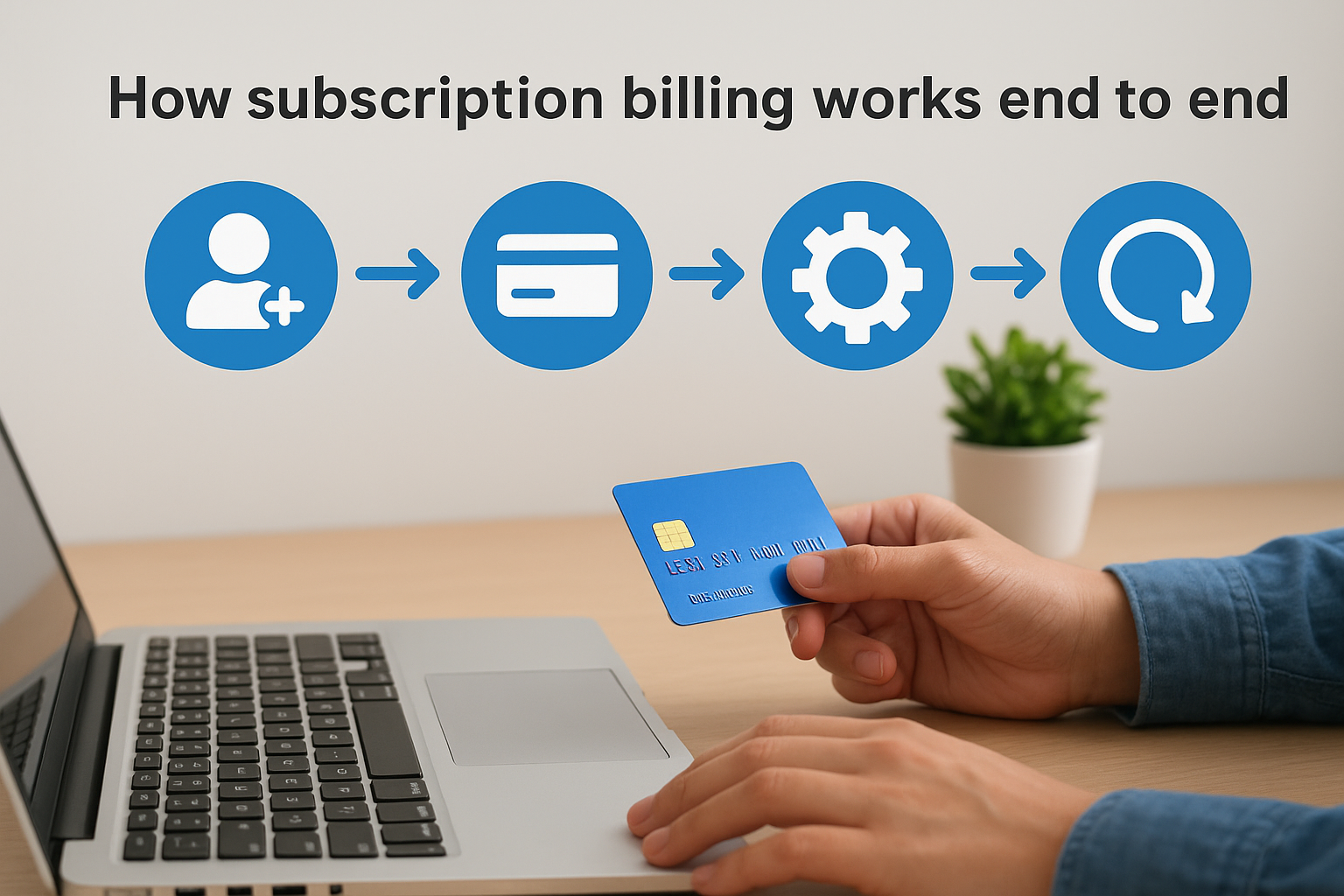
Understanding the mechanics behind subscription billing models helps you set up your system correctly and avoid costly gaps in your revenue operations. At its core, the process moves through four repeating stages: a customer signs up, payment gets processed on a defined schedule, the system handles account changes, and the cycle renews until the customer cancels. Each stage involves decisions that affect both the customer experience and your internal operations.
Customer sign-up and plan selection
When a customer decides to subscribe, they choose a plan and provide their payment credentials, typically a credit card or bank account. Your billing system stores this information securely, often through a payment processor that handles encryption and compliance on your behalf. At this point, the system records the billing start date, which anchors every future charge and renewal. Getting this step right matters because billing errors that trace back to a bad sign-up record are difficult to fix without frustrating the customer.
The sign-up moment sets the tone for the entire customer relationship, so a clean, transparent process here reduces disputes and builds trust from day one.
Payment processing and billing cycles
On each billing date, your payment processor charges the stored payment method and records the transaction. Most businesses bill monthly or annually, though some offer weekly or quarterly options depending on what their customers prefer. If a charge fails because of an expired card or insufficient funds, a well-configured system triggers automatic retry logic and sends the customer a prompt to update their payment information. Without this dunning process in place, failed payments quietly become lost revenue that compounds over time.
Renewals, upgrades, and cancellations
Subscription billing runs on automatic renewal by default, which means the customer continues paying until they take action to cancel or downgrade. Mid-cycle changes, like upgrading from one tier to another, require your system to calculate a prorated charge for the remaining days in the current period. Cancellations need to stop future charges immediately and, depending on your refund policy, may trigger a partial refund. Training businesses using a platform like Axis LMS deal with this constantly when enterprise clients adjust their seat licenses mid-contract, so having clear rules for each scenario built into your billing system saves significant administrative time.
Types of subscription billing models
Not every subscription billing model works the same way, and the differences between them run deeper than just price points. Each model reflects a specific assumption about how customers derive value from your product, and choosing one means betting on that assumption being correct for your audience. Here is a breakdown of the most common models and how each one operates.

Flat-rate billing
Flat-rate billing charges every customer the same fixed price for the same access, regardless of how much or how little they use the product. This model is simple to communicate and easy for customers to budget around. The trade-off is that it treats all customers identically, which means heavy users get a deal while light users may feel they’re overpaying and churn faster.
Simplicity is flat-rate billing’s biggest strength and its ceiling, because it limits your ability to capture more revenue as customer usage grows.
Tiered pricing
Tiered pricing groups features or usage levels into defined plans, typically labeled something like Starter, Professional, and Enterprise. Each tier offers more capability at a higher price, and customers self-select the plan that fits their current needs. This model works well when your product serves customers at different stages of growth, because it gives smaller buyers an affordable entry point while letting larger buyers unlock more value at a higher price point.
Per-user or per-seat billing
Per-user billing charges based on the number of people who access the product. For training platforms, this often means selling seat licenses for a specific number of learners. Customers find this model intuitive because costs scale directly with team size, which makes it easy to justify internally. The downside is that some customers limit their user count to keep costs down, which can actually reduce adoption.
Usage-based billing
Usage-based billing ties charges directly to what customers actually consume, such as the number of courses completed, API calls made, or gigabytes stored. This model rewards lower-volume customers with smaller bills and allows high-volume customers to spend more without hitting an arbitrary ceiling. The challenge is that revenue becomes harder to predict month to month, which requires more careful monitoring of usage trends.
Freemium
Freemium offers a permanently free tier with limited features and charges for access to premium functionality. The free tier drives acquisition, while the paid tier captures customers who have already experienced enough value to commit. This model works best when the upgrade trigger is obvious and your product’s core value is clear even at the free level.
Examples of billing models in SaaS and training
Seeing subscription billing models in practice makes it much easier to identify which one fits your situation. Real-world examples show you how companies structure their pricing to match what their customers value, and they reveal the reasoning behind each choice rather than just the label attached to it.
SaaS billing in action
Most SaaS companies layer multiple models together rather than committing to just one. Slack, for example, uses per-user billing at its core, charging a monthly rate per active member while offering a free tier with limited message history to drive adoption. Dropbox takes a similar approach, combining a freemium entry point with tiered plans that increase storage capacity and admin controls as teams grow. Both companies use the free tier to reduce friction at sign-up, then rely on clear upgrade triggers to convert users once they hit the limits of what the free plan provides.
The most effective SaaS pricing structures make the gap between free and paid feel obvious, not punishing, so customers upgrade because they see value, not because they feel forced.
Usage-based pricing has gained traction among infrastructure and API-driven products. AWS charges based on actual consumption of compute, storage, and data transfer, which means a startup and an enterprise both use the same platform but pay amounts that reflect their actual workload. That alignment between cost and consumption makes the model attractive to technical buyers who want to avoid paying for capacity they don’t use.
Training and LMS billing in action
Training businesses deal with a different set of buyer expectations than typical SaaS products. Enterprise HR teams and compliance officers often prefer seat-based pricing because it maps directly to headcount and fits how their procurement processes work. A company deploying compliance training to 200 employees wants to know their total cost upfront, not after they’ve logged usage. Axis LMS supports this by letting training providers sell seat licenses for defined learner counts, which gives both the seller and the buyer cost certainty from the start.
Some training businesses also use tiered annual plans that bundle access to a full course library, reporting tools, and support levels at different price points. Smaller organizations buy the entry tier to get started, while larger ones move up to unlock advanced compliance tracking and deeper integrations with their HR systems.
How to choose the right model for your business
Choosing among the available subscription billing models starts with one foundational question: how do your customers think about value? The answer to that question should drive your model selection more than any benchmark or industry trend. A billing structure that mismatches how your buyers perceive benefit creates constant friction, from sales objections to renewal resistance, and no amount of clever packaging fixes a model that is fundamentally misaligned.

Understand how your customers measure value
Your customers measure value in different ways depending on their role and their business. HR managers and compliance officers often think in terms of headcount, which makes per-seat or tiered pricing feel natural to them. Developers and technical buyers tend to think in consumption terms, which means usage-based billing feels fair because they see a direct connection between what they spend and what they use. Talking to your existing customers about how they internally justify the cost of a product tells you more than any pricing survey.
Consider mapping your customer types to the models most likely to match their mental model:
- Headcount-driven buyers (HR teams, training managers): per-user or seat-based billing
- Outcome-driven buyers (small businesses, teams with tight budgets): tiered flat-rate plans
- Variable-usage buyers (technical teams, API users): usage-based billing
- Exploration-first buyers (individual learners, early-stage teams): freemium entry points
Aligning your billing structure to the way buyers already think about cost makes every sales and renewal conversation shorter and simpler.
Factor in your operational capacity
The model you choose also needs to match what your team can actually manage today. Usage-based billing produces more revenue potential in theory, but it requires metering infrastructure, more detailed invoicing, and closer monitoring of accounts showing unusual consumption patterns. If your operations team is small and you are still building out your billing systems, a simpler model like flat-rate or basic tiered pricing lets you focus on product and customer success without getting buried in billing edge cases.
Test before you commit
No amount of analysis replaces real customer behavior. Run a structured pricing test with a segment of new customers, measure conversion rates, upgrade frequency, and churn at the three-month mark, then compare those numbers against your baseline. Adjusting your model based on actual data is far less disruptive early on than discovering the model is wrong after you have already scaled it across your entire customer base.
How to implement and manage billing operations
Putting subscription billing models into practice requires more than picking a pricing structure and turning on payments. You need a billing stack that handles recurring charges reliably, manages edge cases like failed payments and mid-cycle upgrades, and gives you clear visibility into the financial health of your subscription business. Getting these operational pieces right from the start saves you from disruptive fixes later.
Choose a payment and billing platform
Your billing platform sits at the center of every transaction, renewal, and account change, so choosing one that matches your current complexity and future needs matters more than picking the cheapest option. Platforms like Stripe and Zuora handle the mechanics of recurring charges, proration, and invoice generation, but they differ significantly in how much custom logic you need to configure.
The right billing platform should reduce your operational workload, not add to it, so evaluate each option based on how well it fits your existing tech stack.
Before committing, confirm that the platform supports every billing scenario you anticipate: free trials, annual prepayment, mid-cycle plan changes, and seat-based licensing if your product charges per user. Building those capabilities into your platform from day one prevents manual workarounds from accumulating into technical debt.
Set up dunning and retry logic
Failed payments are inevitable, and how your system responds to them determines how much revenue you actually collect versus how much silently disappears. Dunning refers to the automated process of retrying failed charges and notifying customers to update their payment information. Without it, a single expired credit card can end a customer relationship that would have otherwise renewed without issue.
Configure your retry schedule to attempt the charge again at spaced intervals, typically on days 3, 7, and 14 after the initial failure. Each retry attempt should trigger a customer-facing notification that explains the issue clearly and provides a direct link to update their billing details.
Track the metrics that matter
Running billing operations without tracking the right numbers leaves you reacting to problems rather than preventing them. Focus on these core subscription metrics to stay ahead:
- Monthly Recurring Revenue (MRR): total predictable revenue generated each month
- Churn rate: percentage of customers who cancel within a given period
- Failed payment rate: share of billing attempts that do not process successfully
- Net Revenue Retention (NRR): revenue retained and expanded from your existing customer base
Reviewing these numbers weekly gives your team early warning signals before a trend becomes a serious problem.
Common pitfalls and how to avoid them
Even businesses that research subscription billing models carefully make the same operational mistakes once they move from planning to execution. Knowing where other companies stumble gives you a concrete advantage when setting up your billing systems and keeping them running smoothly over time.
Setting a model that is too complex too soon
Businesses often over-engineer their billing structure at launch by offering too many tiers, add-ons, and usage thresholds at once. The reasoning sounds logical: more options mean more customers find the perfect fit. In practice, a complicated pricing page creates decision paralysis and pushes potential buyers toward simpler competitors. Start with two or three clearly differentiated plans, let real customer behavior tell you what is missing, and add complexity only when demand clearly justifies it.
Complexity that your customers cannot quickly understand costs you conversions before those prospects ever reach your sales team.
Treating failed payments as a minor issue
Failed payments drain revenue faster than most billing teams realize. When a charge fails and your system has no automated retry or dunning process, that subscription quietly lapses. The customer may not even notice until they lose access, which turns what could have been a routine billing fix into a cancellation and a support escalation. Set up retry logic on a spaced schedule, send clear notifications the day a payment fails, and give customers a frictionless way to update their payment method directly from the email.
Building proactive communication around failed payments also protects the customer relationship. A well-worded message that explains the issue without blame resolves the problem faster and leaves the customer feeling respected rather than penalized for an expired card.
Locking in your pricing model and never revisiting it
Your first pricing model is a starting point, not a permanent policy. Customer needs shift, your product evolves, and competitors adjust their pricing, all of which can make a previously effective model feel misaligned over time. Schedule a formal pricing review at least once per year. Pull your churn data, upgrade rates, and customer feedback to identify whether your current structure still reflects how customers experience value. Adjusting your model based on that evidence keeps your billing aligned with your product’s actual position in the market rather than where it stood when you first launched.
Next steps
Picking the right subscription billing models for your business comes down to understanding how your customers measure value, matching your pricing structure to that reality, and building billing operations that handle the inevitable edge cases without creating manual work for your team. The frameworks in this article give you a clear starting point, but the real learning happens when you put a model in front of actual customers and watch how they respond.
If you deliver training and want to sell it effectively, the billing structure you choose needs to work with how your learners and buyers think about cost. Axis LMS gives you the flexibility to sell seat licenses, bundle course access, and manage recurring training subscriptions in one place. Before committing to a platform or a pricing approach, take a few minutes to find out where you are in the LMS buying process and get a clearer picture of your next move.
