Ask five people to give you a security management definition and you’ll get five different answers. Some point to firewalls and access badges. Others mean risk assessments and audit trails. That confusion causes real problems: gaps in coverage, duplicated effort, and compliance failures that surface only after an incident.
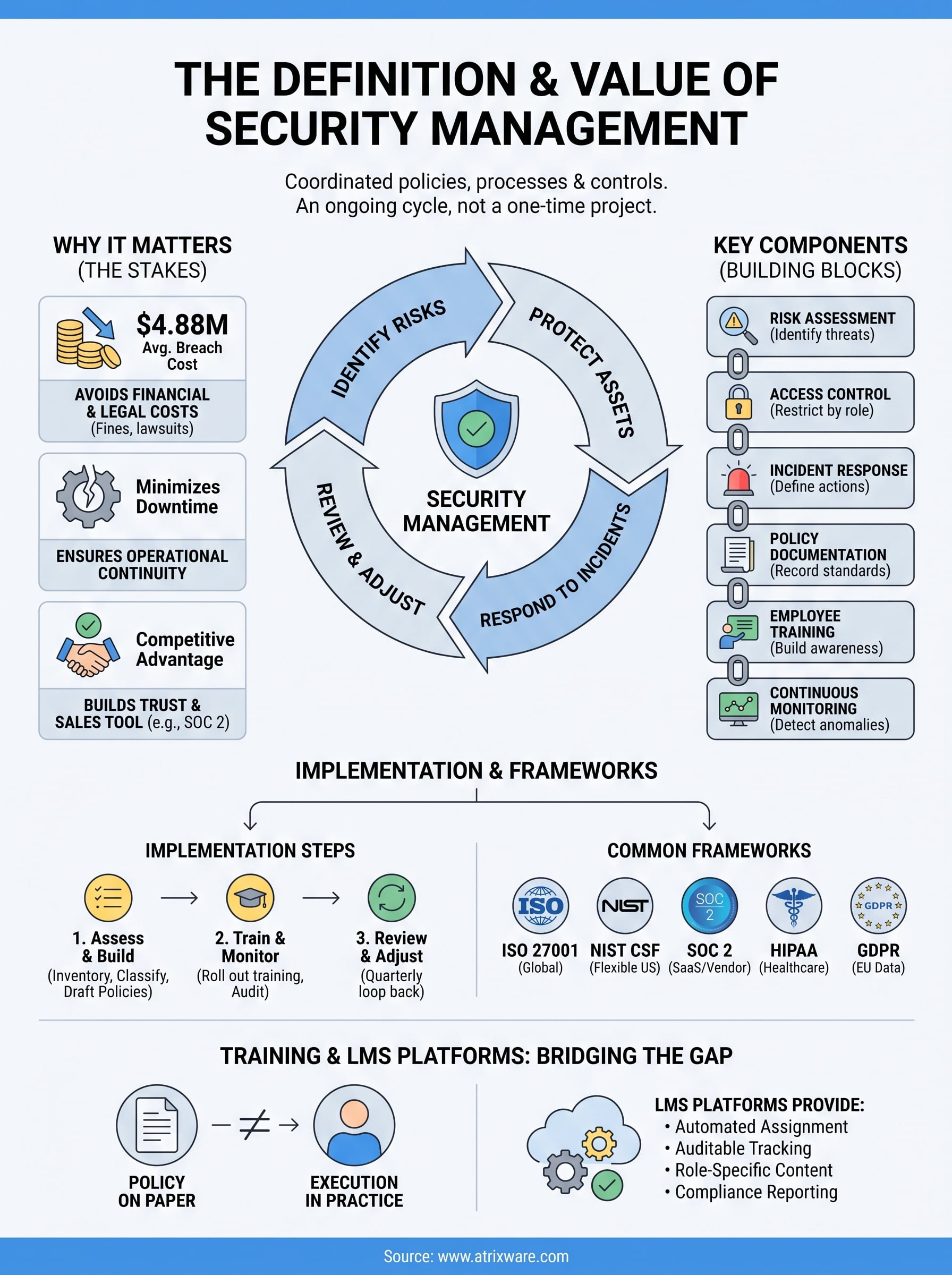
Here’s the straight answer. Security management is the coordinated set of policies, processes, and controls an organization uses to identify risks, protect its assets, and respond when something goes wrong. It covers physical security, information security, and increasingly, the training and access controls that keep people from becoming the weak link. Done right, it’s not a one-time project but an ongoing cycle of assessment, action, and review.
In this article, you’ll get a working definition you can actually apply, plus a breakdown of the key components every program needs, from risk assessment to incident response. We’ll also cover why this matters beyond checking a compliance box, and where training and tracking systems fit into keeping your team accountable and your organization protected.
Why security management matters for your organization
Skip security management and you’re not avoiding costs, you’re deferring them until they’re bigger. A single data breach now averages $4.88 million according to IBM’s 2024 Cost of a Data Breach Report, and that figure doesn’t count the lost customer trust or the months spent rebuilding your reputation. Organizations that treat security as an afterthought pay for it later, usually at the worst possible moment.
The financial and legal stakes
Regulators don’t care whether your gap was intentional. Compliance failures under frameworks like GDPR or HIPAA carry fines that scale with company revenue, and lawsuits from affected customers or partners often follow close behind. A structured security management program gives you documented proof that you took reasonable steps, which matters enormously in front of an auditor or a judge.
Weak security management doesn’t just risk data, it risks the survival of the business itself.
Operational continuity
Beyond fines, think about what happens the day systems go down. Ransomware, insider mistakes, and vendor outages all interrupt operations, and every hour offline costs money and credibility. A mature security management program builds in redundancy, response plans, and clear ownership so your team knows exactly what to do instead of scrambling.
Trust as a competitive advantage
Customers and partners increasingly ask vendors to prove their security posture before signing contracts. Showing a documented, actively managed program isn’t just defensive, it’s a sales tool. Enterprises now routinely require SOC 2 reports or ISO certifications as a condition of doing business, which means weak security management can quietly cost you deals you never even hear about.
Grasping these stakes is why so many leaders now treat security management as a core business function, not an IT side project. The next section breaks down the specific components that turn this understanding into a working, repeatable program.
Key components of an effective security management program
Every solid program rests on the same core building blocks, regardless of company size or industry. Skip one, and the rest weaken like a chain missing a link. Risk assessment comes first: you can’t protect what you haven’t identified, so mapping assets, threats, and vulnerabilities has to happen before you write a single policy.
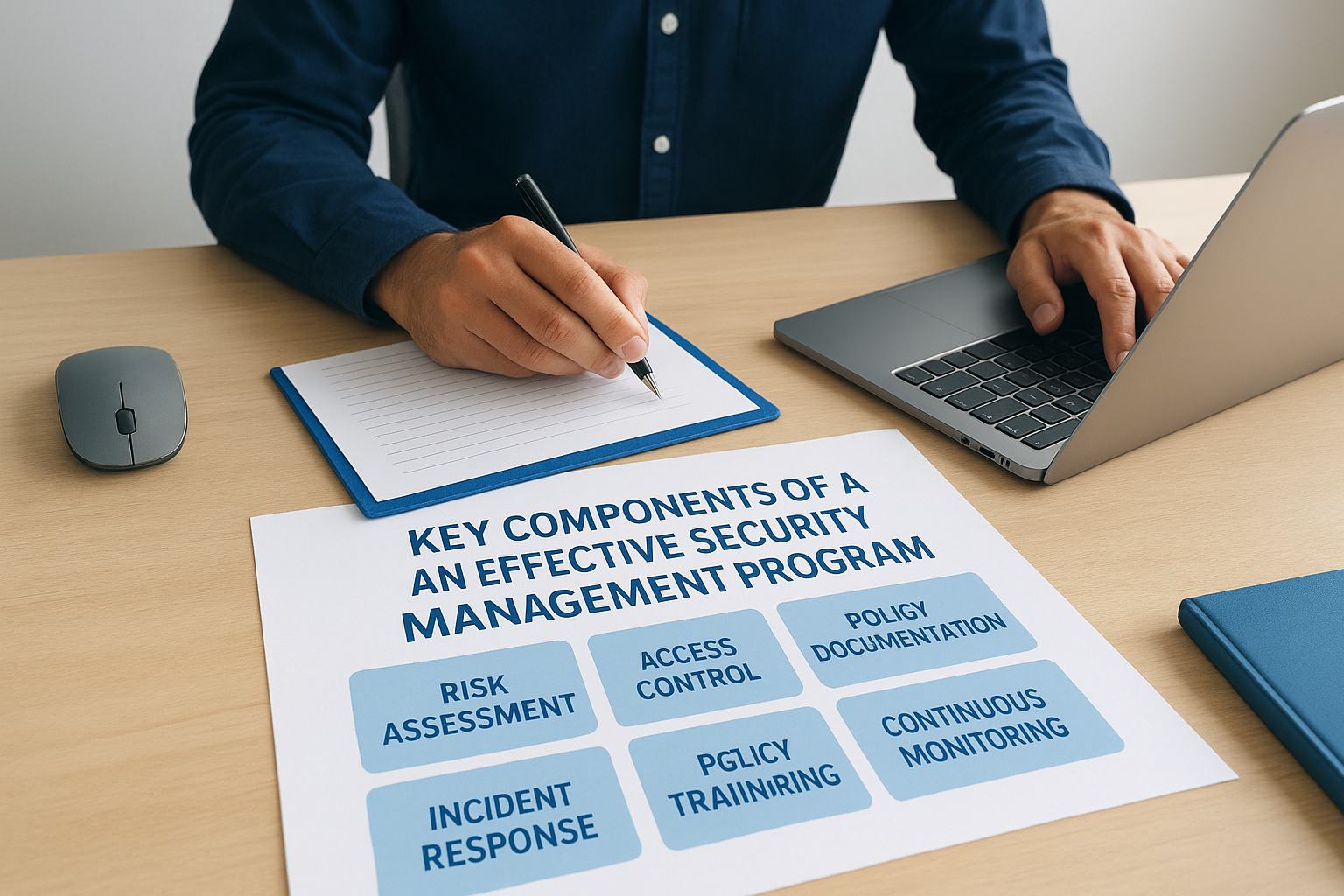
From there, access control and incident response carry the weight of day-to-day protection. Access control limits who can touch sensitive systems and data, while incident response defines exactly what happens the moment something goes wrong, who gets notified, what gets isolated, and how you recover.
| Component | What it does |
|---|---|
| Risk assessment | Identifies and prioritizes threats to assets |
| Access control | Restricts system and data access by role |
| Incident response | Defines actions when a breach or failure occurs |
| Policy documentation | Records standards and expected behavior |
| Employee training | Builds awareness and reduces human error |
| Continuous monitoring | Detects anomalies before they escalate |
Documentation ties everything together, giving auditors, new hires, and leadership a single source of truth. Without it, even a technically sound program looks disorganized from the outside.
How to implement security management step by step
Starting a security management program feels overwhelming until you break it into a sequence. Follow these steps in order, because each one builds on the last.
Assess, then build
Begin with a risk assessment that inventories every system, dataset, and physical asset worth protecting. From there, draft policies that match the risks you actually found, not a generic template pulled from another company.
- Inventory assets and classify data by sensitivity
- Assess threats and vulnerabilities against each asset
- Write policies covering access, incident response, and acceptable use
- Assign clear ownership for each policy area
- Roll out employee training tied to the policies
- Monitor continuously and audit on a set schedule
A security program only works if someone owns each step, on paper and in practice.
Review and adjust
Treat step six as a loop back to step one. Threats change, staff turnover creates new gaps, and vendors add new integrations that expand your attack surface. Scheduling a quarterly review keeps the program honest instead of letting it calcify into outdated documentation nobody reads.
Common security management frameworks and standards
You don’t need to invent a security management program from scratch. Established frameworks give you a tested structure, so you spend your energy on execution instead of reinventing controls that already exist. Picking the right one depends on your industry, your customers, and what regulators expect from you.

The major players
ISO 27001 remains the global benchmark for information security management systems, and certification signals to partners that your controls hold up under independent audit. NIST’s Cybersecurity Framework, maintained by the U.S. government, offers a flexible model built around five functions: identify, protect, detect, respond, and recover, making it a favorite for organizations that want structure without rigid certification requirements.
| Framework | Best fit |
|---|---|
| ISO 27001 | Global, cross-industry certification |
| NIST CSF | Flexible, U.S.-based organizations |
| SOC 2 | SaaS and vendor trust reporting |
| HIPAA | Healthcare data protection |
| GDPR | EU personal data handling |
Frameworks don’t replace judgment, they give your judgment a proven structure to work within.
Matching the framework to your risk
Healthcare organizations lean on HIPAA, while SaaS vendors chase SOC 2 reports because customers demand them before signing. Whichever standard you choose, treat it as a floor, not a ceiling, for your program.
How training and LMS platforms strengthen security management
Policies only work if people actually follow them, and that’s where employee training stops being a checkbox and starts becoming a control. A learning management system turns scattered training efforts into a tracked, auditable process, which matters when a regulator or a customer asks for proof that your team knows the rules.
Tracking accountability at scale
A modern LMS platform assigns compliance courses automatically, flags who hasn’t finished, and generates the completion records auditors want to see. Instead of chasing spreadsheets, security teams pull a report and know instantly where the gaps sit.
- Automated assignment of security and compliance courses
- Real-time completion tracking by department or role
- Recertification reminders for standards like GDPR or FDA 21 CFR Part 11
- Reporting exports ready for audits
Untracked training is just a hope. Tracked training is a control.
Reinforcing culture, not just checkboxes
Beyond compliance, ongoing training shapes how employees actually behave with sensitive data day to day. Platforms like Axis LMS let you build role-specific paths, so a finance employee gets different security training than someone in customer support, matching content to actual risk exposure rather than a one-size-fits-all module.
Putting security management into practice
A clear security management definition only matters if it changes how your organization actually operates. Risk assessment, access control, incident response, and documented policies form the backbone, but none of it holds without people who understand the rules and follow them consistently. That’s the gap that trips up otherwise solid programs: strong policy on paper, weak execution in practice.
Closing that gap starts with tracked, role-specific training that turns compliance from a hope into a verifiable control. If you’re evaluating whether your current setup can handle that job, or whether you’re even ready to bring in a system built for it, take a few minutes to try the LMS readiness quiz. It’ll show you exactly where you stand and what to tackle next.
