
Every dollar your organization spends on training is an investment, but how do you prove it’s paying off? That’s exactly what is training ROI about: putting a concrete number on the value your learning programs generate. Without that number, training budgets are easy targets when leadership starts looking for costs to cut, and L&D teams struggle to justify even the programs that are clearly working.
Training ROI (Return on Investment) measures the financial return your organization gains relative to what it spends on employee development. It’s a straightforward concept, but calculating it accurately requires the right approach, the right data, and often, the right tools to capture that data in the first place. Most organizations know their training costs down to the penny, course licenses, instructor fees, time away from work, but quantifying the benefits is where things get tricky.
At Atrixware, we built Axis LMS with this measurement challenge in mind. The platform’s comprehensive reporting and tracking capabilities give you the raw data you need to connect training activity to business outcomes. But before you can leverage any tool, you need to understand the fundamentals. This article breaks down the training ROI formula, walks through real calculation examples, explores common measurement challenges, and gives you a practical framework for demonstrating the true impact of your training programs.
Why training ROI matters
When organizations skip measuring training ROI, budget decisions get made on instinct rather than evidence. That creates a compounding problem over time. You might continue funding programs that deliver little value while cutting the ones that actually move the needle on performance. Understanding what is training ROI and acting on that understanding is the first step toward building a training function that defends its budget with data, not arguments. Every other business function from marketing to product development justifies its spending with numbers, and training should do the same.
Budget decisions need evidence, not instinct
Every L&D team eventually faces a budget review. Leadership asks what training produced, and without concrete numbers, the conversation gets uncomfortable fast. When you can show that a sales training program generated $180,000 in additional revenue against a $40,000 investment, the dynamic shifts completely. You stop defending costs and start presenting results that speak the same language as every other business function in the room.
The absence of measurement also creates a credibility gap that grows over time. When you request budget for a new program, decision-makers evaluate the ask based on how past investments performed. If past programs carry no documented return, your next request looks like a guess rather than a strategy. Consistent ROI tracking builds a performance record that strengthens every future proposal you bring to leadership.
Without ROI data, training gets treated as an expense. With it, training earns a seat at the same table as marketing, sales, and product development.
ROI data shapes smarter program decisions
Measuring training ROI isn’t only about satisfying finance departments. It gives you operational intelligence you can act on directly. When you compare ROI across different programs, formats, and learner groups, patterns emerge that tell you where to invest more resources and where to pull back. A compliance program with a persistently low ROI might signal poor content design, low learner engagement, or a delivery format that simply doesn’t fit the audience.
Your data also helps you identify which investments scale efficiently. Some programs deliver strong returns for small cohorts but don’t translate well when rolled out to a broader audience. Others improve significantly with scale because fixed development costs get distributed across more learners. Without measurement, you make scaling decisions without knowing whether the underlying economics support them at all.
How retention and leadership alignment raise the stakes
Training ROI extends well beyond direct financial returns. Employee retention is one of the largest hidden costs any organization carries, and training quality has a measurable impact on whether employees stay or leave. Research consistently shows that employees who feel their organization actively invests in their development are far more likely to remain, which translates directly into avoided recruitment and replacement costs.
When you factor turnover costs, onboarding time, and the productivity gap created by vacant roles into your ROI calculations, training programs that reduce attrition often show the strongest returns in your entire portfolio. A well-designed onboarding program might look modest on paper until you account for the full cost of replacing a new hire who left because they felt unsupported in their first 90 days on the job.
Leadership alignment also depends heavily on what you measure and report. There’s a real difference between telling your CEO that 400 employees completed a customer service course and telling them that the program reduced complaint escalations by 22 percent, saving the business $95,000 in resolution costs that quarter. The second statement connects your work directly to the outcomes leadership tracks and cares about. Organizations that build this connection consistently find their training budgets easier to protect and expand because the value is visible, documented, and tied to results the business already measures.
What counts as training ROI
Training ROI isn’t just one number from one type of outcome. Understanding what is training ROI fully means recognizing that returns come in several forms, some tied directly to revenue and cost savings, others connected to operational performance that only translates to dollars when you do the math. Both categories are legitimate, and both belong in your calculation if you want an accurate picture of what your training investment is producing.

Direct financial returns
Direct returns are the easiest to present to leadership because they connect training to dollars with minimal interpretation. Revenue increases tied to sales training, error-reduction savings from technical skills development, and reduced overtime costs from productivity improvements all qualify. When a customer service team completes communication training and your average handle time drops by three minutes per call, the math between that improvement and recovered labor costs is straightforward.
Cost avoidance is another direct return that frequently goes uncounted. Compliance training that prevents a regulatory fine or safety training that reduces workers’ compensation claims produces a measurable dollar figure you can legitimately include in your ROI calculation. These returns are real even though no new revenue changed hands, because the money never had to leave the organization in the first place. Treating cost avoidance as a second-tier outcome understates the value of some of your most important programs.
Cost avoidance belongs in your ROI calculation with the same weight as revenue generation.
Indirect and operational returns
Indirect returns require more interpretation, but they carry substantial financial weight when you take the time to quantify them. Employee retention improvements following stronger onboarding or career development programs reduce your recruitment and replacement costs, and those costs are significant. The Society for Human Resource Management estimates that replacing an employee can cost between 50 and 200 percent of their annual salary depending on their role, which makes retention-focused training one of your highest-return investments once you account for the full cost of turnover.
Productivity improvements also fall into this category when you cannot tie them directly to a revenue line. Faster task completion, fewer escalations, and reduced supervision requirements all translate to recovered labor hours. Those recovered hours have a dollar value, and that value belongs in your analysis. The key is deciding before a program launches exactly how you will quantify each expected benefit. Building your measurement criteria at the design stage gives you cleaner data and a more defensible ROI figure when you present results to leadership.
The training ROI formula and variations
Before you can measure what is training ROI for any specific program, you need the right formula to work with. The core calculation is straightforward, but several variations exist depending on what you’re measuring and how much data you have available. Knowing which version to use, and when, is what separates a defensible ROI figure from one that falls apart under scrutiny.
The standard training ROI formula
The foundational formula comes directly from traditional business ROI methodology and applies cleanly to training programs when you have solid cost and benefit data:

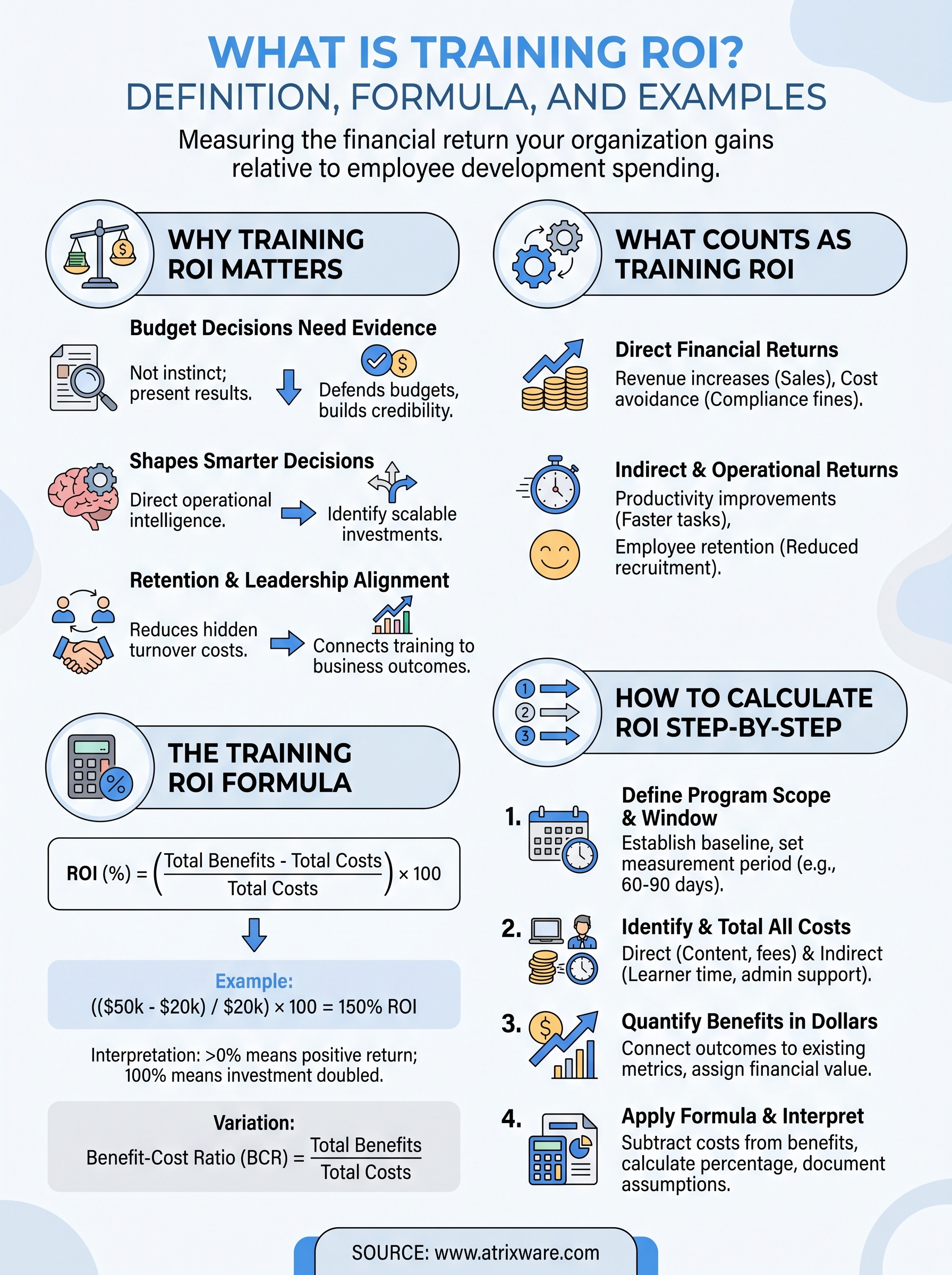
Training ROI (%) = ((Total Benefits – Total Costs) / Total Costs) × 100
A result above zero means your program returned more than it cost. A result of 100% means you doubled your investment. For example, if a training program cost $20,000 and generated $50,000 in measurable benefits, your calculation looks like this: (($50,000 – $20,000) / $20,000) × 100 = 150% ROI. That number tells leadership exactly what the investment produced in a format they already understand from every other business function.
The standard formula works because it uses the same math leadership applies to every other investment decision in the organization.
Variations that fit different scenarios
The standard formula assumes you can convert all meaningful benefits into dollar amounts, which isn’t always realistic. When you’re measuring programs where full monetization is difficult, a few practical variations can give you usable results without forcing inaccurate assumptions into your numbers.
The benefit-cost ratio (BCR) is a simpler version that divides total benefits by total costs rather than subtracting them first. A BCR of 2.5 means you received $2.50 in benefits for every $1.00 spent. This format communicates quickly to stakeholders who want a single summary number rather than a percentage they need to interpret.
Some organizations also separate hard returns from soft returns and report them independently rather than combining them into one figure. Hard returns cover direct financial outcomes like revenue increases and cost savings. Soft returns cover operational improvements like faster onboarding completion or higher manager satisfaction scores that you haven’t fully translated into dollars yet. Reporting both categories separately is more transparent than forcing every outcome into a single calculation, and it gives leadership a complete picture of program value even when some elements resist precise monetization at the time of reporting.
How to calculate training ROI step by step
Understanding what is training ROI in theory is useful, but the real value comes from working through an actual calculation. The process follows four concrete steps that move from scoping your program to producing a number you can present to leadership with confidence. Each step builds on the previous one, so skipping ahead creates gaps in your data that undermine your final result.

Step 1: Define your program scope and measurement window
Before you collect any data, you need to establish exactly what program you’re measuring and over what time period. A sales training rollout requires a different measurement window than a compliance certification program. Setting your scope upfront prevents data drift and gives you a clean baseline to compare against your post-training results.
Choose a measurement window that gives behavioral changes enough time to produce visible outcomes. Most training programs need at least 60 to 90 days post-completion before performance improvements show up in the metrics that matter.
Step 2: Identify and total all program costs
Your cost figure needs to capture everything the program consumed, not just the obvious line items. Direct costs include content development, platform licensing, instructor fees, and any materials you purchased. Indirect costs include learner time away from productive work, manager time spent supporting the training, and IT resources required to deploy it.
Use a cost inventory to avoid gaps:
- Content development or licensing fees
- Platform and technology costs
- Facilitator or instructor compensation
- Learner hours multiplied by average hourly compensation
- Administrative and coordination time
Step 3: Quantify your benefits in dollars
This step is where most organizations stall, but it doesn’t have to be complicated. Start with the outcomes you already track: sales numbers, error rates, customer satisfaction scores, or completion time for key tasks. Then assign a dollar value to the change between your baseline and your post-training measurement.
If you defined your measurement criteria before the program launched, this step becomes a data retrieval exercise rather than a reconstruction project.
Step 4: Apply the formula and interpret your result
With your total costs and total benefits documented, the calculation is straightforward. Subtract your total costs from your total benefits, divide that figure by your total costs, and multiply by 100. A result of 120% means your program returned $2.20 for every dollar invested.
Document your assumptions alongside the final number. If you estimated productivity improvements based on manager surveys rather than time-tracking data, note that clearly in your report. Transparency about your methodology builds credibility and makes the ROI figure far more defensible when leadership asks how you arrived at the number.
How to capture training costs accurately
One of the most common reasons what is training ROI calculations produce unreliable results is an incomplete cost picture. Most organizations start with the obvious line items, course licenses and instructor fees, but stop before they capture everything the program actually consumed. An accurate ROI figure requires a complete cost inventory, and building that inventory before the program launches is far easier than reconstructing it afterward from scattered records and memory.
Direct costs you can invoice and document
Direct costs are the ones that generate a paper trail, and they should be the foundation of your cost total. Content development expenses cover any internal labor hours spent building course materials or external fees paid to an instructional design vendor. Platform licensing, hosting fees, and any third-party tools your team used to build or deliver the training also belong here. If you paid a facilitator, subject-matter expert, or external trainer, their full compensation goes into this category, including travel and accommodation if the training ran in person.
Common direct cost categories to capture:
- Content development labor (internal hours × hourly rate)
- Platform and technology licensing fees
- External vendor or facilitator fees
- Printed materials, equipment, or physical resources
- Travel and accommodation for in-person delivery
Hidden costs that most calculations miss
The costs that most ROI calculations undercount are the ones that never generate an invoice. Learner time is the largest single hidden cost in almost every training program. When an employee spends three hours completing a course, those three hours carry a real dollar value equal to their average hourly compensation. Multiply that across your full learner population and the figure often exceeds everything else in your cost total combined.
Learner time away from productive work is a real cost, and excluding it from your calculation produces an ROI figure that overstates your actual return.
Manager and administrator time also deserves a line in your cost inventory. Scheduling communications, learner support, compliance tracking, and reporting all consume hours that belong to the program. An LMS with strong automation and reporting tools like Axis LMS reduces these administrative hours significantly, but you still need to account for whatever time your team actually spent managing the rollout. Capturing these less visible costs produces a more honest denominator in your formula, which gives you an ROI figure that holds up when leadership asks how you built the number.
How to quantify training benefits in dollars
Quantifying benefits is the step that separates a credible what is training ROI calculation from a rough estimate that leadership will question immediately. The goal is to connect training outcomes to numbers your organization already tracks, then assign a dollar value to the change you observe. You don’t need to invent new measurement systems. In most cases, the data already exists inside your LMS reports, your HR system, or your operational dashboards.
Connect outcomes to the metrics you already track
Start by listing the performance problems your training was designed to solve. A customer service program targeting escalations, a product knowledge course targeting upsell rates, and a safety program targeting incident frequency all point to specific metrics that someone in your organization is already recording. Your job is to establish a baseline before training begins and then measure the same metric after your defined observation window closes.
Match each training objective to a business metric using a simple framework:
| Training Objective | Business Metric | Data Source |
|---|---|---|
| Reduce handle time | Average minutes per call | Call center platform |
| Improve close rate | Revenue per rep per quarter | CRM |
| Reduce safety incidents | Incident reports filed | HR or safety system |
| Accelerate onboarding | Time to full productivity | Manager assessment |
This mapping exercise forces clarity before the program launches and gives you a clean data collection plan rather than a reconstruction project after the fact.
Assign dollar values to the change you measure
Once you have a before-and-after metric, the next step is translating that difference into dollars. Multiply the unit improvement by its financial value to produce a benefit figure you can plug directly into your ROI formula. If your training reduced average customer complaint resolution from five days to three days, calculate the loaded labor cost per day for your resolution team and multiply by the volume of cases handled. The result is a defensible dollar figure tied to a real operational change.
The most credible benefit figures come from calculations built on data your organization already collects and trusts.
For outcomes like retention improvements, use a replacement cost estimate based on salary percentage rather than guessing. Your HR or finance team likely has an existing figure for average cost-per-hire and onboarding time that you can apply directly. Borrowing numbers your organization already endorses makes your benefit calculation far stronger than any external benchmark you might apply instead.
Examples of training ROI in common programs
Seeing what is training ROI in action is often the fastest way to understand how to apply it inside your own organization. Real program examples show how costs and benefits connect in practice, and they give you reference points for setting realistic return expectations before you launch your next initiative.

Sales training
Sales training typically produces some of the most visible ROI numbers in any organization because the benefits connect directly to revenue figures your CRM already tracks. If you spend $30,000 training 20 sales reps and their average quarterly revenue per rep increases from $85,000 to $100,000, you have generated $300,000 in additional revenue against a $30,000 investment. That produces a 900% ROI using the standard formula, and every figure in that calculation comes from data your sales team already measures.
The key variable is determining how much of the performance improvement actually came from training rather than market conditions or other factors. Using a control group or comparing performance across trained and untrained reps in the same period gives you a far more defensible attribution method when leadership reviews your results.
Compliance and safety training
Compliance programs often show their strongest returns through cost avoidance rather than revenue generation. A regulatory fine avoided, a workers’ compensation claim that never filed, or a lawsuit that never materialized all produce real financial returns even though no new revenue entered the business. If your safety training costs $15,000 annually and prevents two incidents that would have each cost $25,000 in claims and resolution, your program returned $35,000 on a $15,000 investment.
Cost avoidance from compliance training is one of the most underreported return categories in any training portfolio.
These programs also carry operational continuity value that compounds over time. Consistent compliance certifications protect your organization from regulatory scrutiny and reduce dependence on individual employees who carry institutional knowledge informally.
Onboarding programs
Onboarding ROI is driven almost entirely by two factors: time to full productivity and first-year retention. A structured onboarding program that moves new hires to full output two weeks faster than an unstructured approach saves real labor costs across every hire your organization makes that year. If your average new hire earns $55,000 annually and you onboard 40 people per year, two weeks of recovered productivity represents roughly $85,000 in recovered output.
Retaining even three or four additional employees per year at an average replacement cost of $15,000 each adds another $45,000 to $60,000 on top of that. These two benefit categories together make onboarding one of the highest-return investments across your entire training portfolio.
Common mistakes that skew training ROI
Even organizations that commit to measuring what is training ROI regularly still produce numbers that misrepresent actual program performance. The errors usually aren’t dramatic, but they compound quickly when decision-makers use flawed figures to allocate next year’s budget. Recognizing the most common calculation mistakes lets you correct them before they distort your results and undermine the credibility of your entire measurement approach.
Measuring too early or skipping a baseline
Collecting post-training data before learners have had time to apply new skills is one of the most frequent errors in ROI reporting. Behavior change takes time to surface in performance metrics, and measuring at the two-week mark instead of the 60-to-90-day mark produces results that look weak even when the program is working exactly as intended. You end up with a number that undervalues a strong program simply because the observation window closed too soon.
Skipping a baseline creates the opposite problem. Without a documented pre-training benchmark, you have nothing meaningful to compare your post-training results against. Estimating where performance started after the fact invites bias into your calculation, and leadership will notice.
Counting only direct costs
Many ROI calculations include platform licenses and facilitator fees while completely ignoring learner time away from productive work. That omission produces an artificially low cost figure, which inflates your ROI percentage and makes your program look more efficient than it actually was. When auditors or finance teams reconstruct the true cost later, the gap between your reported figure and the actual figure damages your credibility on future proposals.
An inflated ROI built on an incomplete cost total is more damaging to your credibility than a lower but honest number.
Build a full cost inventory that includes learner hours, manager support time, and IT resources, not just the items that generated an invoice. A complete denominator gives you an ROI figure that holds up under scrutiny.
Attributing all gains to training alone
When performance improves after a training rollout, it’s tempting to credit the entire change to the program. In most cases, market conditions, new product features, or staffing changes also contributed to the outcome. Claiming 100 percent attribution overstates your results and sets an expectation for future programs that is unrealistic to replicate.
Use control groups or cohort comparisons to isolate the training effect from other variables wherever possible. When control groups aren’t feasible, document the external factors that may have influenced your results and apply a conservative attribution estimate rather than claiming the full gain.
How to improve training ROI over time
Measuring what is training ROI once gives you a data point. Measuring it consistently and acting on the results is what builds a training function that keeps improving its returns year over year. Most organizations see the strongest ROI gains not from launching new programs but from refining what already exists based on real performance data. That process requires a commitment to regular review, honest assessment, and willingness to change what isn’t working.
Iterate based on performance data
Your LMS reporting is the most direct source of intelligence for improving ROI over time. Completion rates, assessment scores, and post-training performance metrics tell you which programs are delivering on their objectives and which are falling short. When a program consistently shows low knowledge retention scores followed by flat performance improvement, the problem is usually content design, not learner motivation.
Consistent underperformance in a program is a design problem before it’s a learner problem.
Review each program’s metrics at least once per quarter and compare them against the baseline data you captured before launch. Build a short improvement checklist that covers content relevance, assessment quality, delivery format, and learner support resources. Programs that fail on two or more of those dimensions need a redesign, not just a refresh.
Close the gap between training and application
The single biggest driver of low training ROI is the gap between what employees learn and what they actually apply on the job. Knowledge retention drops sharply without reinforcement, and that drop directly reduces the performance improvements your ROI calculation depends on. Adding structured follow-up activities such as manager check-ins, short reinforcement modules, or peer practice sessions closes that gap without significantly increasing your program cost.
You can also improve application rates by aligning training content more tightly to the specific tasks learners perform daily. Generic courses that cover broad topics produce weaker behavior change than targeted programs built around real job scenarios. Audit your highest-cost programs first and ask whether the content maps directly to observable work tasks. Where it doesn’t, narrow the scope so learners can apply what they learned within days of completing the training, not weeks. That faster application cycle shortens the time between your training investment and the measurable performance improvements that show up in your ROI calculation.
Your next steps
You now have a complete picture of what is training ROI: how to define it, calculate it accurately, avoid the errors that distort results, and improve returns over time. The framework only works, though, when you have reliable data flowing from your training programs into a system that makes it easy to track, report, and act on. Without that foundation, even the best ROI methodology produces results you can’t fully trust.
Start by auditing one program you currently run and applying the four-step calculation process from this article. Identify your costs, set your baseline, define your benefit metrics, and run the numbers after your observation window closes. That first completed calculation gives you a repeatable model you can apply across your entire training portfolio.
If your current platform makes data collection harder than it should be, explore what Axis LMS can do for your training programs and see the reporting tools in action.
