
You invested in training. Leadership wants to know if it worked. But "it felt useful" doesn’t cut it when someone’s asking for hard numbers. A training ROI model gives you a structured way to connect your programs to measurable business outcomes, not just satisfaction scores or completion rates, but actual financial return.
The Phillips ROI Model is one of the most widely adopted frameworks for doing exactly this. Built on five evaluation levels, it extends the classic Kirkpatrick model by adding a dedicated step for calculating monetary return on investment. It answers the question every training leader eventually faces: did this program produce more value than it cost?
At Atrixware, we build Axis LMS to help organizations deliver, track, and manage training at scale. But delivering training is only half the equation, proving its impact matters just as much. That’s why understanding how to apply a structured ROI methodology is critical for anyone running training programs through an LMS. This article breaks down the Phillips ROI Model level by level, walks through the calculation, and shows you how to put it to work in your organization.
Why training ROI matters to the business
Training budgets rarely shrink during good times, but they’re often the first line item cut when margins tighten. If you can’t demonstrate what training produces in concrete terms, you’re making it easy for leadership to treat it as a cost rather than an investment. A solid training ROI model changes that dynamic by putting your programs in the same language as every other business initiative: dollars returned per dollar spent.
Training budgets need a financial justification
Most organizations spend significant money on learning and development every year, but many L&D teams struggle to articulate what that spending actually produces. Satisfaction surveys and course completion rates tell you whether people showed up and whether they liked it. They don’t tell you whether performance improved, whether errors dropped, or whether that improvement generated measurable financial value for the company.
When you frame training outcomes in financial terms, you shift the conversation from "did learners enjoy it?" to "what did the business gain?"
Leadership makes budget decisions based on expected and demonstrated returns. If your training program sits outside that framework, it’s competing for funding on opinion rather than evidence. Organizations that track ROI systematically are better positioned to protect their budgets, justify new programs, and expand initiatives that are working.
ROI data drives better training decisions
Measuring return on investment isn’t just about defending your budget. It also tells you which programs to keep, improve, or cut. Without this data, you’re making program decisions based on gut instinct or feedback forms. With it, you can identify where learning actually changed behavior and where it didn’t, and then adjust accordingly.
This matters because not every training program produces equal results. A compliance course might carry a high cost-avoidance value by reducing regulatory violations, while a soft skills workshop might show minimal impact on observable performance metrics. Knowing the difference lets you allocate resources where they produce the most return.
Stakeholders expect accountability
Executives and department heads increasingly expect the same accountability from L&D that they demand from marketing, operations, or sales. When a VP asks whether a leadership development program was worth the investment, "participants rated it 4.5 out of 5" is not a satisfying answer. You need to be able to point to specific performance changes and their financial value.
This is the core reason frameworks like the Phillips model exist. They give you a repeatable, defensible methodology for answering that question with evidence instead of estimates. Building this discipline into how you evaluate training programs protects your credibility as an L&D professional and strengthens the case for continued investment in learning across the organization.
The five levels of the Phillips ROI model
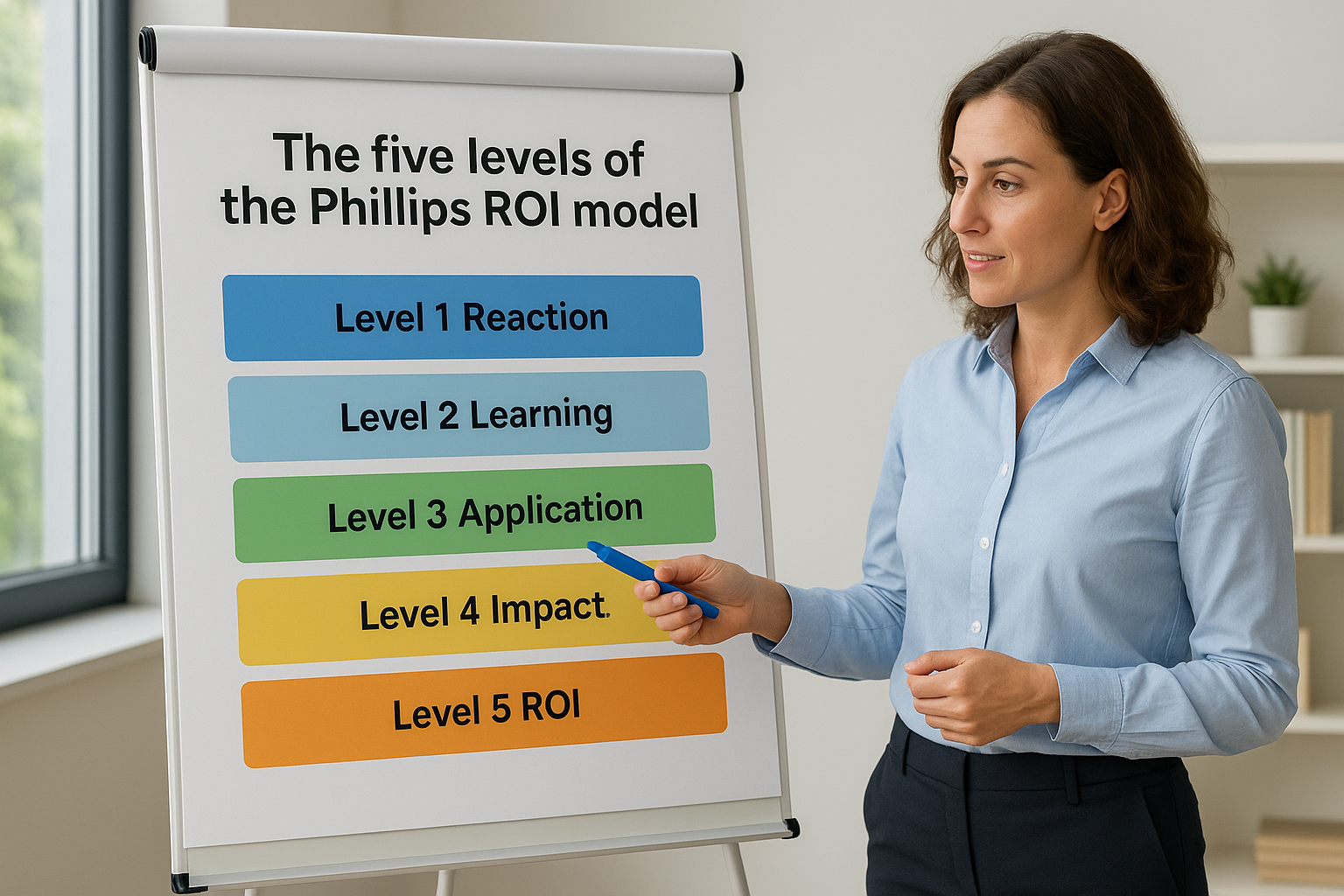
The Phillips ROI Model builds directly on the Kirkpatrick Model by adding a fifth level dedicated to financial measurement. Each level asks a more precise question than the one before it, moving from learner experience all the way to measurable monetary return. You need all five to build a complete, defensible picture of training effectiveness.
Levels one through four: building the evidence base
Level 1, Reaction, captures whether learners found the training relevant and worthwhile, typically through post-course surveys. Level 2, Learning, measures whether they actually acquired the knowledge or skills the program aimed to deliver, usually through assessments or demonstrations. These two levels are the most common in corporate training, but they only tell you what happened in the learning environment.
Application and Impact push the model further. Level 3, Application, shifts focus to on-the-job behavior: are learners actually using what they learned? This is where many organizations stop collecting data, yet it’s one of the most critical checkpoints. Level 4, Impact, asks whether that application produced measurable business results, such as reduced errors, faster onboarding times, higher sales conversion rates, or fewer compliance violations.
If you stop at Level 4, you have powerful evidence. Level 5 translates that evidence into the financial terms leadership actually uses to make decisions.
Level five: the ROI calculation
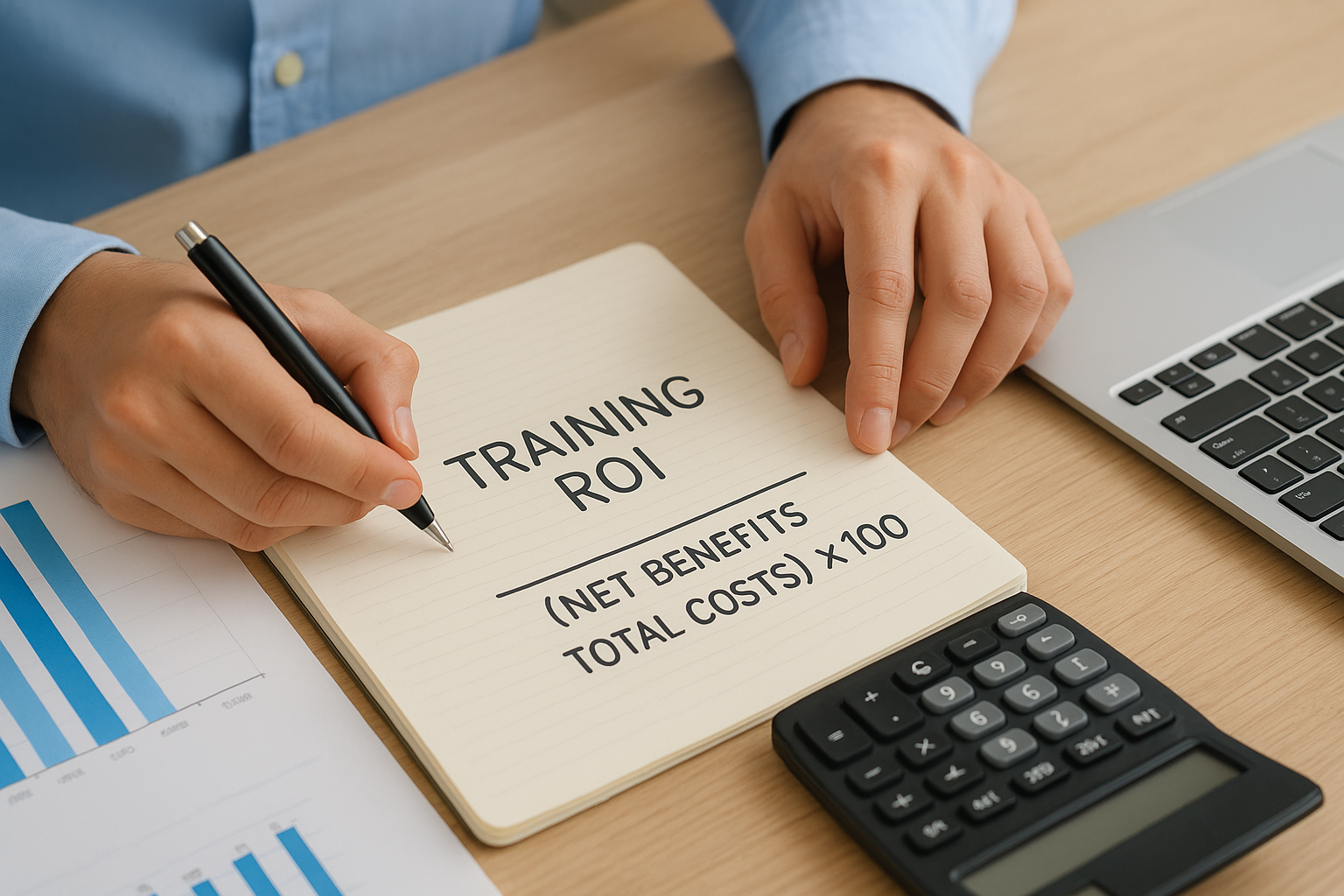
Level 5 is what separates the Phillips training ROI model from most other evaluation frameworks. At this level, you convert the business impacts identified in Level 4 into monetary values, subtract the total cost of the program, and calculate a percentage return on investment. The formula is straightforward: divide net program benefits by total program costs, then multiply by 100.
Reaching this level also requires you to isolate the training’s specific contribution from other variables that may have influenced results, which is both the most challenging and the most credible part of the entire evaluation process.
How to calculate training ROI step by step
The Phillips training ROI model uses a formula that most finance teams recognize immediately: (Net Benefits / Total Costs) × 100. This gives you a percentage you can compare directly against other business investments. Before you plug in any numbers, you need two things: the full cost of the program and the monetized value of the outcomes it produced.
Step 1: Add up all program costs
Total program costs should include everything, not just course development. Many L&D teams undercount by skipping participant time away from their roles, which inflates the ROI figure and damages credibility when finance leaders review your numbers.
Common cost categories to include:
- Course development and content licensing
- Platform or LMS fees
- Facilitator and subject matter expert time
- Participant time, calculated at hourly wage
- Travel and logistics, if applicable
- Program administration
If your cost calculation is incomplete, your ROI number will look artificially high and won’t hold up to scrutiny.
Step 2: Quantify and monetize the business benefits
Once you have your costs, put a dollar value on the outcomes you identified at Level 4 of the model. This means converting business results, such as reduced error rates, faster ramp-up times, or higher sales close rates, into monetary figures. Use existing business data, HR records, or industry benchmarks to build these estimates, and document your assumptions clearly so stakeholders can follow your reasoning.
Step 3: Apply the ROI formula
Subtract your total program costs from your total monetized benefits to get the net benefit. Then divide that figure by total program costs and multiply by 100. For example, if a program cost $20,000 and produced $50,000 in measurable benefits, the net benefit is $30,000 and the ROI is 150%. A positive result means the program returned more than it cost. A negative number tells you where to investigate before running the program again.
What to measure and how to monetize benefits
Knowing which outcomes to track is half the work. The other half is converting those outcomes into numbers your finance team will accept. The Phillips training ROI model only produces credible results when the benefits side of the equation is grounded in real data, not rough estimates pulled from thin air. That means starting with business metrics that already exist in your organization rather than creating new measurement systems from scratch.
Common training outcomes worth tracking
Most training programs affect a narrow set of measurable business variables. Focus your data collection on the areas where the training was specifically designed to create change. Common outcomes that translate well into financial value include:
- Error and defect rates: reduction in mistakes after training multiplies out to labor savings and cost avoidance
- Sales performance: improvements in close rates or average deal size connect directly to revenue
- Onboarding time: faster time-to-productivity for new hires reduces the cost of carrying underperforming headcount
- Compliance violations: fewer incidents lower the risk of fines, legal costs, and operational disruption
- Employee retention: improved engagement linked to learning investment reduces recruiting and replacement costs
Picking two or three outcomes with clean, existing data is more credible than trying to monetize every possible benefit from a single program.
How to assign dollar values to outcomes
Monetizing outcomes requires you to work backward from what each metric is worth to the business. For error reduction, calculate the average cost per error using labor hours to fix it plus any downstream impact. For sales improvements, use your organization’s average deal value and margin. Document every assumption and source you use, because stakeholders will ask.
When precise data isn’t available, lean on conservative estimates and acknowledge the uncertainty explicitly. A lower, well-supported number builds more trust than a large figure no one can verify.
Common pitfalls and how to isolate impact
The most common reason a training ROI model loses credibility isn’t the math, it’s the assumptions behind it. Organizations frequently make the same avoidable mistakes: overcounting benefits, undercounting costs, or skipping the step that matters most, isolating training as the actual cause of the performance change you observed.
Overcounting benefits and undercounting costs
Attributing every positive outcome to a single training program is tempting, but it weakens your case rather than strengthening it. When you claim a 20% sales increase came entirely from a three-day workshop, experienced stakeholders will push back because other variables, like new product launches, market conditions, or manager coaching, likely contributed too. Stick to two or three outcomes where the link to training is clear and supported by data you can actually defend.
Undercounting costs creates the opposite problem. If you leave out participant wages during training, LMS fees, or program administration time, your ROI figure looks artificially strong. When finance reviews it, those gaps destroy trust in the entire analysis faster than a weak benefit number would.
How to isolate training’s specific contribution
Isolation is the step most organizations skip, and it’s the difference between a number people believe and one they dismiss. Several practical methods let you attribute results specifically to training rather than to background noise in your business.
Control groups are the cleanest isolation method: train one group, hold another back temporarily, then compare their performance outcomes directly.
If a control group isn’t feasible, use trend line analysis to project what performance would have looked like without the intervention, then measure the actual result against that baseline. You can also ask managers or participants to estimate what percentage of a performance improvement they attribute directly to the training, then apply that figure to your total benefit calculation and document the method clearly so stakeholders can follow your reasoning.
Bring it all together
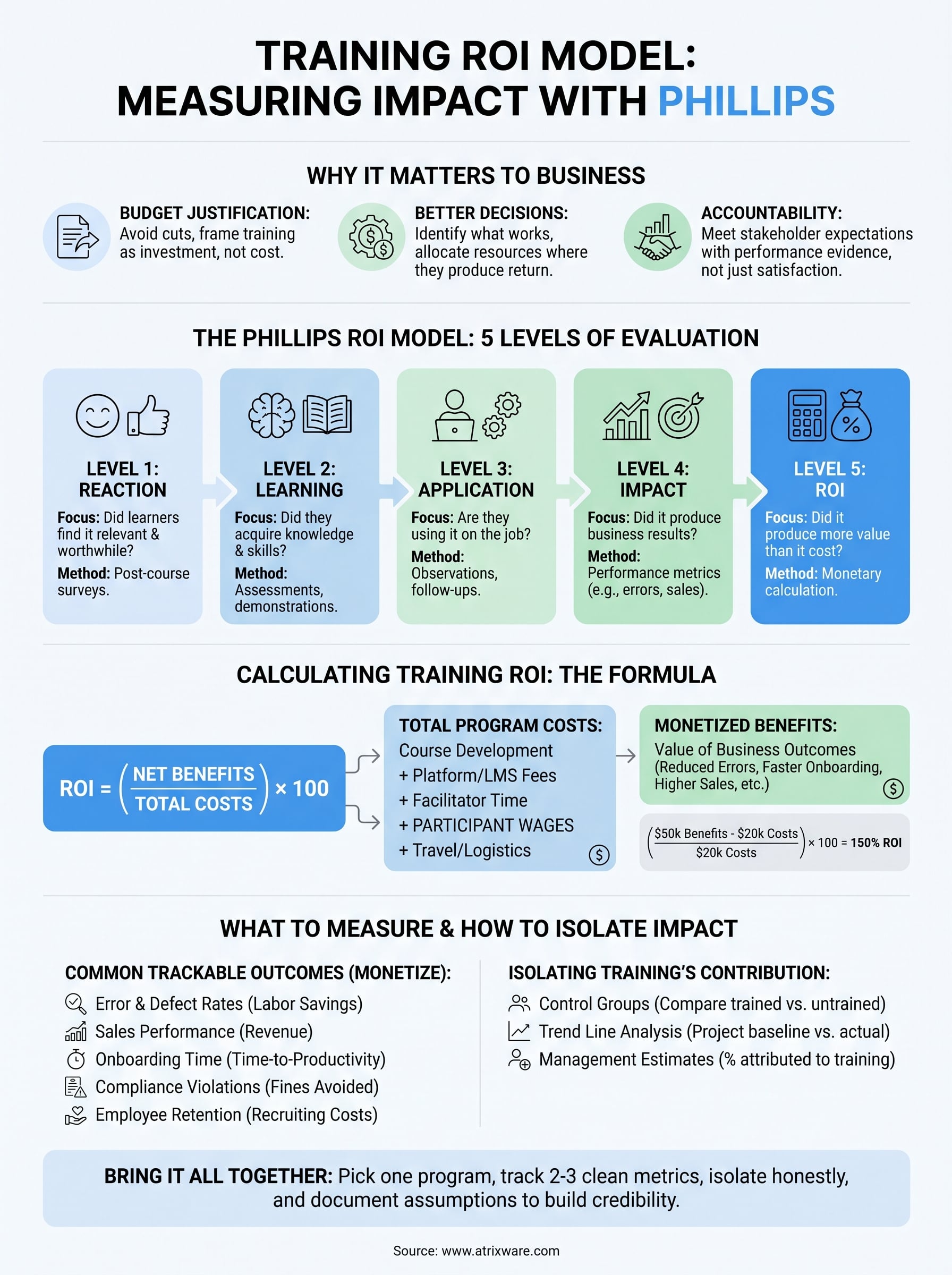
The Phillips training ROI model gives you a clear path from training activity to financial proof. You start by measuring reaction and learning, track whether behavior actually changed on the job, identify the business impact that change produced, and then convert that impact into a number leadership can act on. Each level builds on the one before it, and the final ROI calculation puts your program in the same terms as any other business investment.
Putting this into practice takes discipline, but you don’t need a perfect dataset to get started. Pick one program, track two or three clean metrics, isolate the training contribution honestly, and document your assumptions. That first calculation, even if modest, builds the credibility to expand the methodology across your entire training portfolio. The organizations that do this consistently protect their budgets and earn a seat at the table when business decisions get made.
Ready to track and manage training programs at scale? Explore Axis LMS with a free admin demo and see how it supports your ROI measurement process from day one.
