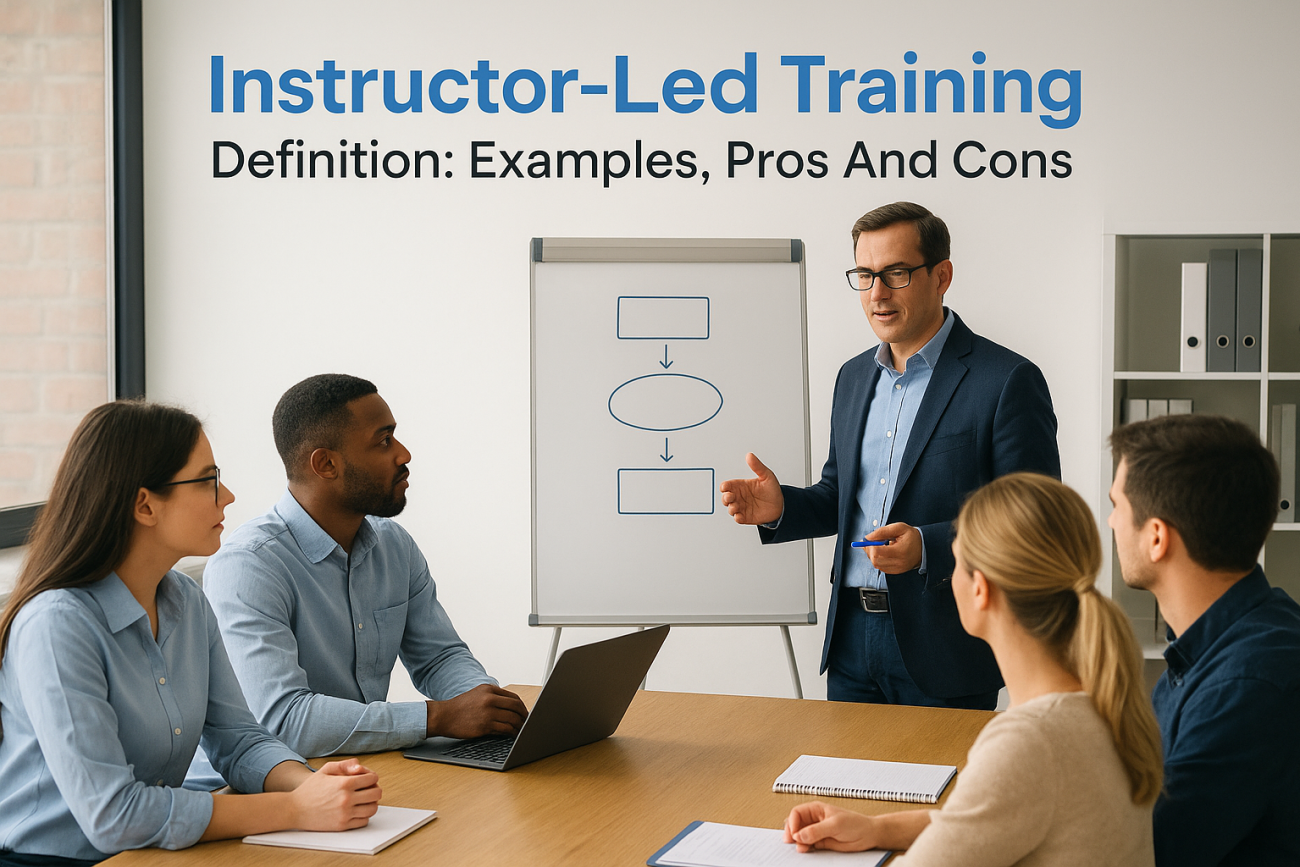
Before you can decide whether instructor-led training fits your organization, you need a clear instructor-led training definition, one that goes beyond the textbook and accounts for how this method actually works in practice. ILT remains one of the most widely used approaches to corporate learning, and for good reason: it puts a real person at the center of the experience, whether that’s in a physical classroom or a virtual session.
The challenge is knowing when ILT makes sense, when it doesn’t, and how to manage it efficiently at scale. That’s where a platform like Axis LMS from Atrixware comes in, giving organizations the tools to schedule, deliver, and track instructor-led training alongside their digital courses, all from one system.
This article breaks down what instructor-led training actually means, walks through real-world examples, and weighs the pros and cons so you can make a grounded decision about using it in your training programs. We’ll also look at how ILT fits into blended learning strategies and what to consider when choosing between in-person and virtual formats.
Key characteristics of instructor-led training
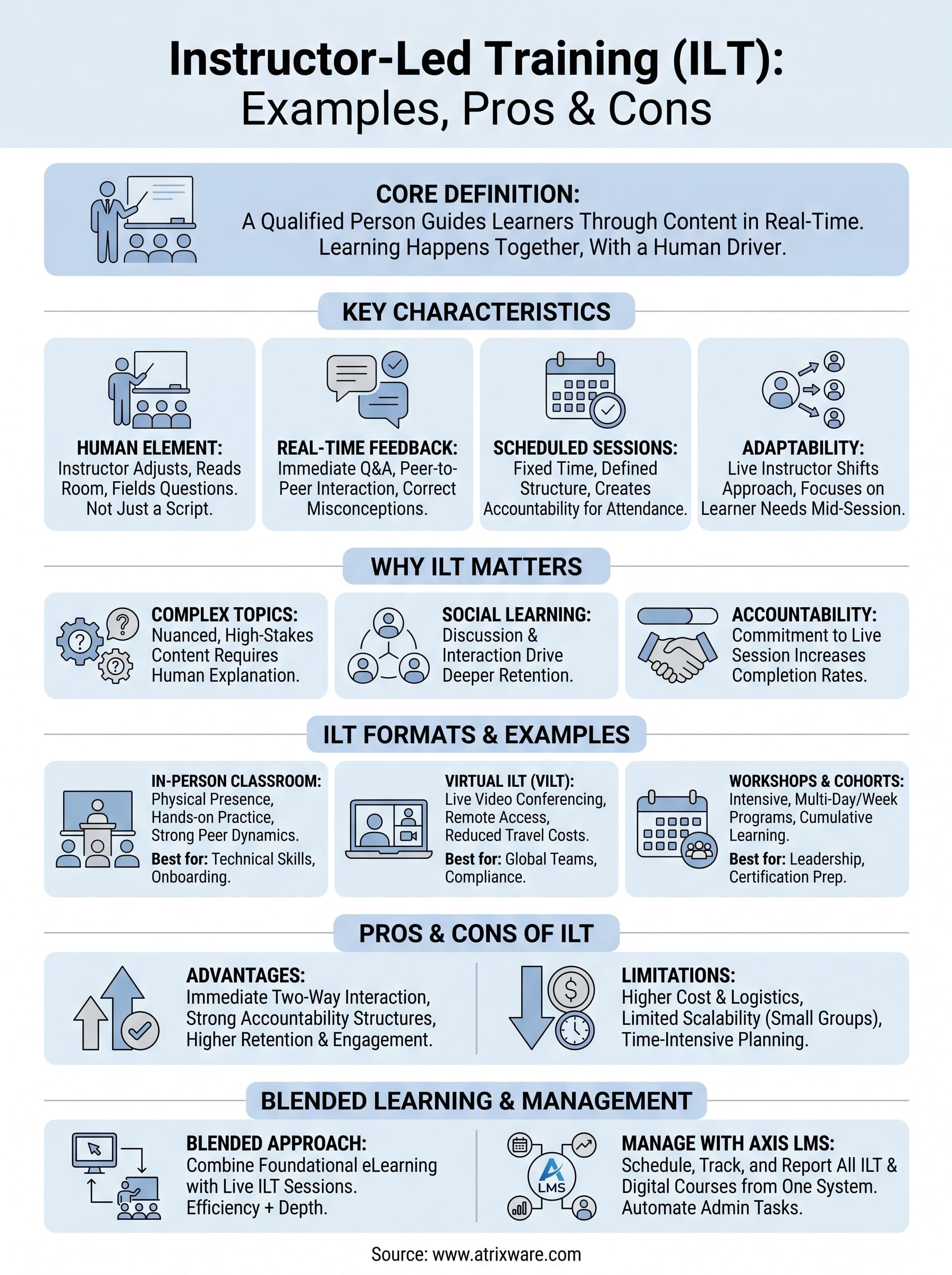
The instructor-led training definition comes down to one core idea: a qualified person actively guides learners through content in real time. Unlike self-paced eLearning, where a learner moves through material on their own schedule, ILT puts an instructor in control of the pacing, delivery, and discussion. That instructor could be standing at the front of a conference room or presenting from a video call, but the defining element is that learning happens together, with a real human driving it.
A live instructor at the center
Every ILT session depends on someone who understands the material well enough to present it, field questions, and adjust on the fly. That person isn’t just reading from a script. They’re watching the room, picking up on confusion, and making judgment calls about when to slow down or dig deeper. This human element is what separates ILT from a pre-recorded video course, and it’s also what makes the format demanding to scale.
The instructor isn’t a delivery mechanism. They’re the backbone of the entire learning experience.
Choosing the right instructor matters as much as choosing the right content. Someone with deep subject knowledge but poor facilitation skills can lose a group fast. You want someone who can hold attention, explain complex ideas clearly, and create a space where learners feel comfortable asking questions, because those conditions directly affect how much people retain.
Real-time interaction and feedback
One of the most important features of ILT is that learners can ask questions and get answers immediately. In a live session, a learner doesn’t need to wait for an email reply or wade through a forum thread. The instructor hears the question and responds on the spot, which means misunderstandings get corrected before they harden into bad habits.

This back-and-forth dynamic also allows learners to build on each other’s thinking. Group discussions, role-plays, and problem-solving exercises all happen in real time, and that shared experience tends to drive higher retention than passive content consumption alone.
Scheduled sessions with a defined structure
ILT runs on a fixed schedule, which means everyone shows up at the same time and moves through the material together. Sessions typically follow a structured agenda that includes an opening, the core content, activities or discussions, and a close. This format creates accountability for attendance and participation, which can be harder to enforce with self-directed learning.
From a logistics standpoint, scheduling also creates natural deadlines for your team. Learners know when the training happens and what they need to prepare. That predictability makes it easier for managers to plan around training and ensures teams complete content within a defined window rather than pushing it off indefinitely.
Adaptability within the session
A skilled instructor can read the group and adjust content delivery based on what they observe. If learners seem lost after a key concept, the instructor can spend more time on it. If the group grasps something quickly, the session can move on without wasting time. This kind of real-time flexibility is built into the format in a way that recorded content simply cannot match.
Adaptability also extends to learning preferences. Some learners respond better to visual examples, others to verbal explanations. An instructor can shift between approaches mid-session, which gives ILT a clear edge when you’re working with a diverse group with varying levels of prior knowledge.
Why instructor-led training still matters
The rise of eLearning hasn’t made ILT obsolete. If anything, organizations that abandoned instructor-led formats entirely often found that learner performance dropped, especially for complex or high-stakes content. Understanding the instructor-led training definition helps explain why: when a human expert actively guides the session, learners get something that no video or quiz can fully replicate, real-time context, correction, and connection to the material.
Complex topics require human explanation
Some content is too dense, too nuanced, or too variable to hand off to a self-paced module. Think about [technical troubleshooting](https://www.atrixware.com/blog/wp/integrating-live-training-into-axis-lms/), regulatory compliance, leadership development, or crisis response. These topics often involve judgment calls that don’t fit neatly into a checklist. When learners work through them in a live session, they can raise scenarios from their actual work, get direct answers, and hear how other team members approach the same problems.
The classroom, physical or virtual, is still one of the few places where learners can test their thinking in real time against someone who actually knows the subject.
An experienced instructor also catches misconceptions before they take root. In a self-paced course, a learner might finish a module with a fundamental misunderstanding and never know it. In an ILT session, that gap surfaces through discussion and gets addressed on the spot.
Social learning drives retention
Learning alongside others isn’t just more engaging. It produces better long-term retention because people encode information more deeply when they discuss it, argue about it, or teach it to a peer. ILT creates natural conditions for this kind of social learning through group exercises, case discussions, and shared problem-solving.
Research from UNESCO on active learning consistently points to discussion-based instruction as one of the most effective methods for knowledge retention. When you put learners in a room together, whether physically or virtually, you give them the conditions they need to process information at a deeper level than passive content consumption allows.
Accountability increases completion rates
Scheduled sessions with a real instructor create a level of commitment that self-paced learning rarely matches. Learners know someone is expecting them to show up, participate, and contribute. That social pressure, combined with a defined start and end time, keeps completion rates significantly higher than open-ended digital courses where learners can defer indefinitely.
Instructor-led training formats and examples
The instructor-led training definition applies across several delivery formats, and knowing which one fits your situation matters as much as knowing whether to use ILT at all. Each format has different logistical requirements, different strengths, and different use cases. Choosing the right one depends on your audience, your content type, and the resources you have available to support the training.
In-person classroom training
In-person classroom sessions are the most traditional ILT format. Learners and the instructor gather in the same physical space, which creates immediate interpersonal dynamics that support discussion, observation, and hands-on practice. This format works well for technical skills training, compliance certification, onboarding, and scenarios that involve physical equipment or direct role-play. For example, a manufacturing company might run in-person ILT to train new hires on equipment safety, where the instructor can physically demonstrate proper technique and correct mistakes on the spot.
In-person training also makes relationship-building easier. When learners are in the same room, they tend to engage more naturally with each other, which strengthens the peer learning that makes ILT effective. The tradeoff is cost: facilities, travel, and scheduling across time zones all add up quickly.
Virtual instructor-led training (VILT)
VILT delivers the same live, instructor-driven experience through a video conferencing platform like Microsoft Teams or Zoom. The instructor presents in real time, learners participate through chat, polls, and breakout rooms, and the session follows the same structured agenda as an in-person class. VILT became the standard fallback during the pandemic, and many organizations have kept it permanently because it eliminates travel costs and makes global training practical.
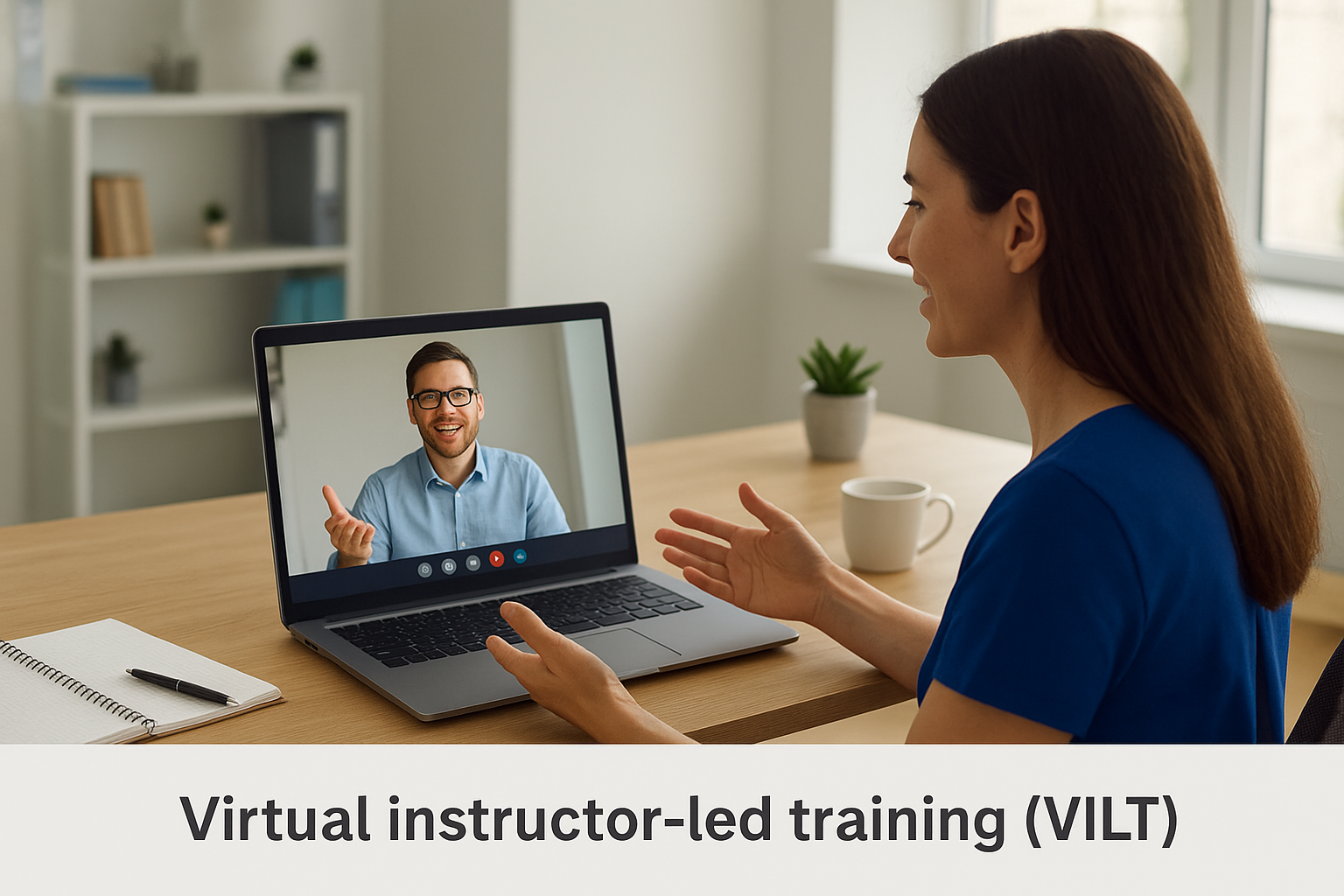
VILT works best when the instructor actively uses interactive features rather than treating the session like a recorded lecture.
Workshops and cohort-based programs
Workshops extend the ILT format into longer, more intensive learning experiences. Instead of a single session, learners move through a multi-day or multi-week program with the same group, building on prior sessions. Leadership development programs, sales training bootcamps, and certification prep courses often use this cohort model because repeated interaction with the same instructor and peers deepens both knowledge and accountability over time. Each session builds directly on the last, which creates cumulative learning that short standalone sessions rarely achieve.
Pros and cons of instructor-led training
Any honest instructor-led training definition has to acknowledge that the format carries real trade-offs. ILT delivers things that other learning methods struggle to match, but it also comes with costs and constraints that can make it impractical if you apply it without thinking through the logistics. Knowing both sides helps you use ILT where it adds the most value and avoid forcing it into situations where a different format would serve your learners better.
The advantages of ILT
The clearest advantage of ILT is immediate, two-way interaction between learners and the instructor. Questions get answered in the moment, misconceptions surface during discussion rather than after the fact, and the instructor can adjust pacing based on what the group actually needs. That responsiveness is something no pre-recorded course can replicate.
When the content is complex or the stakes are high, having a live expert in the room changes the quality of the learning experience entirely.
ILT also creates strong accountability structures that self-paced formats rarely achieve. Learners show up to a scheduled session, participate alongside peers, and complete the training within a defined window. Social dynamics keep people engaged in ways that an open-ended online course simply does not. The result is higher completion rates and stronger retention, particularly for topics that require nuanced judgment or hands-on application.
The limitations you need to account for
The most significant limitation of ILT is cost and logistics. Scheduling sessions across teams, booking facilities or virtual platforms, coordinating instructors, and pulling people away from their work adds up fast. For organizations training hundreds of employees across multiple locations, those costs can become a serious constraint on how often you can run ILT.
Scalability is the second major limitation. An instructor can only teach so many learners at once without the session losing quality. Small group sizes keep discussions productive, but they also mean you need more sessions to reach a large workforce. This is why many organizations pair ILT with eLearning rather than relying on it for every training need. High-frequency, foundational content often fits a self-paced format better, while ILT handles the material where live interaction genuinely changes what learners walk away with.
ILT vs eLearning and blended learning
Understanding the instructor-led training definition in context means seeing where it fits alongside other learning methods, not just what it is on its own. ILT, eLearning, and blended learning each solve different problems for different audiences, and the strongest training programs don’t pick one and ignore the rest. The real decision is matching the right format to your content type, your learners, and the operational constraints your team is working within.
When eLearning makes more sense
eLearning gives learners complete control over their own schedule and pace, which makes it a strong choice for foundational content, compliance attestations, and material that doesn’t require live discussion to stick. If your training covers information every employee needs to absorb independently, such as a company policy update or a software walkthrough, a self-paced course is faster to deploy, cheaper to scale, and easier to track across a large workforce.
Self-paced eLearning works best when the content is stable, the stakes are moderate, and learners don’t need real-time guidance to apply it correctly.
The core limitation is that eLearning removes the human element entirely. Learners can’t ask questions mid-module, can’t hear how peers interpret the material, and can’t get corrected if they work through content with a misunderstanding already in place. For complex, high-judgment topics, that gap directly affects how well learners perform when they apply the training on the job.
Where blended learning bridges the gap
Blended learning combines structured eLearning modules with live instructor-led sessions, giving you the efficiency of digital delivery alongside the depth of real-time instruction. A common approach is to have learners complete foundational content online before the ILT session, so live time focuses on application, discussion, and questions rather than covering basics from scratch. This keeps sessions shorter and more productive because the instructor isn’t spending the first hour explaining terminology.

This structure respects both the instructor’s time and each learner’s schedule. The eLearning component handles information transfer at scale, while the ILT component handles nuanced, interactive work that only a live session does well. For organizations running onboarding, leadership development, or compliance training, a blended model often produces stronger outcomes than either format alone because it matches the right delivery method to each layer of the content rather than forcing everything into one approach.
How to plan and run effective ILT
Putting the instructor-led training definition into practice requires more than booking a room and finding a presenter. The decisions you make before the session starts, from how you structure the agenda to how you select and prepare your instructor, determine whether your ILT delivers lasting learning or just fills time on a calendar. A deliberate planning process separates training that changes behavior from training that people forget by the following week.
Define your objectives before you book anything
Start with a specific learning outcome, not a general topic. Before you schedule a session, write down exactly what you need learners to be able to do differently after the training ends. Vague goals like "understand compliance" don’t give your instructor enough to work with. Concrete objectives like "correctly apply the three-step verification process before approving a vendor invoice" give the session a clear direction and make it possible to measure whether the training actually worked.
If you can’t describe what success looks like for a learner at the end of the session, your planning isn’t ready yet.
Build a session structure that keeps learners active
Passive presentations drain attention quickly, especially in virtual sessions where distractions are one click away. Break your agenda into segments no longer than 20 minutes, and alternate between direct instruction and active exercises such as small group discussions, case studies, or practice scenarios. This rhythm keeps engagement higher throughout the session and gives learners repeated chances to apply what they’re hearing rather than just absorbing it passively.
Prepare your instructor with a facilitator guide that outlines key talking points, timing, and discussion prompts for each segment. A strong guide reduces the risk of sessions running long or dropping content, and it makes running the same training consistently across multiple cohorts far more reliable.
Track attendance and outcomes through your LMS
Your LMS should handle session registration, attendance tracking, and post-training assessments automatically so your team isn’t managing spreadsheets after every session. When you connect ILT data to the same system that tracks your digital courses, you get a complete picture of each learner’s progress across all training formats in one place. That consolidated data also helps you identify which sessions need refinement and which instructors consistently produce strong outcomes, so your ILT program improves over time rather than staying static.
What to do next
The instructor-led training definition is straightforward: a live expert guides learners through material in real time, creating conditions for interaction, immediate feedback, and deeper retention than self-paced formats alone can deliver. Whether you run in-person sessions, virtual classrooms, or a blended mix of both, the format works best when you pair it with a system that handles scheduling, tracking, and reporting automatically so your team can focus on the training itself rather than the administration around it.
Axis LMS gives you the tools to manage ILT sessions alongside your digital courses in one place, from registration and attendance tracking to post-session assessments and learner progress reports. You can schedule cohorts, automate reminders, and see exactly which learners completed which sessions without juggling spreadsheets. If you want to see how it fits your organization before committing, start your free Axis LMS admin demo and explore the platform at your own pace.
