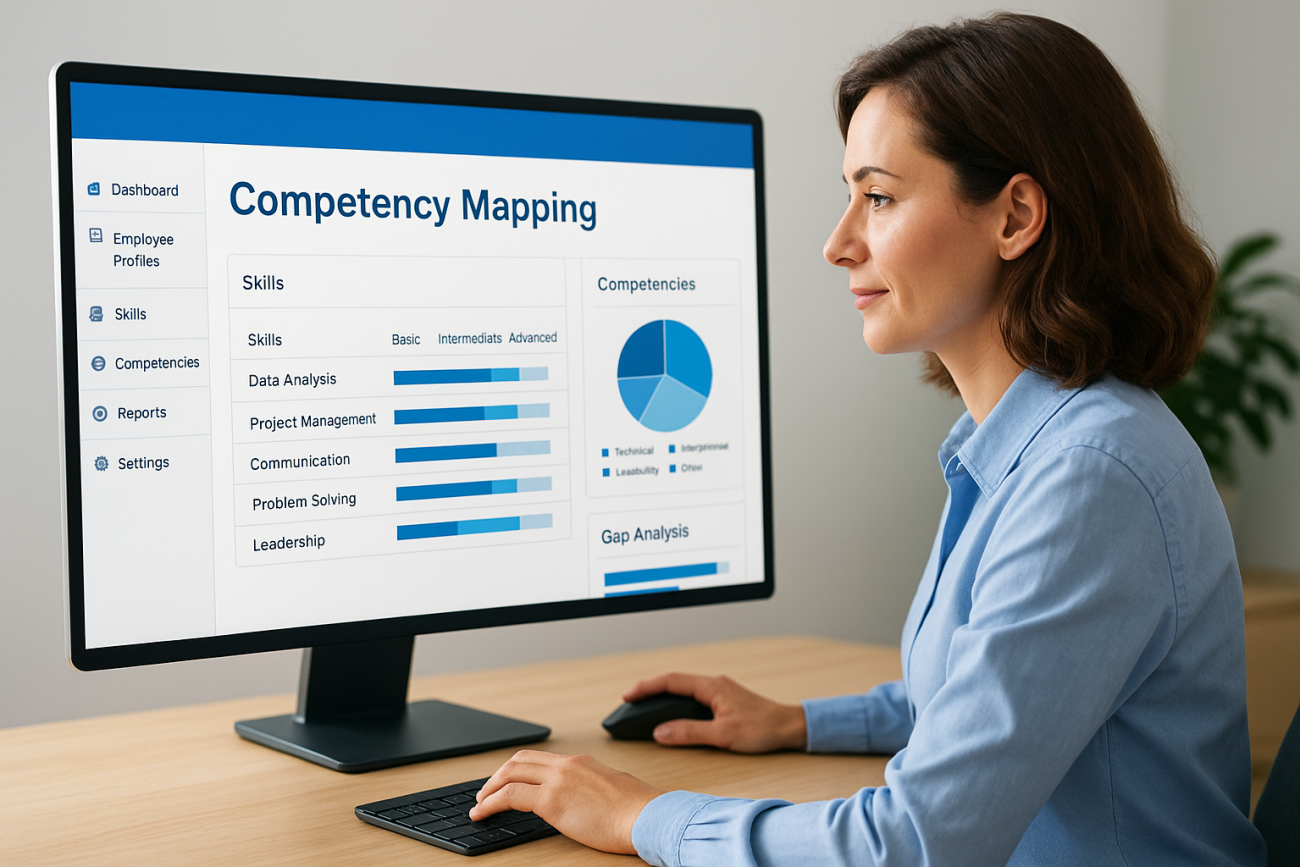
Most organizations know they need to develop their workforce, but far fewer can pinpoint exactly where the gaps are. That’s where competency mapping software comes in. It gives you a structured, data-driven way to identify what your people can do, measure it against what they need to do, and close the distance between the two.
Without this kind of tool, competency management tends to live in spreadsheets, annual reviews, or, worse, someone’s gut feeling. Competency mapping software replaces guesswork with clarity, connecting role requirements to actual employee capabilities so you can make smarter decisions about training, hiring, and development. For organizations using a platform like Axis LMS to deliver and track training, this type of software becomes the missing link, turning learning data into a clear picture of workforce readiness.
This article breaks down what competency mapping software actually is, how it works in practice, and why it matters for businesses serious about developing talent. You’ll find concrete examples of how organizations use it, along with a look at the features that separate useful tools from shelfware. Whether you’re an HR manager building out a skills framework or a training lead trying to align your courses with real business needs, this guide gives you the foundation to move forward with confidence.
What competency mapping software is
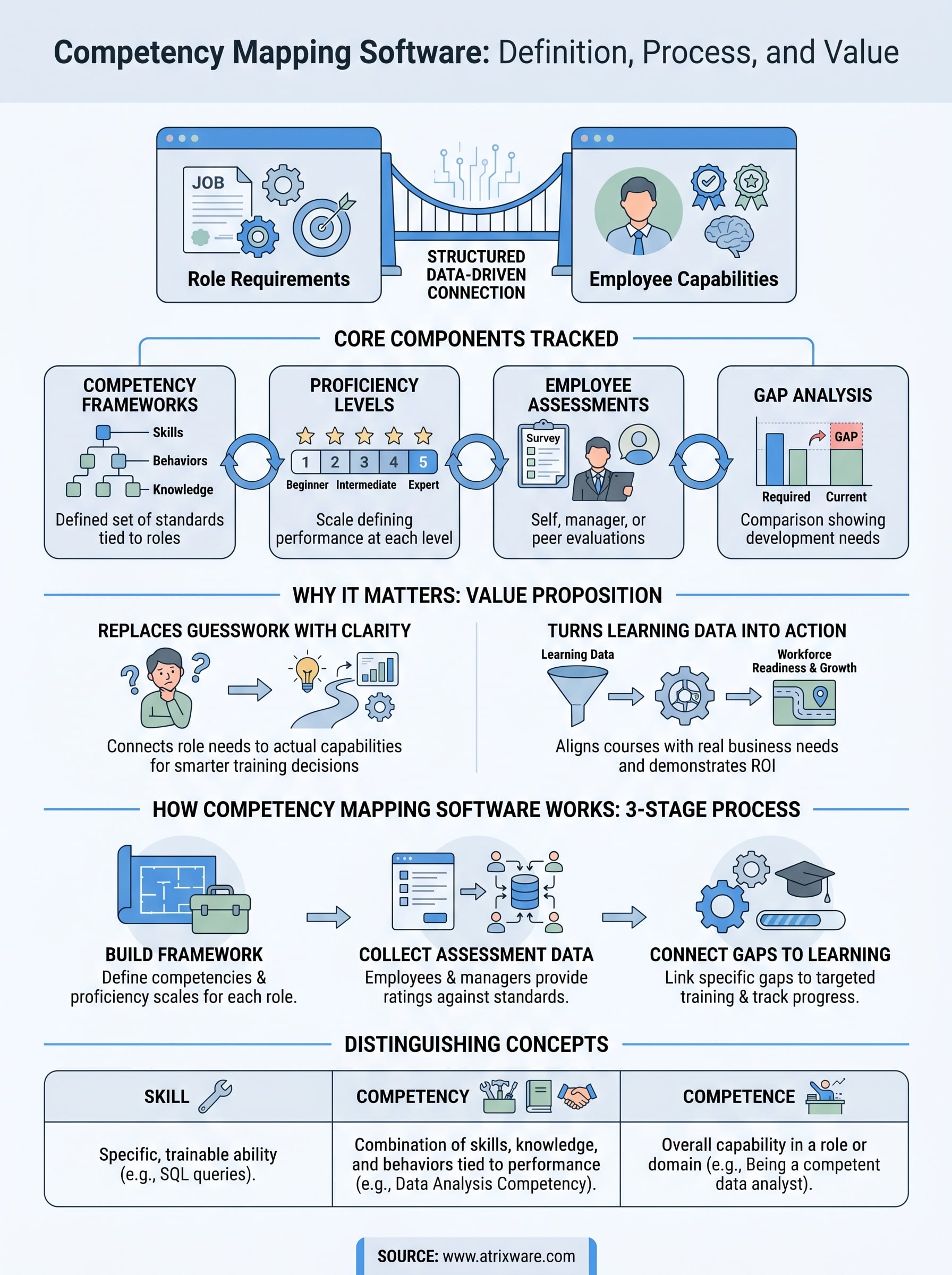
Competency mapping software is a digital platform that lets organizations define the skills, knowledge, and behaviors required for each role, measure how well individual employees meet those requirements, and track progress over time. At its core, it creates a structured connection between what a job demands and what a person actually brings to it. Instead of relying on informal performance conversations or outdated job descriptions, the software gives HR managers and training leads a clear, consistent framework for evaluating workforce capability.
The term "mapping" matters here. You’re not just listing skills in a spreadsheet. You’re drawing a relationship between a role, its required competencies, and the people in that role. The software captures this relationship at scale, so whether you manage 50 employees or 5,000, you can see exactly where your workforce stands and where development investment will make the biggest impact.
Competency mapping software turns an abstract idea, "our people need to perform better," into a concrete, measurable action plan tied to specific roles and individuals.
The core components it tracks
Most platforms are built around a set of interlocking components that together give you a complete picture of workforce capability. Understanding these components helps you evaluate what the software actually does rather than what a vendor claims it does.
| Component | What it means |
|---|---|
| Competency frameworks | A defined set of skills, behaviors, and knowledge standards tied to specific roles or job families |
| Proficiency levels | A scale (often 1 to 5) that defines what beginner, intermediate, and expert performance looks like for each competency |
| Employee assessments | Self-assessments, manager ratings, or structured evaluations that measure where each person currently sits on that scale |
| Gap analysis | A direct comparison between required and current proficiency levels that shows exactly where development is needed |
These components work together rather than in isolation. A competency framework without assessment data is just a document. Assessment data without a framework is just a collection of opinions. The software integrates both sides so the gap analysis becomes something you can act on, rather than a number that sits in a report nobody reads.
How it connects to your training programs
The real value surfaces when you link gap data to actual learning activity. Once you know which competencies your employees are missing, you can connect those gaps directly to training content, development plans, or hiring decisions. For organizations already using a learning management system like Axis LMS, this connection becomes particularly powerful. You can align specific courses to specific competency gaps, assign training automatically based on role requirements, and track completion as evidence of progress toward the required proficiency level.
Putting these two systems together is where competency mapping stops being an HR documentation exercise and becomes a strategic workforce tool. You’re no longer assigning training because it seems relevant or because a regulation requires it. You’re assigning it because the data identifies a specific gap for a specific person in a specific role, and the training directly addresses that gap. That kind of precision reduces wasted training spend, saves your team time, and gives you measurable proof that your development programs are producing real results.
Competency vs skills vs competence
These three terms get used interchangeably in most workplaces, but they describe different things, and mixing them up leads to frameworks that are difficult to build and harder to act on. Understanding where they differ gives you a cleaner foundation for any competency mapping software initiative you plan to run.
What a competency actually is
A competency is a combination of skills, knowledge, and behaviors that a person applies to perform a job function at an acceptable standard. The key word is "combination." You cannot reduce a competency to a single skill or a piece of knowledge in isolation. For example, "client communication" as a competency includes writing clearly, listening actively, adjusting tone to context, and knowing when to escalate an issue. Each element feeds into the outcome, and the software measures how well a person integrates all of them in practice.
A competency describes how someone performs, not just what they know.
How skills and competence fit in
Skills are specific, learnable abilities that a person either has or doesn’t have to some degree. Knowing how to use Excel, write SQL queries, or operate a forklift safely are skills. They are discrete and measurable on their own, but they don’t capture the full picture of how someone performs in a role.
Competence, on the other hand, describes the overall state of being capable in a role or domain. Someone who is competent in project management can execute projects reliably, but that competence draws on a wide mix of skills, knowledge, and situational judgment working together.
Here’s how the three relate:
| Term | What it describes | Example |
|---|---|---|
| Skill | A specific, trainable ability | Writing SQL queries |
| Competency | A bundle of skills, knowledge, and behaviors tied to performance | Data analysis competency |
| Competence | Overall capability in a role or domain | Being a competent data analyst |
Understanding this distinction matters because competency mapping software is built to track competencies, not isolated skills. When you structure your framework around competencies rather than simple skill checklists, you get a far more accurate and actionable picture of whether your workforce is truly ready to perform.
Why competency mapping matters at work
Competency mapping gives organizations a way to ground workforce decisions in evidence rather than assumption. When you know exactly what each role requires and where each employee currently stands, you can direct training budgets toward real gaps instead of general programs, reduce the time managers spend guessing about performance issues, and build a development culture that feels fair and consistent to your employees.
Without a clear competency framework, most organizations end up investing in training that feels productive but produces little measurable change.
It reduces the cost of misaligned training
Most training budgets leak. Organizations spend money on courses that employees do not need, or skip development in areas where the need is urgent. Competency mapping software fixes this by connecting your training decisions directly to verified gap data. When you know that a specific team is weak in regulatory compliance or that a sales group needs to develop negotiation skills, you can target spend precisely. That approach consistently delivers better outcomes than blanket programs assigned to entire departments.
A structured competency framework also makes it easier to demonstrate ROI to leadership. Instead of reporting course completion rates, you can show how proficiency levels improved after a specific learning intervention. That shift from activity metrics to outcome metrics is something most training teams struggle to achieve without the right data infrastructure in place.
It supports better hiring and promotion decisions
When you have a clear picture of what a role requires, you can evaluate candidates and internal promotions against a defined standard rather than a subjective impression. Managers who use competency data during hiring consistently make faster, more defensible decisions because the criteria are visible and agreed upon in advance.
Your employees benefit from this clarity too. When people understand exactly what they need to demonstrate to advance, they can take direct ownership of their development rather than waiting for a manager to tell them what to work on. That shift in ownership tends to improve engagement and retention in ways that general performance reviews rarely achieve on their own.
How competency mapping software works
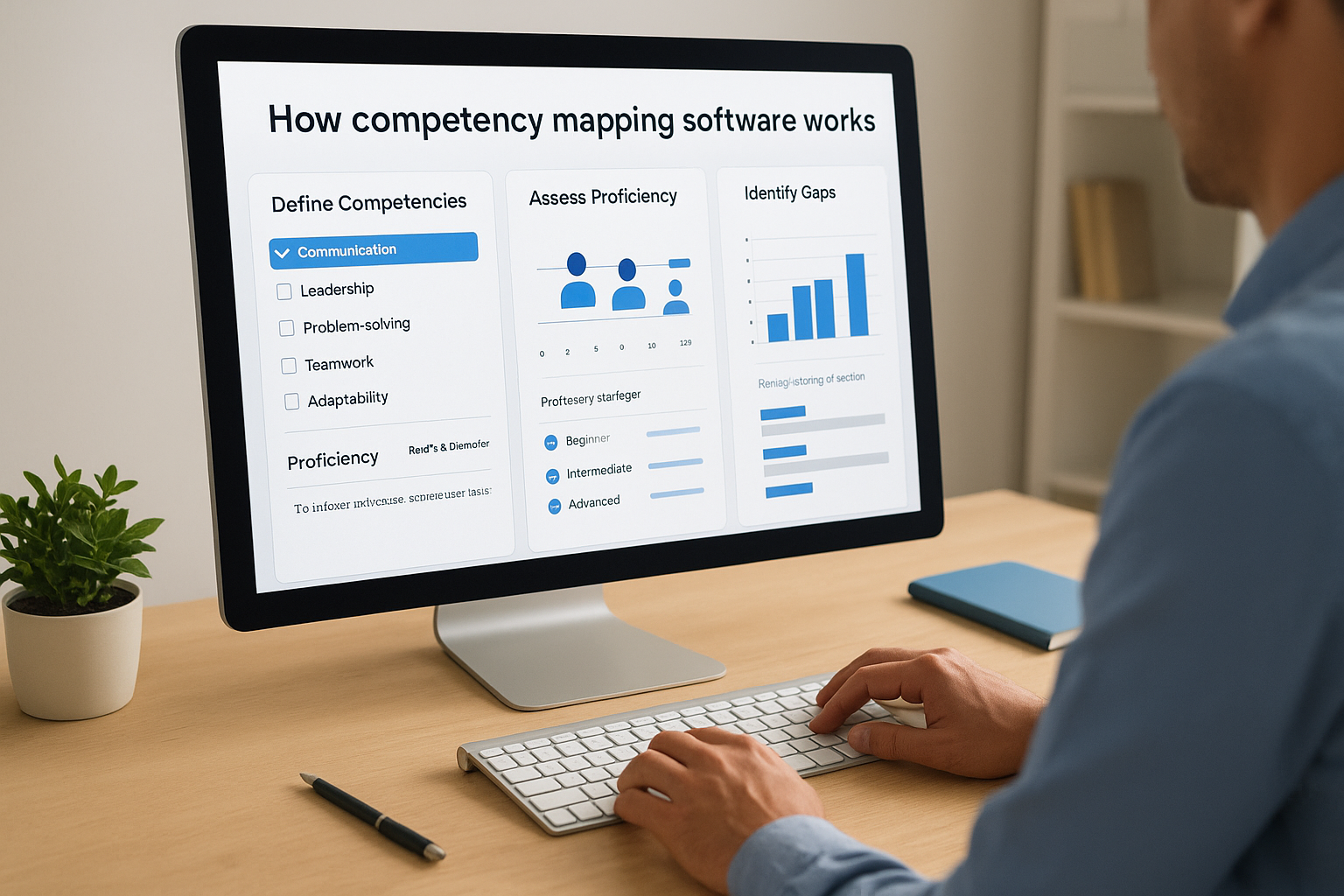
Most platforms follow a consistent three-stage process: define what good performance looks like for each role, measure where your employees currently stand, and connect the gap between those two points to a development action. The software automates the parts of this process that would otherwise take weeks of manual data collection and makes the results visible to everyone who needs them, from frontline managers to HR leadership.
Build your competency framework first
Before the software can measure anything, you need to define the competencies that matter for each role in your organization. Most platforms give you a library of pre-built frameworks you can adapt, or a builder that lets you create your own from scratch. You attach a proficiency scale to each competency, typically ranging from beginner to expert, and describe in clear behavioral terms what each level looks like in practice.
This step is where many organizations underinvest. A vague competency definition like "communication skills" produces inconsistent assessments across different managers. A specific definition tied to observable behaviors produces data that is consistent, defensible, and actually useful for making development decisions.
Collect assessment data at the individual level
Once your framework is in place, the software runs assessments. Employees rate their own proficiency, managers provide their evaluations, and in some platforms, peers contribute ratings as well. The system aggregates these inputs and surfaces a clear proficiency score for each person against each competency required for their role.
The more specific your competency definitions, the more consistent and trustworthy your assessment data will be across managers and teams.
Connect gaps directly to learning
This is where competency mapping software earns its place in your technology stack. After the assessment data is collected, the platform generates a gap report at the individual, team, and organizational level. You can see which competencies fall below the required proficiency threshold and by how much. From there, you link specific training content to each gap, assign it automatically based on role, and track completion alongside proficiency scores to measure whether the learning is actually shifting performance rather than just filling a calendar.
Common competency mapping examples
Seeing how other organizations use competency mapping software in practice makes the concept easier to apply to your own context. The examples below cover three common use cases where competency mapping produces clear, measurable results.
Customer service roles
Customer service teams are one of the most common starting points for competency mapping because the performance requirements are specific and the impact of gaps is immediate. A typical framework for this role includes competencies like active listening, conflict resolution, product knowledge, and escalation judgment. Each one comes with a defined proficiency scale so managers can rate whether an agent handles a complaint at a basic level or genuinely de-escalates tension and retains the customer.

When you define these competencies clearly, you can stop guessing why customer satisfaction scores dip and start identifying which skill gaps are driving the problem.
Once the assessment data is in place, you can connect low proficiency scores directly to targeted training, rather than running generic customer service workshops for the entire team.
Leadership and management development
Organizations that want to build a reliable internal pipeline of future managers use competency mapping to identify high-potential employees before a role opens. A leadership framework typically includes competencies like strategic thinking, team development, decision-making under uncertainty, and stakeholder communication. Mapping these competencies against your current workforce gives you a clear picture of who is ready to step up and where each candidate still needs development.
This approach also removes the subjectivity that tends to surface in promotion discussions. When your leadership criteria are defined and visible, managers make decisions based on consistent, documented evidence rather than personal impressions.
Compliance-heavy industries
Regulated industries like healthcare, financial services, and manufacturing use competency mapping to verify that employees meet specific knowledge and behavioral standards before they perform certain tasks. In these environments, a competency gap is not just a performance issue; it can be a legal or safety liability.
Your framework in this context maps regulatory requirements directly to individual employees, so you can demonstrate during an audit that every person in a critical role has been assessed, trained, and verified against the required standard. That documentation gives compliance officers a defensible, structured record rather than a collection of scattered training certificates.
How to pick and roll out the right software
Choosing competency mapping software starts with getting clear on what your organization actually needs before you open a vendor demo. Most platforms offer similar surface-level features, so the differences that matter show up in integration depth, framework flexibility, and how gap data connects to your existing training infrastructure. If you already use an LMS like Axis LMS to deliver and track training, your priority should be finding a tool that feeds gap data directly into your learning workflows rather than sitting in a separate system your managers never check.
Start with your framework, not the features
Before you evaluate any platform, define the competency framework you want to use for at least one role or job family. This gives you a concrete test case to run against any software you consider. Ask vendors how their platform handles proficiency level customization and whether it supports behavioral anchors for each level. A tool that forces you into a rigid, pre-built framework will create friction the moment your roles diverge from the template.
The framework you build before selecting software will save you more time than any feature on the vendor’s checklist.
When you run a demo, bring real data from an actual role in your organization and walk through the full cycle: build the competency, run a mock assessment, generate a gap report, and assign training. That end-to-end test reveals integration gaps and usability problems that a polished vendor presentation never will.
Roll out in phases, not all at once
Starting with one team or department reduces the risk of a messy implementation and gives you a working example to build internal momentum. Pick a group where the performance requirements are already well understood, run your first assessment cycle, and document what the data reveals. That early success gives you credibility with skeptical stakeholders and surfaces any framework or configuration issues before they affect your entire organization.
Once the first phase is stable, expand by role family rather than by department. Keeping your proficiency scales consistent across every new group you onboard ensures your aggregate gap data stays meaningful at the organizational level and supports reliable reporting to leadership.
Where to go from here
Competency mapping is not a one-time project. It is an ongoing process that connects what your organization needs to what your people can actually deliver, and then closes the distance between those two points through targeted development. When you pair a well-built framework with the right competency mapping software, you stop reacting to performance problems and start anticipating them with data you can act on.
The organizations that get the most out of this approach are the ones that connect competency gap data directly to their training delivery. Axis LMS gives you the infrastructure to do exactly that, linking learning content to specific role requirements and tracking progress against defined proficiency standards over time. If you’re ready to see how that connection works in practice, start your free Axis LMS admin demo and explore how the platform supports a structured, measurable approach to workforce development.
