Every company eventually hits the same wall: employees need new skills, compliance rules keep changing, and onboarding a new hire still takes weeks longer than it should. Corporate training is how businesses close that gap, and if you’re researching it right now, you’re probably trying to figure out what it actually includes and whether your organization needs a formal program at all.
At its core, a corporate training program is a structured effort to build employee skills, knowledge, and compliance readiness through defined courses, tracked progress, and measurable outcomes. It can cover anything from new-hire onboarding and product knowledge to safety regulations and leadership development, and it can run in a classroom, online, or through a mix of both.
This article breaks down the different types of corporate training programs, the topics they typically cover, and the factors that separate a program that gets used from one that collects dust. You’ll also get practical guidance on choosing a provider, including what to look for in course libraries, reporting, and the technology behind it, so you can build training that actually moves the needle on skills and compliance.
Why corporate training matters for your business
Skills gaps cost real money, and most leadership teams underestimate the true cost of poorly trained workers and how fast those gaps open up. A sales rep who doesn’t know the newest product line loses deals to competitors who trained faster. A warehouse worker who missed the updated safety protocol becomes a liability the moment an inspector walks in. Corporate training exists to close these gaps before they turn into lost revenue, lawsuits, or turnover, and companies that treat it as a core operating function rather than an afterthought consistently outperform those that don’t.
A business that trains reactively is always one step behind the problem it’s trying to solve.
The business case for structured training
Well-run corporate training programs deliver returns you can actually track, not just goodwill. LinkedIn’s own workplace learning research has repeatedly found that employees at companies investing in development stay longer and report higher engagement, and the U.S. Bureau of Labor Statistics tracks turnover costs that make retention one of the strongest financial arguments for training you’ll find. Consider what shows up on the balance sheet when training is done right:
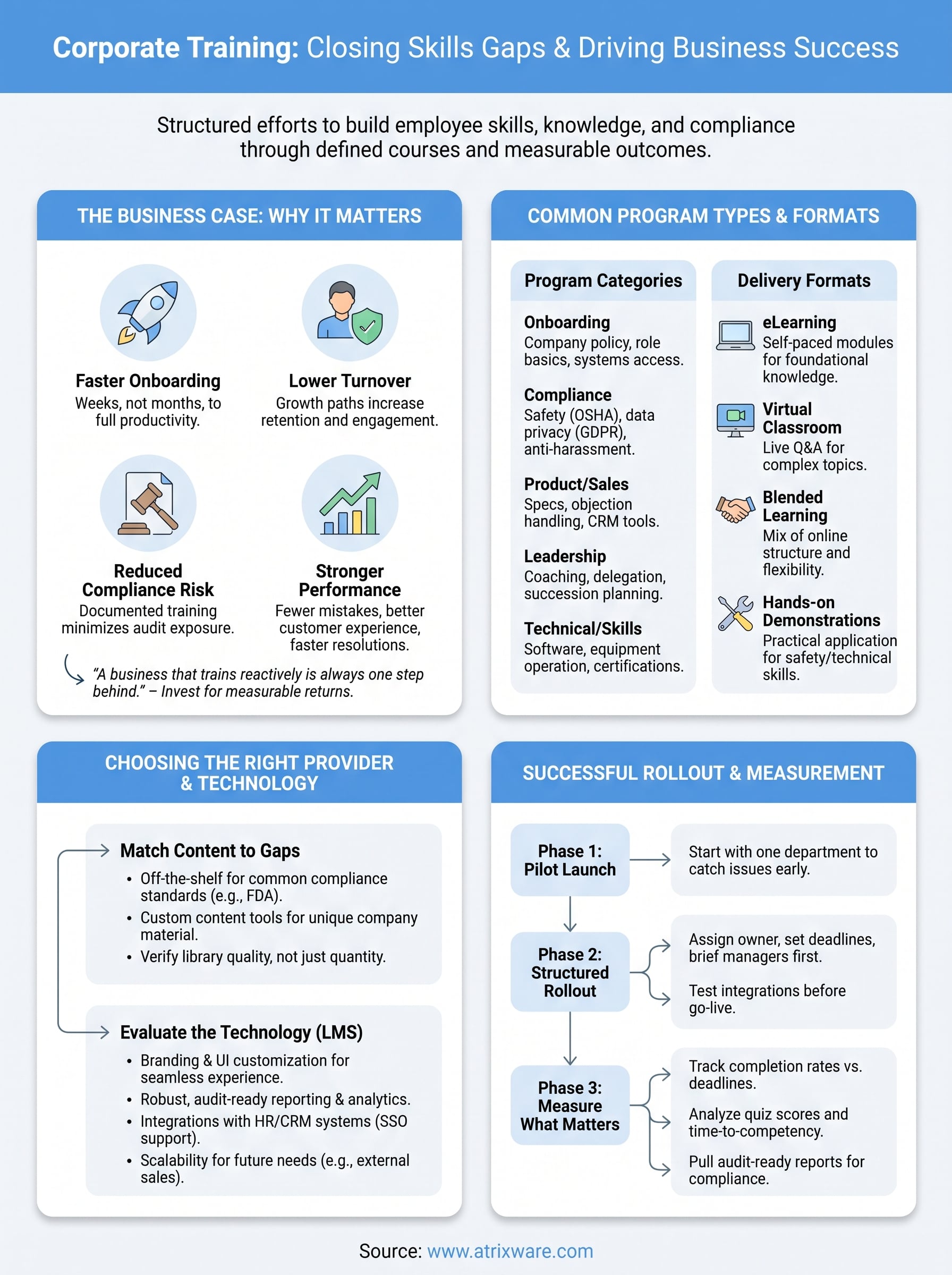
- Faster onboarding: new hires reach full productivity in weeks instead of months.
- Lower turnover: employees who see a growth path are less likely to leave.
- Fewer compliance incidents: documented, tracked training reduces audit and legal exposure.
- Stronger customer experience: well-trained staff resolve issues faster and make fewer costly mistakes.
- Better succession planning: leadership pipelines fill with people who already know the business.
What happens without it
Organizations without a formal program usually don’t notice the damage until it’s expensive. Knowledge lives in a handful of tenured employees’ heads, and when they leave, so does the institutional memory nobody wrote down. Compliance training becomes a scramble of forwarded PDFs and email confirmations that fall apart the moment a regulator asks for proof of completion.
Particularly for regulated industries, this gap is where training for corporate compliance turns from a nice-to-have into a legal necessity, and where an LMS built for regulated compliance training earns its keep. Healthcare, finance, and manufacturing companies face specific mandates, and an informal patchwork of training rarely produces the audit trail regulators expect. A learning management system like Axis LMS solves this by centralizing course delivery, automating re-certification reminders, and generating the reports that prove training happened, exactly when you need them.
Ultimately, the difference between companies that treat training as strategic and those that treat it as a checkbox shows up in performance metrics you can measure: retention, error rates, time-to-productivity, and audit outcomes all move in the same direction once training becomes consistent and trackable.
Common types of corporate training programs and topics
Most corporate training programs fall into a handful of recognizable categories, even though the specific courses look different from one industry to the next. Understanding these categories helps you map your own gaps before you start shopping for a corporate training programme or vendor, the same groundwork behind building a high-impact employee training program, rather than buying a course library that doesn’t match what your team actually needs.
The best training programs are built around real skill gaps, not a generic catalog of courses nobody asked for.
Core training categories and what they cover
Each category serves a distinct business purpose, and most mature training operations run several of them at once through the same platform.
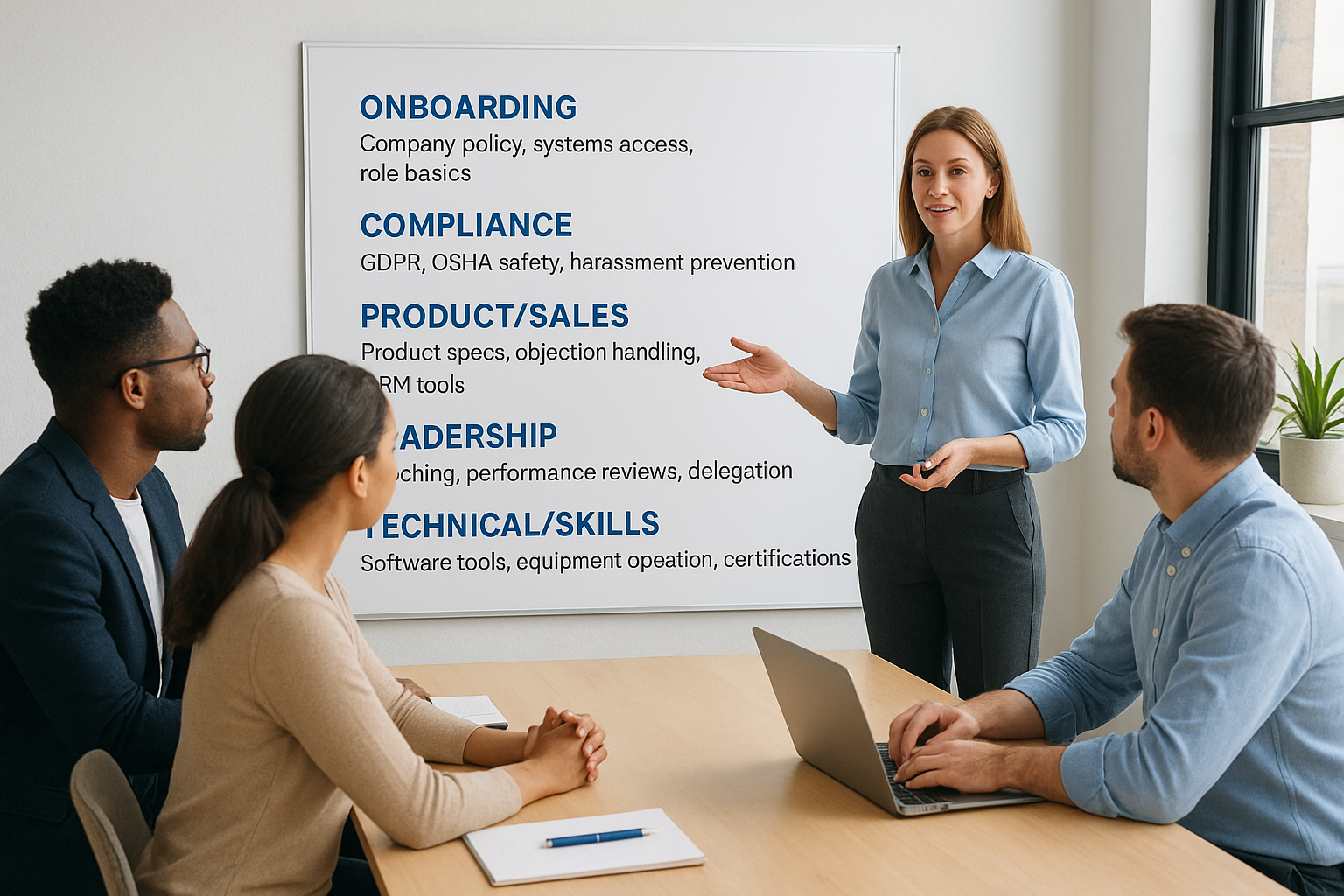
| Training type | Typical topics | Primary goal |
|---|---|---|
| Onboarding | Company policy, systems access, role basics | Faster time-to-productivity |
| Compliance | GDPR, OSHA safety, FDA 21 CFR Part 11, harassment prevention | Audit readiness, legal protection |
| Product/sales | Product specs, objection handling, CRM tools | Revenue growth, faster deal cycles |
| Leadership | Coaching, performance reviews, delegation | Succession planning |
| Technical/skills | Software tools, equipment operation, certifications | Reduced errors, higher output |
Delivery formats you’ll run into
Training corporate teams effectively usually means blending formats rather than picking just one, so it helps to see how e-learning delivery methods compare before you commit. Virtual classrooms work well for live Q&A and complex topics; self-paced e-learning courses fit skills that need repetition; and blended programs combine both so employees get structure without losing flexibility. Channel and partner training often runs entirely online since trainees aren’t on-site, while safety and compliance topics frequently pair a short e-learning module with a hands-on demonstration to satisfy documentation requirements. Whatever mix you choose, the underlying system matters as much as the content: a platform built for corporate training programs, like Axis LMS, lets you deliver all these formats from one place while tracking completions consistently across every course type.
How to choose the right corporate training program
Picking a corporate training program isn’t about finding the biggest course catalog. It’s about matching content, delivery, and reporting to the specific gaps you identified before you started shopping. Vendors love to sell you thousands of pre-built courses, but a library nobody uses is just wasted budget. Start with the skills gaps you mapped out earlier, then work backward to the features that close them.
The right program fits your existing gaps; the wrong program just adds another login nobody uses.
Match content to your actual gaps
Decide early whether you need off-the-shelf courses, custom content, or both. Compliance-heavy industries usually need courses mapped to specific regulations, like FDA 21 CFR Part 11 or OSHA standards, so verify the vendor has that content ready rather than promising to build it later. Sales and product teams often need custom courses built around your own materials, which means you’ll want a corporate training programme with a genuine drag-and-drop authoring tool, not just a video uploader, so compare authoring tools made for corporate trainers carefully.
Evaluate the technology behind the program
Software decisions matter as much as content decisions, so know the must-have corporate LMS capabilities going in. Before signing a contract, confirm the platform handles these basics:
- Branding and UI customization: learners should recognize your company, not a generic vendor skin.
- Reporting depth: on-demand and automated reports that satisfy auditors, not just dashboards for internal use.
- Integrations: connections to your HR and CRM systems, such as BambooHR, Salesforce, or ADP, so user data stays synced.
- SSO support: SAML-based single sign-on through providers like Okta or Azure so employees don’t juggle extra passwords.
- E-commerce capability: useful if you plan on selling training externally down the line.
Axis LMS was built around this exact checklist, which is why organizations use it for everything from compliance tracking to selling seat licenses to partners without switching platforms.
How to roll out and measure corporate training success
Rolling out a new corporate training program works best in phases, not an all-at-once launch that overwhelms managers and IT support tickets alike. Start with a pilot group, usually one department or location, so you can catch content gaps and technical hiccups before the whole company logs in, one of several adoption strategies for launching an LMS worth borrowing. Once the pilot runs clean for a few weeks, expand in waves, giving each group’s managers a short briefing on what’s expected and by when.
A rollout without a pilot group is just a company-wide experiment with your employees as test subjects.
Build a rollout checklist
A structured launch reduces confusion and keeps completion rates high from day one:
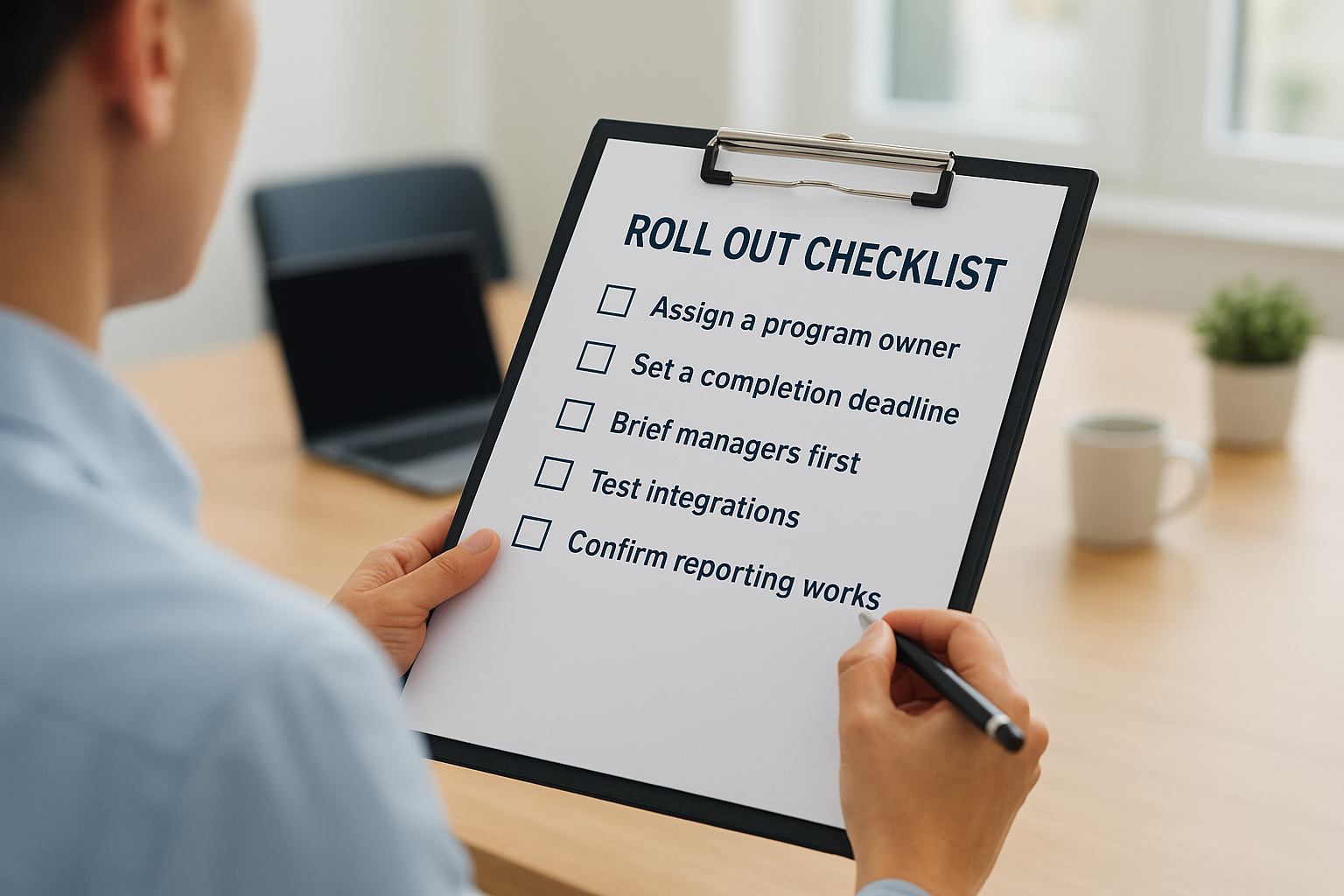
- Assign a program owner who fields questions and tracks adoption.
- Set a completion deadline for each required course, tied to automated reminders.
- Brief managers first so they can reinforce expectations with their teams.
- Test integrations with your HR or CRM system before go-live, not after.
- Confirm reporting works by pulling a sample completion report during the pilot.
Measure what actually proves success
Generic attendance numbers don’t tell you much on their own. Instead, track completion rates against deadlines, quiz or assessment scores, and time-to-competency for new hires moving through onboarding. Compliance programs need a different lens entirely: audit-ready reports showing who completed what, when, and with what score, pulled on demand rather than assembled manually before an inspection, which is why evaluating LMS reporting and analytics matters before you buy.
Axis LMS handles this reporting layer natively, generating both scheduled and on-demand reports so managers see progress without chasing spreadsheets. Reviewing these reports monthly, not just annually, lets you catch a stalled department early and fix it before a deadline turns into a compliance gap. Over time, this data becomes the evidence you need to justify training budget to leadership, since it ties directly to retention, error rates, and audit outcomes.
Putting your training plan into action
Good corporate training isn’t complicated once you break it into pieces: identify your skills gaps, match content and technology to those gaps, roll out in phases, then measure what actually proves the program works. Skip any of these steps and you end up with a course library nobody opens or a compliance file that falls apart under audit.
None of this requires guessing. The categories, delivery formats, and evaluation checklist covered above give you a repeatable process you can apply whether you’re launching your first corporate training program or fixing one that’s stalled.
Start by figuring out where your organization actually stands. Take the LMS readiness assessment to see whether you’re ready to pilot a program, replace an existing platform, or still need to map your gaps first. It takes a few minutes and points you toward the right next step instead of another generic vendor pitch.
