The best partner training LMS software gives each partner group its own branded space, certifies people on a schedule, and sends completion data to the CRM you already use. Axis LMS suits mid-sized programs that also train employees and customers or sell training. Skilljar suits SaaS companies. Thought Industries and LearnUpon suit large partner networks. Absorb LMS and Docebo suit enterprises with complex needs. TalentLMS suits small programs that need to launch fast.
Your partners are not your employees. They work for other companies, they are short on time, and they sit outside your HR system. An LMS built for one internal workforce tends to struggle with partner tiers, separate administrators, and recertification. The wrong choice shows up as low completion rates and partners who never learn your product well enough to sell it.
This article compares seven platforms for channel partner training software needs: what each one does, who it fits, and where it falls short. Atrixware makes Axis LMS, so it is listed first, and we hold it to the same questions as the rest. A selection guide follows the list, with a worked example for sizing your own program.
1. Axis LMS
Axis LMS is a general-purpose learning management system that also handles channel training, which makes it a strong pick when partners are only one of your audiences.

How it handles partner training
Axis LMS is built for organizations of 150 to 100,000 users. It supports online courses and virtual classroom training, with a drag-and-drop interface for building courses quickly. You can run on-demand and automated reports, track CEU credits and re-certifications, and control the branding of every part of the user interface.
For partner programs, the practical strengths are in the connections and the commerce:
- CRM and HR sync: brings in user data from systems like Salesforce, ADP, BambooHR and Zoho.
- Integration reach: a built-in Integration Builder connects to over 5,000 systems, plus a REST API and webhooks for real-time events.
- Single sign-on: SAML 2.0 support, including Okta, Azure and Ping Identity.
- Selling training: e-commerce for individuals and for seat licenses in business-to-business sales.
- AI authoring: AI features can generate quizzes, surveys and presentations from a topic or document.
Axis LMS fits best when partner training has to sit alongside employee training, customer education, or paid courses.
Who it suits and what to watch
Axis LMS suits HR, enablement and compliance teams that want one system for several audiences, and teams that want to charge partners for certification. The Core plan includes 150 to 3,000 users, Pro includes 250 to 4,000, and Enterprise includes 500 to 100,000. Setup usually takes one to three business days, and tech support with unlimited incidents is included.
Smaller programs can start with Axis LMS Lite, listed at $299 for 25 users with online and virtual classroom training. Lite covers 25 to 100 learners.
The trade-off is that Axis LMS is not a partner-only platform. Before you buy, ask how many separate partner portals and administrator levels you need. Lite includes 10 page groups or portals and one level of organization depth, so a program with many partner tiers should confirm limits on the plan it is considering.
2. Skilljar
Skilljar is a platform built for external education, and it is most often chosen by software companies training implementation partners, resellers and customers.
How it handles partner training
Skilljar organizes training into Domains. Each domain has its own URL, SSO configuration, branding and access rules, and you can set a domain to public, login-required or access-code-restricted. That makes it simple to give resellers, integrators and customers separate academies.
The platform covers certification and accreditation, product onboarding paths, self-service enrollment, and analytics on participation and completion across partner groups. E-commerce exists, but it is a supporting feature rather than the focus.
- Separate academies per audience
- Certification for partners and products
- Reporting across partner groups
- Optional connection to Gainsight for customer success teams
Skilljar is the natural shortlist entry when your partners sell and implement software.
Who it suits and what to watch
Skilljar suits SaaS and technology companies with product-heavy partner onboarding. Teams outside technology often find other platforms match their training needs more closely.
It is also less suited to teams that want one system for employee learning. If monetizing courses matters to you, check the e-commerce depth with the vendor. CRM alignment depends on how you set up integrations, so ask for a walkthrough of the data you would see in your own CRM.
3. LearnUpon
LearnUpon is an easy-to-run LMS that uses sub-portals to keep partner groups apart, and it works well for programs that are growing.

How it handles partner training
LearnUpon calls its multi-tenant model Learning Portals. You build a top-level portal and a set of sub-portals, each with its own branding, URL, SSO, admins and content. Edit a course once at the top and the change reaches every sub-portal. You can also license a course from one portal to another and cap the enrollments and time window.
The vendor states that one customer runs over 800 portals from a single instance. E-commerce, powered by Spree and connected to Stripe, lets you sell courses and certifications from a branded storefront.
- Parent and sub-portal structure
- Certification with expiry tracking
- Live session support through webinar integrations
- Automated reminders and notifications
LearnUpon trades some depth for speed: partners and admins can be productive quickly.
Who it suits and what to watch
LearnUpon suits teams without a large learning department that still need separate partner spaces. It also handles customer and employee training, so one system can cover more than partners.
Programs with very large partner ecosystems, or with highly customized enablement, may find specialist platforms more configurable. Commercial training is also less central here than in some alternatives, and CRM-driven workflows may need extra tools.
4. Thought Industries
Thought Industries is built for external learning at scale, and it is the strongest fit on this list when training is a revenue line.
How it handles partner training
Its multi-tenant feature is called Panorama. It creates a very large number of branded or co-branded portals that you manage centrally. When you change a parent course, the update pushes to every portal where that content appears. Each portal has its own branding, URL, SSO settings, admin roles and access controls.
On the commerce side, the platform supports 150 currencies and connects to payment providers including Stripe and Worldpay. It handles subscriptions, bundles, content licensing and a la carte purchases. Buyers with complex multi-currency needs should confirm current capability with the vendor.
- Partner hubs and customer academies
- Certification and recertification management
- Audience segmentation by role, region or partner tier
- Live and on-demand delivery in one place
Thought Industries rewards programs that treat partner education as a product, not a cost center.
Who it suits and what to watch
It suits large partner networks and training businesses with distributors, resellers and customers all learning on one platform. Pricing is custom and starts with a sales conversation.
It is less focused on internal employee learning, so a single platform for staff and partners needs careful evaluation. Smaller programs may find it more complex than they need, and some advanced reporting needs setup.
5. Absorb LMS
Absorb LMS is a broad enterprise platform with strong reporting and a commission-free e-commerce module, and it suits organizations that train several audiences at once.
How it handles partner training
Absorb separates partner audiences through departments and groups. Each department can have its own URL, branding and tailored content, all managed from one admin console. It supports self-paced courses, instructor-led and virtual sessions, assessments, SCORM and xAPI content, and certification management.
The built-in e-commerce module has no commission, supports over 70 payment gateways and multiple currencies, and handles promotional pricing, bundles and multi-seat purchases. Absorb Create, its AI authoring tool, speeds up building courses.
- Branded partner portals through departments
- Advanced reporting and analytics
- Multi-seat purchasing for partner companies
- Optional marketplace content
Absorb works best when one platform has to serve employees, customers and partners with strong reporting.
Who it suits and what to watch
Absorb suits mid-size to large organizations that expect their programs to grow across audiences. Users often praise its modern interface.
The cost of that breadth is complexity. Custom reports can take admin training, and teams wanting a lightweight partner tool will not use most of the features. Highly specialized channel programs may also find purpose-built platforms more targeted.
6. Docebo
Docebo is a configurable cloud LMS for large enterprises that train employees, customers and channel partners across regions.
How it handles partner training
Docebo combines AI-driven content recommendations, social learning and knowledge sharing with certifications, assessments, and analytics. Its large set of configuration options lets global programs tailor the partner experience by audience.
- AI recommendations for partner learners
- Social learning and knowledge sharing
- Certification programs and assessments
- Advanced analytics and reporting
Docebo gives large programs control, but you pay for that control in setup time.
Who it suits and what to watch
Docebo suits global enterprises with dedicated learning teams and partner ecosystems that need advanced learner experience features. If you already run Docebo for employees, extending it to partners can be easier than adding a second system.
The flexibility comes with complexity. Setup and customization for partner use cases can take time, so a small team with a short deadline will likely be better served elsewhere. Ask for a pilot with real partner content before committing.
7. TalentLMS
TalentLMS is a simple cloud LMS that gets small partner programs running quickly without enterprise overhead.
How it handles partner training
TalentLMS uses branches to give partners their own space. It supports course creation, assessments, certificates and basic progress tracking. It is easy to deploy and manage, which makes it a practical first platform for a young partner program.
- Branches for partner groups
- Course building and assessments
- Certificates on completion
- Straightforward progress reporting
TalentLMS is the lowest-friction option here, with limited reporting depth as the price.
Who it suits and what to watch
TalentLMS suits small or early-stage partner programs and teams without a dedicated learning administrator. It is a good way to prove that partners will complete training before you invest in a bigger system.
Analytics and enablement depth are limited compared with enterprise platforms. If you need training data to flow into your CRM, or tiered certification that gates program benefits, test those workflows in a trial first. You may outgrow it as your partner count rises.
How to choose partner training LMS software
Pick the platform whose partner structure, certification rules and integrations match your program today, with room for the next two years. Four checks do most of the work.
Count learners, not partner companies
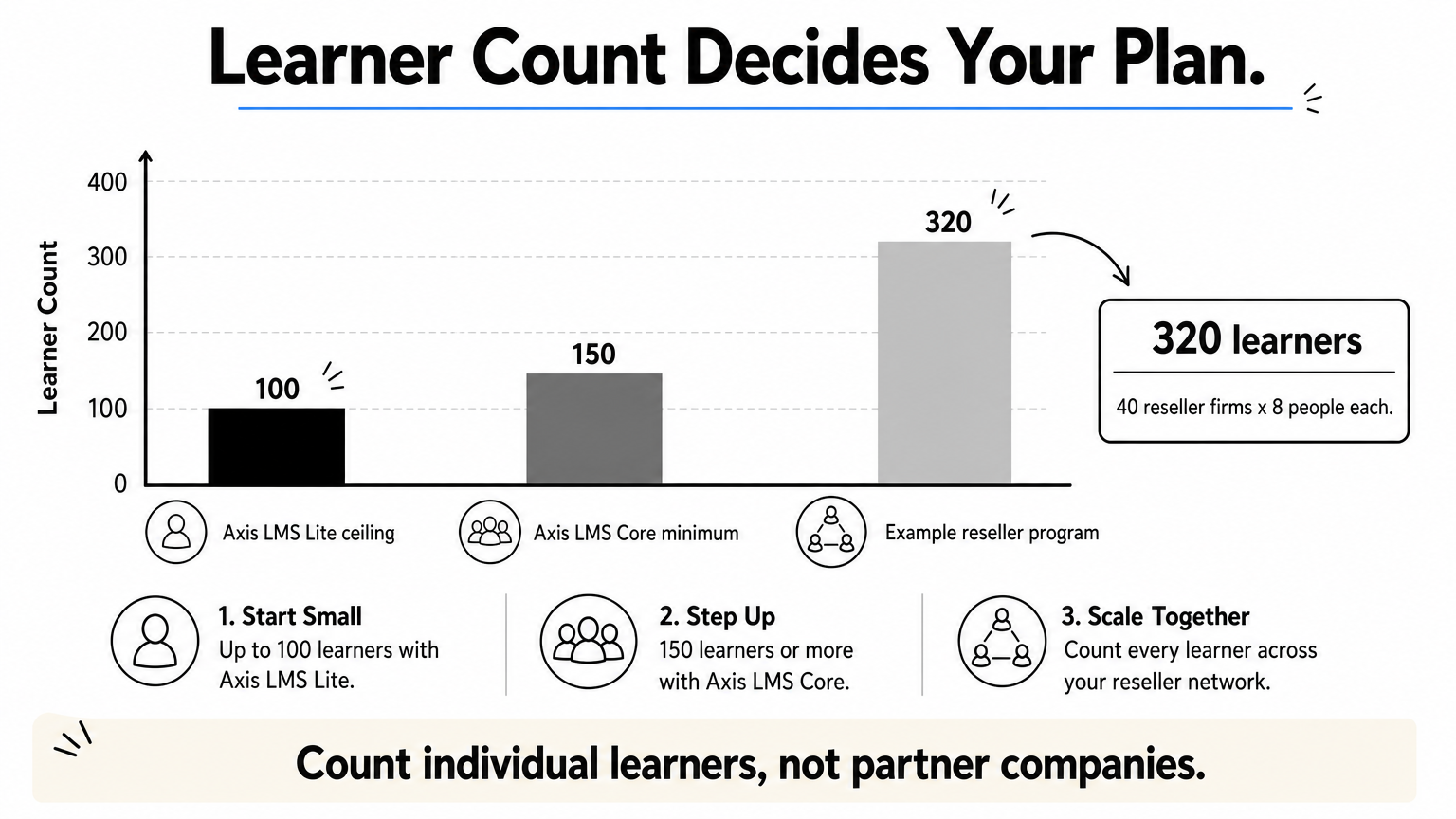
Start with the number of individual learners, because most platforms price and tier by users. Say you have 40 reseller firms and expect eight people from each to train. That is 40 x 8 = 320 learners, which is well above the 100-user ceiling of a small-business plan like Axis LMS Lite. It falls inside the 150 to 3,000 users included with Axis LMS Core. Add the learners you expect in a year, not only today.
Enterprise platforms usually quote on request, based on user count, features and contract length. Ask each vendor about implementation, integrations and support costs too, since those can add meaningfully to the total.
Match the platform to your partner structure
Separate partner spaces matter most when partners compete or need different content. This table sets the seven platforms side by side.
| Platform | How it separates partners | Best fit |
|---|---|---|
| Axis LMS | Page groups, portals and organization structure | Mixed employee, customer, partner and paid training |
| Skilljar | Domains with their own URL and SSO | SaaS partner and customer academies |
| LearnUpon | Learning Portals and sub-portals | Growing programs that want easy administration |
| Thought Industries | Panorama portals | Large networks and training revenue |
| Absorb LMS | Departments and groups | Enterprises that need reporting and e-commerce |
| Docebo | Enterprise configuration options | Global programs with a dedicated learning team |
| TalentLMS | Branches | Small programs that need to launch fast |
Check certification, integrations and reporting
Certification should support expiry and recertification, so partners cannot sell on a two-year-old credential. Ask whether certification can unlock tiers or program benefits. For integrations, list what must receive training data, such as Salesforce or HubSpot, and whether SSO is required. Completion alone does not show readiness, so look for reports that show which partners hold which certifications and who is dropping out.
Run a pilot with real partners
Request a demo, then pilot with one partner group and your real content. Measure how many invited partners finish, how long a new course takes you to build, and whether completion data reaches your CRM. A pilot of 10 to 20 partner learners exposes more than any feature checklist.
Choose on partner structure and CRM data flow first, because features you never configure are wasted spend.
Pick the platform that partners will finish
A good partner training LMS keeps partner groups separate, certifies on a schedule, and sends results to your CRM. Smaller programs can start light with a simple platform like TalentLMS. SaaS programs can look at Skilljar, and very large networks at Thought Industries or LearnUpon. Axis LMS fits when partner training shares a system with employee training, customer education, or paid courses.
Whichever platform you shortlist, test it with real partners before you sign a contract. If Axis LMS is on your list, you can request an Axis LMS admin demo and walk through your own partner structure with the team.
