
Export regulations change constantly, and getting them wrong costs real money. One misclassified shipment or missed license requirement can trigger fines, shipment holds, or worse, a loss of export privileges. That’s why more companies are turning to online export compliance training to keep their teams current on rules from agencies like BIS, OFAC, and the State Department without pulling staff off the floor for in-person seminars.
If you’re searching for this, you’re probably trying to figure out what a solid export compliance program training actually includes, and whether an online format can meet the same standards as traditional classroom instruction. It can, and in many cases it does a better job, because it’s trackable, repeatable, and easy to update the moment regulations shift.
This article breaks down what online export compliance training actually covers, who needs it, and how trade compliance training online fits into a broader compliance strategy. We’ll also look at what to expect from certification tracking and recordkeeping, something any LMS built for compliance, including Axis LMS, is designed to handle from day one.
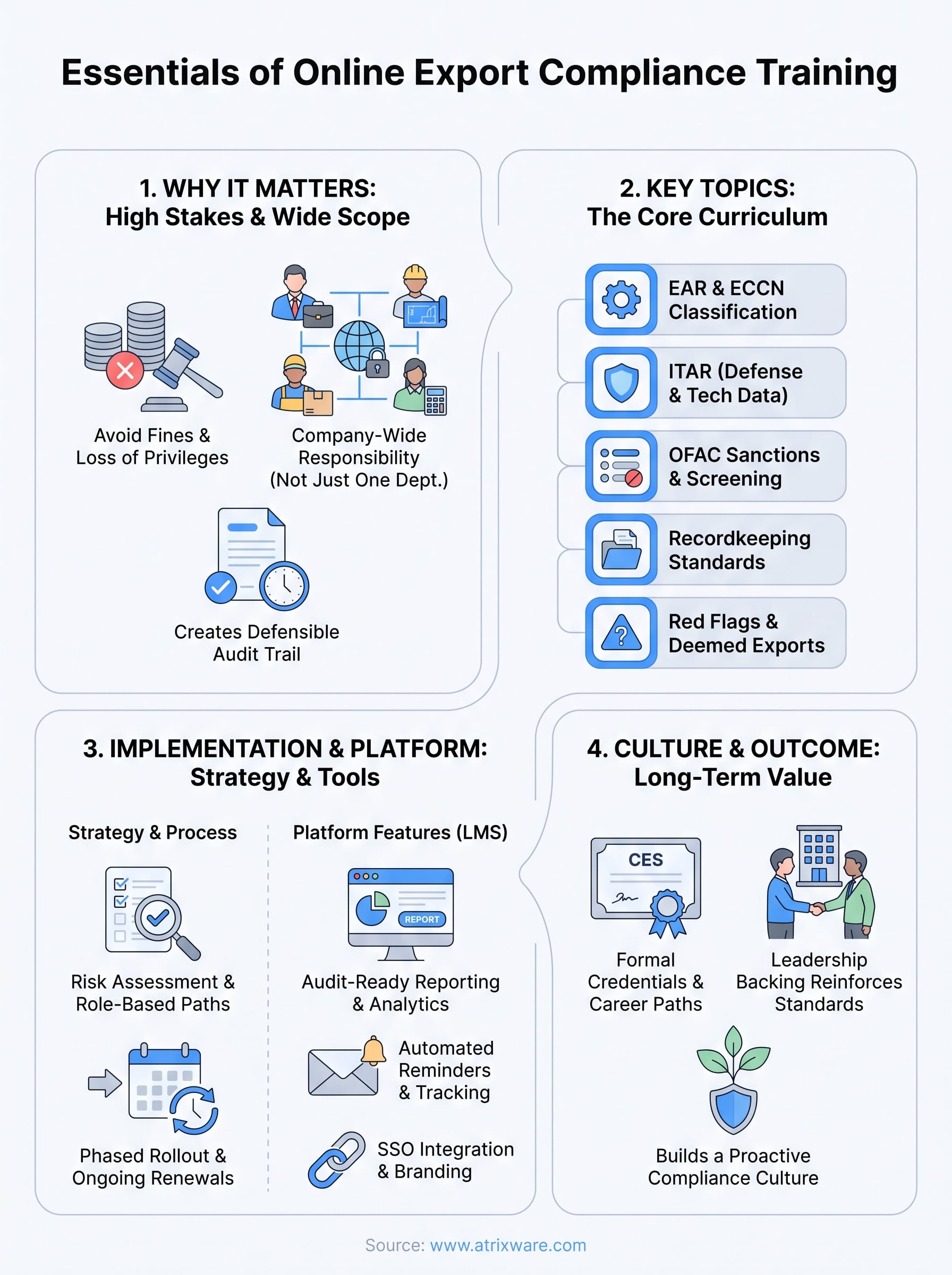
Why online export compliance training matters
The stakes are higher than most teams realize

Export violations aren’t hypothetical risks buried in a compliance manual. The Bureau of Industry and Security publishes enforcement actions regularly, and penalties routinely reach six or seven figures for a single mishandled shipment. A misapplied ECCN, an unscreened denied party, or a missing license can freeze a shipment at the dock or worse, cost a company its export privileges entirely. Ongoing training is what keeps staff from making these mistakes in the first place, not a one-time onboarding checkbox.
A single missed license requirement can cost more than a year of training ever would.
Compliance isn’t just the export team’s job
Beyond the trade compliance office, plenty of employees touch export-controlled information or products without realizing it. That’s why online trade compliance training works better as a company-wide rollout than a departmental afterthought. Consider who typically needs it:
- Sales reps quoting international deals
- Engineers sharing technical data with overseas partners
- Warehouse staff packing and labeling shipments
- Customer service teams handling support tickets from restricted regions
- Finance staff processing international payments
Each group faces different exposure, and role-based assignments make sure nobody gets training irrelevant to their job or misses training that matters.
Online training creates the audit trail you need
Regulators don’t just want proof that training happened, they want proof it happened on schedule, for the right people, with documented completion. A learning platform that logs every quiz score, certificate, and renewal date gives compliance officers exactly that during an audit, something a stack of sign-in sheets from a live seminar never fully captures, and an audit trail is what ensures training integrity in regulated environments.
How to implement export compliance training in your organization
Starting an export compliance training program doesn’t require a full policy overhaul on day one, and the same is true when you roll out a corporate LMS across a large organization. Begin with a risk assessment: figure out which departments handle controlled products, technical data, or international transactions, then build role-based learning paths instead of assigning one generic course to everyone.
Assigning training by department only works if someone owns the process. Give a compliance officer or HR lead responsibility for scheduling, tracking completions, and updating content when regulations change, since export trade compliance training online loses value fast if it sits untouched for two years.
Training that nobody owns becomes training that nobody finishes.
A phased rollout keeps the process manageable:
- Identify high-risk roles (sales, engineering, shipping, finance)
- Assign baseline courses covering EAR, ITAR, and OFAC basics
- Layer in role-specific modules for classification, screening, or licensing
- Set renewal intervals, typically annual, with automated reminders
- Pull completion reports before audits or customer reviews
Lastly, treat the launch as ongoing rather than a one-time project, since automation is what shields your organization from expired credentials. Regulations shift, staff turn over, and new hires need the same rigor as veteran employees, so build renewal dates into the calendar from the start.
Key topics every export compliance training program should cover
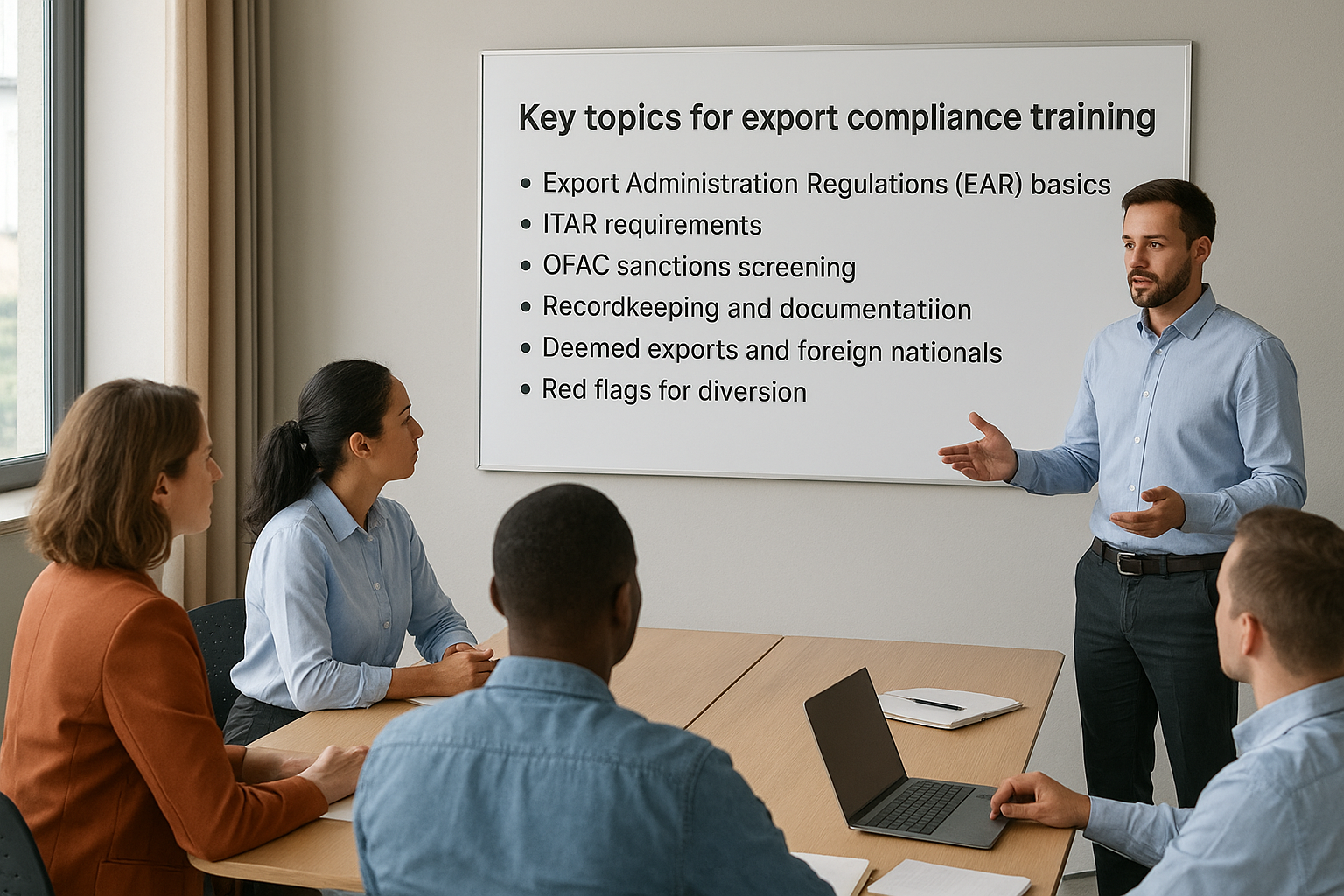
Good export compliance program training goes beyond a single regulation and covers the full landscape of rules your team is likely to encounter. Skipping a topic because it seems unlikely to apply is how gaps form, and gaps are exactly where violations happen. A well-built curriculum should map directly to the regulations your industry actually touches, not a generic template pulled off the shelf.
Training that skips the rules you rarely use is training that fails the one time you need them.
At minimum, plan for:
- Export Administration Regulations (EAR) basics and ECCN classification
- ITAR requirements for defense articles and technical data
- OFAC sanctions screening and denied party lists
- Recordkeeping and documentation standards
- Deemed exports and foreign national access rules
- Red flags for diversion or unauthorized end use
Once those core modules are in place, layer in industry-specific content, aerospace, defense contractors, and semiconductor firms all face different licensing thresholds. Role-specific scenarios, like a sales rep quoting a restricted country versus an engineer emailing a drawing overseas, make abstract regulations concrete and far easier to remember when it counts.
What to look for in an online export compliance training platform
Picking a platform matters as much as picking the curriculum. Content quality counts for little if the system behind it can’t track who finished what, when a certificate expires, or which module a new hire still owes you. Look past the course library and check what makes an LMS system good for compliance training, specifically whether it handles the administrative load that makes compliance defensible during an audit.
Run any vendor through this checklist before you commit:
- Automated renewal reminders and expiration tracking
- Role-based course assignment by department or job title
- Detailed completion reports exportable for auditors
- SSO integration so employees log in without a separate password
- Branding controls so training feels like part of your company, not a generic module
A platform that can’t prove who finished training is a platform that can’t protect you in an audit.
A learning management system built for compliance training, like Axis LMS, handles these requirements natively rather than bolting them on as an afterthought. That distinction shows up fast once you’re pulling records under deadline pressure, not during a calm demo.
Certification options and career paths in export compliance
Beyond internal training, plenty of professionals pursue formal credentials to validate their expertise and stand out in a competitive job market. The Certified Export Specialist (CES) designation and similar programs from trade associations test knowledge of licensing, classification, and sanctions screening at a level well beyond a basic onboarding course. These aren’t required for most roles, but they carry weight when a company is hiring a dedicated compliance manager or building out a trade compliance department from scratch.
Growing demand for these skills has turned export compliance into a legitimate career path rather than a side responsibility bolted onto someone’s job description. Companies expanding into new markets need people who understand ITAR and EAR well enough to advise on deal structure before a contract gets signed, not just react after a shipment gets flagged.
A certificate on the wall means less than a clean audit trail behind it.
Organizations that want to grow their own talent internally can pair a trade compliance training online track with tuition support for outside certifications, using strategic certification and recertification to give ambitious employees a clear path forward while strengthening the company’s overall compliance posture.
Building a culture of export compliance
Training only works when it becomes part of how your company operates, not a course people click through once and forget. Export compliance training online should reinforce a standard that leadership visibly backs, where managers ask about renewal dates and completion reports as routinely as they ask about sales numbers. Strong programs treat every new hire, every role change, and every regulatory update as a trigger for fresh training, not an exception to handle later.
Getting there takes a platform that keeps pace with your team rather than slowing it down. Handling assignments, renewals, and audit-ready reporting without constant manual work is exactly what a purpose-built LMS delivers, and it’s worth seeing firsthand before you commit to one. If you’re evaluating options, take a few minutes to try the Axis LMS admin demo and see how compliance tracking looks from the inside.
