Your employees are your biggest investment, but without the right training, that investment doesn’t reach its full potential. Whether you’re onboarding new hires, upskilling your current team, or meeting compliance requirements, knowing how to build a corporate training program makes the difference between wasted resources and measurable results.
The challenge? Most organizations struggle to create training that actually sticks. Programs get thrown together without clear objectives, content fails to engage learners, and tracking progress becomes a spreadsheet nightmare. The result is frustrated employees and wasted budgets, with leadership left questioning the ROI of training altogether.
This guide breaks down the process into 10 actionable steps you can follow right now. At Atrixware, we’ve helped businesses of all sizes launch effective training programs through our Axis LMS platform, and we’ve seen firsthand what separates successful programs from failed ones. You’ll learn how to align training with business goals, create engaging content, choose the right delivery methods, and measure what actually matters for performance improvement.
What to decide before you design anything
Before you write a single slide or record a video, you need to establish the foundation that determines every other decision. Too many organizations jump straight into content creation without answering fundamental questions about purpose, audience, and resources. When you skip this strategic phase, you end up with training that nobody needs or programs that collapse under unclear expectations.
The most expensive training mistake isn’t poor content; it’s building the right program for the wrong purpose.
Define your business objectives first
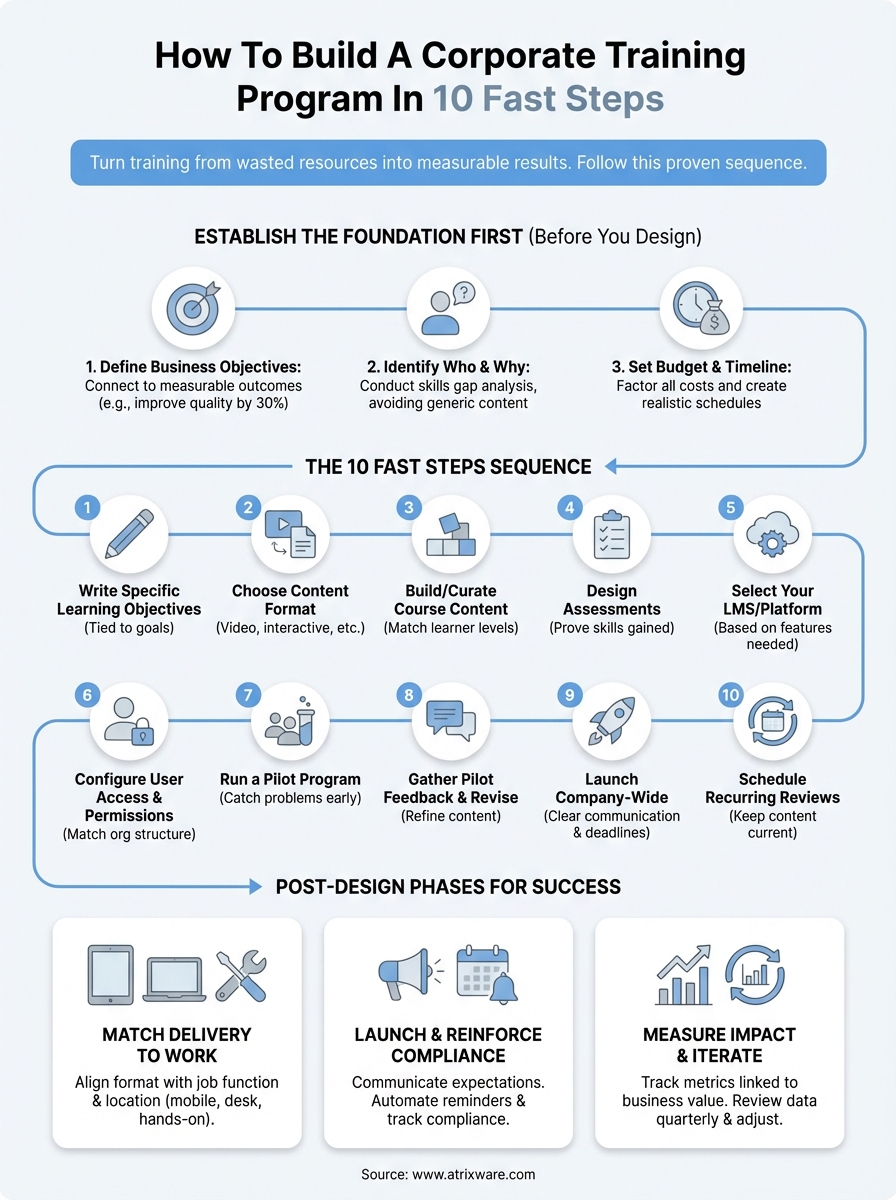
Start by connecting training directly to measurable business outcomes. Ask yourself what specific problems need solving or what opportunities require new capabilities. If you’re struggling with customer retention, your training objective might be "improve customer success team response quality by 30% within six months." If you’re launching a new product, the objective becomes "certify 100% of sales staff on product features before launch date." Vague goals like "improve skills" won’t work because you can’t measure progress or justify the investment.
Your objectives should ladder up to broader company goals that leadership already tracks. This alignment ensures buy-in and makes it easier to prove ROI later.
Identify who needs training and why
You can’t design effective content without knowing exactly who you’re training and what gaps currently exist. Conduct a skills gap analysis by comparing current capabilities against what each role requires. Survey managers, interview top performers, and review performance data to spot patterns in where people struggle.
Different audiences require different approaches. New hires need comprehensive onboarding that covers company culture and foundational skills. Existing employees might need targeted upskilling on specific tools or processes. Don’t make everyone sit through the same generic content when their needs vary significantly.
Set your budget and timeline upfront
Knowing how to build a corporate training program requires honest assessment of available resources before you commit to a scope. Determine your total budget for development, delivery, tools, and ongoing maintenance. Factor in both direct costs like software licenses and indirect costs like employee time spent in training.
Establish realistic timelines that account for content creation, review cycles, pilot testing, and full rollout. Rushing the process leads to poor quality, while dragging it out loses momentum and relevance.
The 10 fast steps to build the program
Once you’ve laid the groundwork, knowing how to build a corporate training program comes down to following a proven sequence that prevents common pitfalls. These ten steps provide the framework you need to move from planning to execution without wasting time on trial and error. Each step builds on the previous one, creating a structured path from concept to measurable results.
Follow this sequence to avoid starting over
You need a clear roadmap that keeps development on track and stakeholders aligned. Here’s the complete sequence:
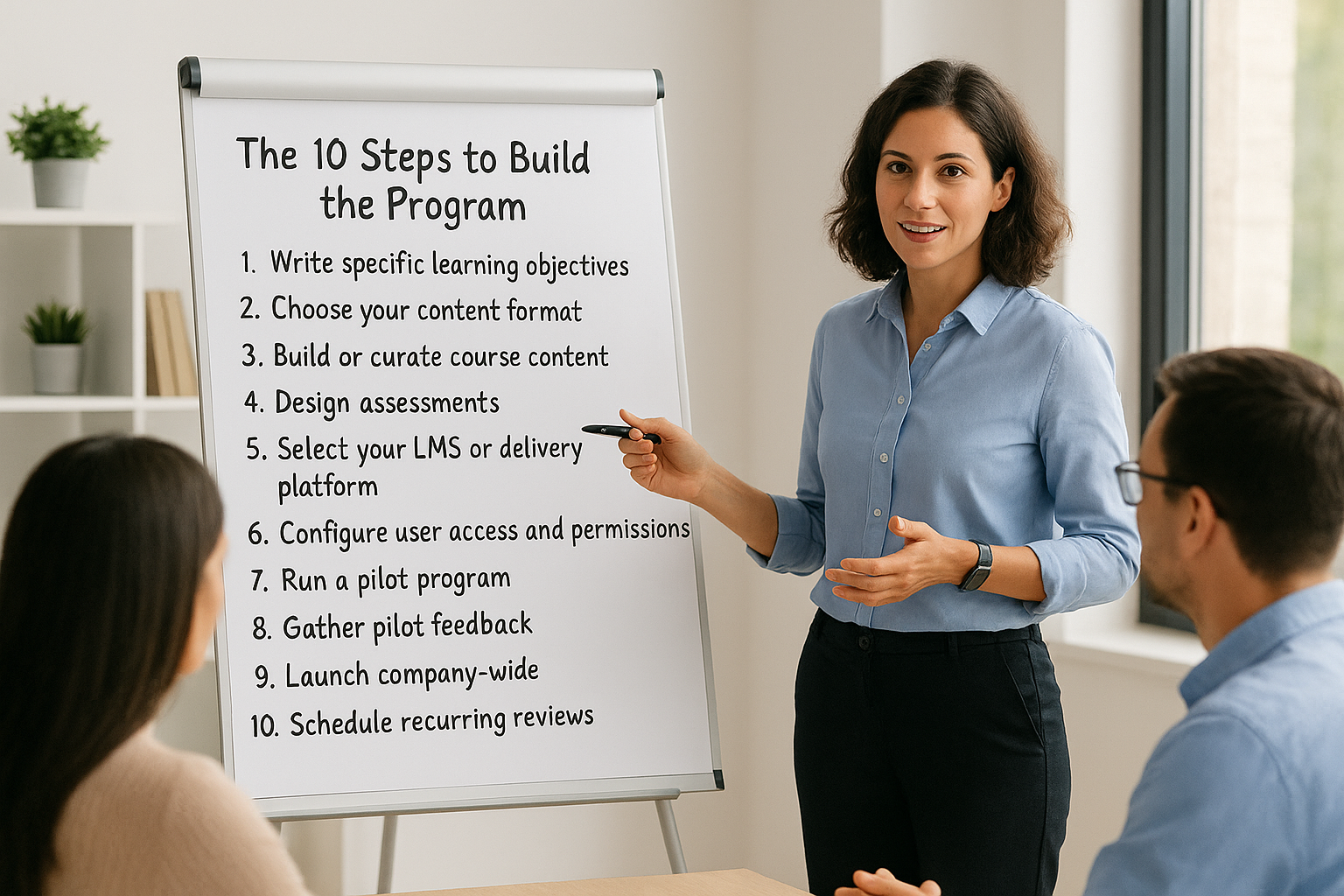
- Write specific learning objectives for each training module that tie back to your business goals
- Choose your content format (video, interactive modules, documents, or blended approaches)
- Build or curate course content that matches your learners’ existing knowledge level
- Design assessments that prove learners gained the required skills
- Select your LMS or delivery platform based on features you actually need
- Configure user access and permissions to match your organizational structure
- Run a pilot program with a small group to catch problems early
- Gather pilot feedback and revise content before full rollout
- Launch company-wide with clear communication about expectations and deadlines
- Schedule recurring reviews to keep content current and relevant
The difference between successful programs and failed ones is following this sequence instead of skipping steps to save time.
Each step requires specific deliverables before you move forward. Rushing through or skipping any step creates gaps that show up as poor engagement or training failure later.
Pick delivery methods and tools that fit the work
Your delivery method makes or breaks whether employees actually complete training and retain the information. Choosing the wrong format or platform leads to low completion rates, frustrated learners, and wasted development costs. Understanding how to build a corporate training program means matching delivery methods to where and how your employees actually work rather than forcing everyone into a one-size-fits-all approach.
Match format to job function and location
Sales teams traveling between client sites need mobile-friendly microlearning modules they can complete in 10-minute chunks between meetings. Manufacturing floor workers require hands-on demonstrations and quick reference guides accessible at their workstations, not hour-long videos they watch at a desk. Remote employees benefit from self-paced online courses with flexible deadlines, while office-based teams might prefer scheduled virtual instructor-led sessions that create accountability.

Consider your employees’ daily reality when selecting formats. If they don’t have regular computer access, app-based training or printed job aids work better than web-only courses. When technical skills require practice, simulation software or sandbox environments beat passive watching every time.
The best training content fails when delivered through methods your employees can’t easily access during their actual workday.
Choose your LMS based on must-have features
Your Learning Management System should solve specific problems in your workflow, not create new ones. Prioritize features that directly support your program goals: automated enrollment and reminders for compliance training, detailed reporting for tracking skill gaps, mobile access for distributed teams, or integration with your existing HR systems for seamless data sync. Skip expensive platforms loaded with features you’ll never use.
Launch, reinforce, and keep compliance tight
Successfully knowing how to build a corporate training program extends beyond initial deployment. Your rollout strategy determines whether employees actually complete training or ignore it until the last minute. Clear communication about expectations, deadlines, and consequences sets the tone, while reinforcement mechanisms ensure knowledge sticks beyond the first completion.
Communicate launch expectations clearly
Send announcement emails that explain what training is required, why it matters, and when deadlines fall. Include direct links to the training portal and instructions for first-time login. Manager briefings work better than company-wide emails alone because immediate supervisors can answer questions and hold teams accountable. Use multiple channels (email, Slack, team meetings) to reach everyone regardless of their primary communication method.
Your launch communication should include:
- Specific completion deadlines for each course
- Estimated time commitment per module
- Where to get technical support
- Consequences for non-completion (if applicable)
- How training connects to job performance
The clearest launch plans fail when managers don’t know they’re responsible for enforcing completion.
Track compliance and trigger reminders automatically
Configure your LMS to send automated reminders at regular intervals before deadlines approach. Set up escalation workflows that notify managers when their team members fall behind. For compliance-critical training, require passing scores on assessments rather than just course completion. Schedule recurring certifications for content that requires regular refreshers, and automatically re-enroll employees when renewal dates arrive.
Measure impact and iterate every cycle
Training programs lose relevance the moment you stop measuring their actual impact on business outcomes. Completion rates tell you nothing about whether employees applied what they learned or if performance improved where it matters. Understanding how to build a corporate training program requires establishing measurement systems that connect learning activities to real results, then using that data to make informed improvements every quarter.
Track metrics that prove business value
Focus on metrics that directly tie to the business objectives you defined at the start. If your training aimed to reduce customer support ticket resolution time, measure average resolution time before and after training completion. If onboarding was the goal, track time-to-productivity for new hires and compare cohorts who completed training versus those who didn’t. Revenue per sales rep, error rates, safety incidents, and compliance audit results all provide concrete evidence of training impact.
Your LMS should automatically track completion rates, assessment scores, and time spent per module. Compare these engagement metrics against performance data from your HR or operations systems to identify patterns. Low assessment scores that correlate with poor job performance signal content gaps, while high scores paired with unchanged performance suggest your training tests knowledge but fails to drive behavior change.
Numbers without context mean nothing; always compare training metrics against the business outcomes you aimed to improve.
Review data quarterly and adjust content
Schedule recurring reviews where you analyze training effectiveness and plan updates. Pull reports on completion rates, assessment scores, and learner feedback. Interview managers about whether they see behavior changes in their teams post-training. Update outdated content, replace modules with low engagement, and expand sections where employees consistently struggle on assessments.
Next steps
You now understand how to build a corporate training program from initial planning through continuous improvement. The framework works whether you’re launching your first program or rebuilding an existing one that underperforms. Your next move depends on where you currently stand in the process.
Organizations evaluating their training approach should assess current gaps between manual tracking and automated systems. If you’re managing enrollments through spreadsheets, chasing employees for completion confirmations, or compiling reports by hand, you’re wasting hours that dedicated training software eliminates. Companies ready to implement structured programs need a platform that handles enrollment automation, progress tracking, assessment scoring, and compliance reporting without requiring IT support for every configuration change.
Axis LMS provides the infrastructure supporting every step you just learned. Start your free admin demo of Axis LMS to explore course building, automated workflows, and the reporting tools that prove training ROI to leadership.
