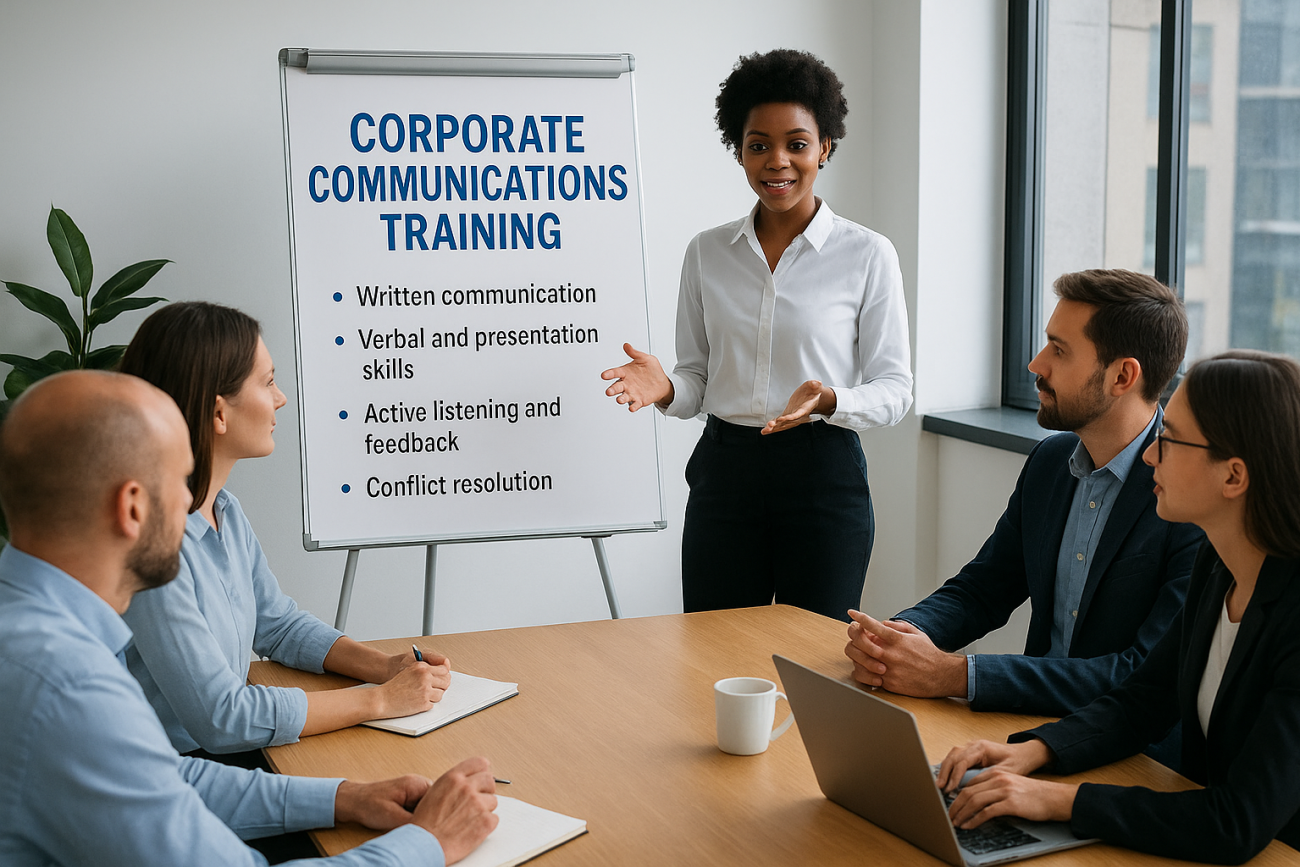
Bad emails, unclear meetings, and mixed messages between departments cost more than most leaders realize. That’s the gap corporate communications training is built to close. Whether you’re onboarding new managers or trying to fix a culture where feedback dies in silence, this kind of training gives people a shared set of skills for speaking, writing, and listening at work in ways that actually move projects forward.
If you’re searching for this topic, you probably want a clear answer to two things: what corporate communication training actually covers, and why your organization should invest in it now rather than later. This article breaks down the core skills involved, from written communication and presentation ability to conflict resolution and cross-team collaboration, and explains the measurable business impact that comes with getting these skills right.
We’ll also look at how companies structure and deliver this training, since format matters as much as content. For teams already using a learning management system, corporate communication programs slot in as trackable employee training courses with real reporting, which makes it easier to prove the training is working and not just a line item on a budget.
Why corporate communications training matters
Most companies don’t have a communication problem because people are careless. They have one because nobody ever taught them a shared standard for how to write a status update, run a meeting, or deliver hard feedback. Corporate communications training fixes that by giving every employee, not just the naturally articulate ones, a repeatable framework for getting their message across clearly the first time. Without it, you get the pattern every manager recognizes: the email that gets misread, the meeting that runs long because nobody stated the goal, the project that stalls because two departments assumed different things.
The real cost of poor communication
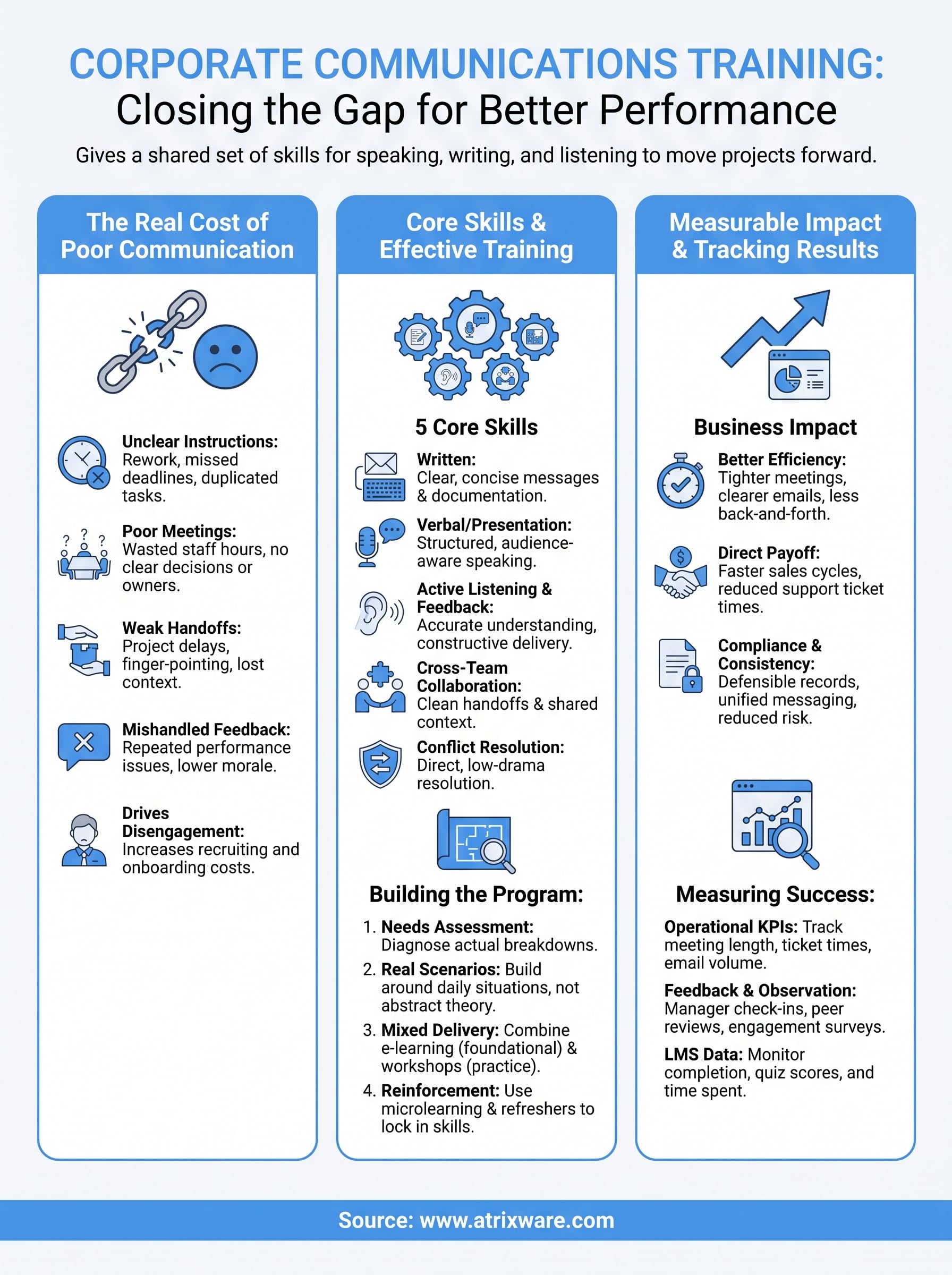
Breakdowns in communication rarely show up on a budget line, but they show up everywhere else. Rework, missed deadlines, and duplicated effort all trace back to someone not understanding what was actually being asked of them, which is a large part of what poorly trained workers really cost you. Poor internal communication also drives disengagement; employees who don’t feel informed or heard tend to disengage faster and leave sooner, which pushes up recruiting and onboarding costs that were entirely avoidable.
| Communication gap | Typical business impact |
|---|---|
| Unclear written instructions | Rework, missed deadlines, duplicated tasks |
| Poorly run meetings | Wasted staff hours, no clear decisions or owners |
| Weak cross-department handoffs | Project delays, finger-pointing, lost context |
| Avoided or mishandled feedback | Repeated performance issues, lower morale |
| Inconsistent customer messaging | Damaged trust, increased support escalations |
Every hour spent clarifying what should have been clear the first time is an hour stolen from actual work.
Better communication drives measurable performance
Once a team goes through structured training for corporate communications, the change usually shows up first in meeting efficiency and email volume. People stop copying ten people on every message because they’ve learned how to identify the actual audience for a decision. Managers run tighter one-on-ones because they’ve practiced structuring feedback instead of improvising it under pressure. None of this is abstract soft-skill polish; it’s operational efficiency dressed up as a people skill.
Sales and customer-facing teams see an even more direct payoff. Reps who’ve been trained on clear, structured messaging close deals faster because prospects don’t have to work to understand the value being offered. Support teams that communicate consistently reduce the back-and-forth that turns a five-minute ticket into a twenty-minute one. Training corporate communication at the team level, rather than leaving it to individual style, means customers get the same quality of interaction no matter who they talk to.
Compliance, risk, and consistency
For regulated industries, communication training isn’t optional polish, it’s part of your compliance posture. How your staff documents incidents, escalates safety concerns, or communicates with regulators can determine whether your organization stays on the right side of a standard like GDPR or FDA 21 CFR Part 11. The Federal Trade Commission has repeatedly flagged unclear or inconsistent customer communication as a factor in complaints that escalate into formal investigations. Training your workforce to communicate consistently, and documenting that training in a compliance training system, gives you a defensible record if a regulator or auditor ever asks how your organization handles disclosure and escalation.
Compliance aside, consistency itself is worth protecting. When every department describes the same policy or product in a slightly different way, customers and partners lose confidence in your organization’s competence, even if the underlying substance is fine. Standardized training closes that gap by making sure the message doesn’t depend on which employee happens to answer the phone.
Culture starts at the top
Leadership behavior sets the tone for how everyone else communicates, so training that skips managers and executives rarely sticks. When senior leaders model clear, direct, and respectful communication, that standard filters down naturally. When they don’t, no amount of training for the rank and file will overcome the example being set above them.
Organizations that treat communication skills as a leadership competency, not just an entry-level soft skill, see faster adoption across the rest of the company. Leaders who’ve been trained to give structured feedback, run focused meetings, and communicate change clearly become the reference point employees copy. That’s the real return on this kind of training: it’s not a one-time workshop, it’s a shift in the operating norms of the organization, and it compounds every time a manager applies what they learned in a real conversation instead of reverting to old habits.
How to build an effective training program
A training program built on a single generic workshop rarely changes behavior for long. Employees sit through it, nod along, and revert to old habits within a month because nothing in the design reinforced what they learned. An effective corporate communication training program starts with a diagnosis, gets built around real scenarios your teams actually face, and includes a mechanism for reinforcing the skills after the initial session ends.
Start with a needs assessment
Before you buy a course or write a curriculum, figure out where communication is actually breaking down. Pull a sample of dropped projects, escalated support tickets, or exit interview notes and look for patterns. Talk to managers about where they see the most friction: is it written communication, meeting discipline, feedback delivery, or cross-department handoffs? Skipping this kind of needs analysis is the single most common reason training for corporate communications fails to stick, because generic content doesn’t address the specific gap your organization has.
Training that isn’t built around your actual communication failures is just entertainment with a certificate at the end.
Design around real scenarios, not abstract theory
Once you know the gaps, build the curriculum around situations employees will recognize immediately. A module on giving feedback should use the kind of underperformance conversation your managers actually dread, not a generic role-play. A module on written communication should use real internal email threads (anonymized) as before-and-after examples. This grounding is what separates practical soft-skill building inside your LMS from a seminar that feels disconnected from the job.
A solid build-out typically includes:
- A short needs assessment or manager survey to confirm the priority skill gaps
- Role-specific tracks, since a sales rep and a compliance officer need different emphasis
- Scenario-based practice, not just lecture content
- A manager reinforcement guide so skills get coached on the job
- A refresher cadence, since one-time training decays within a few months
Choose the right delivery mix
Most organizations get better results mixing formats rather than betting on one. Short e-learning modules work well for foundational concepts like writing structure or meeting agendas, while live workshops or virtual classroom sessions handle the harder skills, like navigating a difficult conversation, that benefit from real-time practice and feedback. Blending both formats keeps the program flexible enough to scale across a large workforce without losing the interactive depth that actually changes behavior.

Track it like any other business initiative
Spreadsheets and sign-in sheets don’t tell you whether training worked, they only tell you who showed up. Running the program through a system like Axis LMS gives you completion data, quiz scores, and manager sign-off in one place, so you can see which teams finished the training and whether comprehension actually improved. That reporting layer is what turns a training initiative into something you can defend to leadership with numbers instead of anecdotes, and it’s what lets you catch a stalled rollout before it quietly dies.
Core skills and topics the training should cover
Good corporate communication training doesn’t try to cover everything at once. It focuses on a handful of skills that show up in daily work, then builds depth in each one instead of skimming across a long list of soft-skill buzzwords. The topics below are the ones that consistently show up in effective programs, regardless of industry or company size.
Written communication
Email, chat, and documentation carry more of a company’s daily communication than any meeting does, yet most employees never receive formal instruction on writing for work. Training in this area should cover structuring a message so the ask is obvious in the first line, matching tone to audience, and cutting the filler that makes a two-sentence request into a three-paragraph email. Documentation standards matter too, especially for teams that write procedures, incident reports, or customer-facing knowledge base articles where ambiguity creates real risk.

Verbal and presentation skills
Speaking clearly under pressure is a trainable skill, not a personality trait, and treating it that way is what separates useful training from a confidence pep talk. Programs should cover structuring a presentation around a single takeaway, handling questions without losing the thread, and running a meeting with a stated goal and a clear owner for each decision. Employees who present to clients or executives also need practice reading the room and adjusting pace, since a technical explanation that works for engineers usually falls flat with a finance audience.
Active listening and feedback
Listening gets treated as passive, but it’s the skill most directly tied to catching problems early. Training should teach employees to paraphrase what they’ve heard before responding, ask clarifying questions instead of assuming intent, and separate what someone said from what they meant. Feedback delivery deserves its own block of time, since most managers avoid hard conversations simply because nobody ever showed them a structure for having one, which is why delivering soft skills training in the workplace takes deliberate design.
A team that listens well catches problems while they’re still cheap to fix.
Conflict resolution and difficult conversations
Disagreement between departments or coworkers is normal; what varies is whether people have the tools to work through it without it turning into avoidance or escalation. This part of the curriculum should give employees a repeatable process for raising a concern directly, de-escalating a tense exchange, and finding a resolution that doesn’t require a manager to step in every time. Skipping this topic is a common gap, since many programs cover writing and presenting but leave conflict handling to chance.
Cross-team and digital collaboration
Much of the friction inside larger organizations comes from handoffs between departments that speak in different shorthand. Training here focuses on translating jargon for outside teams, setting clear expectations in project handoffs, and using collaboration tools (Slack, project trackers, shared docs) in a way that keeps context visible instead of buried in a thread nobody can find later.
| Skill area | What good training builds |
|---|---|
| Written communication | Clear, concise messages and documentation |
| Verbal and presentation | Structured, audience-aware speaking |
| Active listening and feedback | Accurate understanding, constructive delivery |
| Conflict resolution | Direct, low-drama resolution of disagreements |
| Cross-team collaboration | Clean handoffs and shared context across departments |
Together, these five areas cover the situations employees actually face, which is why training for corporate communications built around them tends to produce visible change instead of a certificate nobody references again.
Who needs corporate communications training
Every employee benefits from clearer communication, but the priority order matters when budgets and time are limited. Some roles create outsized risk or leverage when they communicate poorly, and those are the groups that should sit at the front of the line for corporate communications training rather than waiting for a companywide rollout.
New hires and frontline employees
Onboarding is the cheapest moment to set a communication standard, because new employees haven’t yet picked up bad habits from watching everyone else. Frontline staff who answer phones, staff a help desk, or work a retail floor represent your company in every interaction, so inconsistent messaging at this level shows up directly in customer complaints. Building a short communication module into onboarding training for new hires, before someone develops their own improvised style, is far easier than retraining a habit six months in.
Managers and team leads
Managers carry more communication weight than any other role, since they translate strategy downward and surface problems upward. A manager who can’t structure feedback or run a focused meeting slows down everyone reporting to them, and that drag compounds across a large team. Training for corporate communications aimed at this group should emphasize difficult conversations, delegation clarity, and status reporting, since those are the tasks managers repeat daily.
A manager’s communication habits become the whole team’s default settings.
Sales, support, and customer-facing teams
Revenue and retention both run through how well these teams explain value and handle friction. Sales reps need structured messaging that shortens the sales cycle, while support agents need consistency so a customer gets the same answer regardless of who picks up the ticket. Companies selling training externally, through channel partner and B2B training or paid courses, have an even sharper reason to invest here, since a partner’s communication quality reflects directly on the brand behind them.
Compliance, HR, and legal teams
How these teams document decisions, disclosures, and escalations can matter as much as the decisions themselves. Compliance officers who can’t write a clear, defensible record put the organization at risk during an audit, and HR staff who mishandle a sensitive conversation can turn a manageable issue into a formal complaint. Regulated industries in particular should treat this training as part of their standard operating procedure, not an optional extra.
Cross-functional and remote or hybrid teams
Geographically distributed teams lose the informal correction that happens naturally in a shared office, where a raised eyebrow or a quick hallway chat catches misunderstandings early. Remote and hybrid employees depend almost entirely on written and virtual communication, so gaps in that skill go unnoticed longer and cost more to fix once discovered, which is why e-learning suits a hybrid workforce so well.
| Audience | Primary training focus |
|---|---|
| New hires | Baseline writing and workplace communication norms |
| Managers | Feedback, delegation, meeting discipline |
| Sales and support | Structured messaging, consistency across reps |
| Compliance, HR, legal | Documentation, escalation, sensitive conversations |
| Remote or hybrid teams | Written clarity, virtual meeting facilitation |
Mapping these audiences against your own organization chart usually reveals that everyone needs some version of this training, just not all at once. Rolling it out by priority, starting with managers and customer-facing staff, gets the fastest visible return before you expand to the rest of the workforce.
Types of training programs and delivery formats
No single format fits every skill or every workforce, so most organizations end up running several formats in parallel rather than picking just one. The right mix depends on how distributed your team is, how much practice a skill needs, and how quickly you need people trained. Understanding the tradeoffs upfront saves you from building a program around a format that looks efficient on paper but never actually changes behavior.
Self-paced e-learning
Online modules work best for foundational knowledge, things like writing structure, meeting etiquette, or documentation standards, where a learner can absorb the content alone and check their own understanding with a quiz. Compared with other e-learning methods, this format scales cheaply across a large or distributed workforce, and it gives you a clean completion record without pulling anyone out of their workday for hours at a time. Its limit is depth: self-paced e-learning rarely builds the kind of judgment needed for a tense conversation, because there’s no one there to react to what the learner actually says.

Instructor-led and virtual classroom training
Instructor-led sessions, whether in a physical room or a virtual classroom, earn their cost on the harder skills. Giving feedback, de-escalating a disagreement, or presenting to a skeptical audience all require real-time reaction from another person, which no recorded module can replicate. A skilled facilitator can also read the room and adjust on the fly, slowing down when a group is clearly struggling with a concept instead of plowing through a fixed script. This is usually the more expensive format per learner, so it makes sense to reserve it for the skills that genuinely need practice under pressure.
The skills that need a human in the room are exactly the ones a video can’t teach.
Workshops and cohort-based programs
Running a group of managers or new hires through the same cohort creates a shared vocabulary that sticks longer than solo training does. When a team learns the same feedback framework together, they reference it in real meetings afterward, which reinforces the habit without any extra effort from you. Cohort programs also surface peer accountability: nobody wants to be the manager who clearly skipped the reading before showing up.
Blended and microlearning reinforcement
Most effective programs combine short e-learning modules with periodic live practice and brief refresher content delivered weeks or months after the initial session. Corporate communication training decays fast without reinforcement, so a five-minute microlearning nudge or a short scenario quiz sent a month later does more to lock in the skill than adding another hour to the original course.
| Format | Best for | Watch out for |
|---|---|---|
| Self-paced e-learning | Foundational knowledge, large audiences | Limited depth for interpersonal skills |
| Instructor-led / virtual classroom | Difficult conversations, presentation practice | Higher cost per learner, scheduling |
| Workshops / cohorts | Shared frameworks, manager alignment | Requires coordinated scheduling |
| Blended microlearning | Reinforcement, retention over time | Needs ongoing content upkeep |
Whichever mix you choose, delivering it through a platform like Axis LMS lets you house e-learning modules, schedule live and virtual classroom sessions, and track completion across all of them in one dashboard, so the format decision doesn’t turn into a reporting headache later.
How to measure the results of your training
Completion certificates tell you who showed up, not whether anything changed. Measuring corporate communications training properly means looking past attendance and into whether people actually write clearer emails, run tighter meetings, and handle hard conversations better than they did before. Without that layer of measurement, you’re left guessing whether the program earned its budget or just kept people busy for an afternoon, so it pays to know how to measure e-learning effectiveness first.
Start with completion and comprehension data
Before you can measure behavior change, you need a reliable baseline of who finished the training and how well they understood it. A learning management system gives you this automatically: completion rates, quiz scores, and time spent per module all sit in one dashboard instead of scattered across sign-in sheets and someone’s inbox. Low completion in a specific department is often the first warning sign that a rollout is stalling, and catching that early is far cheaper than discovering it during an annual review.
A dashboard that only shows who logged in is measuring attendance, not improvement.
Watch the operational indicators
The more useful signals show up in day-to-day operations, not in the training platform itself. Track these performance KPIs before and after a rollout to see if the program moved the needle:
- Meeting length and frequency, since trained teams tend to run shorter, more focused meetings
- Email volume and reply chains, which usually drop when people write clearer first messages
- Support ticket resolution time, a direct signal of clearer customer-facing communication
- Escalation and complaint counts, especially for compliance or HR-related training
- Employee engagement survey scores, particularly questions about feeling informed or heard
None of these numbers prove causation on their own, but a consistent shift across several of them right after a training rollout is a strong signal that training for corporate communications is actually working.
Use manager observation and peer feedback
Numbers only tell part of the story, so pair them with direct observation. Ask managers to note specific changes: is a report now structuring status updates the way the training taught, or still burying the ask in paragraph three? Short 360-style feedback, where peers rate a colleague’s clarity or responsiveness before and after training, catches improvement that a spreadsheet misses entirely. This step also keeps managers engaged in reinforcing the skills, since they’re paying attention to whether the training actually stuck.
Build a simple scorecard
Pulling these signals into one recurring report keeps leadership focused on the metrics that tie learning to bottom-line performance instead of anecdotes.
| Metric | Data source | What it tells you |
|---|---|---|
| Completion and quiz scores | LMS reporting | Whether people finished and understood the content |
| Meeting length, email volume | Calendar and email tools | Whether daily communication habits changed |
| Ticket resolution time | Support platform | Whether customer-facing clarity improved |
| Engagement survey scores | HR survey tool | Whether employees feel more informed and heard |
| Manager and peer feedback | Structured check-ins | Whether the skill actually shows up in real work |
Revisit the numbers on a schedule
Measuring once right after training tells you almost nothing about retention. Skills decay within a few months without reinforcement, so schedule a follow-up check at 30, 90, and 180 days to see whether the improvement held or faded back to old habits. Organizations running this through an LMS with automated reporting and analytics can schedule these checkpoints as recurring reports, which turns measurement into a routine part of managing the program instead of a one-time audit nobody repeats.
Turning training into stronger communication
Good corporate communications training isn’t a one-off workshop you check off a list. It’s a diagnosis of where your teams actually break down, a curriculum built around real scenarios, and a measurement plan that proves the skills stuck. Skip any one of those pieces and you’re left with a certificate nobody references again, not a change in how people actually work.
The organizations that get real value from this training treat it the way they’d treat any other operational investment: tracked, reinforced, and tied to numbers leadership actually cares about. That’s easier when the training lives inside a system built for it rather than scattered across sign-in sheets and someone’s inbox.
If you’re ready to see what that looks like in practice, start a free Axis LMS admin demo and explore how completion tracking, reporting, and reinforcement come together in one place.
