The best employee sensitivity training online is short, scenario-based, tracked, and matched to your state and your workforce. Traliant and EasyLlama suit multi-state employers that need compliance paperwork. ClickSafety’s 35-minute course suits crews that need one focused module. Alison and the Safe Zone Project suit teams with no budget. Axis LMS comes first because it suits anyone who has to assign any of those courses and prove who finished them.
Finding the right mix is harder than it should be. Search results blend vendor pages, course catalogs, and slide decks. Few of them say what a certificate costs, whether a course meets your state’s rules, or how you will keep records. Plenty of HR managers end up with a course nobody can document. This article compares eight ways to enroll employees, free and paid, and ends with a short guide to choosing between them.
Atrixware builds Axis LMS, so we look at this from the delivery side. Content matters, but records matter just as much. When a complaint lands on your desk, you need to show who took the training, when they took it, and when it expires.
1. Axis LMS for hosting and tracking your own training
Axis LMS is the platform option, not a course library. It delivers whatever sensitivity content you choose, whether you license it, build it, or run it live, and it records every completion. For employee sensitivity training online, that record often separates a program that protects you from one that only looks good.
What it covers
Axis LMS lets you build courses with a drag-and-drop editor or run sessions in a virtual classroom. One system can hold a self-paced module on unconscious bias and a live discussion led by your DEI lead. Automated reminders and on-demand reports show who has finished and who has not.
- A course builder for your own policies, scenarios, and quizzes
- Online and virtual classroom delivery in one place
- Automated and real-time communication with learners
- On-demand and scheduled reports on progress
Who it suits
It suits HR managers, training leads, and compliance officers who regularly face the question "can you prove it?" Axis LMS tracks continuing education units and re-certifications, which helps when your state or your policy requires a refresher every year or two.
IT teams get what they need too. User data syncs with HR systems such as ADP and BambooHR, and single sign-on works through SAML providers including Okta and Azure. Employees do not have to manage one more password.
A sensitivity course only protects you if you can show who took it and when.
Cost and certificate
Axis LMS is software, so it does not ship with sensitivity courses. Pair it with a licensed course from this list, a free option, or content you write yourself. Ask for pricing based on your headcount when you book the Axis LMS admin demo.
Budget for content separately. A free course plus a solid LMS record is a legitimate, low-cost setup. It beats an expensive course with no tracking behind it.
2. Traliant for industry-specific scenarios
Traliant is the strongest pick here for employers whose staff do not work in offices. Its employee sensitivity training online uses scenarios drawn from specific industries. A nurse, a line worker, and a retail associate each see situations that look like their own shift.

What it covers
The course targets workplace diversity, equity, and inclusion. It teaches learners to recognize unconscious bias and microaggressions through interactive content rather than definitions. Course length runs from roughly 40 minutes to two hours depending on the role, and many courses come in multiple languages.
- Industry versions for sectors such as healthcare, financial services, retail, manufacturing, and hospitality
- Interactive video scenarios built around real situations
- Different course lengths for different roles
Who it suits
Choose it if your employees work in healthcare, manufacturing, retail, hospitality, or financial services. It also fits teams with multilingual staff who disengage from generic office examples. It is a weaker fit if you want a cheap one-topic refresher or heavy customization, because options beyond the industry version are limited.
Training sticks when the scenario looks like the learner’s own shift.
Cost and certificate
Traliant does not publish pricing, so request a quote and ask for a per-learner rate at your headcount. Ask whether the course runs on its platform or yours. Also ask how completion data exports. If you track compliance in one system, a clean export saves hours at audit time.
3. EasyLlama for multi-state compliance
EasyLlama fits employers with staff in several states, because it assigns the right training version by employee location. That removes the spreadsheet work of tracking which state wants what. Its employee sensitivity training online covers harassment, discrimination, and workplace sensitivity in short, scenario-based modules.
What it covers
Learners work through interactive scenarios and short videos. An admin dashboard shows completion rates in one view, and the format works on a phone, which helps remote and field employees.
- State-specific versions assigned by employee location
- Harassment, discrimination, and sensitivity topics
- Mobile-friendly modules
- Dashboard tracking for HR
Who it suits
Multi-state HR teams get the most from it. A California employer with remote staff in New York and Illinois is the textbook case. Each person receives the version their state expects, and nobody in HR has to configure it by hand.
The trade-off is depth. It does less on broader DEI topics than a multi-week program would. If you want a long, discussion-heavy curriculum, look at another option on this list.
State rules differ, so let the software pick the version instead of an HR coordinator.
Cost and certificate
Pricing scales with headcount, so ask for a per-learner rate and whether state versions cost extra. Confirm how completions transfer to your own system. The record of completion should be something you can store and produce on request.
4. Kantola for polished video-based learning
Kantola is the pick when past training failed because employees tuned out. It uses professionally produced video with interactive checkpoints, and the production quality is noticeably higher than most compliance catalogs. For employee sensitivity training online, that polish affects how seriously people take the material.
What it covers
Courses cover sensitivity, harassment, and discrimination, plus bystander intervention, which teaches employees what to do when they witness something. Scenes use professional actors, and knowledge checks appear throughout each module so learners cannot simply press play and walk away.
- High-quality video scenarios
- Interactive knowledge checks inside each course
- Bystander intervention training
- Integration with learning management systems
Who it suits
It suits organizations with a history of low completion or low engagement. It also fits teams that already run an LMS and want the course to plug in. Video-heavy learning is not for everyone, and customization is limited.
You can offset both weaknesses with a follow-up. After the video, hold a 20-minute team discussion with two or three scenario questions. That adds the conversation the video cannot provide.
Employees can tell when training was made cheaply, and they treat it accordingly.
Cost and certificate
Expect to request a quote. Ask about license length and the per-learner rate, and ask for a sample module before you buy. A quick test works well here. Have three employees watch one module and tell you honestly whether they would watch another.
5. ClickSafety for a quick 35-minute course
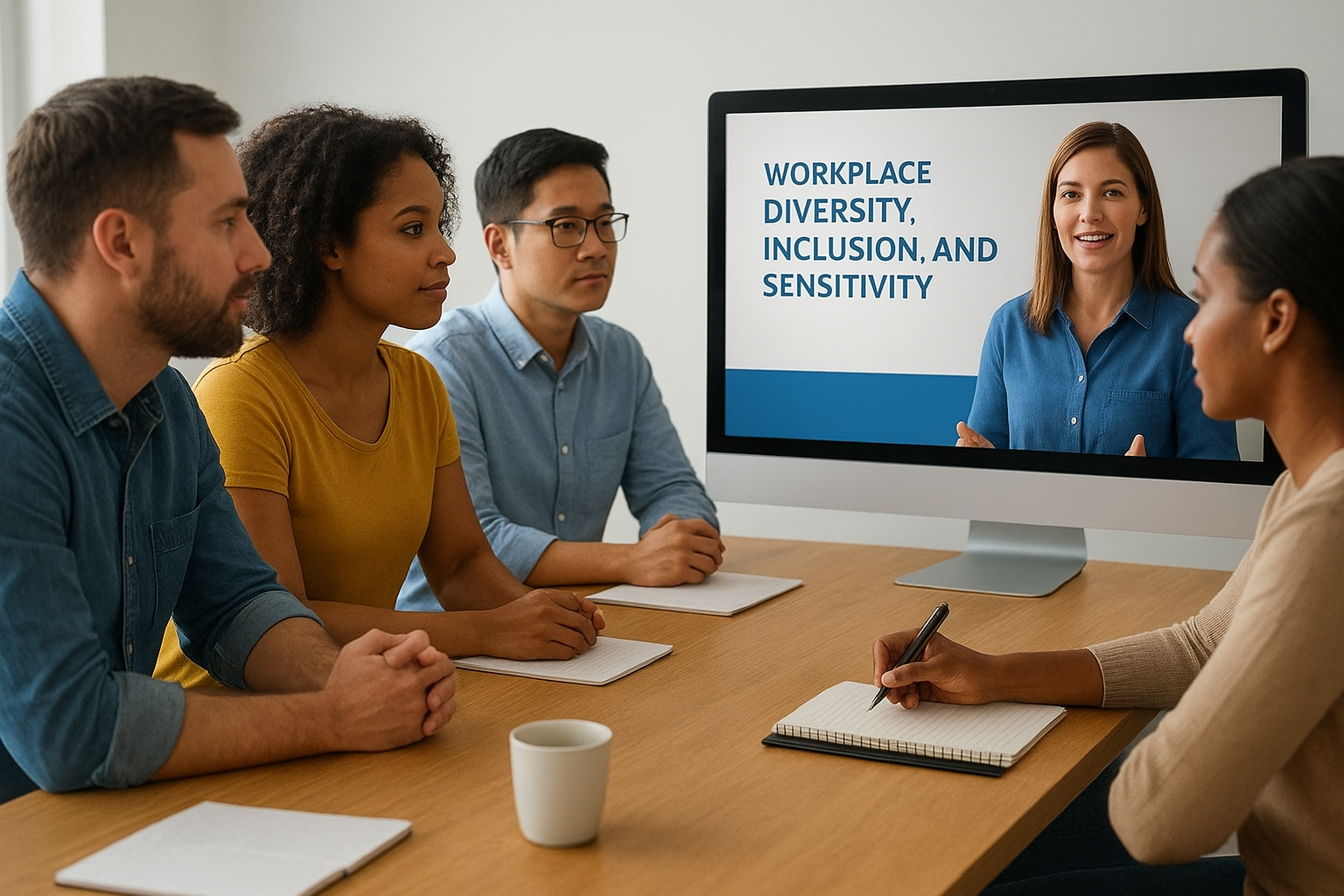
ClickSafety offers a 35-minute Workplace Diversity, Inclusion, and Sensitivity course, which makes it the shortest paid option here. It works for crews and shifts where pulling people off the job for two hours is unrealistic. If you need employee sensitivity training online that fits between tasks, this is the one.
What it covers
The course explains racial identity and racism within a broader workplace diversity and inclusion frame. At 35 minutes it introduces concepts and expectations. It does not try to settle every topic, so treat it as a baseline.
- 35-minute runtime
- Racial identity and racism
- Workplace diversity, inclusion, and sensitivity
Who it suits
ClickSafety is a provider known for safety training, so it suits employers that already buy safety courses from it and want diversity content in the same place. Think of field crews, industrial sites, and job-based teams with tight schedules.
Pair it with a short live talk. A ten-minute toolbox-style conversation after the course lets supervisors connect the lesson to real jobsite behavior. It also gives employees a chance to ask questions.
A short course works best as the start of a conversation, not the end of one.
Cost and certificate
Ask for a per-seat price and whether volume discounts apply. Confirm what record the course produces when someone finishes. If it generates a completion certificate, upload it to your LMS so every employee file is complete.
6. Coursera for a university-led diversity course
Coursera suits individual managers and HR leads who want depth from an academic source rather than a compliance module. Its Diversity and Inclusion in the Workplace course is led by Professor Junko Takagi of ESSEC Business School. It is one of the more rigorous ways to do employee sensitivity training online on a self-directed basis.
What it covers
The course looks at how organizations benefit from diversity while avoiding discrimination. It uses real-world examples to teach best practices for building a safe, inclusive environment.
- University-led instruction from ESSEC Business School
- Real-world workplace examples
- Focus on benefits of diversity and avoiding discrimination
Who it suits
It fits managers and HR professionals who want to understand the reasoning, not just the rules. It is a poor fit for mandated, company-wide training. Unless you buy a team plan, you have no central view of who finished, and a course designed for individual learners will not match your policy language.
Use a university course to deepen your leaders, not to document your whole workforce.
Cost and certificate
Many Coursera courses can be audited for free, but a verified certificate generally requires paid enrollment. Terms change, so check the course page before you promise employees a certificate. If someone earns one, collect a copy and file it with their training record.
7. Alison for a free cross-cultural awareness course
Alison is the easiest zero-budget starting point for free employee sensitivity training online. Its Introduction to Cross-Cultural Awareness course is a primer on how cultural differences shape workplace communication. It works as a foundation, not a full program.
What it covers
The course covers the benefits of cross-cultural awareness, the challenges teams face, and practical tips for overcoming cultural barriers. Video lessons and assessments help learners check their understanding.
- Benefits and challenges of cross-cultural awareness
- Practical tips for overcoming cultural barriers
- Video lessons with assessments
Who it suits
Small businesses, nonprofits, and new teams get the most from it. It is a good addition to onboarding, where it sets expectations for respectful communication across backgrounds. It will not cover legal compliance topics like harassment prevention, so do not rely on it for a state mandate.
Free training builds awareness, but it does not build a compliance record by itself.
Cost and certificate
Learning is free, while certificates are typically sold separately, so confirm the fee before you require one. Ask each employee to send you their completion proof, and log it in your LMS so the free course still produces a usable record.
8. The Safe Zone Project for free live workshops
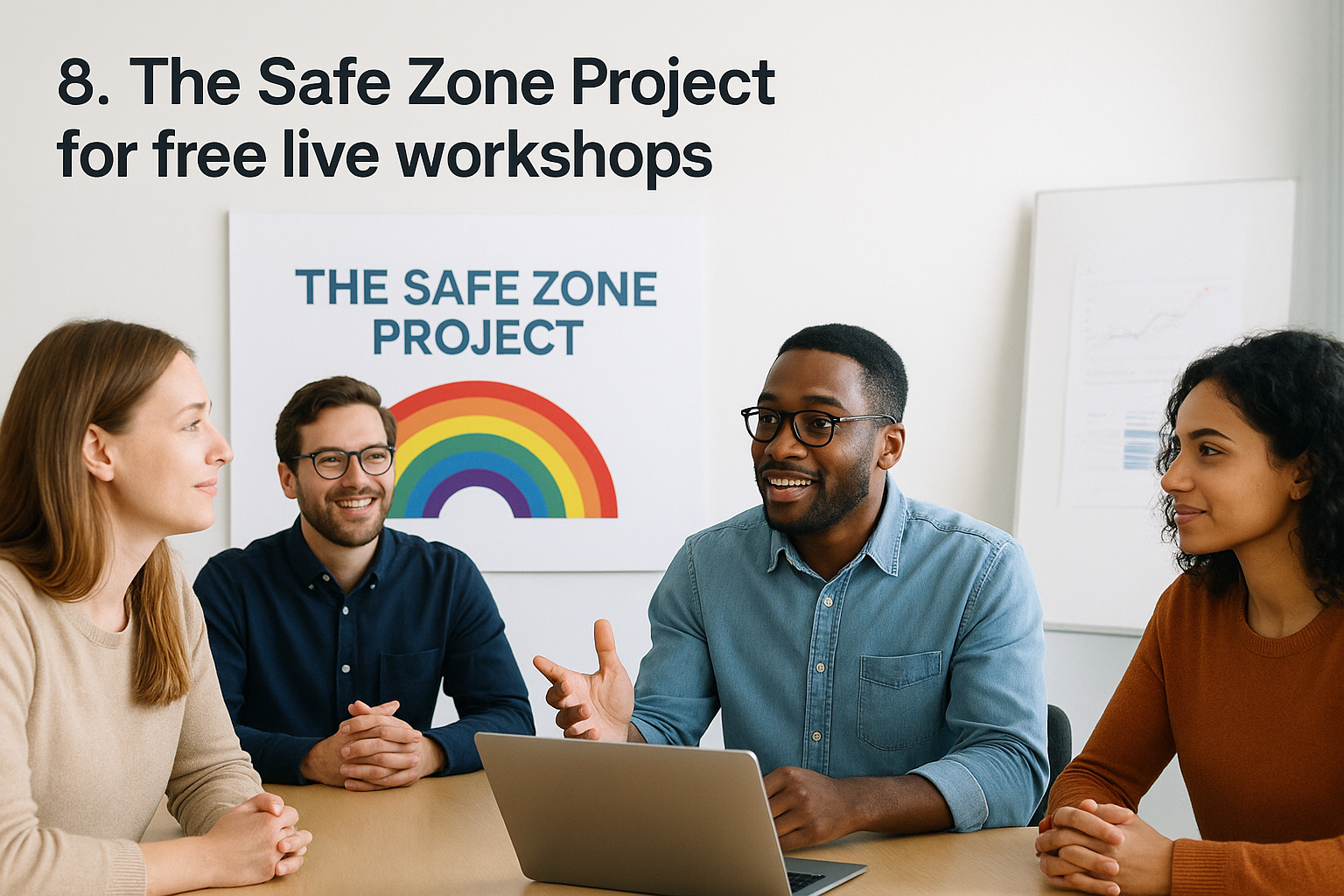
The Safe Zone Project is the best free option for discussion-led training. It offers a free LGBTQ+ awareness and allyship curriculum used by facilitators in over 100 countries. It is built for live sessions, which makes it a different kind of employee sensitivity training online than the self-paced courses above.
What it covers
The project provides a foundational curriculum that a facilitator adapts and runs with a group. Sessions center on awareness and allyship, and the format encourages participants to share and ask questions.
- Free, ready-made facilitator materials
- LGBTQ+ awareness and allyship focus
- Designed for live, trainer-led delivery
Who it suits
It suits companies with an internal facilitator, such as an HR partner or an employee resource group leader. Teams that value conversation over click-through modules benefit most. Remote groups can run it over a video call, which keeps travel and room costs at zero.
Having someone from inside the company lead matters. Employees often feel safer raising honest questions with a colleague they trust than with an outside trainer.
Live sessions work because people can ask the question they were afraid to type.
Cost and certificate
The materials are free. It is a curriculum rather than a certification program, so you create the record. Keep a sign-in sheet or a virtual-session attendance log, and add it to each employee’s file. If you run it in an LMS, schedule the session and mark attendance there.
How to choose a sensitivity training course
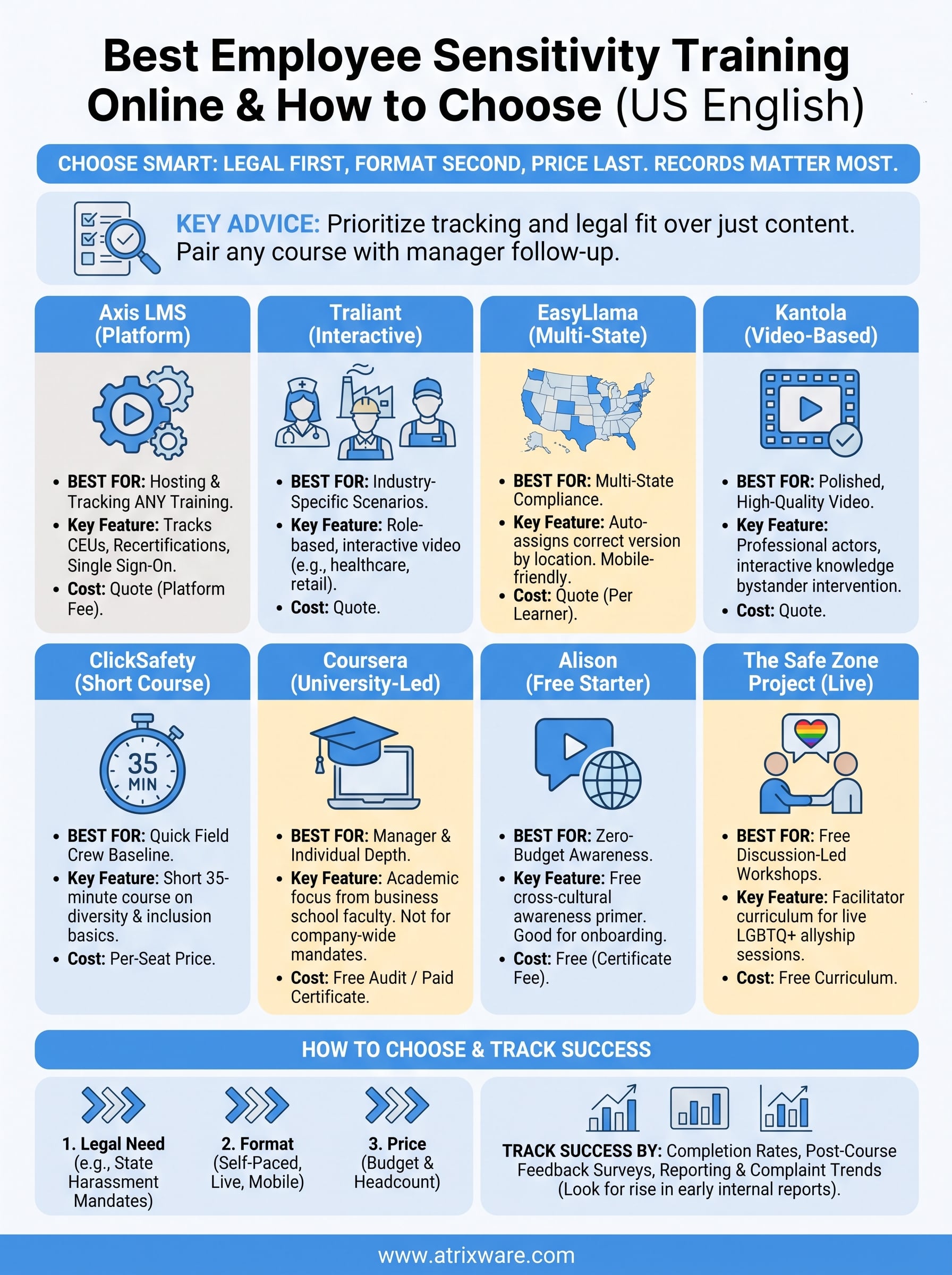
Choose on legal need first, format second, and price last. A course that fits your state, your workforce, and your record-keeping will outperform a cheaper one that misses on any of the three. Use these checks to narrow the eight options above.
What good sensitivity training covers
Sensitivity training is a real, established category of workplace training. It teaches employees to recognize bias, stereotypes, and microaggressions, to communicate respectfully across differences, and to know what to do when conduct crosses a line. Common examples include unconscious bias modules, cultural awareness, harassment and bystander intervention, racial identity and racism, and LGBTQ+ allyship.
Be realistic about results. Research by sociologists Frank Dobbin and Alexandra Kalev found that one-off mandatory diversity training rarely changes behavior and can provoke resistance. Pair any course with manager follow-up, clear reporting channels, and a refresher schedule.
What the law requires
Several states, including California, New York, Illinois, and Connecticut, require harassment prevention training. Those mandates name harassment prevention, not sensitivity training, so check that your course covers the required content, hours, and frequency. California requires training every two years for employers with five or more employees, while New York requires it annually.
The EEOC’s harassment guidance explains the federal rules. Confirm your state’s details with employment counsel before you buy.
Side-by-side comparison
This table sets the eight options next to each other so you can narrow the list fast.
| Option | Format | Cost | Best for |
|---|---|---|---|
| Axis LMS | Platform for any content | Quote at demo | Tracking and re-certification |
| Traliant | Interactive e-learning | Request a quote | Industry-specific teams |
| EasyLlama | Short scenario modules | Request a quote | Multi-state employers |
| Kantola | Produced video | Request a quote | Fixing low engagement |
| ClickSafety | 35-minute course | Per-seat price | Field crews, quick baseline |
| Coursera | University course | Free audit, paid certificate | Managers, individual learning |
| Alison | Self-paced video | Free, certificate fee | Zero-budget starter |
| Safe Zone Project | Live facilitated | Free | Discussion-led allyship |
Free options and certificates
Free works well for awareness and less well for compliance. Alison, the Safe Zone Project, and Coursera’s audit access cover the free route. If your company already pays for LinkedIn Learning, its Diversity, Equity, Inclusion, and Belonging for All path adds courses at no extra cost and offers a certificate on completion.
Whatever you pick, keep all completions in one place. A folder of scattered PDFs will not help you in an investigation.
How to know it worked
Track three things. Watch the completion rate for accountability, send a short feedback survey right after the course, and review complaint and reporting trends over the following six to twelve months. A rise in early reports through internal channels alongside fewer formal complaints is a good sign.
Start with records, then pick the course
The right course depends on your workforce, your state, and your budget, but the records requirement never changes. Pick content that fits your people, deliver it in a way they will finish, and keep proof of every completion. Free courses can carry the awareness load, while paid providers cover compliance and industry detail.
If you are weighing platforms for tracking all of it, the LMS readiness quiz shows where you are in the buying process and what to settle first. From there you can decide whether Axis LMS fits the way your team trains.
