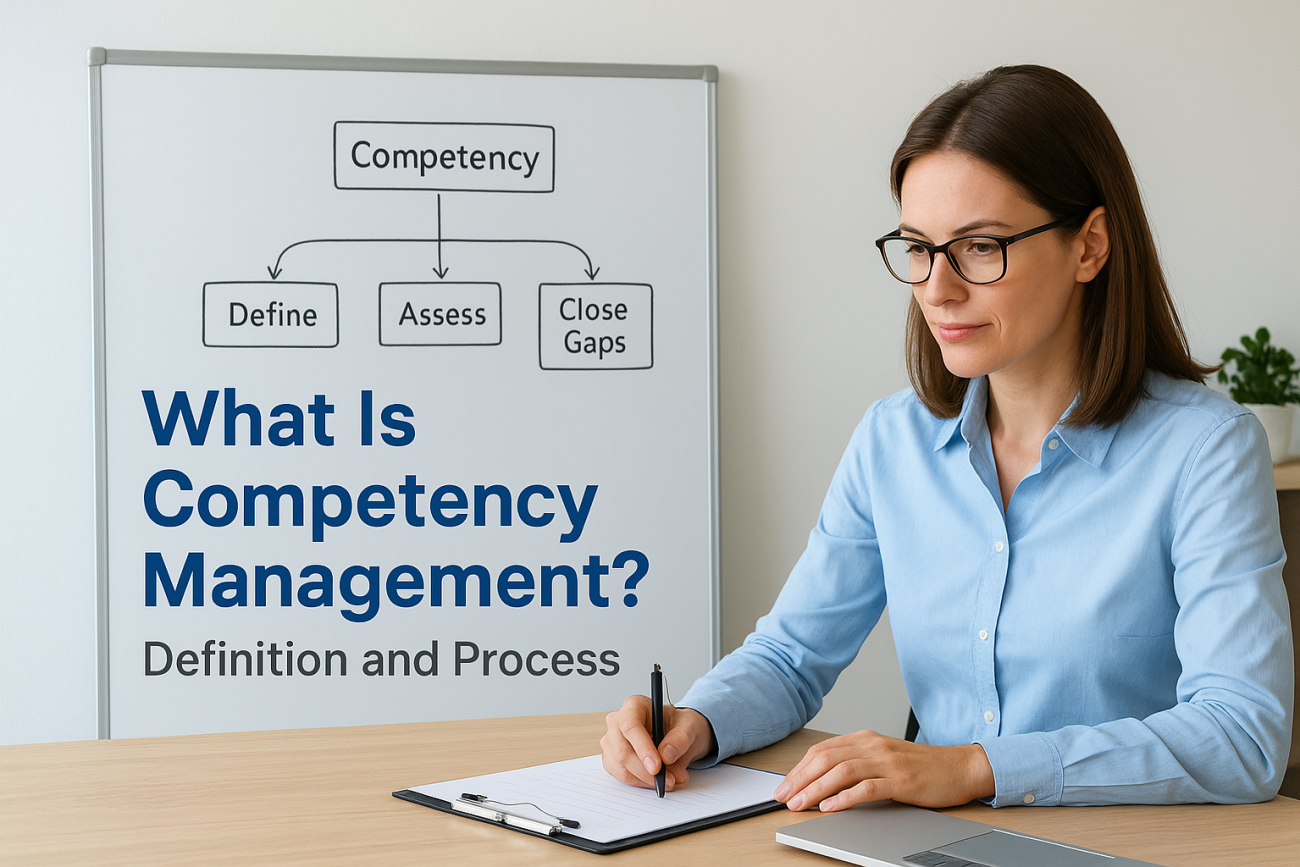
Ask five managers what a strong employee skill set looks like, and you’ll get five different answers. That’s the problem competency management solves. It’s the practice of defining the specific skills, knowledge, and behaviors people need to do their jobs well, then measuring where employees actually stand against those standards and closing the gaps through targeted training.
If you’re here, you probably want a straight answer to what this term means and how it plays out day to day, not another vague HR buzzword definition. Competency management is a structured process: you build competency frameworks for each role, assess employees against them, spot gaps, and assign training or development plans to close those gaps. It’s how organizations move from guessing who’s qualified to knowing it.
This article breaks down the full definition, walks through each step of the competency management process, and explains why it matters for compliance, promotions, and workforce planning. We’ll also look at how the right systems make tracking competencies far less of a manual headache, especially once you’re managing dozens of roles across a growing team.
Why competency management matters for your organization
Skill gaps rarely announce themselves. An employee looks busy, hits deadlines, and seems competent, right up until a customer complaint, a failed audit, or a botched product launch reveals that nobody actually checked whether they had the underlying skill set the job required. Understanding what competency management actually solves, it closes that visibility gap before it turns into a business risk. Instead of assuming people can do their jobs because they’ve been doing them for a while, you measure it directly against defined standards.
If you can’t measure a skill, you can’t manage the risk of not having it.
That single shift, from assumption to measurement, changes how several parts of the business operate. Here’s a quick look at who benefits and how:
| Stakeholder | What competency management gives them |
|---|---|
| HR and L&D | A clear map of who’s qualified, who needs training, and where hiring gaps exist |
| Compliance officers | Documented proof that staff meet regulatory or certification requirements |
| Sales and channel managers | Confidence that reps and partners can represent products accurately |
| Line managers | Objective data for promotions, raises, and performance conversations |
| Executives | Workforce planning data tied to actual capability, not job titles |
Compliance and audit-ready records
Regulators don’t care how confident your team feels about GDPR or FDA 21 CFR Part 11 requirements. They want proof. A competency framework tied to a Learning Management System gives you exactly that: timestamped records showing who completed which training, when their certification expires, and what happens next if they fall out of compliance. When an auditor asks for evidence, you pull a report instead of scrambling through email threads and spreadsheets. That difference alone justifies the setup time for most regulated industries, from healthcare to finance to manufacturing.
Fair promotions and pay decisions
Promotions built on gut feeling breed resentment, and they expose the company to real legal risk when a passed-over employee can show favoritism instead of merit. Competency data removes the guesswork. When you can show that Employee A scored higher on the specific competencies the next role requires, and Employee B didn’t, you’ve replaced office politics with a defensible, documented decision. This matters just as much for internal mobility as it does for external hiring, since it lets you identify people ready for a stretch role long before their resume would suggest it.
Workforce planning and succession
Succession planning falls apart when nobody knows what a role actually demands beyond its job description. A properly maintained skills matrix across your organization tells you exactly where you’re thin. If three of your five certified safety inspectors are five years from retirement, you’ll see that gap now, while there’s time to train replacements, instead of discovering it the week someone hands in notice. This same data feeds smarter hiring, too. Recruiters stop writing job postings from vague templates and start writing them from the actual competencies that make someone succeed in that specific role at your company.
Reducing costly turnover and training waste
Onboarding a new hire costs real money, and a big chunk of that cost gets wasted when training doesn’t target actual gaps. Generic, one-size-fits-all courses bore employees who already know the material and rush past the ones who don’t. Competency-based training flips this: you assess first, then assign only the modules a person genuinely needs. Employees stay more engaged because the training feels relevant, managers get people productive faster, and the training budget stops funding courses nobody needed in the first place. Over a year, across dozens of roles, that efficiency adds up to a measurable reduction in both training spend and the frustration that drives good people out the door.
How to build a competency management process
Building a working system doesn’t require a consulting firm or a six-month rollout. It requires four repeatable steps: define what good looks like, assess where people stand, close the gaps you find, and revisit the whole thing on a schedule. Skip any one of these steps and the process quietly collapses back into guesswork, which is exactly the problem you’re trying to fix.
Step 1: Define the competencies for each role
Start by breaking each job into its actual required competencies, not the vague bullet points from an old job description. Talk to top performers, review incident reports, and pull from industry standards where they exist. A customer support role might need competencies in product knowledge, de-escalation, and CRM proficiency, while a plant supervisor needs safety protocol mastery and equipment troubleshooting.
A competency you haven’t written down doesn’t exist as far as your training program is concerned.
Step 2: Assess current skill levels
Once the standards exist, measure people against them. This is where a skills assessment earns its keep, whether through manager evaluations, practical demonstrations, quizzes, or certification checks built into your LMS. Consistency matters more than the specific method: use the same rubric for every employee in the same role, or the data becomes useless for comparison.
Step 3: Assign targeted training to close gaps
Gaps identified in step two turn directly into training assignments. This is the step that turns competency management from a paperwork exercise into a real development tool:
- Map each competency gap to a specific course, module, or on-the-job task
- Set deadlines tied to compliance windows or performance review cycles
- Automate reminders so managers aren’t chasing overdue training by email
- Track completion in a central dashboard rather than a spreadsheet someone forgets to update
Axis LMS handles this step natively, matching gaps identified in assessments to the right course automatically instead of leaving a manager to guess which module fits.
Step 4: Monitor, report, and update the framework
Roles change, regulations get amended, and products evolve, so a competency framework built two years ago is probably already stale in places. Review it at least annually, or immediately after any major process or compliance change. Reporting closes the loop here: pull data on completion rates, time-to-competency, and recurring gap patterns to see whether the whole system is actually working or just generating paperwork.
Treat this as a cycle, not a project with an end date. Organizations that revisit their frameworks regularly catch skill decay and shifting job demands early, while those that set it and forget it end up right back where they started, relying on assumptions instead of evidence.
Key components: frameworks, models, and matrices
People use "framework," "model," and "matrix" interchangeably, and that sloppiness causes real confusion when teams try to build their first system. Each term describes a different layer of the same structure, and knowing the difference helps you build the right document instead of a confused hybrid that satisfies nobody. Think of it as zooming out from a single role to your entire organization, then zooming back in to a spreadsheet you actually use day to day.

Competency frameworks
A competency framework is the master document. It defines every competency your organization recognizes, grouped by category, such as technical skills, leadership behaviors, and compliance requirements. Large companies often maintain one framework per department, since a warehouse supervisor and a marketing coordinator share almost nothing in terms of required skills. Good frameworks include a clear definition for each competency and a proficiency scale, usually three to five levels, so "communication" doesn’t mean something different to every manager grading it.
Competency models
While the framework covers the whole organization, a competency model applies that framework to a single role or role family. It answers a narrower question: what does "good" look like specifically for a customer success manager, or a certified welder? A model pulls the relevant competencies out of the broader framework and attaches them to that job description, often weighting some competencies as critical and others as helpful but not essential.
A framework tells you what competencies exist. A model tells you which ones actually matter for this job.
Skills and competency matrices
Everything above stays theoretical until you build a skills matrix, the actual tracking tool that plots employees against the competencies their role requires. This is where competency management stops being a policy document and starts being an operational tool managers check weekly.
| Component | Scope | Primary Use |
|---|---|---|
| Competency framework | Entire organization or department | Defines the full universe of skills and behaviors expected |
| Competency model | Single role or role family | Applies the framework to a specific job’s requirements |
| Skills matrix | Individual employees vs. their role’s model | Tracks current proficiency and flags gaps in real time |
Manually maintaining a matrix in a spreadsheet works for a team of ten. It falls apart at fifty, once you’re juggling multiple departments, expiration dates, and re-certification cycles. That’s the practical reason most growing organizations move their matrix into a Learning Management System like Axis LMS, where assessment results feed the matrix automatically and gaps trigger training assignments without anyone manually cross-referencing a spreadsheet against a job description. The framework and model can live in a document. The matrix needs to live somewhere that updates itself.
Competency management examples across roles and industries
Abstract definitions only go so far. Seeing how a competency framework actually plays out across different jobs makes the concept click faster than any textbook explanation. Below are real-world patterns pulled from the industries Axis LMS customers work in most, covering healthcare, manufacturing, sales, and channel partner training. Notice how the format stays the same everywhere: define the skill, set a proficiency bar, then measure against it. Only the specific skills matrix contents change from one role to the next.
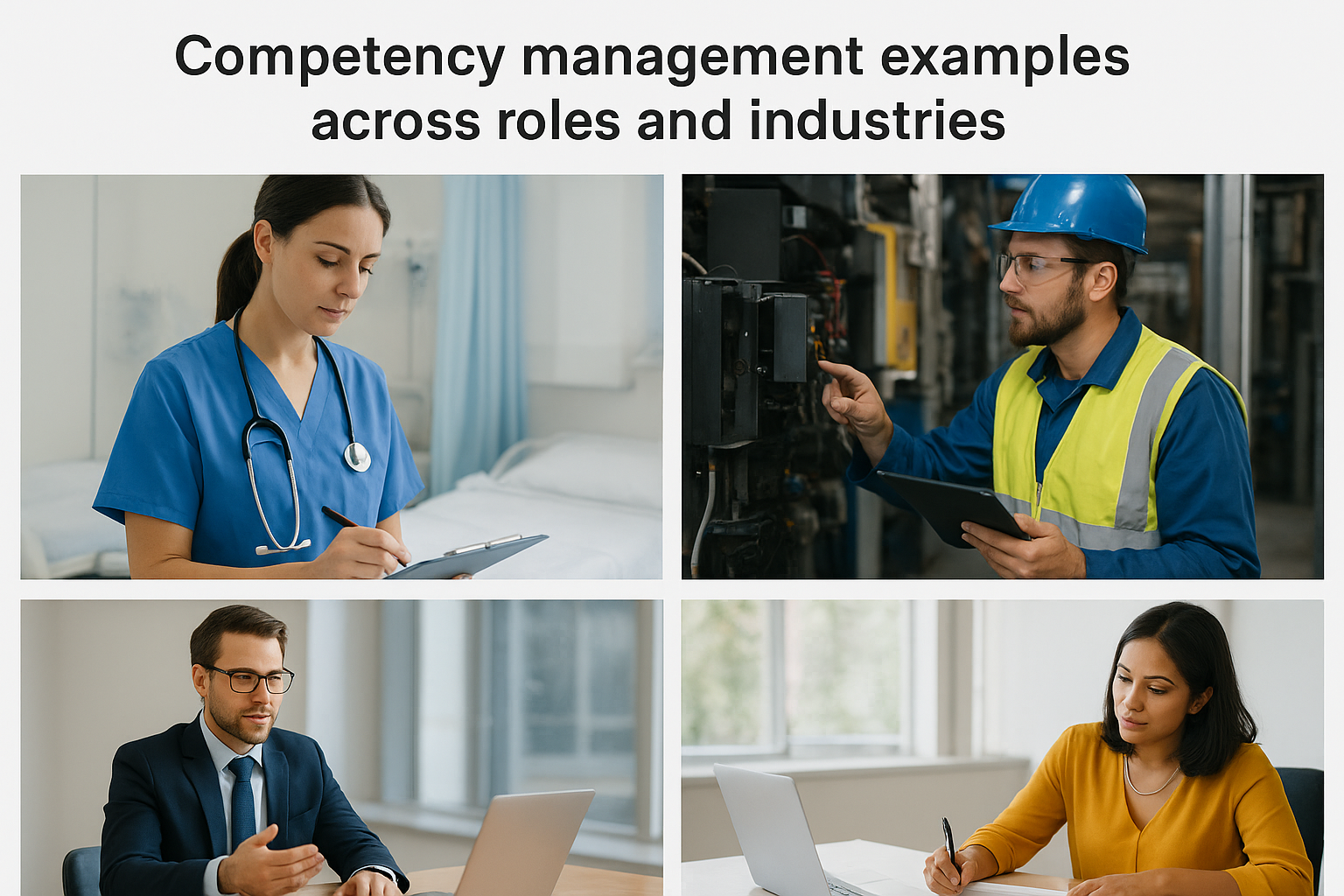
| Role | Industry | Core competencies | How it’s assessed |
|—|—|—|
| Registered nurse | Healthcare | Medication administration, infection control, patient charting | Skills checklist, supervised observation, annual re-certification |
| Line technician | Manufacturing | Equipment troubleshooting, lockout/tagout safety, quality inspection | Practical demonstration, safety audit, LMS quiz module |
| Account executive | SaaS/Sales | Product knowledge, objection handling, CRM proficiency | Role-play scoring, call recordings, quota performance |
| Channel partner rep | Distribution | Brand messaging, pricing rules, compliance disclosures | Certification exam, partner portal completion tracking |
| Compliance analyst | Finance | Regulatory reporting, data privacy standards, audit documentation | Case study review, annual compliance exam |
Healthcare organizations lean hardest on compliance training, since a missed re-certification isn’t just a training gap, it’s a licensing problem that can shut down a department. A hospital tracking nursing competencies against something like FDA 21 CFR Part 11 requirements needs airtight, timestamped records, not a manager’s memory of who attended which session.
Manufacturing environments treat competency management as a safety system first and a development tool second. Equipment changes constantly, and a technician certified on one machine model isn’t automatically qualified on its replacement. Companies that track this well catch the gap before an injury does, not after.
The best competency programs catch skill gaps before an incident does, not after.
Sales organizations use competency data differently, tying it directly to revenue outcomes rather than risk avoidance. A rep who scores low on objection handling gets targeted coaching before the next big deal, not a generic refresher course months later. Selling training to external customers or partners, one of the use cases Axis LMS supports directly, follows this same logic in reverse: you’re certifying that someone else’s team has the competency to represent your product correctly.
Channel and partner training adds a layer most internal programs skip entirely. You’re managing competencies for people who don’t work for you, which means the certification itself has to double as your proof that partners are qualified to sell or service your product under your brand. Across every one of these examples, the mechanics stay identical even though the stakes and content look completely different from one industry to the next.
Common challenges and how to overcome them
Even a well-designed competency management program hits friction once it meets the reality of busy managers, changing job requirements, and employees who worry the whole exercise is really about weeding people out. None of these problems are fatal, but ignoring them lets a good framework decay into a document nobody trusts. Below are the four issues that come up most often with Axis LMS customers rolling out a new competency framework, along with what actually fixes each one.

Inconsistent assessments across managers
Give ten managers the same rubric and you’ll still get ten different interpretations of what "proficient" means, unless you build in guardrails. Calibration sessions, where managers score the same sample employee together and discuss the gaps in their ratings, close this gap faster than any written policy. Pair that with scenario-based examples for each proficiency level in your skills matrix, so "meets expectations" has a concrete behavior attached to it instead of being left to gut feel.
A rubric without calibration is just an opinion with extra formatting.
Frameworks that go stale
A competency framework built for last year’s product line or last year’s regulations quietly stops matching reality, and nobody notices until an audit or a bad hire exposes it. Fixing this means treating updates as scheduled work, not an afterthought:
- Assign an owner for each department’s framework, not just HR broadly
- Trigger a review whenever a role changes, a new regulation lands, or equipment is replaced
- Set a standing annual review even if nothing else prompts it
Data scattered across spreadsheets
Once you’re tracking competencies for more than a handful of roles, spreadsheets become the bottleneck rather than the solution. Someone forgets to update a cell, a re-certification deadline slips past unnoticed, and a manager pulls a report that’s already three weeks out of date. Centralizing assessment results, training assignments, and certification expirations in a Learning Management System removes the manual upkeep entirely and gives everyone the same live view instead of five different copies of the same file.
Employee resistance and mistrust
Workers sometimes read a new skills assessment as a setup for layoffs rather than a development tool, and that fear kills honest self-reporting before it starts. Overcoming this takes transparency: explain upfront how results feed training and growth opportunities, not disciplinary action, and let employees see their own scores and gaps directly rather than hearing about them secondhand from a manager. Programs that share results openly, tied clearly to training rather than punishment, see far higher engagement than ones that keep the data locked in HR’s back office.
Putting competency management into practice
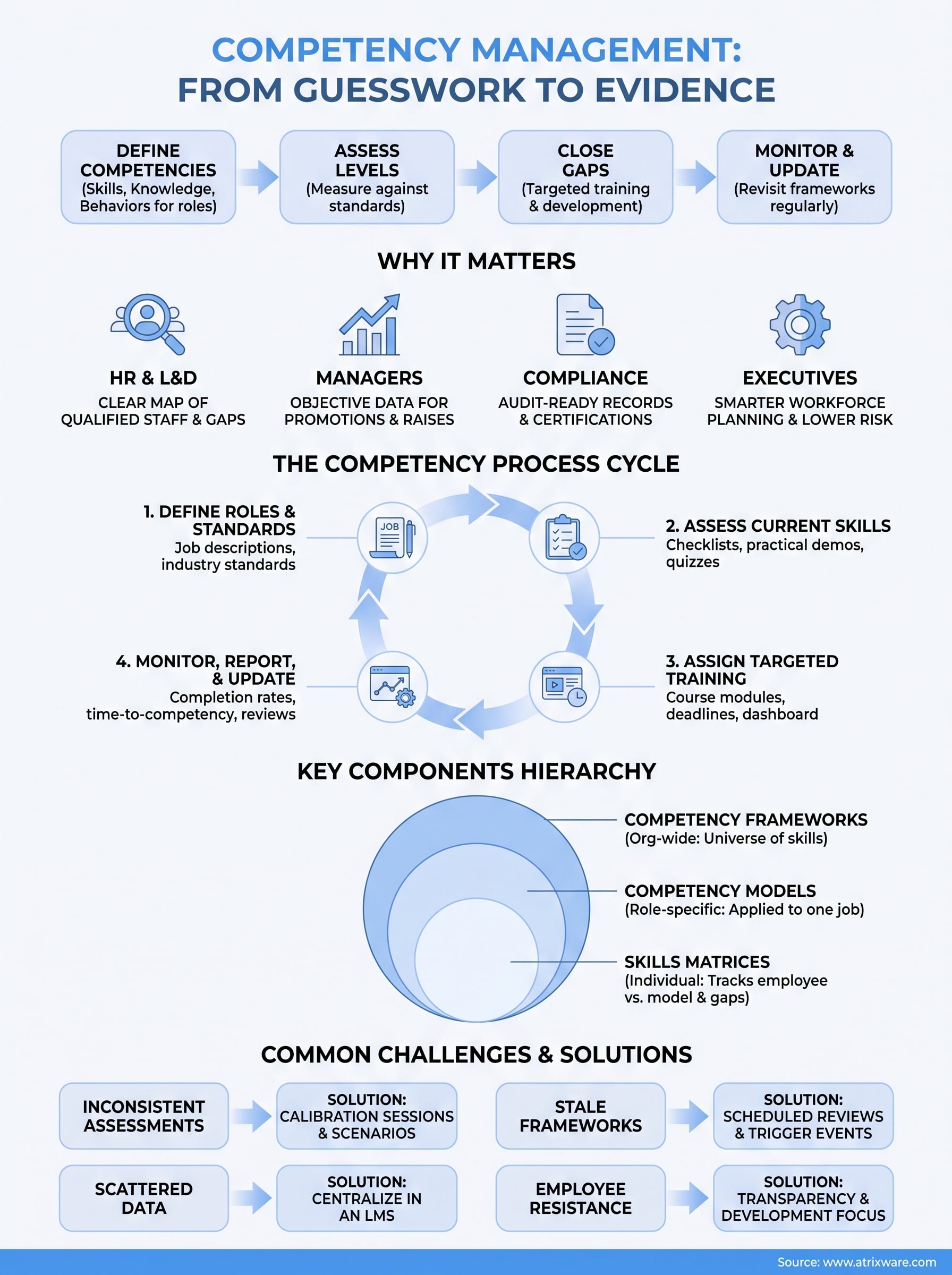
Competency management isn’t complicated once you strip away the jargon. Define what good looks like for each role, measure people against that standard, close the gaps with targeted training, and revisit the whole thing on a schedule. Skip a step and you’re back to guessing who’s actually qualified, which is the exact problem this whole process exists to fix.
Getting the framework right on paper matters, but the real payoff shows up once assessments, training assignments, and certification tracking stop living in scattered spreadsheets and start updating themselves automatically. That’s the difference between a policy document nobody opens and a live system managers actually check. If you’re ready to see how that works with real course assignments and reporting instead of theory, try a free demo of Axis LMS and watch a competency gap turn into a completed training assignment in minutes, not weeks.
