
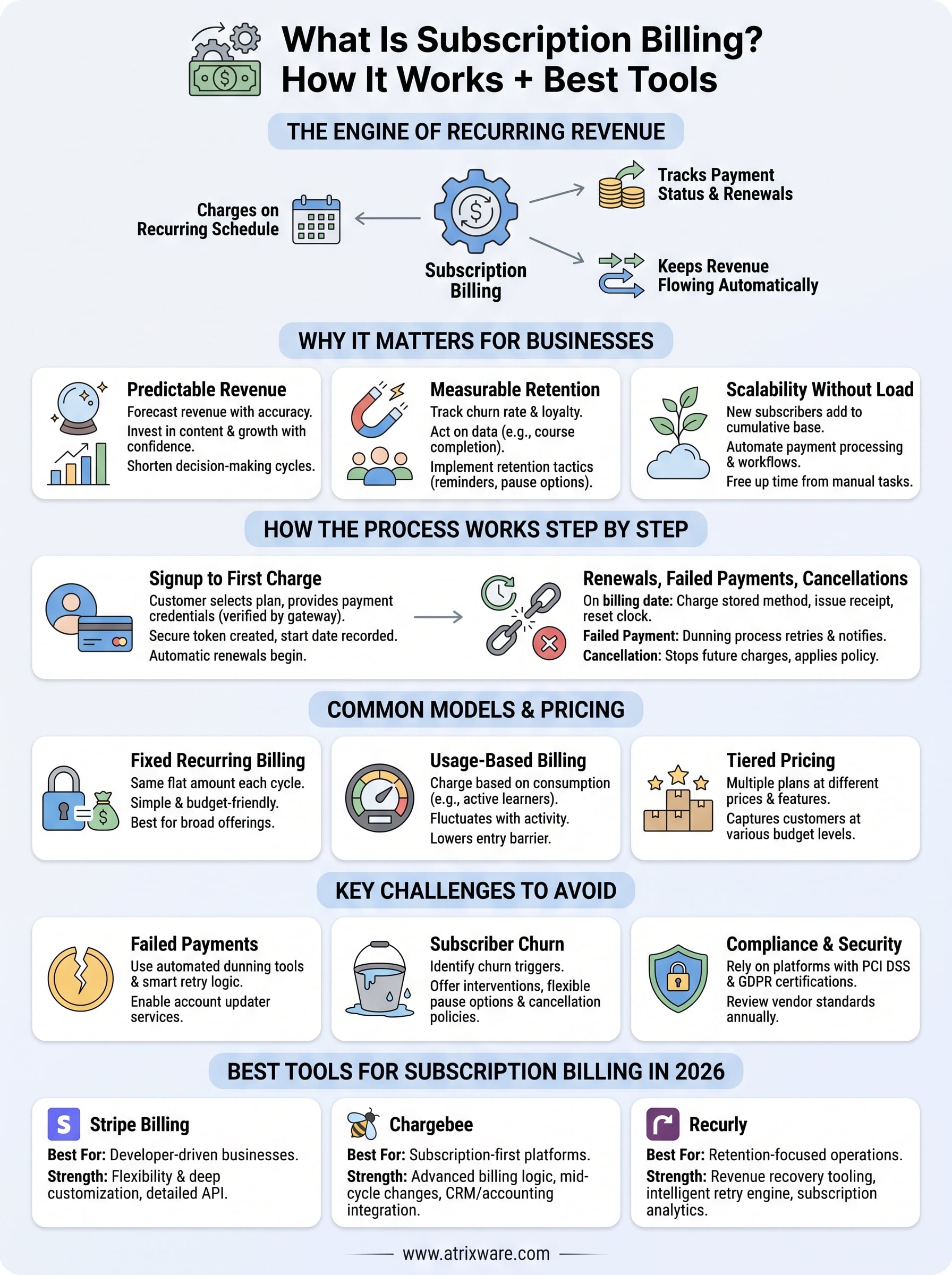
Every time a customer pays a monthly fee to access your training courses, software, or content library, subscription billing is doing the heavy lifting behind the scenes. It’s the engine that charges customers on a recurring schedule, tracks payment statuses, handles renewals, and keeps revenue flowing without manual intervention. For businesses selling training through platforms like Axis LMS, getting this process right directly affects cash flow, customer retention, and scalability.
But what is subscription billing, exactly, and how does the underlying payment cycle actually work? Whether you’re planning to monetize your training programs or you already sell courses and need a better way to manage recurring revenue, understanding this billing model is a practical first step.
This article breaks down the core mechanics of subscription billing, walks through how the process works from signup to renewal, and covers the best tools available to automate it.
Why subscription billing matters for businesses
Understanding what is subscription billing goes beyond knowing it charges customers on a recurring schedule. The real value shows up in how it changes the way your business operates day to day. When you shift from one-time payments to a recurring model, you stop chasing individual transactions and start building a compounding revenue structure that becomes more stable as your subscriber base grows. For training businesses in particular, that shift can mean the difference between income that evaporates between course launches and a reliable stream that funds ongoing development.
Predictable revenue changes how you plan
One of the strongest advantages of subscription billing is the financial visibility it gives you. When customers pay monthly or annually, you can forecast revenue with real accuracy rather than estimating based on sporadic past sales. That predictability lets you invest in better course content, expand your team, or upgrade your LMS infrastructure with actual numbers backing those decisions.
Predictable recurring revenue is one of the clearest indicators of business health, and it directly influences how investors, lenders, and partners assess your organization’s long-term value.
This kind of financial clarity also shortens your decision-making cycles. Instead of waiting to see whether a new course launch performs well enough to cover costs, you base your budget on contracted monthly recurring revenue (MRR), giving you a concrete figure to plan from every single month rather than projecting from best-case scenarios.
Customer retention becomes measurable and actionable
Subscription billing gives you a built-in mechanism to track customer loyalty over time. Churn rate, which measures how many subscribers cancel within a given period, becomes one of your most useful performance indicators. When you can see exactly when customers leave and connect that timing to specific triggers, such as course completion, a pricing change, or an onboarding gap, you can act on real data instead of guessing.
For training platforms, this is especially practical. If learners consistently cancel after finishing a certification program, that pattern signals an opportunity to introduce advanced content or a renewal incentive before those learners reach that decision point. Retention-focused tactics like automatic renewal reminders, flexible pause options, and loyalty pricing all work together to reduce churn and extend the total value each subscriber brings to your business.
Scalability without added operational load
Growing a training business on one-time sales means revenue only grows as fast as you can sign new customers. With subscription billing, each new subscriber adds to a cumulative base that continues generating income without requiring extra effort from your team after the initial setup. That structure scales in a way that single-purchase models cannot match.
Subscription billing also cuts down on the manual work your team carries week to week. Automated payment processing, renewal notifications, and failed payment recovery workflows all run without human intervention once your billing system is properly configured. For HR managers, training directors, and business owners already managing complex operational workflows, removing billing friction frees up meaningful time and eliminates the errors that come with manual invoicing.
How subscription billing works step by step
Once you understand what is subscription billing, the next practical step is seeing exactly how the payment cycle runs from start to finish. The process follows a clear sequence of events that your billing system executes automatically, but knowing each stage helps you configure things correctly and catch problems before they damage revenue or the customer experience.

From signup to first charge
The cycle starts when a customer selects a plan and submits their payment credentials, typically a credit card, bank account, or digital wallet. Your billing system passes this information to a payment gateway, which verifies the payment method and generates a secure token. That token replaces the raw card details in your system, so every future charge can process without the customer needing to re-enter their information each billing period.
Storing payment data as encrypted tokens satisfies PCI DSS compliance requirements and removes a significant liability from your infrastructure without adding friction for the customer.
After the payment method is verified, the system records the subscription start date and schedules the next billing event based on the interval you’ve configured, whether monthly, quarterly, or annual. A confirmation goes out to the customer, and from this point forward, renewals run automatically without any manual involvement from your team.
Renewals, failed payments, and cancellations
On each billing date, your system charges the stored payment method, issues a receipt, and resets the billing clock for the next period. When a payment fails, the dunning process kicks in automatically. Dunning workflows retry the charge on a defined schedule, send notification emails to the customer, and escalate the account if recovery attempts are exhausted.
Cancellation follows a straightforward path as well. When a subscriber cancels, the system stops all future charges immediately and applies your configured cancellation policy, which might mean continued access through the end of the paid period or a prorated refund. Getting these edge cases right from the start prevents disputes and builds subscriber trust over time.
Common subscription billing models and pricing
Once you understand what is subscription billing and how the payment cycle runs, you need to choose the right billing model for your business. Different pricing structures attract different types of customers, and the model you select shapes everything from your revenue predictability to how learners perceive the value of your training programs. Picking the wrong structure creates friction at the buying decision and can push potential subscribers away before they ever start a trial.
Fixed recurring billing
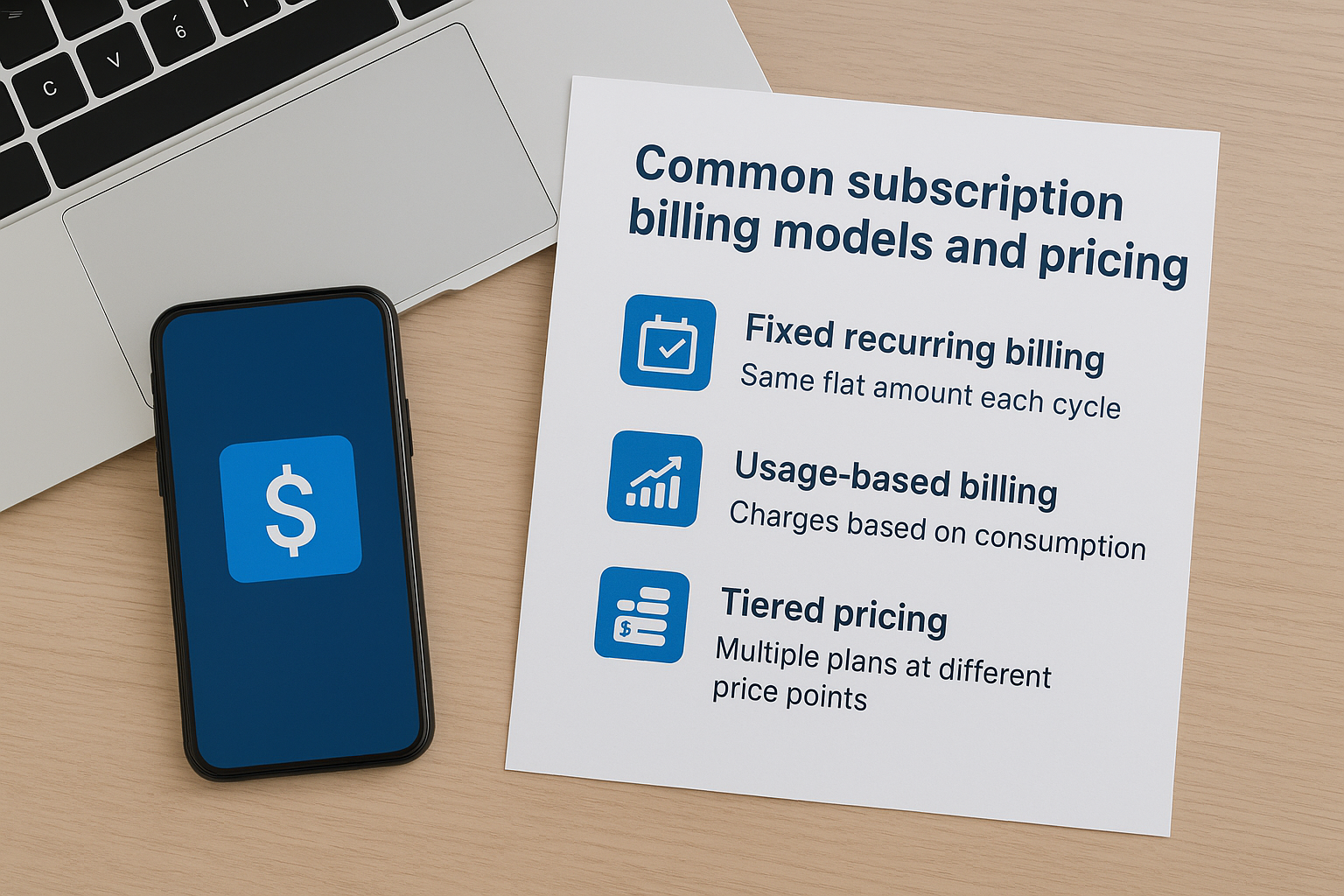
Fixed recurring billing charges the same flat amount on every billing cycle, regardless of how much the customer actually uses the product. This is the most common structure for training platforms because it’s simple for your team to manage and easy for your customers to budget around. A learner paying $49 per month for unlimited course access knows exactly what they’ll owe next month, which reduces cancellations driven by billing surprises.
Fixed pricing works best when your training library offers enough breadth that most subscribers use only a fraction of what’s available, making the flat fee feel like a strong deal.
Usage-based billing
Usage-based billing ties each customer’s charge directly to how much they consume, whether that’s the number of active learners, course completions, or certificates issued. This model works well for organizations with fluctuating training needs, such as companies that scale seasonal workforce programs up and down throughout the year. Your revenue follows customer activity, which introduces some variability in monthly numbers but often lowers the entry barrier for smaller organizations just getting started.
Tiered pricing
Tiered pricing offers multiple plans at different price points, each unlocking a specific set of features or user limits. A training business might offer a Starter plan for up to 50 learners, a Professional plan for up to 500, and an Enterprise plan with no cap and full compliance reporting included. This structure lets you capture customers across multiple budget levels without underpricing your most valuable capabilities or locking out smaller teams entirely.
Key challenges and how to avoid them
Even when you fully understand what is subscription billing and have the right model in place, operational problems can quietly erode your revenue. Failed payments, subscriber churn, and compliance gaps are the most common issues businesses run into once their subscription programs scale, and each one requires a deliberate strategy rather than a reactive fix after the damage accumulates.
Failed payments and revenue leakage
Failed payments are one of the most underestimated threats to subscription revenue stability. A card expiration, an insufficient balance, or a bank-level rejection can interrupt a billing cycle without warning, and if your system lacks an automated recovery process, that subscriber simply lapses. Dunning management tools handle this automatically by retrying the charge on a defined schedule and sending recovery emails before the account is suspended.
Set up smart retry logic that staggers attempts across several days rather than retrying immediately, since many card failures resolve on their own within 48 to 72 hours.
You can also reduce card failures proactively by enabling account updater services, which pull refreshed card details directly from card networks when a customer’s card is replaced or renewed, keeping billing cycles uninterrupted without requiring the subscriber to take any action.
Subscriber churn and retention gaps
Churn is unavoidable in any subscription business, but unmanaged churn compounds quickly and often masks deeper problems in your onboarding or content delivery. Identify the specific points in the subscriber lifecycle where cancellations spike, then build targeted interventions such as check-in emails, progress nudges, or upgrade offers before customers reach those critical decision points.
Offering a pause option instead of a hard cancel gives subscribers who need a temporary break a reason to stay connected. Flexible cancellation policies protect goodwill and frequently result in reactivations weeks or months later without any additional acquisition cost.
Compliance and data security
Handling recurring payment data means operating under strict regulatory standards, including PCI DSS for card data and GDPR if you serve subscribers in European markets. Rely on a billing platform that maintains these certifications on your behalf and documents them clearly in its service agreements rather than attempting to build that compliance infrastructure internally. Review those certifications annually to confirm your vendor stays current as standards evolve.
Best tools for subscription billing in 2026
Knowing what is subscription billing gives you the conceptual foundation, but the platform you select determines how cleanly that process runs once your subscriber base grows. The right tool handles payment processing, dunning workflows, proration, and revenue reporting without requiring custom development from your team. Each option below targets a slightly different business profile, so match your choice to your current scale and the complexity of your pricing structure.
| Tool | Best For | Key Strength |
|---|---|---|
| Stripe Billing | Developer-driven businesses | Flexibility and deep customization |
| Chargebee | Subscription-first platforms | Advanced billing logic |
| Recurly | Retention-focused operations | Revenue recovery tooling |
Stripe Billing
Stripe Billing suits businesses that need developer-level control over their billing logic without building a payment infrastructure from the ground up. Your development team can configure flat-rate, usage-based, and tiered pricing within a single account, and the built-in dunning tools recover failed payments automatically on a schedule you define. Stripe’s API documentation is detailed enough that custom billing workflows take a fraction of the time they would take to build independently.
- Configurable retry logic for failed payment recovery
- Supports multiple pricing models within one account
- PCI DSS Level 1 certification handled at the platform level
Stripe’s account updater service pulls refreshed card details directly from card networks, keeping billing cycles intact when subscribers receive replacement cards.
Chargebee
Chargebee is built specifically for subscription-first businesses that need more billing flexibility than a general-purpose payment processor provides. It handles mid-cycle plan changes, proration calculations, and multi-currency billing without custom workarounds, which makes it a practical fit for training businesses managing tiered seat-based pricing across different markets.
The platform connects directly with CRM and accounting systems, so your billing data stays synchronized across your full operations without manual exports or reconciliation work between tools.
Recurly
Recurly focuses on subscriber retention and revenue recovery, making it the strongest option when churn and failed payments are your primary concerns. Its intelligent retry engine analyzes payment failure patterns and adjusts retry timing to maximize recovery rates, which directly protects your monthly recurring revenue without your team lifting a finger.
Recurly also surfaces detailed subscription analytics that surface underperforming pricing tiers and lifecycle drop-off points before they create compounding revenue gaps.
Key takeaways and next steps
Subscription billing converts sporadic one-time payments into a structured recurring revenue stream that grows as your subscriber base expands. Understanding what is subscription billing means recognizing that the real value sits in the compounding effect: each subscriber you retain adds to a predictable monthly base that funds smarter decisions across your entire training operation.
The right billing model, whether fixed, usage-based, or tiered, shapes how customers perceive your pricing and directly affects your churn rate. Pair that model with a purpose-built tool like Stripe Billing, Chargebee, or Recurly, and you eliminate the manual overhead that slows growing businesses down. If you sell or plan to sell training through an LMS, your billing system and your learning platform need to work together seamlessly from day one. Take the Axis LMS readiness quiz to find out where your training program stands today.
