You probably already know which teams are struggling, but can you pinpoint exactly which skills are missing? That’s the difference between a gut feeling and a skills assessment, and it matters more than most leaders realize. Without a structured way to evaluate what your people can actually do, you’re making training decisions based on assumptions instead of evidence.
A well-run skills assessment reveals the gap between where your workforce is and where it needs to be. It tells you who’s ready for a promotion, who needs upskilling, and where your organization is exposed to risk, especially around compliance and regulatory requirements. The problem is, most companies either skip this step entirely or treat it as a one-time checkbox exercise. Neither approach gives you actionable data you can build on.
This guide walks you through how to conduct a skills assessment from start to finish, covering the frameworks, methods, and tools that produce real results. We built Axis LMS to help organizations like yours deliver and track targeted training programs, so we’ve seen firsthand what happens when companies get assessments right, and what it costs when they don’t. Whether you’re evaluating current employees or screening candidates, these steps will help you identify skill gaps with clarity and build a training strategy that actually closes them.
What to decide before you start
Before you pick tools or build questionnaires, you need to answer a few foundational questions. Skipping this step is one of the main reasons skills assessments fail to deliver usable data: without clear answers upfront, you collect inconsistent information, confuse your employees, and produce results that don’t connect to any real business decision. This pre-work is the structure that holds everything else together.
Who owns the process
Every assessment needs a single owner, even when multiple teams contribute to it. That person is typically a Training and Development manager, an HR business partner, or a senior department head, depending on the scope of what you’re running. Without a named owner, decisions stall, communication breaks down, and the process loses momentum before it produces anything useful.
Your owner doesn’t have to work alone. They should coordinate with managers who understand the day-to-day demands of each role, subject matter experts who can validate skill definitions, and an LMS administrator if you plan to deploy assessments through a platform. Define these roles in writing before you launch.
| Role | Responsibility |
|---|---|
| Assessment Owner | Manages the full process and communicates results |
| Department Managers | Provide role context and validate skill requirements |
| Subject Matter Experts | Define skill levels and scoring criteria |
| LMS Administrator | Configure and deploy assessment tools |
| Employees | Complete assessments honestly and on time |
Who you’re assessing and why
The population you assess determines nearly every other decision you make: the skills you evaluate, the methods you use, and how you interpret the results. Are you assessing an entire department, a specific job function, a team going through a technology transition, or external candidates? Each scenario calls for a different approach, and mixing populations without accounting for the difference produces data that’s hard to act on.
Your reason for running the assessment matters just as much as the "who." Common purposes include identifying training gaps, preparing for a new system rollout, meeting compliance requirements, or supporting promotion decisions. Write down the purpose in one sentence before you move forward. If you can’t do that, you need more internal alignment before you launch anything.
The most useful assessments are specific: a defined group of people, measured against a defined set of skills, for a defined business reason.
How you’ll handle confidentiality and communication
Employees respond very differently to assessments depending on how the results will be used and who will see them. If people think their scores will affect their job security, they’ll perform to expectations rather than show their actual ability. Being vague about this upfront poisons the data before you collect a single response.
Decide your confidentiality rules before the assessment launches: will results go directly to managers, stay with HR, or be shared only with the individual? Then communicate those rules clearly, along with the purpose, the timeline, and what comes next. When employees trust the process, you get honest responses that actually reflect where your workforce stands. That honesty is the foundation of learning how to conduct a skills assessment that produces results worth acting on.
Step 1. Define the business goal and scope
Every successful skills assessment starts with a clear business goal, not a vague desire to understand where employees stand. If you can’t state the goal in one specific sentence, you haven’t defined it yet. This step forces you to connect the assessment to a real business outcome, which is what separates learning how to conduct a skills assessment from actually executing one well.
Write your goal as a single statement
Your goal statement should name the group, the skill area, and the business reason you’re running the assessment. Keep it specific enough that someone outside your team could read it and understand exactly what you’re trying to accomplish. Vague goals produce vague data, and vague data doesn’t drive decisions.
Here are examples of weak goals versus strong ones:
| Weak Goal | Strong Goal |
|---|---|
| "Understand team skills" | "Identify gaps in data analysis skills across the sales ops team to prioritize Q3 training." |
| "Check compliance readiness" | "Assess GDPR knowledge for all customer-facing staff before the August audit." |
| "Improve onboarding" | "Measure technical proficiency of new hires in weeks 1-4 to reduce ramp time by 20%." |
A goal statement that names a specific group, skill set, and business outcome will guide every other decision you make in this process.
Set the scope boundaries
Once you have your goal, define the boundaries of the assessment: which roles are included, which are excluded, and what time frame you’re working within. Scope creep is one of the most common reasons assessments drag on and produce inconclusive results. The more precisely you draw the lines, the easier it is to build the right questions and interpret the data you collect.
Document your scope in writing before you move to the next step. Include the job titles or departments involved, the total number of employees, the deadline for completion, and any skill areas that are explicitly out of scope. This document becomes your reference point whenever someone tries to add requirements mid-process, and it keeps your assessment focused on the outcome that actually matters.
Step 2. Build a skills framework and rating scale
A skills framework is the list of competencies you’re measuring and the criteria that define each level of performance. Without one, different evaluators apply different standards, and your results become impossible to compare across employees or departments. This step gives you a structured foundation for everything that follows, including how to conduct a skills assessment that produces consistent, defensible data.
Define the skills you need to measure
Start by listing the skills that matter for the roles you’re assessing. Pull from job descriptions, performance reviews, and direct input from managers who oversee the work daily. Aim for a focused list of 8 to 12 skills per role. Going broader than that makes the assessment harder to complete and harder to act on.
Organize your skills into clear categories so the framework stays easy to navigate and evaluate. Grouping by type helps evaluators work through the assessment efficiently without losing track of what each section measures:
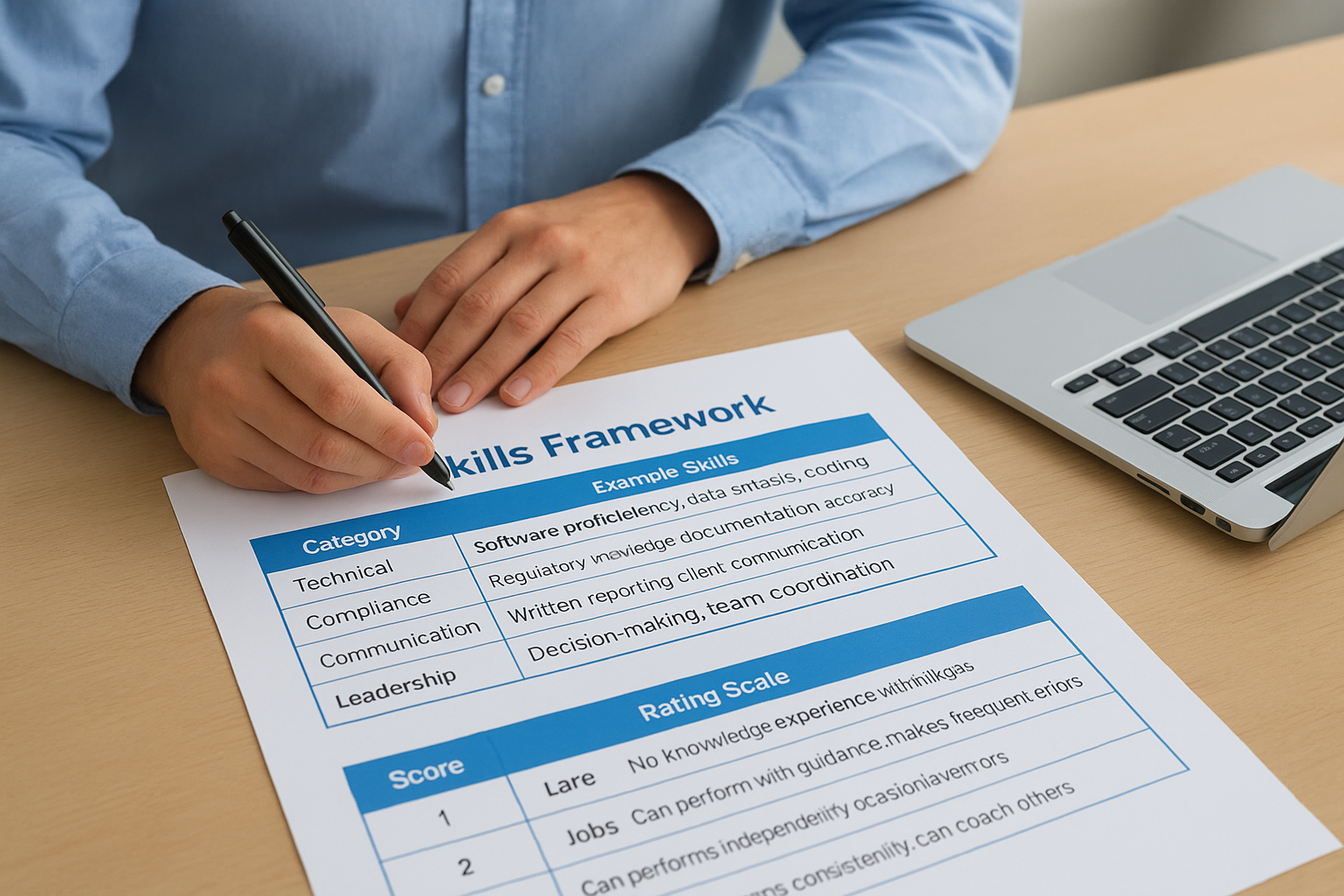
| Category | Example Skills |
|---|---|
| Technical | Software proficiency, data analysis, coding |
| Compliance | Regulatory knowledge, documentation accuracy |
| Communication | Written reporting, client communication |
| Leadership | Decision-making, team coordination |
Keep your framework focused on skills that directly connect to job performance, not general personality traits or soft qualities you can’t observe and measure.
Choose a rating scale that fits your context
Your rating scale determines how assessors score each skill, so it needs to be specific enough to reduce guesswork. A 4-point scale works well for most organizations because it forces a clear distinction between acceptable and strong performance without creating too many judgment calls. Here is a template you can adapt:
| Score | Label | Description |
|---|---|---|
| 1 | No Exposure | No knowledge or experience with this skill |
| 2 | Developing | Can perform with guidance; makes frequent errors |
| 3 | Proficient | Performs independently with occasional errors |
| 4 | Advanced | Performs consistently; can coach others |
Attach behavioral anchors to each score so every evaluator interprets the scale the same way. A behavioral anchor is a short, observable description of what that score looks like in practice. For example, a score of 3 for "data analysis" might read: "Builds standard reports using existing templates without assistance." Anchors remove ambiguity and make your ratings defensible when employees or managers question the results.
Step 3. Pick assessment methods and tools
The method you choose determines how you collect evidence of a skill, and the tool you choose determines how you deliver, score, and store that evidence. These two decisions directly affect how accurate your data is, how much time the assessment takes, and how employees engage with the process. Getting both right is a core part of learning how to conduct a skills assessment that produces results you can trust and act on immediately.
Match the method to the skill type
Not every skill is measurable the same way. A knowledge-based skill like regulatory compliance is best tested with a written quiz, while a practical skill like software operation is better captured through a work sample or live simulation. Selecting the wrong method wastes time and produces data that doesn’t reflect real ability on the job.
Match your assessment method to how the skill actually shows up in day-to-day work, not to what’s easiest to administer.
Here are the most common methods and when each one fits:
| Method | Best For | Example |
|---|---|---|
| Knowledge quiz | Compliance, policy, product knowledge | GDPR rules, safety procedures |
| Self-assessment | Soft skills and self-awareness | Communication, time management |
| Manager rating | Observable behaviors and outputs | Leadership, team coordination |
| Work sample | Technical and applied skills | Writing, coding, data analysis |
| Structured interview | Role-specific judgment and experience | Problem-solving, decision-making |
For most corporate training assessments, combining two methods gives you stronger data than relying on one alone. For example, pair a knowledge quiz with a manager rating to separate what an employee knows from what they actually do.
Select your delivery tools
Your delivery tool needs to match the scale and complexity of your assessment. For a team of ten, a shared spreadsheet might work for a basic manager rating. For a company-wide rollout across multiple departments, you need a platform that automates distribution, tracks completion, and stores results in a single location.
A Learning Management System (LMS) handles all of this in one place. You can build quizzes, assign them to specific employee groups, set completion deadlines, and pull reports without manually following up with anyone. For compliance-heavy industries, an LMS also creates an auditable record of who completed each assessment and when, which gives you solid documentation during regulatory reviews or audits.
Step 4. Run the assessment and collect evidence
Execution is where most skills assessments break down in practice. You can have a solid framework and the right tools, but if the rollout is poorly communicated or unevenly managed, you’ll get inconsistent participation and incomplete data. This step is about running the process in a controlled, documented way so you collect evidence that actually reflects the skill levels across your organization.
Launch with a pilot group first
Before you send the assessment to your entire target population, run it with a small pilot group of 5 to 10 people. This group should represent a mix of roles and experience levels. A pilot catches broken links, confusing instructions, and rating scale ambiguity before those problems affect hundreds of employees. Once the pilot group finishes, collect their feedback on the experience, not just their scores, and fix any issues before the full launch.
A pilot run is the fastest way to protect the integrity of your data before you go wide.
When you’re ready for the full rollout, send a clear launch message that covers the purpose, timeline, and what employees should expect after completing the assessment. Include the deadline and direct instructions for how to access the assessment. Vague communication is the number one reason completion rates drop before you have enough data to work with.
Track completion and follow up on gaps
Once the assessment is live, monitor completion rates in real time rather than waiting until the deadline to see who finished. An LMS makes this straightforward: you can see who started, who submitted, and who hasn’t opened the assessment at all. Set an internal checkpoint at the halfway point of your deadline window. If completion falls below 70 percent at that point, send a targeted reminder to non-completers through their direct managers, not a mass email blast aimed at everyone.
Document any employees who request an extension, flag technical issues, or need accommodations during the process. Keeping a clean record of exceptions protects you if someone challenges the results later. Consistent documentation is part of knowing how to conduct a skills assessment that holds up under scrutiny, especially in regulated industries where auditors may ask for detailed evidence of how the process was run, not just what the scores show.
Step 5. Analyze results and act on gaps
Raw scores mean nothing until you interpret them against the goal you defined in Step 1. Resist the urge to act on individual outliers before you look at the full picture. Start by calculating average scores per skill across your assessed group, then compare those averages to the minimum proficiency level you need for each role. That comparison is where the real insight lives, and it’s the step that separates knowing how to conduct a skills assessment from knowing how to use one.
Spot patterns before you focus on individuals
Look for skills where a large portion of your group scored below proficient, not just the employees who scored lowest. A pattern across 40 percent or more of your group signals a systemic gap, which means the solution is a training program, not individual coaching. A single low scorer in an otherwise strong group is a different problem that calls for a different response.

Use a simple summary table to make the patterns visible before you draw any conclusions:
| Skill | Avg Score | % Below Proficient | Priority |
|---|---|---|---|
| GDPR compliance | 1.8 | 62% | High |
| Data reporting | 2.4 | 38% | Medium |
| Client communication | 3.1 | 14% | Low |
| Software proficiency | 2.1 | 51% | High |
The skills with the highest percentage of employees below proficient and the strongest connection to your business goal should move to the top of your training plan immediately.
Turn gaps into a training plan
Every high-priority gap needs a concrete next action, not a general note to "address this in the next quarter." For each skill you flag, assign a training format, an owner, and a target completion date before you close out the analysis phase. This prevents the assessment from becoming a report that sits on a shelf while nothing changes.
Assign different training responses based on gap severity: employees scoring a 1 need foundational instruction before they can benefit from anything more advanced, while employees scoring a 2 often respond faster to guided practice and feedback than to formal coursework. Matching the training format to the gap level is what converts your assessment data into measurable skill improvement.
Put the results into motion
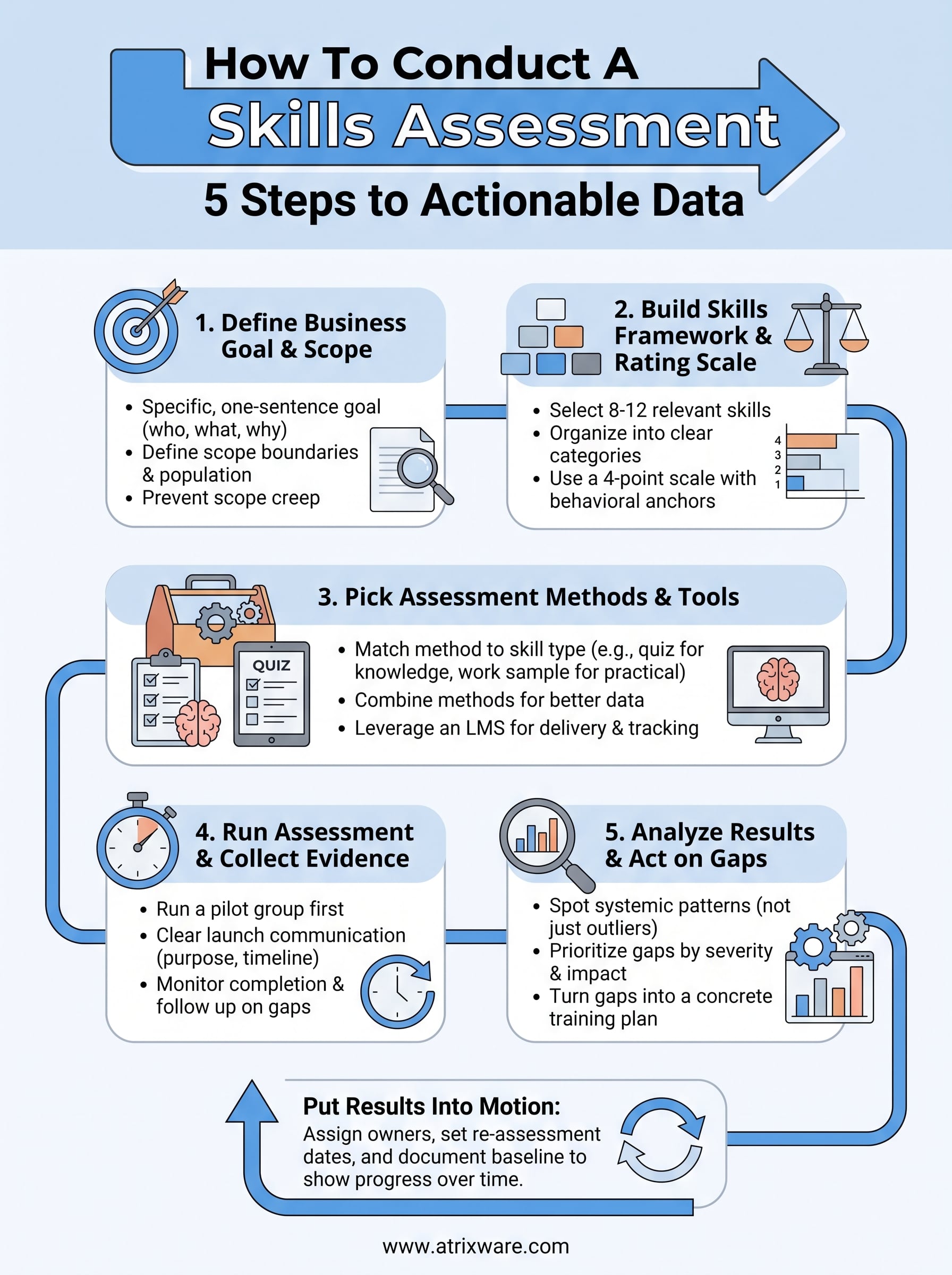
A skills assessment only creates value when it drives action. The data you collected, the gaps you identified, and the training priorities you ranked mean nothing if they sit in a spreadsheet while the skills shortage continues. Assign each high-priority gap to a training owner this week, set a 90-day review date to remeasure, and document your baseline scores now so you can show progress later. That cycle of assess, train, and reassess is how you build a workforce that actually improves over time.
Knowing how to conduct a skills assessment is the first step, but executing it at scale requires the right infrastructure. Axis LMS lets you build and deliver assessments, track completion, and connect results directly to targeted training programs without managing the process manually. If you’re ready to see how it works in practice, start your free Axis LMS admin demo and explore the tools that turn assessment data into real skill gains.
