
Self-paced courses get a lot of attention, but some training simply works better when a real person is leading the session. Think onboarding new hires through complex workflows, walking a sales team through objection handling, or running compliance scenarios that demand real-time discussion. These are moments where clicking through slides alone won’t cut it. So, what is instructor-led training, and why does it still hold so much weight in corporate learning programs?
Instructor-led training (ILT) is a structured learning format where a trainer guides participants through content in real time, either in a physical classroom or through a virtual session. It’s been around for decades, and for good reason: live instruction creates space for immediate feedback, spontaneous Q&A, and hands-on practice that self-paced modules can’t replicate. When the material is nuanced, high-stakes, or requires group collaboration, ILT consistently outperforms passive learning methods.
That said, running instructor-led training well requires the right infrastructure behind it. Scheduling sessions, enrolling learners, tracking attendance, and measuring outcomes across departments, none of that manages itself. That’s exactly where a platform like Axis LMS from Atrixware fits in, giving organizations the tools to deliver, manage, and report on instructor-led training alongside their broader learning programs, all from one system.
This article breaks down how instructor-led training works, the specific benefits it offers, real examples of both in-person and virtual formats, and clear guidance on when ILT is the right choice for your team. Whether you’re building a training program from scratch or rethinking how you deliver existing content, you’ll walk away with a practical understanding of where instructor-led training belongs in your strategy.
What instructor-led training means
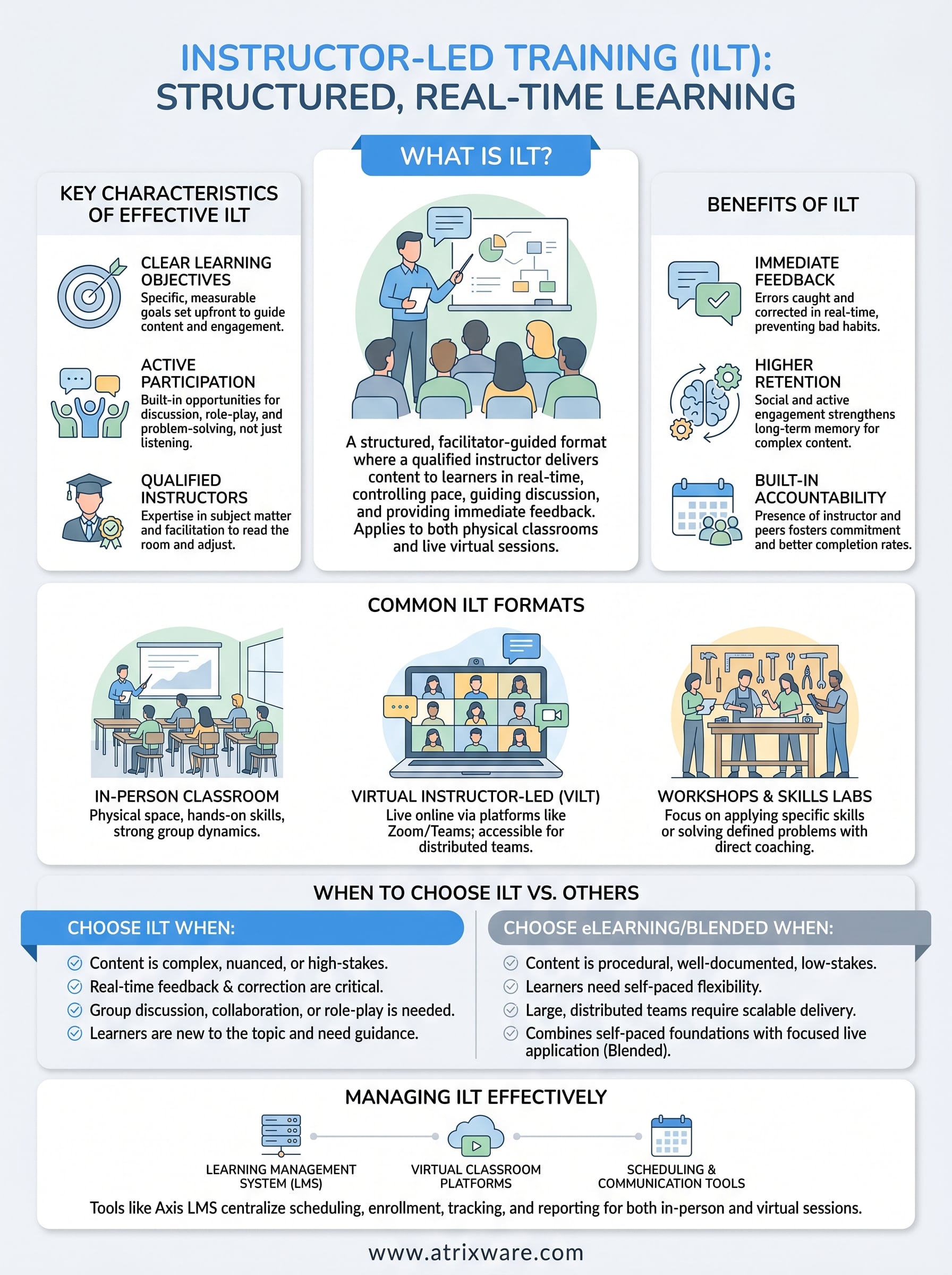
Instructor-led training is a structured, facilitated learning format where a qualified instructor delivers content to a group of learners in real time. The instructor controls the pace, guides discussion, answers questions as they arise, and adjusts the session based on how participants respond. This applies to both in-person classrooms and live virtual sessions, which means "instructor-led" doesn’t automatically require everyone to be in the same room.
The core definition
When someone asks what is instructor led training, the most direct answer is this: it’s any training where a human expert guides participants through material simultaneously, rather than learners moving through content on their own schedule. The instructor brings subject matter to life through explanation, demonstration, and live interaction. Learners aren’t passively absorbing slides, they’re asking questions, working through scenarios, and responding to prompts in the moment.
ILT has deep roots in traditional classroom education, but it has evolved significantly within corporate learning. Today, instructor-led can describe a full-day in-person workshop, a one-hour live webinar, a hands-on skills lab, or a virtual classroom session spanning multiple time zones. The delivery channel changes, but the defining element stays constant: a live instructor is present and actively driving the experience from start to finish.
The instructor’s presence is what separates ILT from every other training format, the ability to respond, adjust, and interact in real time is what gives this method its sustained effectiveness.
How ILT differs from self-paced learning
Self-paced eLearning, video libraries, and microlearning modules all serve real purposes, but they work very differently from ILT. In self-paced formats, learners control the timing and sequence of their own experience. There’s no live person available when something is unclear, no group energy to push the conversation forward, and no instructor watching for signs that a concept isn’t connecting.

ILT flips that dynamic entirely. The instructor monitors comprehension in real time, reading the room, adjusting explanations on the fly, and creating space for group discussion that reinforces learning through peer interaction. This matters most when content is complex or high-stakes. A learner hitting a confusing moment in a self-paced module might simply click past it rather than work through the confusion. In a live session, that gap gets caught and addressed before it compounds.
The distinction also shapes how you measure outcomes. A learner who completes a self-paced module has demonstrated persistence, not necessarily understanding. An instructor can directly observe whether participants apply concepts correctly, ask probing questions mid-session, and intervene when a concept isn’t landing, all before the training ends and people return to their jobs.
Who leads and attends ILT sessions
The instructor role varies by context. In corporate environments, instructors are often subject matter experts, senior employees, compliance officers, or external consultants brought in for specialized content. In other cases, a dedicated trainer or learning and development specialist takes the lead, particularly for recurring skills-based or onboarding sessions delivered to new cohorts regularly.
Participants are typically employees, partners, or customers who share a common learning need at a specific point in time. A session might run for a single employee cohort, a cross-functional project team, or an external audience learning how to use a product. Group sizes vary considerably, from small workshops of five to ten people where open discussion is central, to larger presentations with dozens of attendees where interaction is more structured and moderated. The format adapts, but the role of the instructor as an active guide remains the consistent thread across all of them.
Key characteristics of effective ILT
Not all instructor-led training delivers results equally. The format gives you the conditions for effective learning, but those conditions only work when the session itself is built around a few non-negotiable qualities. Understanding what separates productive ILT from a forgettable lecture is essential before you design or deliver anything, and it directly addresses a core part of what is instructor led training in practice, not just in theory.
Clear learning objectives set upfront
Every effective ILT session starts with specific, measurable objectives that both the instructor and participants understand before the session begins. These aren’t vague themes like "understand customer service." They’re concrete outcomes like "apply the three-step escalation process to a real scenario." When objectives are clear, the instructor can structure content purposefully, and learners know exactly what they’re working toward, which keeps engagement from drifting.
Writing strong objectives before you build anything else also helps you decide what to cut. Every activity, discussion question, and exercise should connect directly to at least one stated objective. Anything that doesn’t connect is a distraction that consumes session time and dilutes the overall focus.
Without defined objectives, even a skilled instructor struggles to keep a session on track, and participants rarely leave knowing what they were supposed to learn.
Active participation built into the design
Effective ILT is not a monologue. The design deliberately creates opportunities for learners to respond, question, practice, and apply rather than simply listen. This includes structured discussion questions, role-play scenarios, group problem-solving tasks, and periodic comprehension checks throughout the session. Passive formats where the instructor speaks for 90 percent of the time consistently underperform because listening without doing does not build skills that transfer back to the job.
Participation also helps the instructor calibrate in real time. If a discussion question produces confused looks or off-target answers, the instructor can revisit the concept before moving forward. That live responsiveness is exactly what separates ILT from a recorded video.
Qualified instructors who can read the room
The instructor’s competence in both subject matter and group facilitation determines whether a session lands or falls flat. Subject matter expertise alone is not enough. An effective ILT instructor knows how to ask open questions, manage dominant participants, draw out quieter learners, and shift their approach when something is not working. These are facilitation skills that require deliberate practice and development.
Your choice of instructor affects every downstream outcome, from participant engagement during the session to knowledge retention weeks later. Organizations that invest in instructor preparation, including train-the-trainer programs and structured feedback cycles, consistently see stronger results than those that hand a subject matter expert a slide deck and send them into a room unprepared.
Common ILT formats and real examples
Understanding what is instructor led training in practice means looking at the specific formats it takes across different industries and team sizes. ILT is not a single delivery method; it covers a range of formats that share one defining quality: a live instructor guides learners through content in real time. The format you choose depends on your audience, content complexity, and the logistics your organization can realistically support.
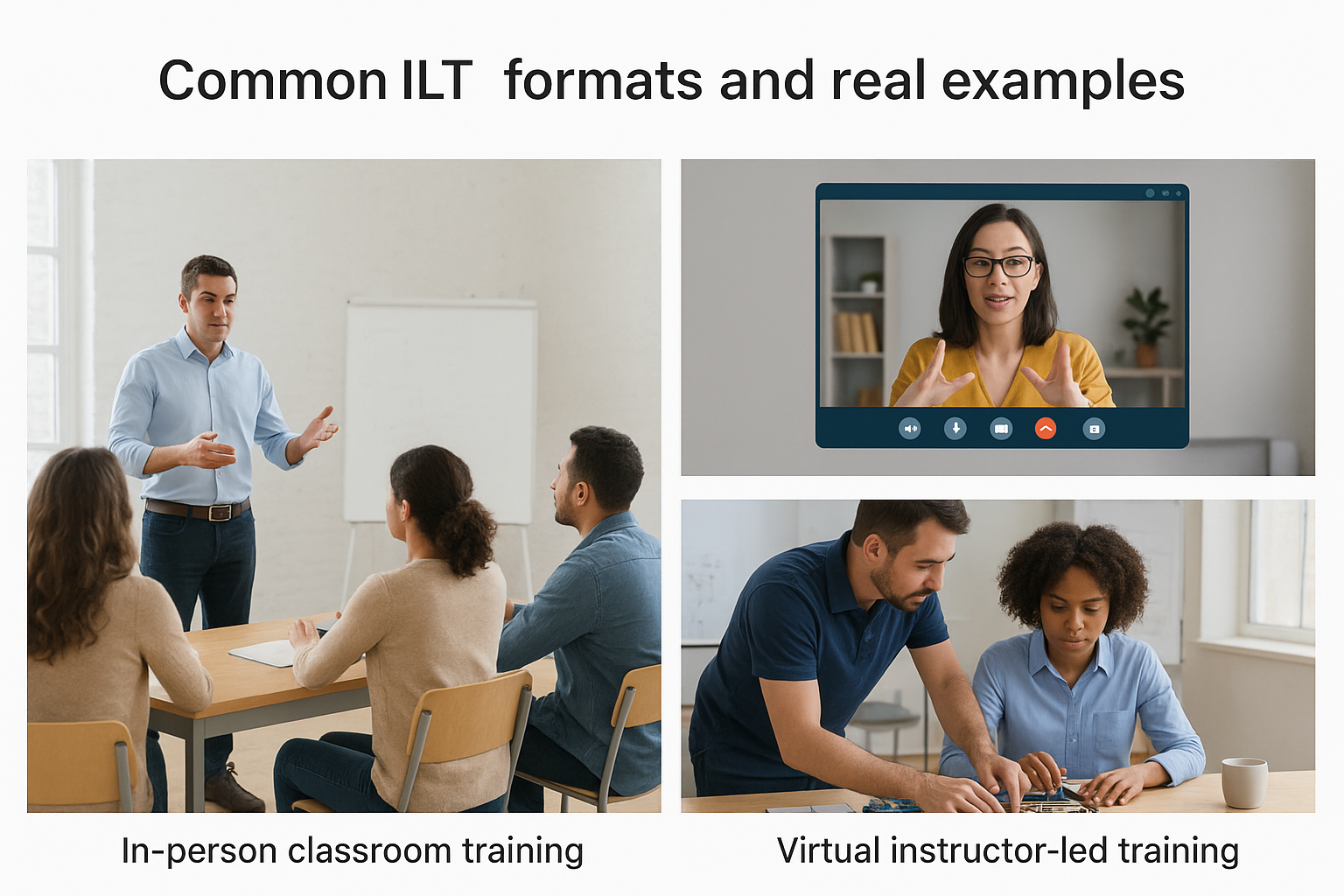
In-person classroom training
In-person ILT is the format most people picture when they hear "training." An instructor and a group of learners occupy the same physical space, working through structured content together over hours or days. This format works especially well for hands-on technical skills, safety certification, and compliance scenarios where direct observation matters. A manufacturing company running equipment safety training, a hospital conducting hands-on clinical procedure walkthroughs, or a financial firm delivering regulatory compliance workshops are all real-world examples of in-person ILT at its strongest.
In-person training creates conditions for trust and group cohesion that other formats struggle to replicate, particularly when learners need to build team-level skills alongside individual ones.
Group dynamics play a central role in classroom settings. Peer discussion, live role-play, and immediate feedback from both the instructor and fellow participants add dimensions of learning that recorded content simply cannot match.
Virtual instructor-led training
Virtual ILT (VILT) delivers the same real-time, instructor-guided experience through video conferencing tools like Zoom or Microsoft Teams instead of a physical room. This format has expanded significantly as distributed workforces have grown. A software company training customer success teams across multiple cities, or a healthcare organization onboarding remote nurses on documentation systems, both rely on VILT to reach learners without requiring travel or centralized facilities.
The core structure mirrors in-person ILT closely, with live instruction, breakout group discussions, polls, and shared screen demonstrations replacing physical handouts and whiteboard sessions. The logistics differ, but the instructor’s real-time presence remains the defining factor.
Workshops and skills labs
Workshops focus tightly on applying a specific skill or solving a defined problem within the session itself. Rather than covering broad content, a workshop might dedicate three hours to helping a sales team practice a new discovery conversation framework with live coaching from a trainer. Skills labs follow a similar structure but often incorporate physical tools, software environments, or simulations where participants build competence through repeated practice with direct instructor feedback. Both formats produce measurable skill gains in a short time frame when designed well.
Benefits of instructor-led training
When you consider what is instructor led training and why organizations keep investing in it despite the availability of cheaper self-paced alternatives, the answer comes down to outcomes that live instruction consistently delivers better than any other format. These benefits are not incidental; they are structural advantages that emerge directly from having a skilled instructor present in real time, guiding learners through content they need to apply accurately on the job.
Immediate feedback and real-time correction
One of the clearest benefits of ILT is that errors get caught before they become habits. When a learner misunderstands a process or applies a concept incorrectly during a role-play or exercise, the instructor can step in immediately, correct the misunderstanding, and re-demonstrate the right approach. This matters significantly for technical skills, compliance procedures, and any content where practicing something incorrectly has real downstream consequences.
Catching a misconception during a session is far less costly than discovering it weeks later through a compliance failure or a customer complaint.
Self-paced modules rely on quiz scores to flag gaps, but those scores only capture what a learner selects, not how they actually think through a problem or apply a skill under pressure. ILT gives you direct, observable visibility into both.
Higher retention for complex content
Learners retain information better when they engage with it actively and socially, and ILT is designed around both of those conditions. Group discussion forces participants to articulate their understanding in their own words, which strengthens memory encoding in ways that reading or watching alone does not. When your training covers multi-step processes, nuanced judgment calls, or high-stakes compliance content, the interactive structure of ILT produces stronger long-term retention than self-paced alternatives deliver.
Built-in accountability
Attendance and active participation in a live session create social accountability that self-paced formats cannot replicate. When learners know an instructor and peers are present, they prepare more thoroughly, pay closer attention, and contribute more actively. This effect is particularly noticeable in cohort-based programs where shared deadlines and group performance expectations reinforce individual commitment throughout the entire training period.
A learner who might click past a difficult module late at night in a self-paced course is far less likely to disengage in front of colleagues and a facilitator. That accountability translates directly into better completion rates and stronger measurable performance when you track outcomes after the program wraps up.
Challenges and limitations to plan for
Knowing what is instructor led training means knowing its real limitations, not just its strengths. ILT delivers results in the right conditions, but it also introduces operational and financial pressures that self-paced formats avoid. Planning for these challenges upfront gives you the best chance of building a program that actually runs smoothly, rather than one that looks great on paper but creates friction at every execution point.
Scheduling and logistical complexity
Getting the right people in the same session at the same time is one of the most persistent challenges in running ILT at scale. When you have multiple departments, distributed teams, or shift-based workers, coordinating attendance without disrupting operations becomes its own project. A single scheduling conflict can cascade into low attendance, session rescheduling, and delayed training completion for entire cohorts.
The more learners you need to train simultaneously, the more your scheduling process needs to be treated as a formal workflow, not an afterthought.
Instructor availability adds a second layer of complexity. If your program relies on one or two subject matter experts to lead sessions, any conflict in their schedules directly delays training for everyone waiting in the queue. Building a bench of qualified instructors and establishing backup facilitation plans protects your program from those bottlenecks before they surface.
Higher cost per learner
ILT typically carries a higher per-learner cost than self-paced alternatives because it requires dedicated instructor time, session preparation, materials, and in many cases, facilities or virtual platform licensing. When you run in-person sessions, you also absorb travel costs and lost productivity from employees spending full days away from their primary responsibilities. These costs add up quickly, particularly when you need to run the same session repeatedly for new cohorts.
The financial reality doesn’t make ILT the wrong choice, but it does make cost-per-outcome a metric worth tracking deliberately. Pairing ILT with pre-work or follow-up self-paced modules can reduce the time learners need in live sessions, which trims cost without compromising the outcomes that justify using ILT in the first place.
Scaling to large or distributed teams
Delivering consistent ILT to hundreds of learners across multiple locations is difficult without significant coordination infrastructure. Instructor variability is a real risk: two instructors covering the same content rarely deliver it identically, and those inconsistencies affect what different learner groups actually take away. Standardizing session materials, facilitator guides, and assessment criteria across every delivery instance is essential if consistency matters for your training outcomes, particularly in compliance-driven contexts where the content itself carries regulatory weight.
When to choose ILT vs eLearning or blended
Understanding what is instructor led training only gets you so far if you don’t know when to actually use it. The format you choose should match the content, the learner’s needs, and the operational reality of your organization, not default to whatever you’ve used before. Each delivery method has a domain where it outperforms the others, and recognizing those boundaries saves you time, budget, and training outcomes that missed the mark.

When ILT is the right call
Choose ILT when your content demands real-time feedback, group discussion, or direct observation of skill application. Compliance training that involves complex judgment calls, onboarding for roles with high interpersonal demands, and technical certifications where errors carry real risk are all situations where ILT delivers something self-paced modules cannot. If your learners need to practice a skill live, receive immediate correction, or build shared understanding as a team, live instruction is the right investment.
The higher the stakes of getting the content wrong on the job, the stronger the case for ILT over any asynchronous alternative.
ILT also works best when your audience is new to a topic and likely to encounter confusion without a real person available to clarify. Dropping a new hire into a self-paced module on a nuanced workflow is a recipe for passive clicking rather than genuine learning.
When eLearning works better
Self-paced eLearning consistently outperforms ILT for content that is procedural, well-documented, and low-stakes, where learners can revisit material at their own pace without missing much from the absence of a live facilitator. Product knowledge libraries, software navigation tutorials, and mandatory policy acknowledgment training all fit this profile. eLearning also scales cleanly across large, distributed teams without the scheduling constraints that make large ILT programs difficult to coordinate.
When blended is the smarter option
Blended learning combines self-paced modules with live instructor sessions, letting each component do what it does best. A strong blended design might use eLearning to cover foundational concepts before a cohort ever enters a live session, so the instructor can spend the entire session on application, discussion, and practice rather than background content. This approach reduces live session time without sacrificing the depth that only an instructor can facilitate.
Consider blended formats when your content has both a knowledge layer and a skills layer, when live session time is expensive or limited, or when your learners span multiple time zones and full synchronous delivery creates access barriers that hurt attendance and completion.
How to design an ILT program step by step
Designing effective ILT requires more than assembling slides and booking a room. Every decision you make during the design phase, from session length to activity selection, shapes whether participants walk away with skills they can actually use. Following a clear sequence helps you avoid the most common design mistakes that turn a well-intentioned program into a forgettable lecture.
Start with your audience and objectives
Before you build a single slide or write a facilitator guide, identify who your learners are and what they need to accomplish by the end of the session. Map out role-specific knowledge gaps, prior experience with the topic, and any real constraints on their availability during training. Then write specific, measurable learning objectives that define what success looks like for each participant, not just for the program overall.
These objectives drive every downstream decision. If you’re designing onboarding ILT for new sales hires, your objectives might specify that participants can demonstrate the discovery call framework on a live role-play before the session ends. That target shapes your content sequencing, your activity choices, and how you measure whether the training actually worked.
Build the session structure and materials
With clear objectives in hand, map your content flow so that each module or activity directly serves at least one objective. Open with context that connects the training to participants’ actual jobs, then sequence content from foundational concepts to applied practice rather than pushing everything through in chronological order. Build in deliberate interaction points every 10 to 15 minutes to prevent passive listening from taking over the session.
Structuring content around application, not just information delivery, is what separates ILT that produces behavior change from ILT that produces quiz scores.
Your materials should include a facilitator guide with timing notes, discussion prompts, and contingency answers for common questions, alongside participant workbooks or job aids they can reference back on the job.
Prepare your instructors and run a pilot session
Understanding what is instructor led training at a design level means treating instructor preparation as part of the design itself, not a separate afterthought. Walk every instructor through the facilitator guide in detail, cover how to manage discussion pacing and handle questions that pull sessions off track, and give them a chance to run through key segments before the first live cohort arrives. Run a pilot with a small group, collect specific feedback on pacing, clarity, and activity structure, then revise before you roll the program out at scale.
How to deliver virtual ILT that works
Virtual instructor-led training introduces a distinct set of delivery challenges that in-person sessions don’t face. Technology barriers, participant distraction, and the absence of physical room energy all require deliberate design choices to overcome. If you’re asking what is instructor led training in a virtual context, the honest answer is that it demands more preparation and more intentional facilitation than a classroom session, not less.

Set up your technology before the session
Your platform choice and technical setup directly affect whether participants can focus on learning or spend the session fighting connection issues. Test your video, audio, screen sharing, and any interactive tools like polls or breakout rooms at least 24 hours before the live session. Send participants a simple pre-session checklist so they arrive with working audio and a distraction-reduced environment. A session that starts with five minutes of troubleshooting signals disorganization and erodes the credibility your instructor needs to carry the room.
Before the first participant joins, confirm these elements are ready:
- Audio quality on the instructor’s end (headset over laptop mic)
- Screen sharing permissions configured for any co-facilitators
- Breakout rooms pre-assigned if your session includes small group activities
- Backup communication channel (email or chat) if the platform drops
Keep engagement high throughout
Participant attention in a virtual session drops faster than in a physical room, and the design of your session needs to account for that reality from the first minute. Build in interaction every 10 to 12 minutes at a minimum, using live polls, directed questions to specific participants, or short breakout group tasks that require active output rather than passive listening. Giving participants something to produce, whether a typed answer in chat, a position to defend in discussion, or a problem to solve in a small group, keeps attention anchored to the content rather than to whatever else is open on their screen.
The more output you ask participants to generate during a virtual session, the less room distraction has to take hold.
Manage the virtual room like a live instructor
Facilitation in a virtual environment requires the same read-the-room instincts as in-person delivery, but through a narrower lens. Watch for long silences after open questions, camera-off patterns that signal disengagement, and chat activity that drops off mid-session. Calling on participants by name, rotating who answers discussion questions, and explicitly inviting quieter attendees into the conversation all maintain the instructor presence that defines effective ILT regardless of whether the room is physical or digital.
Tools that make ILT easier to manage
Running ILT well is as much an operational challenge as it is a design one. Scheduling sessions, enrolling participants, tracking attendance, and reporting on outcomes all generate administrative load that compounds quickly when you’re running multiple cohorts across departments or locations. The right tools remove that friction so your team can focus on delivering quality training rather than managing spreadsheets and chasing confirmations.
A learning management system
A learning management system (LMS) is the operational backbone of any well-run ILT program. An LMS lets you schedule instructor-led sessions, manage enrollments, track who attended, and pull completion reports without building separate tracking systems for each program. When someone asks what is instructor led training at scale, the honest answer is that it requires this kind of centralized infrastructure to stay manageable, particularly once you’re running concurrent sessions for different teams or locations.
Axis LMS from Atrixware handles both virtual and in-person ILT alongside self-paced content in one system, which means your administrators aren’t switching between platforms to manage different training types. You can set up session rosters, automate enrollment confirmations, and generate attendance reports on demand, all without manual data entry after every session wraps.
Centralizing your ILT management in an LMS reduces the operational overhead that causes programs to run inconsistently or fall behind schedule.
Virtual classroom platforms
For virtual ILT, your video conferencing platform determines the quality of the live session experience for both instructors and participants. Tools like Microsoft Teams and Zoom both support breakout rooms, polls, screen sharing, and chat, which are the core interaction features your facilitators need to run engaging sessions rather than one-way presentations. Choosing a platform your learners already use in their daily work reduces the technical friction that derails the first few minutes of a live session.
Integration between your virtual classroom tool and your LMS matters significantly for reporting accuracy. When attendance data flows automatically from the platform into your LMS, you avoid the manual reconciliation that creates gaps in your completion records.
Scheduling and communication tools
Coordinating session times, sending reminders, and managing rescheduling requests eats up more time than most training managers expect. Calendar integrations and automated notification tools reduce the manual communication burden, particularly when you’re managing recurring cohorts with rotating enrollment. Many LMS platforms include built-in scheduling and automated reminder functionality, which keeps participants informed without requiring your team to send individual follow-ups for every session.
Automated pre-session reminders and post-session surveys also improve both attendance rates and your ability to collect actionable feedback after each delivery.
Next steps
Now you have a clear picture of what is instructor led training, how it works across formats, and when it delivers stronger results than self-paced alternatives. The key is matching your delivery method to your content and your learners’ actual needs, rather than defaulting to what your organization has always done. Whether you’re running workshops, virtual sessions, or a blended program, the infrastructure behind your training determines how consistently it runs and how accurately you measure outcomes. Getting that foundation right is what separates programs that produce real behavior change from those that only generate completion records.
Picking the right tools is where most organizations get stuck. If you’re evaluating whether your current setup can support a structured ILT program, start with the LMS readiness quiz. It helps you identify exactly where your training infrastructure stands and what you need to move forward with confidence.
