Not every learner absorbs information the same way, or at the same speed. Some need extra time with foundational concepts, while others are ready to move ahead after a single pass. Traditional training treats everyone identically, and that’s exactly where it falls short. The adaptive learning definition centers on a straightforward idea: use technology to adjust the learning experience in real time based on each person’s performance, preferences, and progress.
At its core, adaptive learning relies on algorithms and data to figure out what a learner knows, what they don’t, and what they need next. It’s a shift from static, one-size-fits-all courses toward training that responds to the individual. For organizations managing employee onboarding, compliance, or customer education, that shift matters, because it directly impacts how quickly people gain competence and how well they retain it.
At Atrixware, we build Axis LMS to help businesses deliver smarter, more effective training at scale. Understanding how adaptive learning works, and where it creates real value, is key to getting more from your training investment. This article breaks down what adaptive learning actually means, how the underlying technology operates, and the specific benefits it brings to corporate learning environments.
What adaptive learning is and is not
The term gets used loosely in corporate training conversations, so a clear adaptive learning definition is worth establishing before moving forward. Adaptive learning is a technology-driven instructional approach that continuously collects data on a learner’s responses, pacing, and knowledge gaps, then adjusts the content, sequence, or difficulty to match what that individual needs at that moment. It is not a single product or feature, but a methodology supported by algorithms and data models that you can apply across employee onboarding, compliance training, customer education, and beyond.
What adaptive learning actually is
At its foundation, adaptive systems monitor specific learner behaviors: correct and incorrect answers, time spent on content, number of attempts, and patterns across multiple interactions. From that data, the system builds a model of each learner’s current knowledge state and uses it to determine what content to deliver next. This might mean surfacing a remedial module, skipping material the learner already understands, or adjusting the difficulty of the next assessment question.
Adaptive systems do not react to a single wrong answer in isolation; they build a picture of knowledge over time and adjust the entire learning path accordingly.
Consider two of your employees starting the same compliance course. They might finish with completely different content sequences, based entirely on what each person knew at the start and how quickly they demonstrated competence along the way. That individualized progression is what separates adaptive learning from simply offering multiple course tracks or letting learners self-select their difficulty level. The system makes those decisions automatically, using performance evidence rather than assumptions about what a learner needs.
What adaptive learning is not
Adaptive learning is not the same as self-paced learning. Giving someone the flexibility to move through a course at their own speed is a scheduling accommodation. For a system to qualify as truly adaptive, the platform itself must make content and sequencing decisions based on demonstrated performance data, not simply permit the learner to advance whenever they click the next button. Self-paced training gives people control over timing; adaptive training gives the system control over what comes next.
It is also not the same as personalized content curation, where a platform recommends courses based on a learner’s job role or stated interests. Recommendation engines suggest what to take; adaptive systems change what happens inside a learning path based on demonstrated knowledge gaps. The distinction matters because investing in recommendations alone will not produce the efficiency and retention gains that a true adaptive system delivers to your training program.
Why adaptive learning matters for training teams
Training teams face constant pressure to deliver measurable results with limited time and budget. When every learner moves through the same content at the same pace, your strongest performers waste time on material they already know, while others fall behind without enough support. Applying the adaptive learning definition to your training strategy means you stop treating both groups identically and start routing each person toward exactly the content they need, based on what the data actually shows about their knowledge state.
It reduces wasted training time
Every hour your employees spend reviewing content they already understand is an hour pulled away from productive work. Adaptive systems skip material a learner has already demonstrated mastery of, compressing the time it takes to reach competency without cutting corners on the gaps that actually exist. For large organizations running mandatory compliance courses across hundreds of employees, that reduction in seat time adds up quickly and frees your training team to focus on higher-value learning initiatives rather than managing a one-size-fits-all content library.
Organizations that adopt adaptive platforms consistently report significant reductions in training time compared to fixed-path courses, without sacrificing knowledge retention or assessment scores.
It improves knowledge retention and compliance outcomes
Learners who receive content matched to their current knowledge state retain information more effectively than those who move through material that is either too easy or too advanced for where they are. That directly translates to stronger performance on compliance assessments, faster onboarding, and fewer errors in roles where accurate knowledge is critical. For training teams responsible for regulatory compliance or certification tracking, the ability to show that each individual received the right instruction at the right level also strengthens your audit trail and reduces organizational risk considerably.
How adaptive learning works in practice
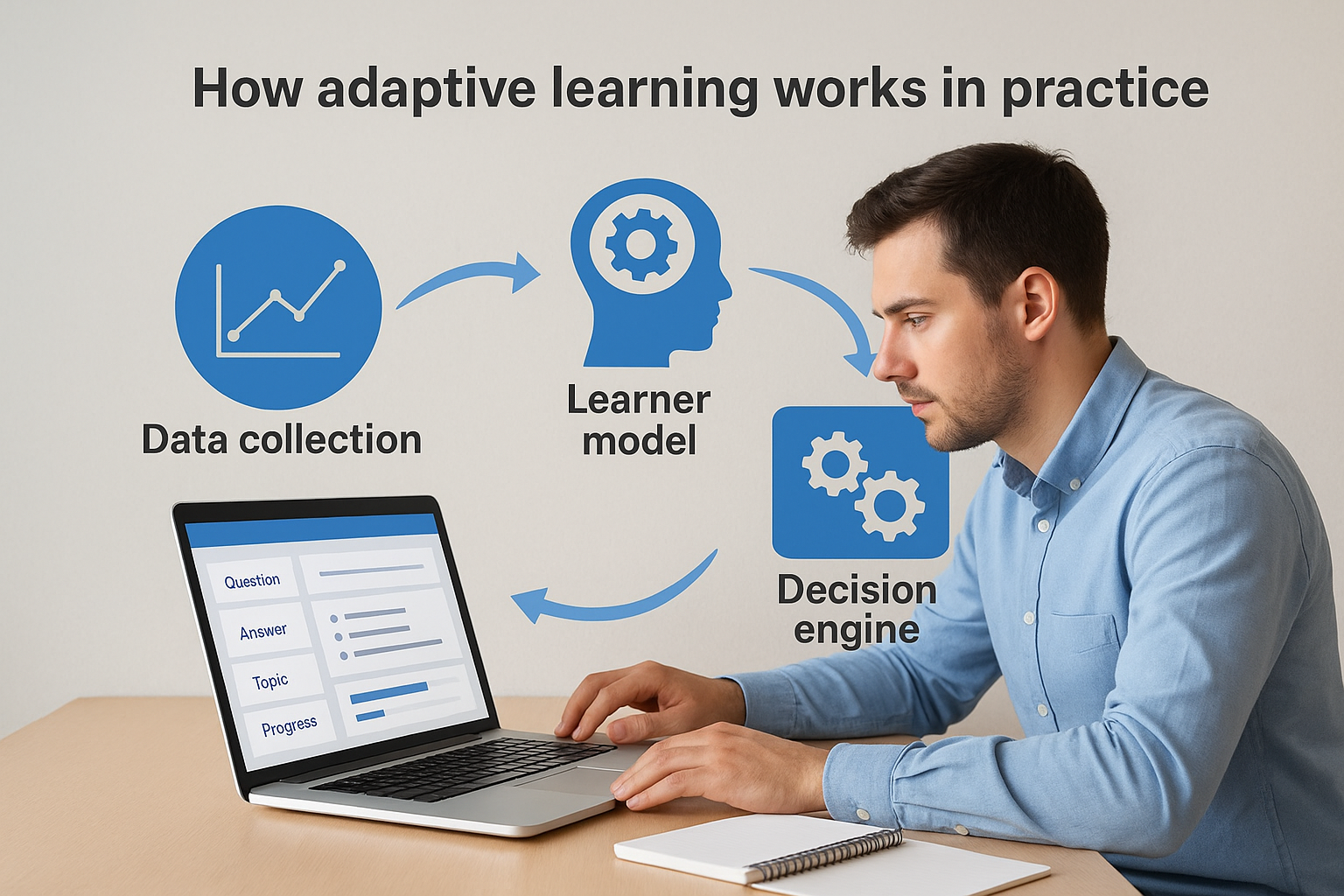
Understanding the adaptive learning definition at a conceptual level is useful, but seeing how the mechanics actually play out helps you evaluate whether a system delivers what it promises. Three core components power every adaptive learning system: data collection, a learner model, and a decision engine that connects the two. Each piece depends on the others, and removing any one of them leaves you with a static course wearing an adaptive label.
The data layer: tracking what learner behavior reveals
Every adaptive system starts by capturing raw performance data as learners interact with the content. This includes which questions a learner answered correctly, how long they spent on each item, how many attempts they needed, and whether they revisited specific material. The system does not treat this as a simple score; it interprets patterns across multiple data points to build a continuously updated picture of what each learner knows and where knowledge gaps persist.
The quality of an adaptive system depends entirely on how much behavioral data it collects and how precisely its model interprets that data.
How the algorithm routes each learner forward
Once the system has a reliable snapshot of a learner’s knowledge state, the decision engine determines the next step in their learning path. For a learner who answered foundational questions correctly, the algorithm advances them past review material. For a learner who struggled with a specific concept, it surfaces targeted remediation content before moving forward. This routing happens automatically, without requiring your training team to manually intervene or review individual progress at each decision point. The result is a learning path that looks different for every person who takes the same course, built entirely on performance evidence rather than assumptions about what each individual needs.
How to implement adaptive learning in an LMS
Putting the adaptive learning definition into practice inside your LMS starts with a clear plan. Before you configure anything, you need to map out the knowledge competencies your course is designed to build. Without that map, your system has no basis for deciding which learners need more time on which concepts, and your branching logic will reflect guesswork rather than instructional design.
Start with a diagnostic assessment
Your first implementation step is building a pre-course diagnostic that measures what each learner already knows before they touch your main content. This does not need to be a long test; even 10 to 15 targeted questions can give your LMS enough data to route learners accurately from the start. When learners demonstrate mastery in specific areas upfront, the system skips those modules and moves them directly to the content they actually need.
A diagnostic assessment at the start transforms your LMS from a content delivery tool into a genuine adaptive system from the very first learner interaction.
Build your branching rules around performance thresholds
Once your diagnostic is in place, you need to set performance thresholds that tell the LMS what to do at each decision point. For example, a learner scoring below 70% on a topic triggers a remediation module before they advance, while a learner scoring above 90% skips straight to the next competency. Your LMS should let you configure these rules without custom code, using conditional logic tied directly to assessment results. Keep your thresholds grounded in the actual competency level required for each role.
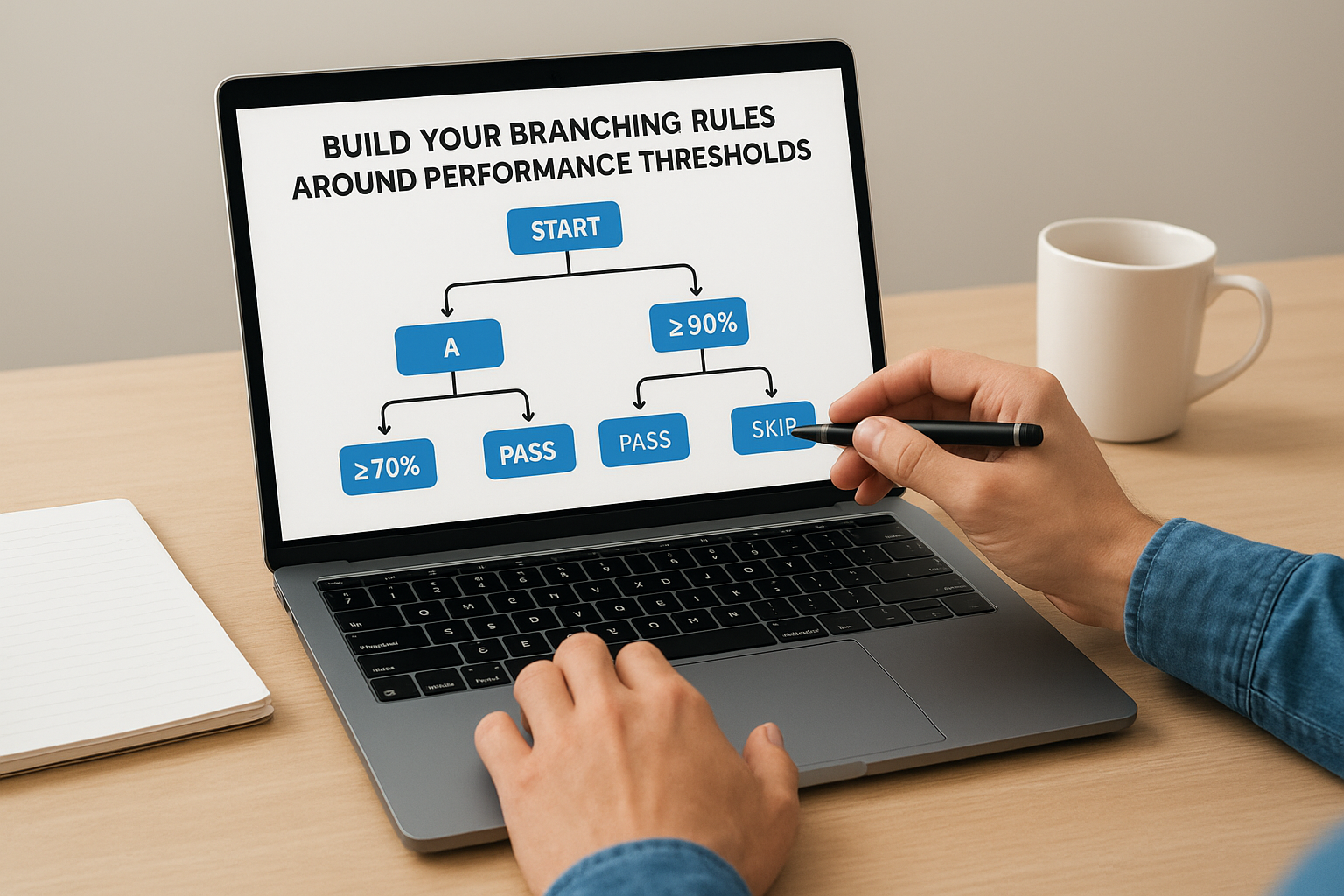
A few practical rules to apply when setting up your branching logic:
- Tie each threshold to a specific learning objective, not a general course score
- Build at least two paths per module: one for learners who pass and one for those who need review
- Test every path manually before launch to confirm no learner gets stuck in a loop or skips critical content
Key features and common pitfalls to avoid
Not every platform that claims to follow the adaptive learning definition actually delivers it. Before you commit to a system, check whether it includes the specific capabilities that make adaptation real rather than cosmetic. The features below separate genuine adaptive systems from courses that simply offer branching menus.
Features that signal a genuine adaptive system
A true adaptive platform gives you granular, real-time reporting on individual knowledge gaps, not just completion percentages. It tracks performance at the competency level, updates learner models continuously, and routes content based on that data without manual admin intervention. Look specifically for these capabilities before selecting a platform:
- Configurable branching logic tied directly to assessment thresholds, not manual course tracks
- A built-in diagnostic assessment that fires before the main content begins
- Competency-level tracking that shows exactly which objectives each learner has or has not met
- Clear audit records showing which content each learner received and the performance data that triggered each routing decision
If a platform cannot show you exactly how it made each routing decision, it is not genuinely adaptive, regardless of what the marketing claims.
Pitfalls to avoid during rollout
The most common mistake is launching without a competency map. If you have not defined the specific knowledge objectives your course must build, your branching rules have no anchor, and learners end up routed based on arbitrary scores rather than meaningful gaps. Start with two paths per module, confirm they work, and expand only after you have validated each branch manually.
Treating adaptive learning as a one-time setup is the other frequent error. Learner performance data reveals patterns over time, and your thresholds, remediation content, and branching rules all need periodic review to stay accurate. Build a quarterly review into your training calendar so the system keeps pace with your actual competency requirements.
Key takeaways
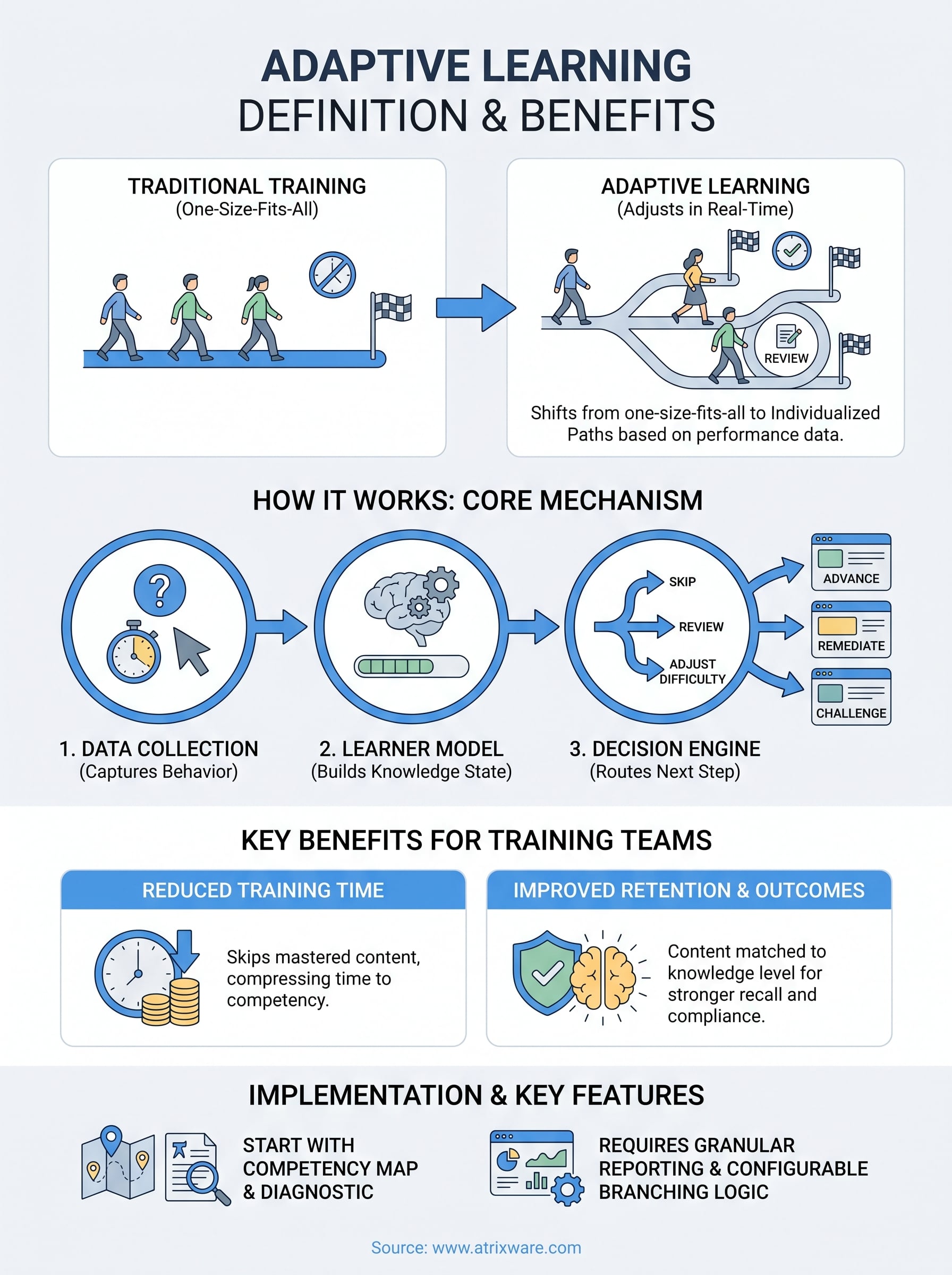
The adaptive learning definition comes down to one core idea: technology that uses performance data to adjust each learner’s path in real time, rather than delivering identical content to everyone. Genuine adaptive systems collect behavioral data continuously, build a model of each learner’s current knowledge state, and route them forward based on evidence rather than assumptions about what they need.
For your training team, this approach translates to reduced seat time, stronger knowledge retention, and measurable compliance outcomes. The gains depend on building a clear competency map before you configure anything, starting every course with a diagnostic assessment, and reviewing your branching rules regularly so the system stays accurate as your training requirements evolve over time.
Ready to see how an LMS can support adaptive learning for your organization? Take the LMS readiness quiz to find out where you stand and what your next step looks like.
