Most new hires will not tell you what is broken in your onboarding unless you ask. By day 30 they have already noticed the confusing login steps, the training modules that repeat each other, and the manager who never checked in. A well-timed new hire training survey turns those quiet complaints into fixes you can act on.
Here is the short answer. Send a brief survey at the end of week one, then again at 30, 60, and 90 days. Keep each one to 8 to 12 questions, mix rating scales with two or three open-ended prompts, and shift the focus as the hire settles in. Early surveys should cover clarity and logistics. Later ones should cover confidence, job readiness, and support from their manager.
Below you will find ready-to-use new hire training survey questions grouped by timing, with notes on what each question reveals and how to read the answers. At Atrixware, we see teams get the most from this feedback when surveys run automatically inside their LMS and results sit next to course completion data.
1. Day 1 and first-week check-in questions
When to send it
Send a two-question pulse at the end of day 1, then the full survey on Friday of week one. Day 1 captures logistics while they are fresh: did the laptop work, did anyone greet them. The Friday survey captures how the first five days actually felt.
Keep the whole thing under five minutes. A new hire who is still learning names will not write essays, and a long form signals that onboarding is just another task to get through.
What it measures
This survey measures first impressions and basic readiness, not learning outcomes. It is too early for that. You are checking whether the fundamentals worked:
- Welcome and logistics (equipment, accounts, desk or remote setup)
- Clarity of the first-week plan and schedule
- Early confidence that they made the right choice
Sample questions
Use a 1 to 5 agreement scale for the first five questions and leave the last one open. These new hire training survey questions keep the focus on things you can fix this week.
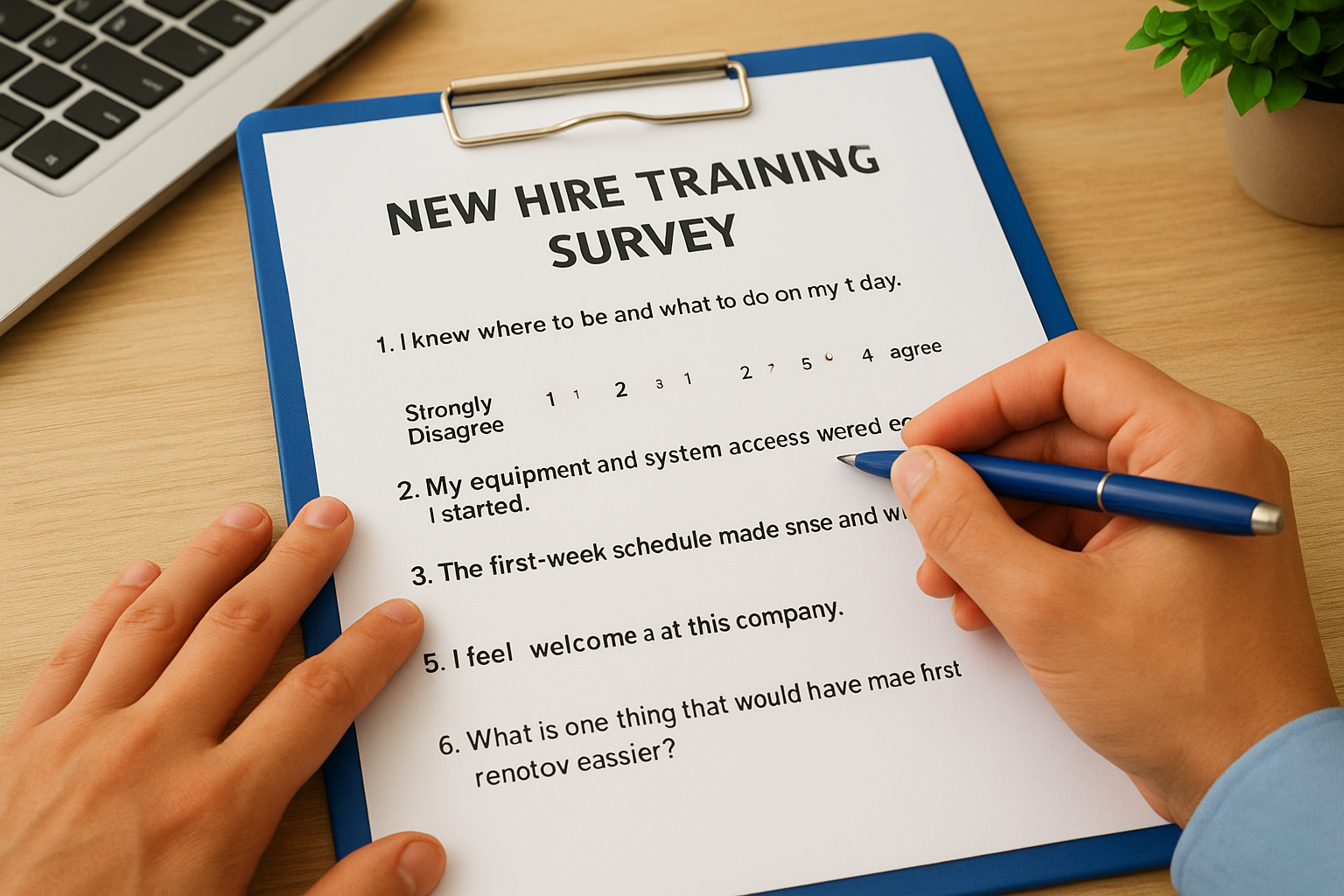
- I knew where to be and what to do on my first day.
- My equipment and system access were ready when I started.
- The first-week schedule made sense and was realistic.
- I met the people I need to work with.
- I feel welcome at this company.
- What is one thing that would have made your first week easier?
How to act on the answers
Review responses within 48 hours. First-week problems are cheap to fix and expensive to ignore. A missing login takes minutes to resolve, but left alone it turns into days of lost work and a poor first impression.
Fix what a new hire reports in week one, and tell them you did.
Patterns matter more than single comments. If three of five hires call the schedule unclear, rewrite the first-week plan before the next cohort starts. If one person flags a gap, follow up with a short personal message from their manager.
2. Training content and relevance questions
When to send it
Ask right after each required course, then again in a short survey at the end of week two. Immediate feedback is more accurate, because by day 30 hires blur one module into the next, and meaningful feedback for online training depends on that freshness. Keep post-course surveys short.
- After each course: questions 1 and 2 only
- End of week two: all six questions
What it measures
Here you check whether the training is useful, accurate, and well paced. Completion rates tell you who clicked through. They do not tell you who learned anything. Look at three things:
- Relevance to the actual job
- Pace and length
- Format fit (video, reading, live session)
Sample questions
Rate the first five on a 1 to 5 scale and leave the last one open. These new hire training survey questions work best when tied to a specific course name.
- The training covered what I need to do my job.
- The content was accurate and up to date.
- The pace was neither too fast nor too slow.
- I could apply what I learned right away.
- The format suited how I learn.
- Which module was least useful, and why?
How to act on the answers
Compare scores by module. A course rated 2 out of 5 by several hires is a candidate for a rewrite or removal. A low pace score usually means you should split it into shorter lessons.
Low scores point to a specific module, so fix that module, not the whole program.
Then check ratings against quiz results in your LMS. When hires rate a course highly but still miss the questions, the course is engaging but not teaching. Tighten the content before you touch the delivery.
3. Role clarity and expectations questions
When to send it
Add these to the week-one Friday survey and ask them again at day 30.
Comparing the two sets of answers shows whether expectations got clearer or drifted once the hire started doing real work.
What it measures
This part of a new hire training survey checks whether people understand what success looks like in their role. Look at three areas:
- Understanding of daily responsibilities
- Clarity on priorities and goals
- Match between the job description and the actual work
Sample questions
Use a 1 to 5 agreement scale for the first five questions and leave the last one open.
- I understand my main responsibilities.
- I know what success looks like in my first 90 days.
- My actual work matches the job description I was given.
- I know who to ask when priorities conflict.
- I understand how my work affects team goals.
- What is still unclear about your role?
How to act on the answers
Watch question 3 closely. A gap between the job posting and the daily work erodes trust quickly, so fix the posting or the workload, whichever is wrong.
A hire who cannot describe success cannot deliver it.
Next, ask managers to hold a 30-minute expectations conversation with anyone who scores below 3 on questions 1 or 2. Agree on three written goals before the meeting ends.
4. Tools, access and resources questions
When to send it
Send a quick version on day 3, once hires have tried to log in everywhere. Repeat the full set at day 30, when they use the tools without hand-holding.
Missing access costs real hours, so do not wait for the scheduled survey if someone reports a block.
What it measures
Tools questions check whether new hires can do the work with what they have, which starts with picking learning and development tools that fit your organization. This part of a new hire training survey covers three areas:
- Access to systems, accounts, and equipment
- Ease of use of tools after training
- Ability to find policies, documents, and help when stuck
Sample questions
Rate the first five on a 1 to 5 agreement scale and leave the last one open.
- I had every system login I needed by the end of week one.
- The training showed me how to use our main tools.
- I can find company policies and documents quickly.
- I know where to go when a tool stops working.
- My equipment and software let me work without problems.
- Which tool or resource do you still struggle with?
How to act on the answers
Track days to full access for each hire. If question 1 scores below 3, ask IT to provision accounts before the start date, using a checklist triggered by offer acceptance.
Access delays are an onboarding failure, not a new hire problem.
Low scores on question 3 point to a content problem. Build a single resource page for new hires with links to key tools, policies, and the person to contact for each one.
5. 30-day new hire training survey questions
When to send it
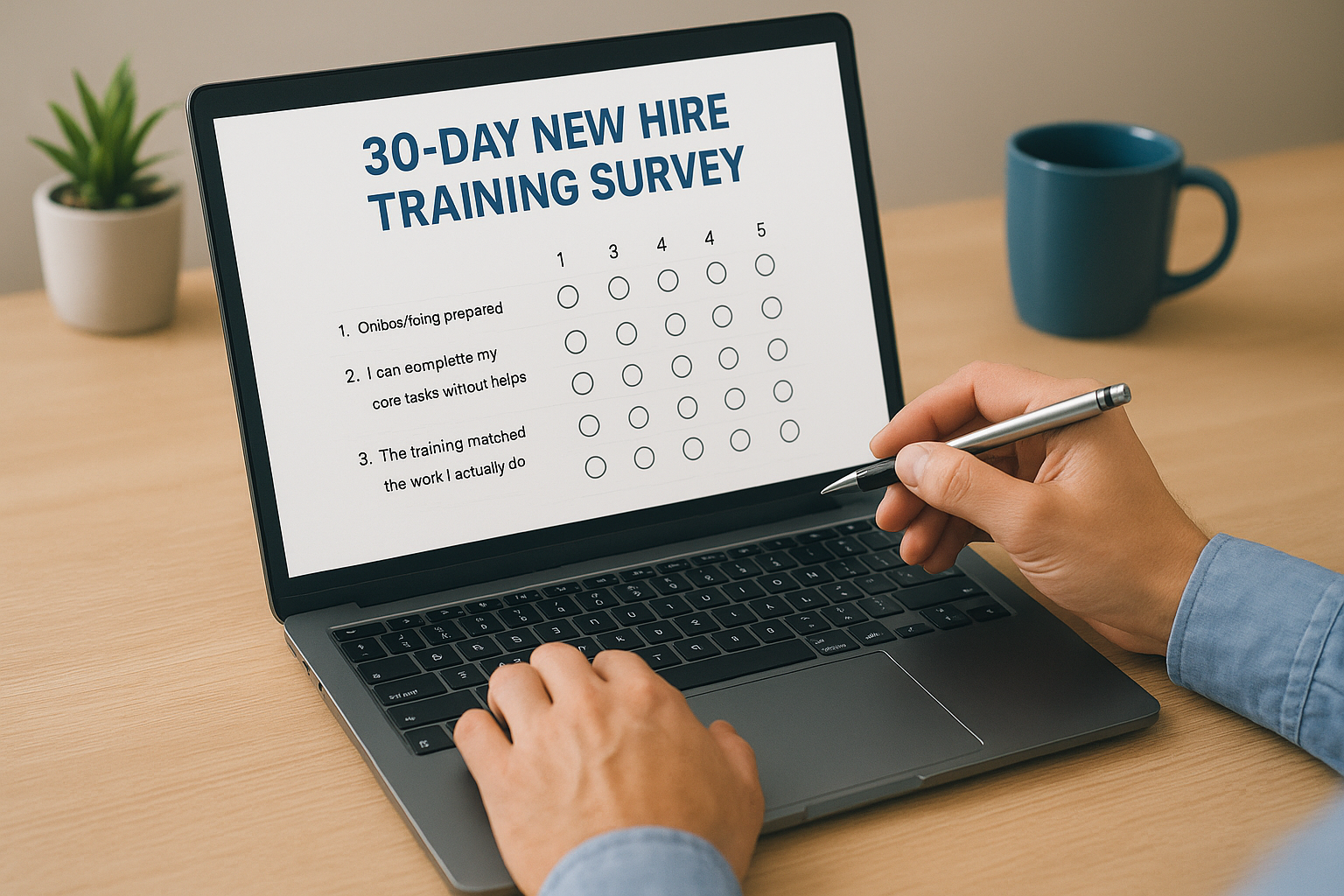
Schedule the survey for day 28 to 30, just before the manager’s formal 30-day review. That way the manager walks into the conversation with real data. Automate the send from each hire’s start date so it never depends on someone remembering, the same way you would when automating the rest of your online training.
Keep it to 10 minutes at most. By now hires can handle a little more depth than in week one.
What it measures
This new hire training survey is the first full read on the overall onboarding experience. It pulls together what the earlier surveys sampled in pieces:
- Overall satisfaction with onboarding
- Confidence doing core tasks without help
- Fit between training and the real work
- Early signs of whether they plan to stay and grow
Sample questions
Rate the first five on a 1 to 5 agreement scale and leave the last one open.
- Onboarding prepared me for the work I am doing now.
- I can complete my core tasks without constant help.
- The training matched the work I actually do.
- I have received useful feedback on my performance.
- I am glad I joined this company.
- If you ran onboarding, what would you change first?
How to act on the answers
Compare questions 1 and 2 against the same hire’s week-one scores. A flat or falling trend means onboarding stalled after the welcome phase, so look at the gap between week two and week four.
The 30-day survey tells you whether onboarding is working, not just whether it was pleasant.
Follow up on any score of 2 or lower within a week. Then share two or three changes you made because of the cohort’s answers. Hires who see their feedback used are far more likely to answer honestly at 60 and 90 days.
6. Manager and mentor support questions
When to send it
Ask at day 30 and again at day 60, and include the mentor question only if the hire has an assigned buddy. Manager support changes over time, so two data points show whether check-ins faded after the first few weeks.
What it measures
This part of a new hire training survey checks whether managers and mentors show up for the hire. Look at three things:
- Frequency and quality of check-ins
- Usefulness of the feedback received
- Whether the hire feels safe asking questions
Sample questions
Use a 1 to 5 agreement scale for the first five questions and leave the last one open.
- My manager checks in with me regularly.
- I get clear, useful feedback on my work.
- I feel comfortable asking my manager questions.
- My mentor or buddy helps me learn how things get done here.
- My manager supports my growth at this company.
- What is one thing your manager could do to support you better?
How to act on the answers
Segment results by manager, which is simple when managers have their own LMS accounts. Low scores that cluster under one manager point to a coaching gap, not an onboarding gap. Share those results privately and keep responses anonymous when a manager has fewer than five reports.
People leave managers, so measure the manager early.
Then give managers a simple fix: a 15-minute weekly one-on-one for the first 90 days with a shared agenda. If mentor scores run low, check the buddy’s workload before you blame the person.
7. Team integration and culture questions
When to send it
Include these in the day-30 survey and repeat them at day 60. Belonging builds slowly, so the second reading shows whether early friendliness became real connection. Remote hires deserve an extra check at week three, since they miss the hallway conversations that office hires pick up for free.
What it measures
This part of a new hire training survey checks whether people feel connected to the team and understand how things really work here. Look at three areas:
- Relationships with teammates beyond their manager
- Fit with team norms and company values
- Inclusion in meetings and decisions
Sample questions
Use a 1 to 5 agreement scale for the first five questions and leave the last one open.
- My teammates are friendly and helpful.
- I have someone at work I can talk to openly.
- I understand the unwritten rules of how our team works.
- My ideas are heard in meetings.
- The company values I was told about match what I see day to day.
- What would help you feel more part of the team?
How to act on the answers
A low score on question 2 means the hire is working in isolation. Pair them with a peer buddy outside their reporting line, and book two informal chats with colleagues from other teams within the next two weeks.
A new hire without one trusted colleague is already halfway out the door.
Question 5 deserves a hard look too. If hires keep saying the culture differs from the pitch, fix the recruiting message or the behavior behind it. Then ask remote and hybrid hires separately what is missing, because their answers often differ from on-site peers, much like adapting training frameworks for a deskless workforce.
8. 60-day skills and confidence questions
When to send it
Send this survey at day 56 to 60, ahead of the manager’s second check-in. The hire has now worked without a safety net for a month, so answers about skills rest on real tasks instead of guesses.
Pair it with a short skills check from the manager. Self-ratings plus manager ratings show where confidence and ability disagree.
What it measures
The 60-day part of a new hire training survey checks whether training has turned into job competence and real confidence, the goal behind any blueprint for getting new hires job-ready faster. Look at three areas:
- Skill level on core tasks
- Confidence solving problems alone
- Gaps that training has not filled yet
Sample questions
Rate the first five on a 1 to 5 agreement scale and leave the last one open. These new hire training survey questions ask about doing, not knowing.
- I can handle my core tasks without checking with others.
- I feel confident solving problems on my own.
- I know which skills I need to build next.
- Training prepared me for the difficult situations I face.
- I get to use my strengths in my work.
- Which skill do you wish onboarding had taught you?
How to act on the answers
Compare each hire’s self-rating with the manager’s view. High confidence with weak performance calls for coaching on standards. Low confidence with strong performance calls for recognition and reassurance.
Confidence lags competence, so check both before you decide a hire is struggling.
Then turn question 6 into a learning plan for that person. If several hires name the same gap, add a course for it to the onboarding track for the next cohort.
9. 90-day retention and growth questions
When to send it

Send this survey at day 85 to 90, before the formal 90-day review. The hire is no longer "new" in the eyes of the team, so this is the last onboarding survey and the first real retention check.
Keep the window open for one week. Managers are busy with reviews, so a reminder on day three of that week usually lifts response rates.
What it measures
This final new hire training survey checks whether the hire plans to stay and whether they can see a future here. Look at three areas:
- Intent to remain with the company
- Visible paths for growth and development
- Match between the job they were sold and the job they have
Sample questions
Rate the first five on a 1 to 5 agreement scale and leave the last one open.
- I see myself working here a year from now.
- I can see a path for growth at this company.
- My role is what I expected when I accepted the offer.
- I would recommend this company to a friend as a place to work.
- My manager and I have talked about my development goals.
- What would make you more likely to stay?
How to act on the answers
Treat a score of 2 or lower on question 1 as a flight risk, the kind that early retention micro-milestones are built to catch. Ask the manager to hold a stay conversation within a week. Hires who are already looking rarely change their minds on their own.
A 90-day survey is the cheapest early warning you have for turnover.
Then compare these scores with actual turnover at 6 and 12 months. After a few cohorts you will see which answer predicts exits at your company. Build an individual development plan for every hire, with one stretch goal and one course tied to it, the way you would when designing personalized training in your LMS.
10. Open-ended questions for honest feedback
When to send it
Add two or three open-ended prompts to every survey from week one through day 90. Rating scales show you where the problem is. Written answers tell you why it exists, which is why interactive feedback design is worth the effort.
Place them at the end, after the rating questions, so hires are warmed up. Mark them optional. Forced comments produce filler.
What it measures
Open questions surface problems you did not think to ask about. A rating scale only covers what you predicted, while free text catches the broken process, the unclear policy, and the small moment that made someone feel unwelcome.
- Specific stories behind low scores
- Ideas for improvement from the person who just lived the process
- What is already working and should stay
Sample questions
Use these in any new hire training survey, rotating two or three per round so the form stays short.
- What has been the most helpful part of onboarding so far?
- What has been the most confusing or frustrating part?
- What is one thing you wish someone had told you earlier?
- If you could change one thing about training, what would it be?
- What is one thing we should keep doing exactly as is?
- Is there anything else you want leadership to know?
How to act on the answers
Tag each comment by theme, such as training content, tools, manager, or culture, then count. Three mentions of the same issue across a cohort is enough to justify a fix.
Written comments tell you what to fix, so read every one.
Reply with a short "you said, we did" note. Keep responses anonymous where you can, since honest answers depend on safety, and hires stop writing once they see nothing changes.
11. Questions to ask training and onboarding stakeholders
When to send it
Run this survey after each cohort reaches day 90. Send it to the managers, mentors, trainers, and HR or IT staff who handled those hires. If you hire in small batches, a short quarterly pulse works just as well.
What it measures
New hires only see their own slice of onboarding. Stakeholders see the machinery behind it. This side of a new hire training survey checks workload, handoffs, and readiness:
- Whether managers had the time and tools to onboard well
- Whether HR, IT, and trainers passed work to each other cleanly
- Whether hires reached expected productivity on schedule
Sample questions
Rate the first five on a 1 to 5 agreement scale and leave the last one open. Use these new hire training survey questions alongside what the hires told you.
- I knew my responsibilities during this hire’s onboarding.
- I had enough time to support the new hire properly.
- I got the start date and role details early enough to prepare.
- Handoffs between HR, IT, and training ran smoothly.
- This hire reached expected productivity on schedule.
- What one change would make onboarding easier for you?
How to act on the answers
Place stakeholder scores next to hire scores for the same cohort. Where the two disagree, you have found a blind spot. Managers who rate onboarding highly while hires rate it low usually are not doing the work they think they are.
Hires show you the symptoms, and stakeholders show you the cause.
Then fix the process owner gaps first. If question 3 scores low, set a rule that managers get hire details at least two weeks before day one. If question 2 scores low, cut other duties for the people carrying the load, or onboarding quality will keep sliding.
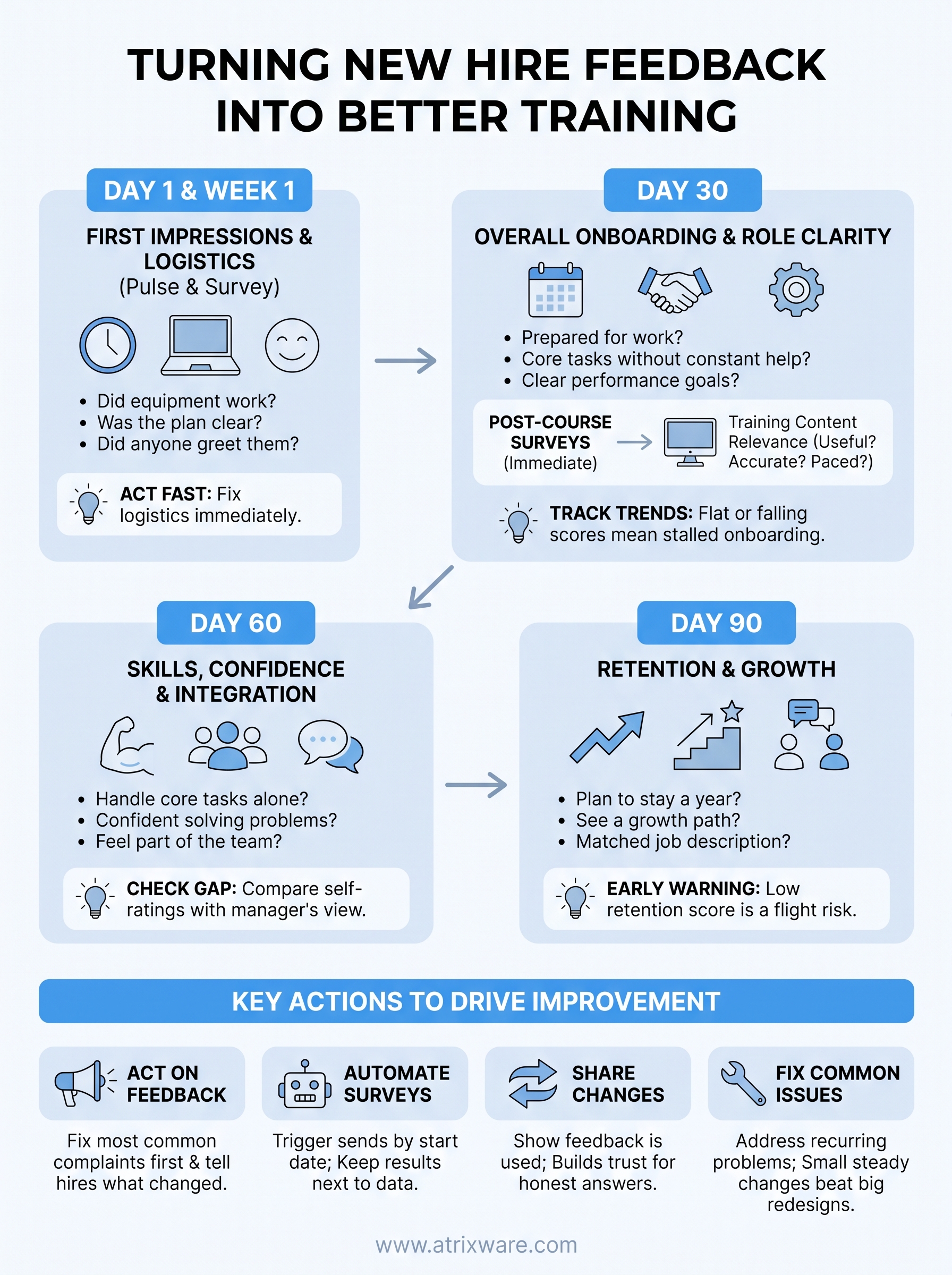
Turning new hire feedback into better training
A new hire training survey only pays off when you act on it. Send it at the end of week one and again at 30, 60, and 90 days, then fix the most common complaint first and tell hires what changed. That one habit builds the trust that makes every later answer more honest.
You do not need all eleven question sets on day one. Start with the week-one and 30-day surveys, add the rest as your process matures, and compare hire scores with stakeholder scores after each cohort. Small, steady changes beat a big redesign.
Manual surveys fade fast, though. If you want sends triggered by start date and results sitting next to course completion data, see how Axis LMS handles onboarding surveys in an admin demo.
