
New hire recipient rights training is the mandatory orientation that you must finish before you work with anyone who receives services through Michigan’s public mental health system. Your employer’s community mental health network delivers it through its Office of Recipient Rights (ORR). You complete it within 30 days of your hire date, pass a test, and receive a certificate as proof.
The course explains the rights people have under the Michigan Mental Health Code and what you must do to protect them. This article covers who has to take it, how to register and finish it live or online, what the test involves, and how annual updates keep your certification valid. Details such as session formats and registration steps vary by network, so confirm them with your own ORR.
Atrixware makes Axis LMS, a learning management system built for compliance training. That is why the last section looks at how employers keep new hires from missing the 30-day window.
Why new hire recipient rights training matters
This training matters because it is a condition of the job. You cannot work with people receiving public mental health services until you have completed it, and the certificate is how your employer proves you did.
Who has to take it
All employees of a community mental health network and its contracted providers must complete it before working with people who receive services. Direct support professionals, contracted agency staff, and, at some networks, board members are covered too. Your job title does not exempt you.

The training exists to protect the people you serve. You learn what their rights are, how to recognize a violation, and where to take a concern.
The 30-day deadline
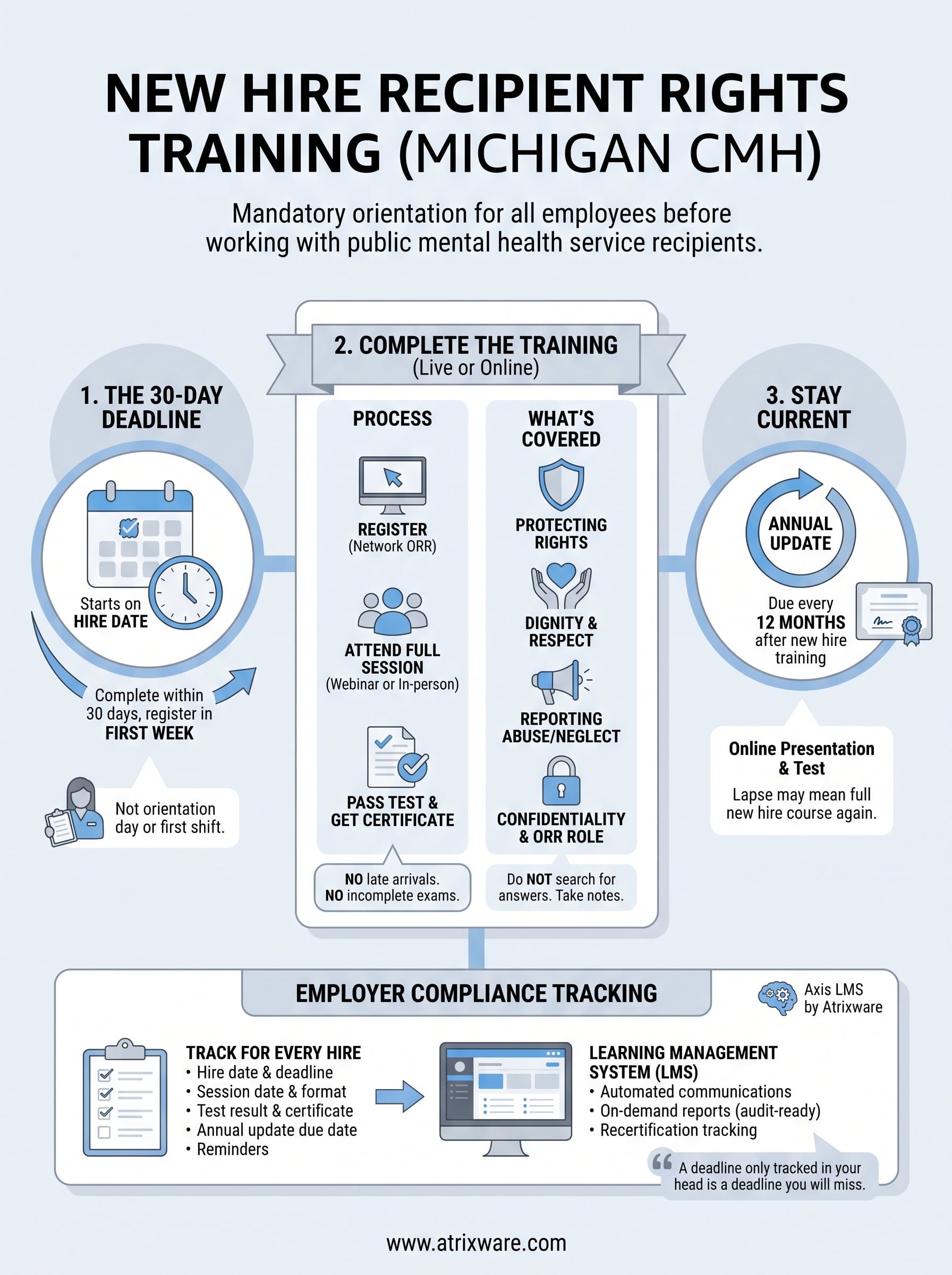
The clock starts on your hire date, not your first shift with a client or your orientation day. Some networks state the deadline is firm and enforced, so treat it that way.
Here is a worked example. You are hired on March 3. Your deadline is April 2. Sessions fill up, so you should register in your first week, not your last.
The 30-day deadline runs from your hire date, so register for a session in your first week.
How to complete new hire recipient rights training
You complete it by registering for a session through the network that oversees your employer, attending the full course, passing the test, and keeping your certificate. The sequence below works for most Michigan employers.
Step-by-step process
- Ask HR or your supervisor which community mental health network’s ORR trains your agency.
- Open that network’s training calendar and pick a new hire rights session dated before day 30.
- Register with your details ready. Networks commonly ask for your hire date, a driver’s license or state ID number, your email, and your employer’s name and contact information.
- Attend the entire session. Late arrivals may have to reschedule.
- Pass the test and download or collect your certificate, then give a copy to your employer.
Live webinar, in person, or online
Formats differ by network. Some run the training as a live webinar on Microsoft Teams, and some hold face-to-face classes. One network lists a three-hour in-person session on a first-come basis with no registration. Another welcomes walk-ins until the room is full but sends anyone more than 15 minutes late to another class.

You will also find self-paced courses online, including an introduction to recipient rights on the state-supported Improving MI Practices learning site. Do not assume such a course replaces your network’s new hire session. Ask your ORR whether it accepts a given course before you spend time or money on it. The same goes for searches for free online options: your employer needs a certificate its ORR will accept, and that is what counts.
Register through the network that oversees your employer, and confirm it will accept your certificate.
What the course covers and how to pass the test
The course teaches you the rights protected by the Michigan Mental Health Code, and the test checks that you understood them. At some networks the test is electronic and you bring a charged smartphone, laptop, or tablet. Your certificate depends on passing it.
What to expect in the session
Expect to learn how to recognize abuse and neglect, why dignity, respect, and confidentiality matter, and how rights complaints are reported and investigated. You also learn what the ORR does and how to reach it. The content is built for people who work with recipients every day, so examples tend to be practical.
How to pass without searching for answers
Many people search for test answers. Skip that. Questions and versions change, and incomplete or late exams are not accepted at some networks. Training you did not actually complete can cost you the certificate.
Instead, attend every minute, take notes on the rights and reporting steps, and ask the trainer when a scenario is unclear. If you fail, ask your ORR how retakes work. Those rules are set locally.
The best test prep is attending the whole session and taking notes on rights and reporting steps.
Annual updates and related rights trainings
After your new hire course, you take an annual update to keep your certification current. One network requires the update test to be passed within 12 months of the new hire training. The update is usually online: you review a presentation, then take the test.
Keeping your certification current
Using the earlier example, if you finish the new hire course on March 20, your first annual update is due by March 20 of the next year. Print or save the certificate each time. Networks differ on whether they accept updates after a lapse. At least one says annual updates are allowed only if your certification has not lapsed, so a missed deadline can mean sitting through the full new hire course again.
Which rights training applies to you
Several Michigan trainings share similar names. This table separates them.
| Training | Who takes it | Timing | Format |
|---|---|---|---|
| New hire rights training | Staff working with recipients | Within 30 days of hire | Live webinar or in person, with test |
| Annual rights update | Staff who completed new hire training | Within 12 months of the last one | Online presentation and test |
| Substance use disorder rights training | Substance use disorder providers | Set by your network and the state | Online course |
| Basic Skills Training, Parts I and II | Rights office staff only | Within 90 days of hire | Three-day sessions each |
Rights office staff follow a separate path. According to MDHHS, Basic Skills Training is not substance use rights training and is not the same as the new hire course.
New hire training starts your certification, and the annual update keeps it alive.
How employers keep new hires on schedule
Employers stay compliant by treating the hire date as a trigger and tracking every due date in one place. Spreadsheets work until someone leaves or a session fills up, and that is when deadlines slip.
What to track for every hire
Record these fields for each employee:
- Hire date and the calculated day-30 deadline
- Registered session date and format
- Test result and certificate on file
- Annual update due date, 12 months after the last training
- Reminder dates for the employee and the supervisor
Where a learning management system helps
The live new hire session belongs to your ORR, but tracking it does not have to. A learning management system like Axis LMS supports compliance training, re-certification tracking, automated communications, and on-demand reports. You can see who is approaching a deadline, send reminders automatically, and pull a report when an auditor asks.
Annual updates that your network allows you to deliver online fit neatly into the same system. Confirm with your ORR what your agency may deliver itself.
A deadline you only track in your head is a deadline you will eventually miss.
Finish early, then stay current
New hire recipient rights training is required, time-limited, and tied to your hire date. Register for a session in your first week, attend all of it, pass the test, and keep your certificate. Then calendar your annual update for 12 months out.
If you manage staff, the harder part is tracking dozens of due dates at once. If you are weighing a system for that, take this quick LMS readiness assessment to see where you are in the process.
