Picking a corporate training solution in 2026 is harder than it used to be. The market is crowded with platforms that all claim to boost engagement, simplify compliance, and integrate with everything you already run, but half of them buckle once you add a few thousand learners or need a custom certification path. If you’ve spent an afternoon comparing demos and still can’t tell which vendor actually fits your organization, you’re not alone.
This guide cuts through the noise. We evaluated corporate training solutions based on how well they handle real business needs: onboarding at scale, tracking Continuing Education Units, syncing with HR systems like BambooHR or ADP, and giving administrators enough branding control to make the platform feel like part of your company, not a bolted-on tool.
Below you’ll find nine platforms worth your consideration for 2026, including where each one excels and where it falls short. We built this list from the perspective of HR managers, compliance officers, and training leads who need reliable reporting and a system that won’t require a developer every time you want to change something. By the end, you’ll know which option matches your training goals and budget.
1. Axis LMS by Atrixware
Atrixware built Axis LMS for organizations that outgrow simple course-hosting tools but don’t want the complexity or price tag of enterprise-only platforms. It’s a full-featured system for delivering, tracking, and managing both online and virtual classroom training, and it’s the platform we know best since it’s our own. That said, we’re including it here because it genuinely competes with the bigger names on this list, especially for mid-market and growing companies that need compliance tracking and HR integrations without a six-figure implementation.

A corporate training solution should feel like part of your business, not a separate system your team has to work around.
Key features
Axis LMS covers the fundamentals administrators actually use every day, not just the features that look good in a sales demo.
- Drag-and-drop course builder for rapid content creation without developer help
- Automated and on-demand reporting to track learner progress and training effectiveness
- Compliance management tools built for standards like GDPR and FDA 21 CFR Part 11 electronic records
- CEU and re-certification tracking for regulated industries
- Deep branding customization so the learner-facing UI matches your company identity
- E-commerce functionality for selling online courses and seat licenses to external customers
Best for
Companies handling employee training, compliance training, and customer or channel training from a single platform tend to get the most value here. It suits HR managers and compliance officers who need audit-ready reporting, plus training teams that want to sell courses externally without buying a separate e-commerce tool. Because the interface stays intuitive for both learners and admins, it also works well for organizations without a dedicated LMS administrator on staff.
Integrations
Axis LMS connects to the systems most training teams already depend on. It syncs user data with HR and CRM platforms including ADP, Salesforce, BambooHR, and Zoho, and its LMS integration options extend to over 5,000 additional systems covering CRM, HR, email, and e-commerce. For teams needing custom connections, a REST API and webhooks support real-time event updates, and SSO works with SAML providers like Okta, Azure, and Ping Identity.
Pricing
Atrixware doesn’t publish flat pricing because deployments vary by learner count, hosting preference, and feature needs. You can request an Axis LMS admin demo to get a quote scaled to your organization, whether that’s a small team or a multi-department enterprise rollout.
2. Docebo
Docebo built its reputation on AI-driven learning, and it’s one of the more polished enterprise LMS platforms on the market. It targets larger organizations that need to manage learning across multiple departments, regions, or even external audiences like partners and customers, all from one system. The platform leans heavily on automation to cut down the manual work of assigning courses and generating reports.
Key features
Docebo’s standout feature is its AI-powered content curation, which recommends courses to learners based on role, activity, and skill gaps. It also includes:
- Social and collaborative learning tools for peer-driven content sharing
- Automated learning paths tied to skill assessments
- A robust content marketplace with pre-built courses from third-party providers
- Multi-language support for global teams
The right platform should reduce manual admin work, not just add more dashboards to check.
Best for
Docebo suits large enterprises with dedicated L&D teams and budgets to match. It works particularly well for companies running external training programs for partners or customers alongside internal employee development, since it separates audiences cleanly without requiring multiple logins or platforms.
Integrations
Docebo connects with major HR systems like Workday and SAP SuccessFactors, along with Salesforce for customer training use cases. It also offers a REST API for custom builds and supports SSO through standard SAML providers.
Pricing
Docebo doesn’t list public pricing. Quotes are custom and typically scale with active user counts, which can get expensive quickly for organizations with large, infrequent learner populations.
3. 360Learning
360Learning built its platform around collaborative learning, betting that employees learn faster from each other than from top-down course assignments. It’s a strong pick if your training culture already leans on subject-matter experts to create content, since the platform makes it easy for non-instructional designers to build and publish courses without a steep learning curve.
Key features
The platform’s core strength is peer-created content, supported by a co-authoring workflow that lets multiple contributors build a course together. Other notable features include:
- Skills-based learning paths that adapt to role and performance data
- Built-in course feedback loops so learners can flag outdated content
- AI-assisted course creation to speed up authoring
- Onboarding templates aimed at reducing new-hire ramp time
A training platform earns its keep when your own employees want to build content in it, not just consume it.
Best for
360Learning suits mid-size to large companies with a strong internal knowledge base and a culture of employee-led training, particularly in fast-growing tech and sales organizations that need to scale onboarding quickly. It’s less suited to companies that need heavy compliance tracking or CEU management, since those aren’t the platform’s focus.
Integrations
360Learning connects with common HR tools like BambooHR and Workday, along with Slack and Microsoft Teams for notifications inside existing workflows. It offers a REST API for custom integrations, though its integration library is smaller than what you’ll find with Docebo or Axis LMS.
Pricing
Pricing is quote-based and tied to active user counts, with published starting tiers for smaller teams but custom quotes required once you cross a few hundred users.
4. TalentLMS
TalentLMS positions itself as the easy button for teams that need training up fast without a long implementation cycle. It’s built by Epignosis, and the pitch is simple: get a course live in minutes, not weeks. That focus on speed makes it a favorite among smaller companies and teams that don’t have a dedicated LMS administrator watching over the system full time.
Key features
Speed is the whole point here, and the feature set backs that up with a gamification engine that adds points, badges, and levels to keep learners engaged without extra setup work.
- Pre-built course library covering compliance and soft-skills topics
- Bulk user import and automated course assignment
- Mobile app for offline course access
- Simple, template-driven course authoring tool
A corporate training solution only pays off if your team actually opens it, and TalentLMS is built to get people through the door fast.
Best for
Small to mid-size businesses looking for one of the more approachable training platforms for a small business on this list tend to land here first. It suits teams that need to launch onboarding or basic compliance training quickly, without a long procurement or setup process, though larger enterprises usually outgrow it once reporting and branding needs get more complex.
Integrations
TalentLMS connects with common tools like Slack, Zoom, and Salesforce, plus Zapier for lighter-weight custom connections. Its API exists but is less robust than what Docebo or Axis LMS offer for deep HR system syncing.
Pricing
Pricing starts with a free tier for up to five users, then scales through published tiers based on active user counts, making costs predictable for smaller teams.
5. Absorb LMS
Absorb LMS markets itself as an enterprise-grade platform with a strong focus on automation and reporting, aimed at organizations that need to run training at scale without adding headcount to the admin team. Founded well before the current wave of AI-branded LMS platforms, Absorb has built a reputation for reliability with mid-size to large companies, particularly in regulated industries like finance and healthcare where audit trails matter as much as course completion rates.
Key features
Absorb’s training automation with workflows and webhooks stands out, letting admins set triggers for enrollment, notifications, and certification renewals without manual follow-up.
- Customizable dashboards for tracking KPIs across departments
- AI-powered course tagging and search
- Built-in e-commerce for external course sales
- Absorb Create, a companion authoring tool for building content directly in the platform
The best corporate training solutions handle repetitive admin work automatically, freeing your team to focus on content quality instead of chasing overdue certifications.
Best for
Organizations running compliance-heavy training programs at scale tend to get the most from Absorb, especially those in finance, healthcare, or manufacturing where recertification deadlines carry real regulatory weight. It also suits companies that want to sell training externally, since the built-in e-commerce tools remove the need for a separate storefront.
Integrations
Absorb connects with Salesforce, Microsoft Teams, and major HRIS platforms like Workday, along with Zoom for virtual classroom sessions. Its API supports custom builds, and SSO works through standard SAML providers.
Pricing
Pricing is quote-based and scales with active user counts and feature tier, with implementation costs that can run higher than lighter platforms on this list due to the setup involved in configuring automation rules.
6. Litmos
Litmos, now part of SAP, built its name on being one of the fastest platforms to deploy for companies that need training live within days, not months. It’s a cloud-based LMS aimed at mid-size and large organizations that want a straightforward system without heavy customization overhead, and it’s especially common in sales training and customer education programs where speed to launch matters more than deep configuration options.
Key features
Litmos leans on its content library partnerships, giving admins access to thousands of off-the-shelf courses covering compliance, leadership, and technical skills without building anything from scratch.
- Video-based course authoring with built-in screen recording
- Automated compliance reminders and certification tracking
- Gamification with leaderboards and badges
- Salesforce-native training modules for customer-facing teams
Fast deployment only matters if the platform can still handle your compliance reporting once training goes live.
Best for
Sales-driven organizations and companies running customer training programs tend to get the most out of Litmos, particularly those already invested in the SAP or Salesforce ecosystem. Mid-size businesses that want a functional corporate training solution without a long implementation cycle also fit well here, though enterprises with complex branding needs often find the customization options limited.
Integrations
Litmos integrates tightly with Salesforce and SAP SuccessFactors, reflecting its ownership structure, along with Zoom and Microsoft Teams for virtual sessions. Its API supports custom connections, though the integration library is narrower than what Docebo or Axis LMS offer.
Pricing
Pricing is quote-based and tied to user count and module selection, with costs that can climb once you add premium content library access on top of the base platform.
7. Articulate 360
Articulate 360 isn’t a full LMS, it’s an authoring toolkit that pairs with whatever learning management system you already run, including Axis LMS. Instructional designers have relied on Articulate’s tools for years to build interactive courses, and the 360 subscription bundles everything into one package instead of selling each app separately. If your team already has a place to host and track training but needs better tools for actually building it, this fills that gap.

Key features
The suite centers on Storyline 360 and Rise 360, two course-building apps with very different workflows aimed at different skill levels.
- Storyline 360 for fully custom, interactive course design
- Rise 360 courses in Axis LMS for fast, responsive course creation using pre-built blocks
- A content library with templates, stock photos, and video assets
- Review 360 for collecting stakeholder feedback during development
A corporate training solution is only as good as the courses inside it, and Articulate exists to make those courses better.
Best for
Instructional design teams and training departments that already own an LMS but need stronger authoring tools get the most value here. It suits organizations producing a high volume of custom courses internally, rather than companies looking for a system to track learners or manage compliance reporting.
Integrations
Articulate 360 exports courses in SCORM, xAPI, and cmi5 formats, making it compatible with nearly any LMS on the market, Axis LMS included. It doesn’t offer HR or CRM integrations since it’s not built to manage learner data.
Pricing
Articulate 360 runs on an annual subscription per author seat, published on their site, with team plans available for multiple content creators.
8. Udemy Business
Udemy Business flips the usual corporate training solution model on its head by giving employees access to a massive, pre-built course catalog instead of asking your team to create content from scratch. It works well for companies that need broad skills coverage across technical, creative, and business topics without hiring instructional designers or licensing separate content libraries. Rather than functioning as a traditional LMS with deep administrative controls, it leans on curated marketplace content taught by outside instructors.
Key features
Udemy’s biggest draw is its course catalog, which spans thousands of titles across software development, leadership, data analysis, and dozens of other subjects.
- Role-based learning collections curated for specific job functions
- Skills assessments to identify gaps before assigning courses
- Analytics dashboard tracking completion and engagement by team
- Option to publish internal courses alongside the public catalog
A course catalog only helps if it points employees toward skills your business actually needs, not just whatever’s trending.
Best for
Companies prioritizing broad skills development over compliance tracking or CEU management tend to fit best here, especially fast-growing tech companies that need to close employee skills gaps quickly without building a content library. It’s less suited to organizations needing tight regulatory compliance features or deep branding control, since Udemy’s strength lies in content breadth rather than administrative depth.
Integrations
Udemy Business connects with common HR and talent systems like Workday and SAP SuccessFactors, along with Slack and Microsoft Teams for notifications. Its API allows for reporting exports and basic user provisioning, though it doesn’t match the integration depth of platforms built primarily around HR data synchronization.
Pricing
Pricing runs on a per-user annual license, with team and enterprise tiers based on catalog access and reporting features, published in general ranges on Udemy’s site but finalized through a custom quote for larger teams.
9. Skillsoft
Skillsoft has spent decades building content libraries for large enterprises, and its Percipio platform packages that content with a modern learning experience layer. It’s aimed at organizations that need leadership development, compliance, and technical skills training under one contract, often replacing several smaller vendors at once. Government agencies and Fortune 500 companies make up a large share of its customer base, which shapes how the platform prioritizes security and scale over flexibility.

Key features
Skillsoft’s depth comes from its Percipio content engine, which curates courses, books, and video into role-based learning journeys instead of a flat catalog.
- Leadership and business skills library built by in-house experts
- Technology and developer training tracks with hands-on labs
- Compliance courses mapped to specific regulations and industries
- AI-driven skill benchmarking to identify team-wide gaps
A corporate training solution built around content breadth only works if the courses stay current, and Skillsoft leans on its own authoring teams to keep pace.
Best for
Large enterprises and government organizations needing a single vendor for leadership, trackable compliance training, and technical training tend to get the most from Skillsoft. It suits companies replacing multiple point solutions with one contract, though smaller teams often find the platform heavier than they need.
Integrations
Skillsoft connects with major HR platforms like Workday and SAP SuccessFactors, along with SSO support through standard SAML providers. Its API allows for reporting and provisioning, though custom integration work typically requires vendor involvement rather than self-service setup.
Pricing
Pricing is quote-based and scales with seat count and content library access, with enterprise agreements often negotiated over multi-year terms rather than month-to-month billing.
10. How to choose the right corporate training solution
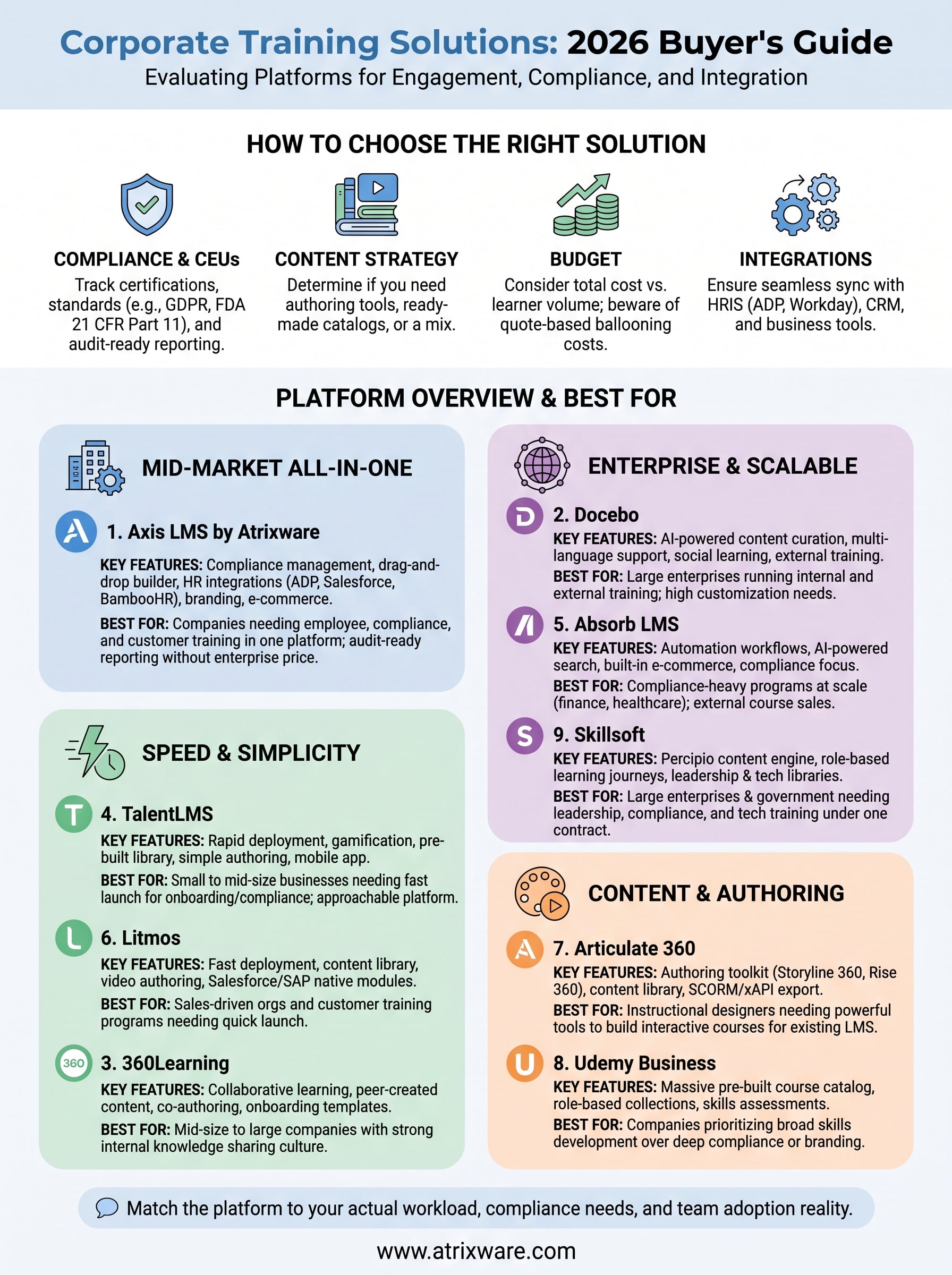
Matching a platform to your organization comes down to a handful of practical questions, not feature checklists, and a step-by-step LMS comparison process gets you there faster. Start with your compliance burden: if you’re tracking CEUs, certifications, or standards like GDPR and FDA 21 CFR Part 11, you need a compliance-ready training platform with reporting built for audits, not bolted on after the fact. Next, look at your content strategy. Some teams need an authoring powerhouse like Articulate 360, others need a ready-made catalog like Udemy Business or Skillsoft, and many need a system flexible enough to do both, which is where a platform like Axis LMS earns its place.
Budget shapes the decision too, but not in the way most buyers expect. Quote-based pricing from Docebo, Litmos, or Skillsoft can look attractive upfront, then balloon once you add active users or premium content tiers. Compare total cost against your actual learner volume, not the number in a sales deck, and account for the full cost of implementing an LMS.
The right corporate training solution isn’t the one with the most features, it’s the one your team will actually use every day.
Finally, weigh integration depth against what your business systems demand. A company running payroll through ADP and sales through Salesforce needs a platform that syncs cleanly with both, without custom development for basic HR data flow. Here’s a quick checklist to run through before signing anything:
- Does it handle your specific compliance and CEU tracking needs?
- Can non-technical staff build and update courses?
- Does pricing stay predictable as your user count grows?
- Does it integrate with your existing HR and CRM tools out of the box?
- Will learners actually want to log in, or will adoption stall after week one?
Choosing the right fit for your team
No single platform on this list wins every category, and that’s the point. A corporate training solution built for compliance-heavy enterprises like Skillsoft won’t suit a fast-growing sales team better served by Litmos, and a pure authoring tool like Articulate 360 still needs a real LMS behind it to track results. What matters is matching the platform to your actual workload: your compliance obligations, your HR integrations, and whether your team will actually log in once the novelty wears off.
If you’re weighing options and want a platform that handles compliance tracking, branding, and HR integrations without enterprise pricing, Axis LMS was built for exactly that gap. Rather than guess where you land, take the quiz to see if you’re ready for an LMS and find out how close you are to a confident decision, and where your training program still needs work before you sign anything.
