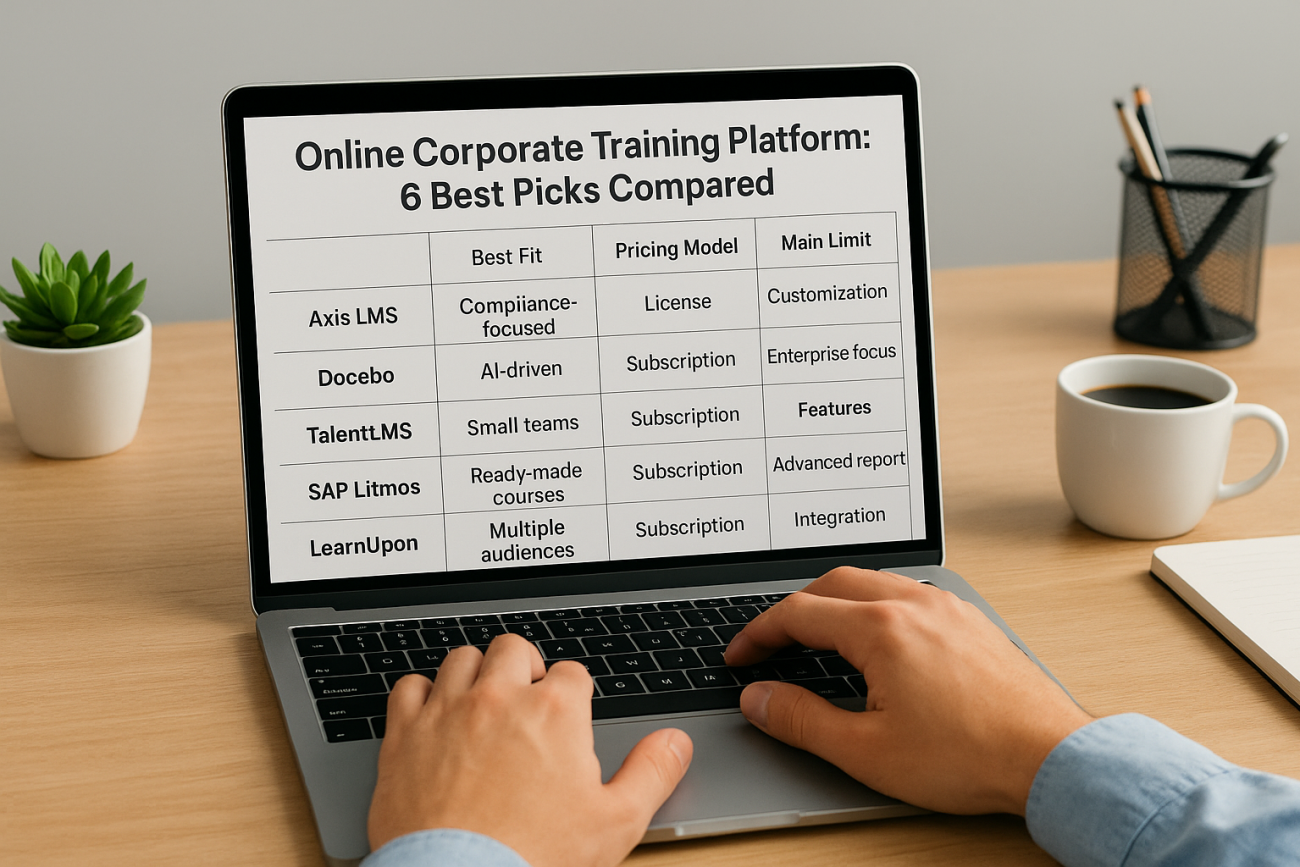
The best online corporate training platform depends on who you train and how much admin time you can spare. Axis LMS fits teams that need branding, compliance tracking, integrations, and the option to sell training. Docebo suits large enterprises that want AI-driven recommendations. TalentLMS suits small and mid-sized teams that want fast, affordable setup. SAP Litmos suits teams that want ready-made courses. LearnUpon and Absorb LMS suit teams that train several audiences from one account.
Choosing among online corporate training platforms is hard because every vendor promises the same things: easy, scalable, engaging. Pricing is often hidden, and the real limits show up only after you sign. This article compares six platforms on what they do, who they suit, and what they cost or lack, so you can build a short list without opening ten more tabs.
Full disclosure: Atrixware makes Axis LMS, and it is listed first. I applied the same criteria to every platform, including the limits of our own. Pricing changes often, so confirm current numbers with each vendor before you decide.
1. Axis LMS by Atrixware
Key features
Axis LMS is a learning management system built to deliver, track, and manage online and virtual training for employees, customers, and partners. Admins build courses with a drag-and-drop interface, assign them, and run on-demand or automated reports on learner progress. It covers more than basic course hosting:

- Compliance tools for GDPR and FDA 21 CFR Part 11 training, plus tracking for continuing education units (CEUs) and re-certifications
- User data sync with systems such as ADP, Salesforce, BambooHR, and Zoho, plus an integration builder that reaches more than 5,000 systems
- A REST API, webhooks, and SAML single sign-on with providers like Okta, Azure, and Ping Identity
- Extensive branding controls for the learner interface
- E-commerce for selling courses to individuals and seat licenses to business buyers
Axis LMS puts compliance tracking, integrations, and course sales in one system with a simple interface.
Who it suits
If you want an online corporate training platform that handles several kinds of training at once, this is the profile. Think employee onboarding, customer education, channel partner training, and compliance, all in one place. HR managers and compliance officers get a clear admin experience, and IT gets the API and SSO.
It also fits teams that want to turn training into revenue. The seat-license model supports B2B sales, not just single-learner purchases.
Pricing and limitations
Atrixware tailors Axis LMS to your needs, so request a quote through the Axis LMS admin demo and bring your learner count and use cases. Ask for the learner-side view too.
Axis LMS is built to deliver your own training content. If your main need is a large catalog of ready-made courses, SAP Litmos is the closer fit.
2. Docebo
Key features
Docebo is an enterprise-focused LMS best known for AI-driven learning recommendations. Its engine suggests content based on a learner’s role and activity history, which saves admins from hand-assigning everything. Strong analytics show where learners stall.
- AI-based content and learning path suggestions
- Social learning tools so employees can share knowledge across locations
- Detailed reporting on learner progress
Docebo earns its place when personalization at scale matters more than simple setup.
Who it suits
Docebo suits global companies with distributed teams and a dedicated learning function. If you want a corporate online training platform that adapts to each employee without constant admin work, it delivers.
A team of 50 people with a handful of courses will likely not use most of it.
Pricing and limitations
Pricing is quote-based and typically tied to active users, so cost follows how many people actually learn each month. That can help or hurt depending on your usage pattern.
The tradeoff is weight. Expect a longer implementation and more configuration than lighter tools, so budget time as well as money.
3. TalentLMS
Key features
TalentLMS is a cloud LMS known for speed and simplicity. Admins can launch a course library quickly, and learners rarely need instructions. It supports blended learning and integrates with Zoom and Microsoft Teams, which helps hybrid teams.
- An intuitive interface for admins and learners
- Live session support through video tools
- Transparent, published pricing tiers
TalentLMS wins on time to launch, not on depth of customization.
Who it suits
It suits small and mid-sized businesses that need an online corporate training platform running within days and have no full-time LMS administrator. Onboarding, safety refreshers, and basic compliance courses are a natural match.
Teams that expect to grow into complex reporting or custom integrations should test those needs early.
Pricing and limitations
Plans are priced by user count, with paid tiers starting around $69 per month and a free option for very small teams. Check the vendor’s current plan page, since tiers shift.
The main limit is customization. Large enterprises with specialized workflows may find it less flexible than platforms built for complex setups.
4. SAP Litmos
Key features
SAP Litmos is the pick when you want content on day one. It ships with an extensive library of ready-to-use courses covering general compliance, sales, and leadership. It is known for fast deployment and easy navigation.
- Off-the-shelf course catalog
- Gamification such as leaderboards and badges
- Quick rollout with minimal configuration
Litmos trades custom depth for speed, which is the right trade when you have no content yet.
Who it suits
Litmos suits organizations that need to train people this quarter and lack the staff to build courses from scratch. It works well for standard topics like harassment prevention or workplace safety, where generic material is acceptable.
If your training teaches your own products and procedures, you will still build custom content.
Pricing and limitations
Pricing is quote-based, so expect a sales conversation. Ask whether the content library is included or priced separately, because that changes the total cost.
Ready-made courses are generic by nature, and personalization features are lighter than in AI-focused platforms. Review a few sample courses before you buy.
5. LearnUpon
Key features
LearnUpon stands out for automation and ease of use. A clean interface streamlines onboarding, reporting runs automatically, and multi-portal access lets different learner groups see their own branded space.
- Automated enrollment and reporting
- Separate portals for employees, customers, or partners
- Straightforward analytics for admins
LearnUpon removes admin busywork, which is where small L&D teams lose the most time.
Who it suits
It suits teams that value workflow automation and a tidy admin experience over feature breadth. A small L&D group serving employees plus customers can run an online corporate training platform like this without a dedicated administrator.
It minimizes setup time, which matters if you are replacing spreadsheets.
Pricing and limitations
Pricing is quote-based, so request figures early and confirm what is included in each tier.
The platform is built around portals and automation. A team with one audience and a few courses may never use much of that, and a simpler tool could cost less.
6. Absorb LMS
Key features
Absorb LMS is designed for organizations that train multiple audiences: employees, customers, and partners. Its multi-portal feature creates branded learning environments for each group, with centralized analytics across all of them.
- Multiple branded portals under one account
- Built-in e-commerce for selling content
- Centralized reporting across audiences
Absorb is strongest when training is a product or a channel program, not just an HR task.
Who it suits
It suits companies running extended enterprise training, such as partner certification or paid customer courses. If your corporate online training platform must also bring in revenue, this is a serious option.
Internal-only training teams rarely need this much structure.
Pricing and limitations
Pricing is quote-based. Expect pricing and implementation to reflect a larger program.
The platform is aimed at scalable, multi-audience setups, so smaller teams may pay for capacity they do not use. Compare it against Axis LMS and LearnUpon if you sell or share training externally.
How to choose between these platforms
Side-by-side comparison
Start with your audience, then check pricing model and the main limit. This table sets the six platforms side by side. Treat it as a screening tool, not a verdict, because fit matters more than features.
| Platform | Best for | Pricing model | Main limit |
|---|---|---|---|
| Axis LMS | Multi-purpose training, compliance, selling training | Tailored quote | Built for your own content, not a big course catalog |
| Docebo | Large enterprises wanting AI recommendations | Quote, tied to active users | Heavy for small teams |
| TalentLMS | Small and mid-sized businesses, fast launch | Published tiers, from about $69/month | Less customizable for complex needs |
| SAP Litmos | Ready-made compliance and sales content | Quote-based | Generic content, lighter personalization |
| LearnUpon | Automation and multiple portals | Quote-based | Unused features for one audience |
| Absorb LMS | Extended enterprise and paid training | Quote-based | Aimed at larger programs |
Questions to ask in every demo
Ask each vendor the same questions so the answers are comparable:
- Which audiences will you train: employees, customers, partners, or all three?
- Which systems must it sync with, such as your HR platform or CRM?
- Do you need audit trails for regulations or certifications?
- Will you sell courses, and to whom?
- Who builds content, and how often does it change?
Run a pilot before you commit
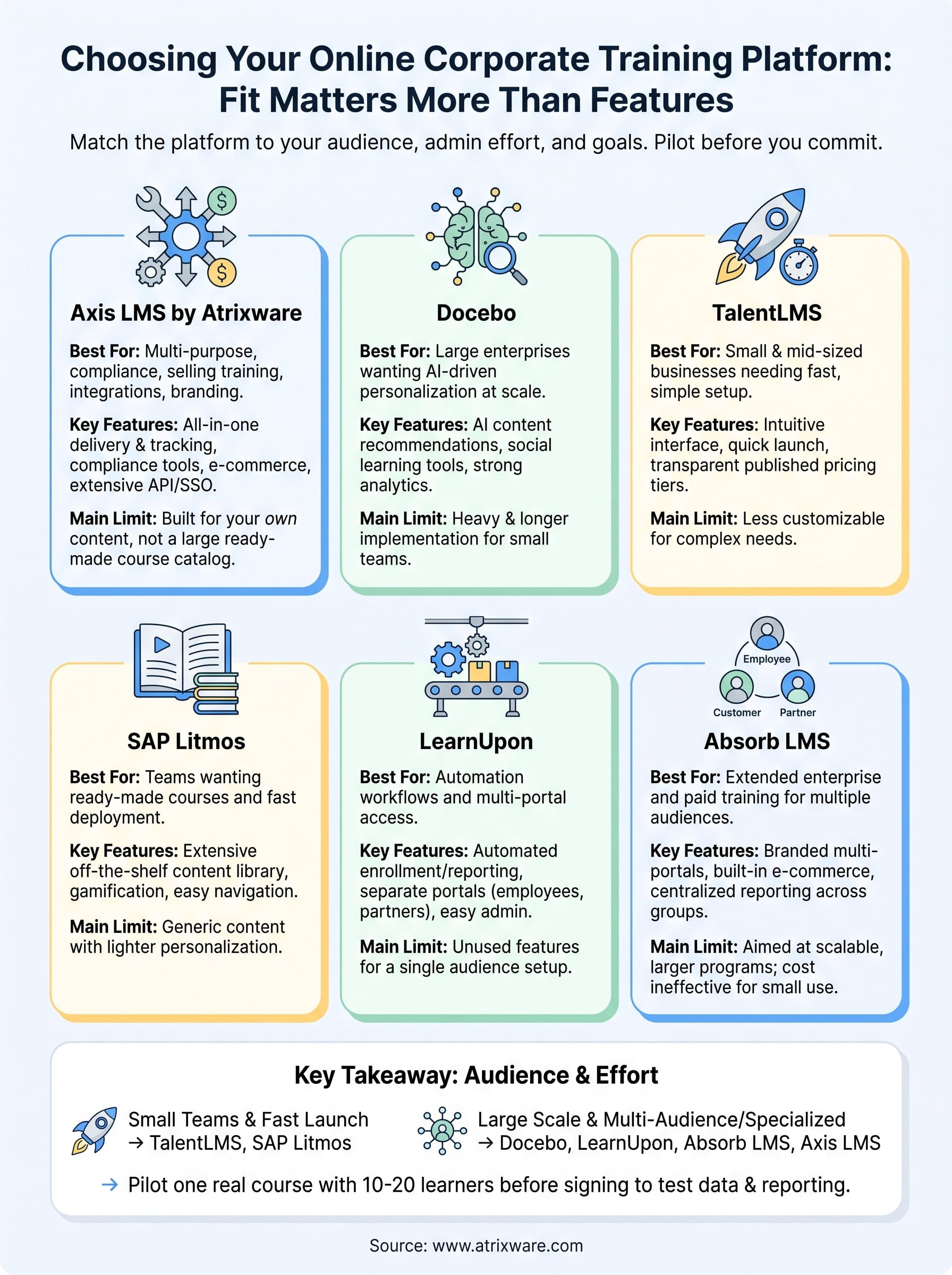
Before you sign with any online corporate training platform, pilot one real course with 10 to 20 learners. Test single sign-on, pull a completion report, and ask what a data export looks like. A vendor that cannot show those three things in a trial will not improve after the contract.
Picking your platform
The right choice comes down to audience and effort. TalentLMS and SAP Litmos get small teams moving quickly, Docebo rewards large organizations that want AI personalization, and LearnUpon and Absorb LMS handle multiple audiences. Axis LMS is the pick when compliance, integrations, branding, and selling training all matter in one system.
Shortlist two or three, ask the same demo questions, and pilot before you sign. If you are not sure how far along your buying process is, take the LMS readiness quiz and see which stage you are at before you book any demos.
