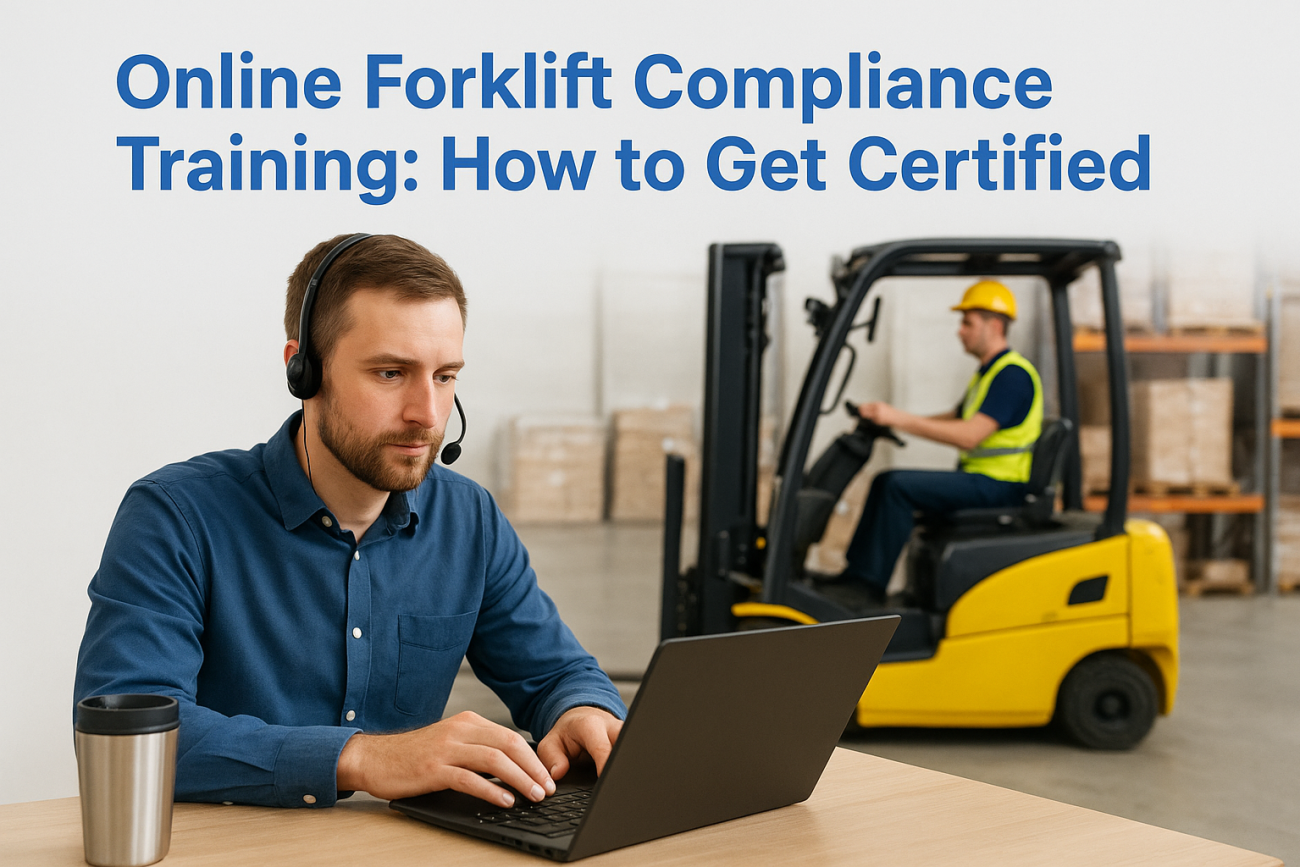
Searching for compliance training online forklift courses turns up dozens of providers, but the route that satisfies OSHA has three parts. Finish an online course for the classroom instruction, complete hands-on practice on the truck you will use, and pass a workplace evaluation by a qualified person. The online part takes about one to four hours. The other two happen at your worksite, and your employer signs the final certification.
This is where most people get stuck. Many sites advertise "100% online forklift certification" with an instant wallet card, which suggests you are done after a quiz. OSHA’s powered industrial truck standard, 29 CFR 1910.178, says otherwise. An employer who accepts only a printed card can fail an inspection, and an operator who pays for that card can still be turned away on day one.
This guide shows you how to choose a legitimate course, finish it, complete the practical evaluation, and keep records that hold up. At Atrixware, we build Axis LMS, a learning management system that organizations use to deliver and track compliance training. So we also cover how employers handle forklift training for a whole crew.
What online forklift certification really covers
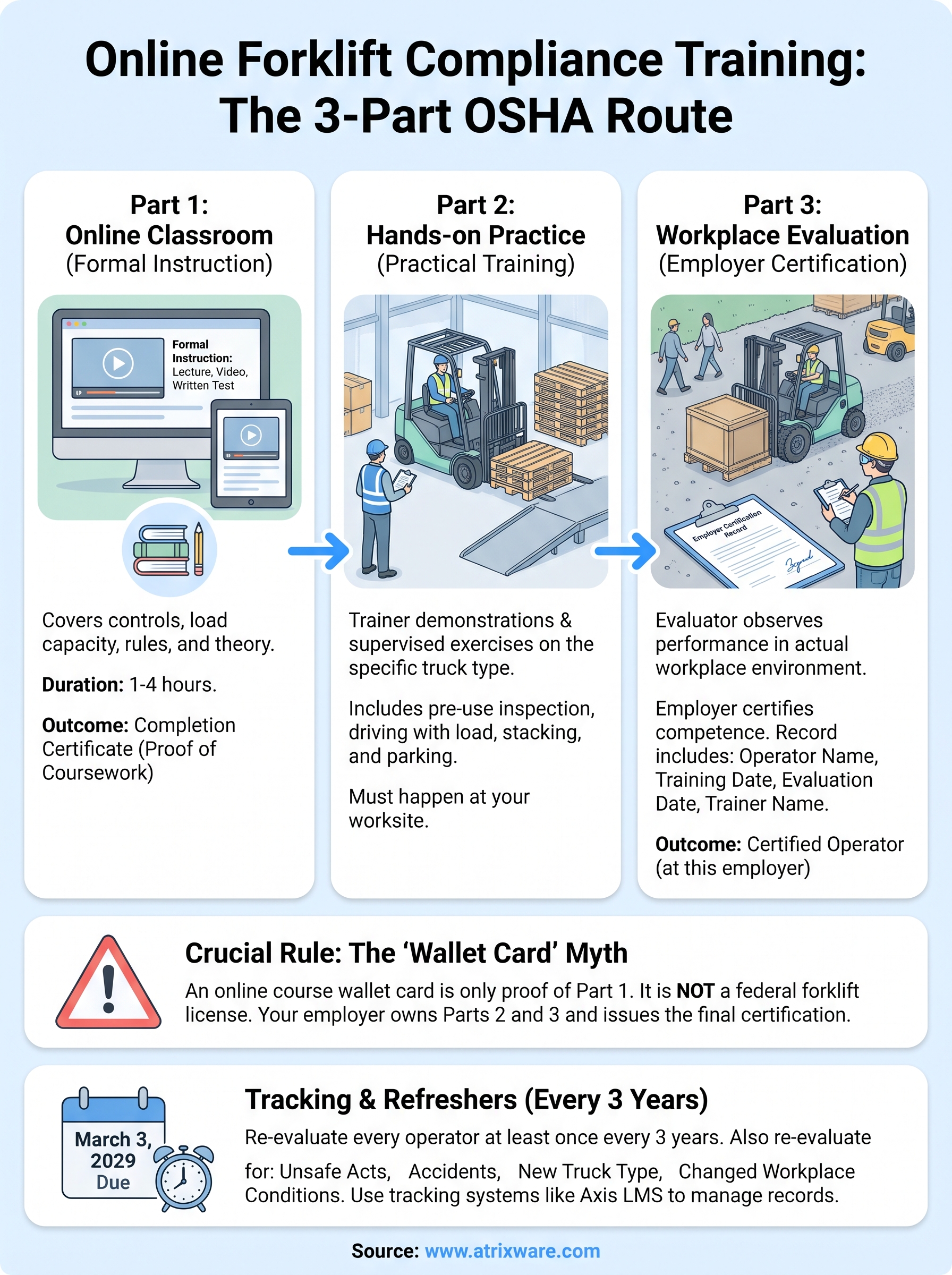
Online forklift training covers only the classroom portion of what OSHA requires, so a course alone never makes you fully certified. The standard at 29 CFR 1910.178(l) splits operator training into three parts, and only the first can happen on a screen.

The three parts OSHA requires
| Part | What it involves | Can it be online? |
|---|---|---|
| Formal instruction | Lecture, video, written test | Yes |
| Practical training | Trainer demonstrations and supervised exercises on the truck | No |
| Evaluation | Observation of your performance in the workplace | No |
The employer then certifies that you were trained and evaluated. The record must include the operator’s name, the training date, the evaluation date, and the identity of the trainer or evaluator. Nothing in the rule creates a federal forklift license, so a wallet card from a website is proof of coursework, not a license.
An online course covers one of OSHA’s three required parts, and your employer owns the other two.
Who needs it and whether a new employer accepts it
Anyone who operates a powered industrial truck needs training, from Class I electric riders to Class VII rough terrain trucks. Federal child labor rules also generally bar workers under 18 from operating forklifts.
Most companies accept an online course as the classroom part. A new employer must still evaluate you on its own trucks and in its own workplace. Earlier training can shorten what gets repeated if you were found competent, but it never replaces that evaluation.
Step 1. Pick an OSHA-aligned online course
Pick a course that teaches the topics listed in 1910.178(l)(3), matches your truck class, and states plainly that your employer must complete the hands-on evaluation. Those three checks filter out most of the weak options.
Check what the course must teach
The standard lists truck-related and workplace-related topics. Before you pay, confirm the course outline includes:
- Controls, instruments, and differences from driving a car
- Load capacity, stability, and the data plate
- Pre-use inspection, refueling, and battery charging
- Surface conditions, ramps, and narrow aisles
- Stacking, load handling, and pedestrian traffic
- Hazardous locations and closed environments
Also confirm the truck class (I through VII) and your industry. Construction sites fall under separate rules, so look for a course that says it covers yours.
Compare length, price, and red flags
Providers advertise courses from under 1 hour to 4 hours, and single-operator prices start around $60. Free courses and practice tests exist. They help you study, but check whether the test and completion record are free before you rely on one.
| Advertised length | Best fit |
|---|---|
| Under 1 hour | Experienced operators who need a refresher |
| About 2 hours | New operators on common truck types |
| 4 hours | Warehouse or construction crews that want more depth |
Walk away from any course that promises a "federal forklift license," skips the hands-on requirement, or hides its outline.
A course that promises a forklift license or ignores the hands-on requirement sells a card, not compliance.
Step 2. Complete the course and pass the test
Register under your legal name, work through every module in order, and pass the final test. Then save the completion certificate right away, because your employer needs it to start the practical stage.
Work through the modules
- Register with the name your employer will use on its records.
- Use a desktop or tablet where you can watch video comfortably.
- Write down the stability triangle, load center, and data plate basics.
- Check the retake policy before you start the final test.
- Download the certificate as a PDF and print the wallet card.
Take notes on your own equipment as you go. Jot down your truck class, its rated capacity, and the aisle widths where you will drive, so the lessons connect to your worksite.
Hand the proof to your employer
Give the certificate to your supervisor or safety manager. It documents the formal instruction, and it shows the trainer that you are ready for practical training. It does not make you an authorized operator yet.
Save the completion certificate the moment you pass, since it proves the classroom part is done.
Step 3. Finish hands-on training and evaluation
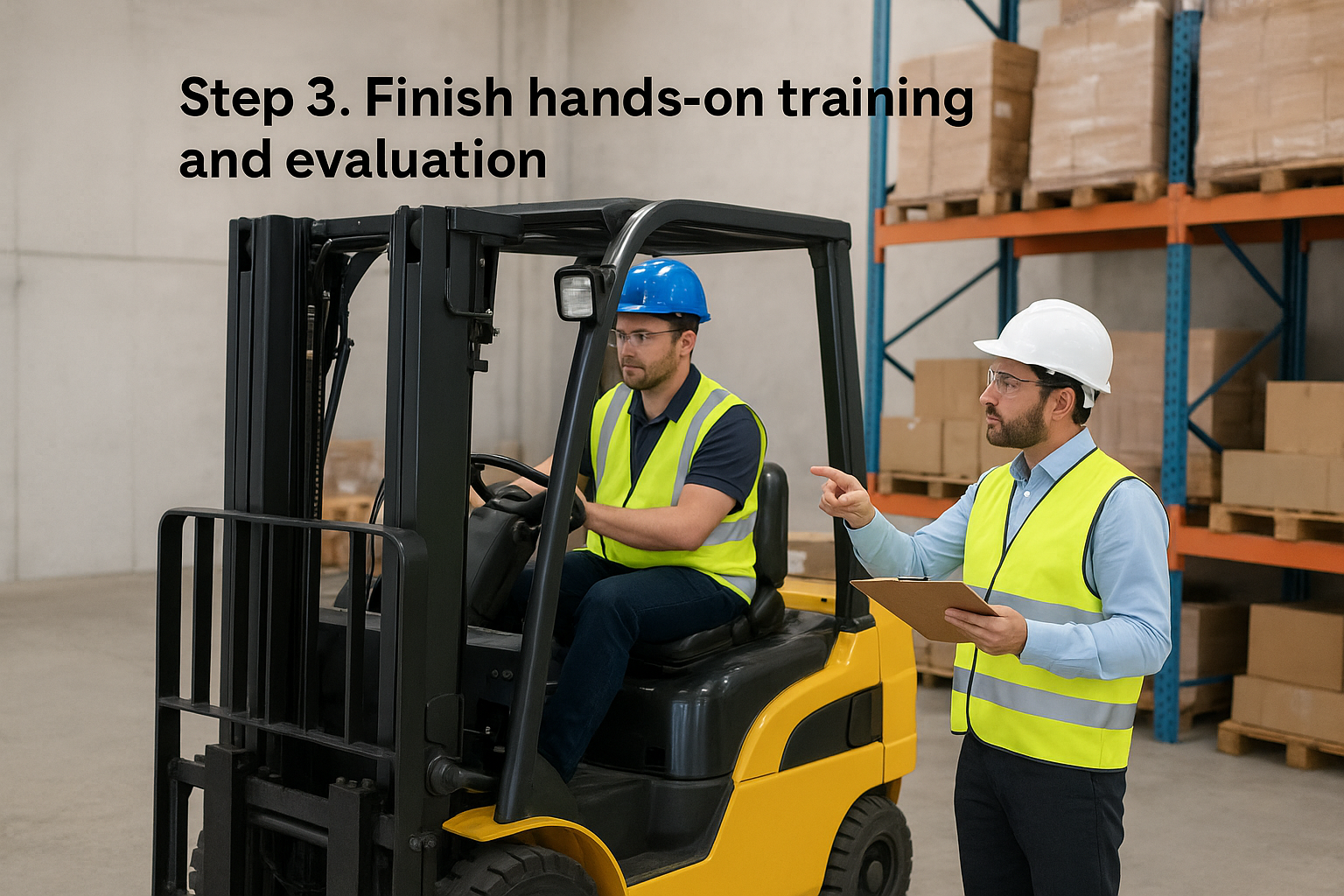
Practical training and the workplace evaluation turn a course completion into real certification. A trainer with the knowledge and experience to train operators and judge their competence must run both, on the truck type you will actually drive.
Arrange practical training on your own truck
Ask your employer to schedule a trainer who demonstrates each task while you practice under direct supervision. A solid session covers:
- Pre-use inspection of forks, chains, tires, horn, brakes, and steering
- Travel with and without a load, with forks kept low
- Turning in narrow aisles and driving on ramps
- Picking up, stacking, and placing loads at height
- Parking, setting the brake, and lowering the forks
- Refueling or battery charging procedures
Practice with loads that match your real work. A trainer who only watches you drive an empty truck around a lot is not covering the standard.
Get evaluated and certified
The evaluator watches you work in your actual environment, including the pedestrians, racking, and floor conditions you face daily. If you perform safely, your employer completes the certification record with your name, both dates, and the trainer’s name. Keep a copy of that record, because it is the document that proves you are certified at this employer.
Certification happens when your employer signs the record, not when a website prints a card.
Step 4. Track records and schedule refreshers
Re-evaluate every operator at least once every three years, and sooner when something changes. Missed refreshers are one of the easiest compliance gaps to avoid with a simple tracking system.
Know when retraining is due
An operator evaluated on March 3, 2026 must be re-evaluated by March 3, 2029. Refresher training plus a new evaluation is also required when:
- You are seen operating the truck unsafely
- You are in an accident or near miss
- An evaluation shows you are not operating safely
- You are assigned a different type of truck
- A workplace condition changes how safely you can operate
Keep records for a whole crew
A spreadsheet works for five operators. Past that, due dates and lost certificates become the main risk. A learning management system can deliver the online course, track completions, and generate reports. Axis LMS tracks re-certifications and runs on-demand and automated reports. You then pair that data with the evaluation dates your trainers record. Atrixware usually sets up a new Axis LMS system within 1 to 3 business days after purchase.
Put the three-year evaluation date on a calendar or in your LMS on the day an operator is certified.
Your next move on forklift compliance
Online forklift training works as the first third of OSHA compliance. Pick a course that matches your truck class, pass it, complete hands-on practice, and get evaluated at your workplace. Then keep the signed record and schedule the next evaluation within three years.
If you manage a crew, the hard part is not the course. It is making sure every operator finishes all three parts and gets re-evaluated on time. To see whether a learning management system fits that job, take the LMS readiness quiz and find out which stage of the buying process you are in.
