
A new hire finishes an online module on Tuesday afternoon, then spends Thursday morning practising the same task next to an experienced colleague. That pairing of screen and room is the everyday shape of blended learning for employee training. Published definitions describe it as a combination of online courses and in-person training, and as a mix of in-person and online methods intended to be effective and engaging. The definition is simple. The delivery decisions sitting behind it are not, which is why planning a blend for a 2026 training calendar takes more thought than adding a workshop to an e-learning course.
This guide covers what the term means in practice, where the model earns its keep, how to decide which parts of a programme belong online and which need a room, and how to review a blend without overstating what it delivered.
What blended learning means in an employee training context
The clearest working definition is the simplest one: blended learning combines online courses with in-person training. A broader version describes it as a mix of in-person and online learning methods, and a third describes it as combining multiple learning formats so employees can learn, practice, and apply new knowledge in the context of their work.
Those three descriptions point at the same idea from different angles. The first is about delivery channels. The second is about the experience. The third is about what the employee is meant to do with the material afterwards. Taken together, they suggest that a blend is not simply two formats sitting side by side. It is a programme where the online parts and the face-to-face parts are doing different jobs in service of the same outcome.
The contrast is with single-mode delivery. A purely online programme or a purely classroom programme relies on one channel for everything: first exposure, practice, feedback, and assessment. A blended programme spreads those jobs across channels and uses each for what it does best.
| Delivery mode | What it involves | Planning implication |
|---|---|---|
| Online only | All content, practice, and assessment delivered through digital channels | One channel carries every learning job, including the ones that benefit from live human interaction |
| In-person only | All content, practice, and assessment delivered face to face | Group time carries everything, including material that could be absorbed individually |
| Blended | A combination of online courses and in-person training, with each format used for what it does best | Requires explicit decisions about sequencing, handovers, and how the two halves connect |
One caution on terminology. The visible research behind this guide sets out definitions and reported benefits but does not provide a full taxonomy of blended learning models. If a vendor or internal stakeholder presents a named model as the standard, treat it as one option among several and check the source before building around it.
Why organizations keep returning to a mixed delivery model
Blended learning is widely used by organizations aiming to improve learning outcomes and employee engagement, and one source describes it as having established itself as a cornerstone of modern learning and development strategies. The reported benefits are practical rather than dramatic:
- Increased flexibility for employees to learn, according to respondents who reported benefits of blended approaches.
- Better retention of the information learned, again according to reported respondent views.
- Higher engagement, which appears in the definitions as an intended outcome of mixing in-person and online methods.
- Opportunities to learn, practice, and apply new knowledge in the context of the employee’s actual work.
Those claims are worth holding at arm’s length. The research pack does not include quantified outcomes, study methodologies, sample sizes, or effect sizes, so it cannot tell you how much flexibility or retention improvement to expect in your own organization. What it does support is the direction of travel: flexibility and retention are the reasons organizations cite. If an internal business case needs numbers, run a small pilot and generate your own.

Matching each format to the work it supports
The core design question in any blend is not “how much online, how much in person” but “which parts of this job need which conditions.” A useful habit is to walk through the programme and ask a short set of questions for each chunk of content or practice.
- Does this need to be repeated at the learner’s own pace, or is once enough?
- Does this need a facilitator who can watch someone attempt the task and correct them in the moment?
- Does this need a group discussion where peers from different teams compare notes?
- Does this need to be practised in the physical environment where the work happens?
- Does this need to be consistent across many sites or cohorts?
Answers that point toward repetition, consistency, and self-pacing tend to land in the online portion. Answers that point toward live observation, immediate correction, or peer discussion tend to land in the in-person portion. The point of the blend is that neither half has to do everything.
Sequencing a blend from first exposure to application
Once the split is decided, sequence matters. A common and durable pattern moves the employee through four stages, with the mode changing at each handover.
- First exposure online. Employees meet the core material before they arrive, so group time is not spent reading slides aloud.
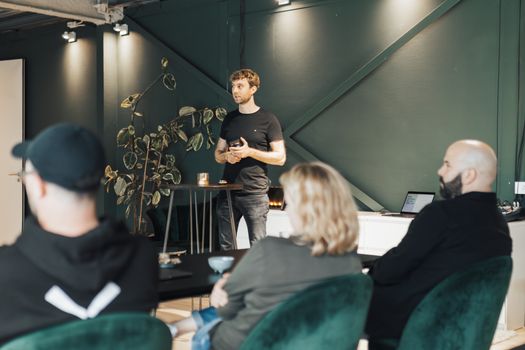
- Live session for practice. The face-to-face block is spent on attempts, feedback, and discussion rather than on coverage.
- Application in the workflow. The employee applies the new knowledge in their own work, which is the stage the definition of blended learning points at most directly.
- Follow-up online. Short reinforcement, reference material, and a checkpoint keep the material alive after the room has emptied.
Two details decide whether this pattern holds. The first is the handover: employees need to know why the online work exists and what the live session will assume they already know. The second is the closing loop: if the follow-up stage never happens, the blend quietly collapses back into a classroom event with some pre-reading attached.
Delivery logistics that decide whether the blend holds
Most blends that fail do so for operational reasons rather than instructional ones. The following points are worth settling before the first cohort starts.
- Time. Employees need protected time for the online portion, not an assumption that it fits into gaps.
- Access. Check that everyone in the cohort can reach the online material on the devices they actually use.
- Manager buy-in. Line managers need to understand why the in-person day exists and what employees are expected to bring to it.
- Facilitator preparation. A live session built around practice needs a facilitator briefed on what the online portion covered.
- Communication. One clear schedule showing both modes, sent once and repeated, prevents most no-shows.
None of these are exotic. They are simply easy to skip when a programme is assembled in a hurry.
Measuring a blend without inventing numbers
Because the available research does not supply quantified outcomes, any measurement plan has to be built locally. Three layers are usually enough to tell you whether the blend is working.
- Participation: who completed the online portion, who attended the live session, and where the drop-off happened.
- Application: whether managers see the behaviour change in day-to-day work, gathered through short structured check-ins.
- Perception: whether employees report the flexibility and retention benefits that organizations cite, asked in their own words.
Vendors and internal advocates often present return on investment figures for blended programmes. Treat any such figure as a claim to verify, and ask for the methodology, the sample, and the comparison group before it enters a business case.

Common failure points to design out early
Four patterns account for a large share of disappointing blends. The online portion becomes a compliance checkbox that nobody reads. The in-person day duplicates the online content instead of building on it. The follow-up stage is dropped when the project budget closes. And the blend is judged on attendance alone, which tells you nothing about whether anyone can do the job differently afterwards. Each is cheap to prevent at the design stage and expensive to fix once several cohorts have been through.
Frequently Asked Questions
What is blended learning for employee training?
It is a training approach that combines online courses with in-person training. Published descriptions define it as a mix of in-person and online learning methods, and as a combination of multiple formats that help employees learn, practice, and apply new knowledge in the context of their work. The defining feature is that both channels are used deliberately rather than one replacing the other.
Is blended learning better than fully online or fully in-person training?
The research reviewed here does not support that claim. Sources describe blended learning as widely used and report benefits such as flexibility and better retention of information, but they do not provide quantified comparisons against single-mode delivery. Whether a blend outperforms a purely online or purely classroom programme depends on the task, the audience, and how well the programme is run.
How do you decide which content belongs online and which in person?
Ask what each piece of the programme needs. Material that benefits from repetition, self-pacing, and consistency across cohorts usually suits the online portion. Material that needs live observation, immediate correction, or peer discussion usually suits the in-person portion. The aim is to give each format the work it does best rather than to hit a fixed ratio.
How should an organization measure whether a blend worked?
Build the measurement locally, since the available sources do not supply outcome figures. Track participation across both modes, gather manager observations about whether the behaviour changed on the job, and ask employees directly whether they experienced the flexibility and retention benefits organizations commonly cite. Verify any vendor return on investment claim by asking for its methodology and comparison group.
Can a small team run a blended programme?
Yes, though the operational details matter more than the size of the team. Protect time for the online portion, confirm device access, brief line managers, and make sure the follow-up stage actually happens. A small blend with a clean handover between the online and in-person stages usually lands better than an ambitious programme whose logistics were never settled.
