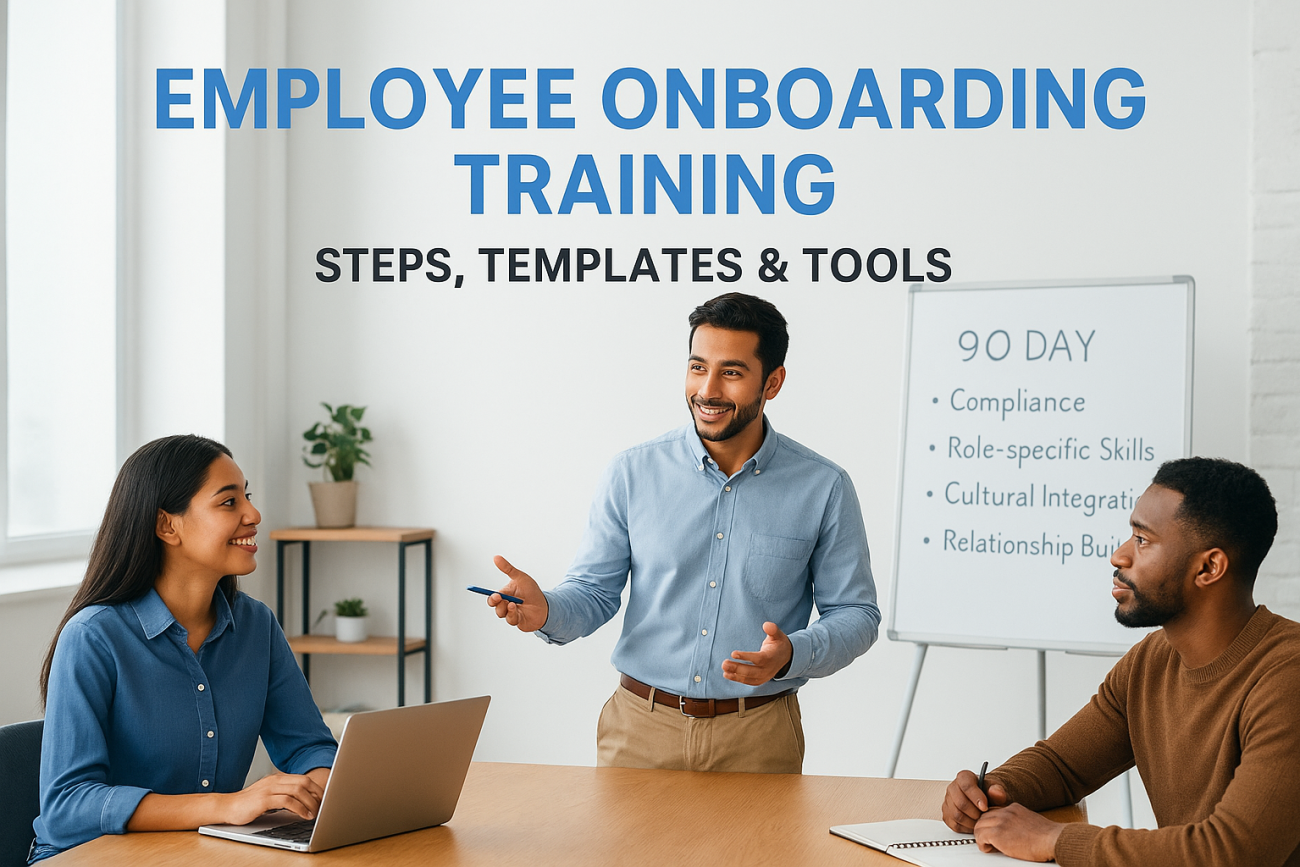
A new hire’s first weeks carry more weight than most managers expect. The training they receive, the people they meet, and the clarity they feel about their role all shape whether they settle in or start looking elsewhere. Employee onboarding training works best when it is treated as a structured program with defined phases rather than a folder of forms handed over on day one. The sections below break that program into parts you can build, sequence, and maintain throughout the year.
What Employee Onboarding Training Actually Covers
Onboarding training is not a single orientation session. Industry guidance for 2026 describes targeted training sessions that typically run from one week to two months, with content that stretches well beyond paperwork. The scope usually includes:
- Company background, structure, and how work gets done internally
- The industry the organization operates in and the pressures it faces
- Products and services, including what each one does and who it serves
- Customers, their expectations, and how the role connects to them
- New tools and systems the employee will use daily
- Important policies and general procedures
That list matters because it shows the difference between a compliance exercise and actual preparation. A program built only around policies leaves a new hire able to follow rules but unable to do the job. A program that only covers tasks leaves them productive but disconnected from the reasons behind the work.
The Four Phases of a Program That Holds Up
Onboarding frameworks consistently describe four stages: preboarding, orientation, foundation building, and mentoring or buddy systems. Each phase has its own job to do, and skipping one tends to show up later as confusion, slow ramp-up, or early turnover.
Preboarding: Preparing Before Day One
Preboarding covers everything that happens between the signed offer and the first morning. Paperwork, equipment, system access, and a clear outline of what the first day will involve all belong here. This is also the right moment to assign a buddy so that a familiar name is waiting on day one. A new hire who arrives to a working laptop, a named contact, and a schedule already knows what to expect.
Orientation: The First Day and First Week
Orientation sets the tone. A first-day checklist and itinerary give the new employee a visible plan instead of a series of vague introductions. Company context, policies, general procedures, and a tour of the tools they will use fit naturally here. Keep the administrative items grouped so the week still leaves room for conversation and relationship building rather than back-to-back briefings.
Foundation Building: Weeks One Through Eight
This is where job-specific training does its work. The focus shifts from the organization to the role: what excellent performance looks like, which tasks come first, and where the new hire should go with questions. Weekly check-ins with the manager during this stretch give you a place to correct course early and to assign additional training as gaps appear. Feedback at this stage should be specific and frequent.
Mentoring and Buddy Systems
A buddy serves a different purpose than a manager. The manager handles expectations, priorities, and performance. The buddy answers the smaller questions that new hires hesitate to raise with a supervisor, and helps them build relationships across the team. Mentoring and buddy systems are treated as integral to onboarding, not as an optional extra, and they are one of the cheapest retention tools available.
A Phase-by-Phase Timeline
Mapping each phase to an owner keeps the program from stalling. The table below reflects the responsibilities that typically sit with HR, the hiring manager, and the assigned buddy.
| Phase | Main focus | Typical owner |
|---|---|---|
| Preboarding | Paperwork, equipment, access, first-day plan, buddy assignment | HR and hiring manager |
| Orientation | First-day itinerary, company context, policies, tools | HR |
| Foundation building | Job-specific training, expectations, weekly feedback | Hiring manager |
| Mentoring | Ongoing questions, social integration, informal support | Buddy or mentor |
| Six-month review | Performance conversation, training confirmation, plan adjustments | Manager and HR |
Three Design Principles That Make Training Stick
Structure alone does not guarantee that anything is absorbed. Reviews of modern onboarding training solutions tend to highlight the same three qualities in programs that work.
Human-First Communication
Instructions land better when they sound like they came from a person rather than a system. That means plain language in your materials, a real name attached to each check-in, and clarification of why a piece of training matters for the role. New hires who understand the reasoning behind a task retain it far more reliably than those who are simply told to complete it.
Collaboration and Engagement
Training that isolates a new employee from the team slows everything down. Build in opportunities to work alongside colleagues, sit in on real meetings, and contribute something small early. Engagement during onboarding is not about entertainment. It is about giving the person a reason to pay attention and a sense that their presence matters.
Adaptive Sequencing
Different roles need different weights. A technical hire may need deeper product and tool training, while a customer-facing hire may need more time on customers and procedures. An adaptive sequence adjusts what comes first and how much time each topic gets, instead of pushing every new employee through an identical block of content.
The Six-Month Follow-Through
Onboarding does not end when the first-month checklist is done. A six-month view keeps the program accountable and catches problems before they harden. A workable sequence looks like this:
- Continue weekly meetings to discuss performance expectations and provide feedback.
- Explain what excellent work looks like from your perspective, and tell the new hire when they are doing well.
- Facilitate goal setting and assign training as needs appear.
- Confirm that required training is complete.
- Schedule an informal performance meeting with the employee.
- Review any work plan adjustments for the next three months.
- Hold a performance conversation before any six-month probationary period ends.
Not every organization runs a formal probationary period, so adjust the last step to match your own employment terms and confirm the details with your HR team. The underlying principle holds either way: a scheduled conversation near the six-month mark prevents small misunderstandings from becoming resignation letters.
Why Structure Improves Retention
Structured, people-focused onboarding is designed to support new employees from day one, and that support is associated with improved retention and reduced turnover. The mechanism is not complicated. People stay where they feel competent, connected, and clear about what is expected of them. Each of those three feelings comes from something concrete: adequate training for competence, a buddy and regular meetings for connection, and a documented work plan for clarity. When any one of them is missing, the others have to work harder to compensate.
Where Programs Lose Traction
Most onboarding programs fail gradually rather than all at once. Watch for these patterns:
- Everything is front-loaded into day one, leaving the new hire saturated and unable to retain details.
- A buddy is assigned in name only, with no expectation of time spent together.
- Check-ins stop after the second or third week, just as the harder questions start to surface.
- Required training is never formally confirmed as complete.
- The work plan is set at the start and never revisited.
Each of these is fixable with a calendar entry and a named owner. The value of writing the program down is that gaps become visible before a new hire has to point them out.
Frequently Asked Questions
How long should employee onboarding training last?
Guidance for 2026 describes targeted onboarding training sessions that typically run from one week to two months. The right length depends on the role, the complexity of the tools involved, and how much industry and product knowledge the person needs. What matters more than a fixed number is sequencing the content so each phase builds on the last.
What topics belong in onboarding training?
Common topics include the company and how it operates, the industry, products and services, customers, the tools a new hire will use, and important policies and general procedures. Together these give a new employee both the practical skills and the context needed to make sensible decisions without asking for guidance on every small item.
What role does a buddy play during onboarding?
A buddy is a peer assigned to support the new hire, usually from before day one. Assigning a buddy is a widely recommended practice, and mentoring or buddy systems are considered integral to the onboarding process. The buddy handles everyday questions, helps build relationships across the team, and offers a low-pressure channel for concerns the new hire may not raise with a manager.
When should the first formal performance conversation happen?
Schedule a performance conversation before any six-month probationary period ends. In practice this should follow weeks of shorter feedback discussions rather than arriving as a surprise. Ahead of that meeting, confirm required training is complete and review any adjustments to the work plan for the next three months. Check your own employment terms, since probationary periods vary by organization.
Do you need onboarding software to run this program?
No, though software helps at scale. A calendar, a written checklist, and a named owner for each phase will carry a small team a long way. Reviews of onboarding training solutions often point to human-first communication, collaboration and engagement, and adaptive sequencing as the qualities that matter. Those are program design choices, not features you can buy.
