Disengaged employees cost you more than morale. They cost you retention, productivity, and revenue you never see leave. If you’re an HR manager or L&D lead trying to fix that in 2026, you already know the fix isn’t a single pizza party or a survey nobody reads. You need employee engagement training programs that actually change behavior, and you need to know which ones are worth your budget before you commit.
This list answers that question directly. We’ve evaluated the top programs on course content quality, delivery format, pricing, and how well they translate into measurable culture change rather than just a completion certificate. Whether you’re building out onboarding, addressing a retention problem, or trying to get managers to actually lead instead of just supervise, you’ll find a program here that fits your team size and budget.
Below, we break down each program’s strengths, pricing structure, and ideal use case, plus what to look for when you’re ready to roll training out through your own LMS.
1. What to look for in an engagement training program
Before you hand over a budget code, get clear on what separates a real training program from a webinar with a certificate at the end. The best employee engagement training programs are built on research, not opinion. They cite sources like Gallup’s meta-analyses or academic organizational psychology, and they give you a framework you can repeat every quarter, not a one-time pep talk. If a program can’t tell you which specific behaviors it changes in managers or employees, walk away.
Content depth matters more than a flashy sales page. Look for programs that address the actual drivers of disengagement: unclear expectations, lack of recognition, poor manager relationships, and no visible growth path. A strong curriculum ties each module to a measurable workplace behavior, like holding a weekly one-on-one or giving specific feedback within 48 hours of a project milestone. Vague modules on "building a positive culture" without concrete scripts or exercises rarely stick past week two.
A training program only earns its price tag when it changes what managers do on Monday morning, not just what they believe on Friday afternoon.
Delivery format is your next filter. Self-paced online courses work for large, distributed teams and cost less per learner, but they need built-in accountability, like quizzes, discussion prompts, or manager check-ins, or completion rates collapse. Live workshops and cohort-based courses build stronger peer accountability but cost more and demand more scheduling. Neither format is inherently better; weighing e-learning delivery methods comes down to your team’s size, geography, and how much hands-on coaching your managers already get.
Here’s a quick checklist to run any program through before you buy:
- Evidence base: Does it reference published research or proprietary engagement data, not just anecdotes?
- Behavioral specificity: Are learners taught exact actions, scripts, or habits, not abstract principles?
- Manager focus: Does it train the people who most influence day-to-day engagement, since Gallup consistently ties manager quality to team engagement scores?
- Measurement built in: Does it include pre- and post-training assessments or engagement surveys to track change?
- Delivery fit: Does the format match your team’s schedule, location, and learning preferences?
- Integration: Can you track completions, scores, and follow-up activity inside the systems you already use, like your LMS?
Pricing transparency deserves its own line item. Some workplace engagement training vendors quote per-seat pricing upfront; others require a sales call before you see a number. Neither approach is a dealbreaker, but budget extra time for vendors who hide pricing, since that usually means custom enterprise contracts and longer procurement cycles. Keep this checklist next to you as you read through the nine programs below, because the right fit depends less on brand recognition and more on how well a program matches your team’s actual gaps.
2. Axis LMS by Atrixware
Axis LMS takes a different approach than the courses further down this list: instead of selling you a pre-packaged engagement seminar, it gives you an LMS built for employee training programs so you can build, deliver, and track your own engagement curriculum, whether that’s licensed content, homegrown manager training, or a mix of both. For teams that want ownership over their engagement strategy rather than a one-size-fits-all workshop, this matters more than it sounds.

What it covers
The platform itself doesn’t hand you a fixed engagement syllabus. Instead, it gives you the drag-and-drop course builder, virtual classroom support, and automated communication tools to run manager coaching cohorts, onboarding tracks for new hires, recognition programs, and recurring pulse-survey follow-ups, all inside one system. You can upload third-party engagement content, build your own video-based modules, or blend both, then tie completions directly to compliance and certification tracking if your engagement work overlaps with regulatory training.
The right engagement outcome usually depends less on which course you buy and more on whether anyone tracks what happens after it ends.
Who it’s for
Axis LMS suits HR and L&D teams that already have (or want to build) their own engagement content and need infrastructure to scale it across departments, locations, or a distributed workforce. It’s a strong fit for organizations juggling multiple training goals at once, since the same system handles compliance, onboarding, and engagement without separate platforms.
Format and duration
Delivery is entirely self-directed by your team: self-paced modules, live virtual sessions run through the LMS, or blended cohorts, running on whatever cadence you set, from a single afternoon workshop to a year-long manager development track.
Cost
Pricing is quote-based and scales with user count and feature needs. Reach out through the Axis LMS page for a demo and pricing specific to your team size.
3. Gallup engagement champions
Gallup built its reputation on decades of engagement research, and its Engagement Champions certification program is the closest thing in this list to a direct pipeline from that research to your training room. This isn’t a vendor repackaging generic advice; it’s the organization that literally coined the Q12 survey teaching you how to use its own framework inside your company.
What it covers
The program trains internal champions to run CliftonStrengths-based coaching, interpret Q12 engagement survey results, and lead action-planning sessions with managers after each survey cycle. Modules cover how to turn survey scores into specific manager behaviors, how to coach around individual strengths rather than generic leadership traits, and how to sustain momentum between survey cycles instead of letting results sit in a slide deck.
Data without a coach to act on it is just a spreadsheet nobody opens again.
Who it’s for
This fits organizations that already run (or plan to run) Gallup’s Q12 engagement survey and want internal staff, not outside consultants, to own the follow-through. It suits mid-size to large HR teams with the bandwidth to certify a few people who then train managers company-wide, rather than smaller teams looking for a quick one-off workshop.
Format and duration
Certification runs as a cohort-based virtual or in-person program, typically spanning several days of instruction plus a certification exam. Gallup also offers shorter standalone workshops on strengths-based management for teams that don’t need full certification.
Cost
Gallup doesn’t publish flat pricing online; certification and workshop costs depend on cohort size, delivery format, and whether you bundle in the Q12 survey license itself. Expect a sales conversation and a quote in the low-to-mid five figures for a small certification cohort, with survey licensing billed separately based on headcount.
4. Dale Carnegie’s employee engagement course
Dale Carnegie has been teaching interpersonal skills since 1912, and its employee engagement offering leans hard on that legacy: relationship-building, communication, and trust as the levers that move engagement scores, rather than survey mechanics or HR process. If you want a program that treats engagement as a people-skills problem first and a data problem second, this is where you look.
What it covers
Course content centers on trust-building communication techniques, conflict resolution, and recognition habits drawn from Carnegie’s original human relations principles, updated for modern hybrid teams. Sessions walk managers through active listening drills, feedback scripts, and exercises for recognizing contributions in ways employees actually notice, rather than generic "great job" comments that fade by lunch.
Engagement rarely fails because managers lack data; it fails because they never learned how to have an honest conversation.
Who it’s for
This program suits frontline and mid-level managers who need practical interpersonal skills more than strategic frameworks. It’s a solid fit for retail, hospitality, healthcare, and other people-heavy industries where day-to-day manager-employee interactions drive most of the engagement variance, and less suited to teams already deep into data-driven engagement analytics.
Format and duration
Dale Carnegie runs this as both in-person workshops and live virtual sessions, typically structured across multiple weekly sessions rather than a single-day intensive, so participants can practice techniques between meetings. Corporate cohorts can also request customized on-site delivery for larger groups.
Cost
Pricing isn’t published on a flat rate card; Dale Carnegie quotes based on cohort size, delivery format, and whether you want customized content for your industry. Expect a sales consultation before you see numbers, with public open-enrollment sessions generally running in the low four figures per seat and private corporate cohorts priced separately.
5. LSA Global’s employee engagement training
LSA Global positions itself as a custom corporate training firm rather than an off-the-shelf course provider, and its engagement programs reflect that: everything gets built around your specific engagement survey data and organizational goals instead of a fixed curriculum. If your engagement problems are unique to your culture or industry, this customization is the main draw.
What it covers
Content isn’t fixed until LSA Global runs a diagnostic on your organization, typically pulling from existing engagement survey results, focus groups, or manager interviews. From there, they build modules addressing your specific gaps, whether that’s manager accountability, cross-team collaboration, or change fatigue after a reorg. Expect customized workshops on trust-building, feedback delivery, and action-planning tied directly to your engagement metrics rather than generic best practices.
Generic engagement advice fixes generic problems; your team’s disengagement usually isn’t generic.
Who it’s for
This fits mid-size to large organizations with a documented engagement problem, existing survey data to work from, and budget for a consultative process rather than a plug-and-play course. It suits companies that already tried a standard training vendor and found the content too broad for their specific culture or industry constraints.
Format and duration
Delivery happens through instructor-led workshops, either in-person or virtual, typically scoped as a multi-week or multi-month engagement rather than a single session. LSA Global also builds in follow-up coaching and reinforcement sessions since custom programs assume you’re solving a specific, ongoing problem rather than checking a training box.
Cost
Pricing is fully custom and requires a consultation call before you see any number. Because the diagnostic and content-build process adds real labor on their end, expect costs to run higher than off-the-shelf courses, generally landing in the mid five figures for a full engagement program including diagnostics, delivery, and follow-up coaching.
6. DecisionWise’s engagement magic program
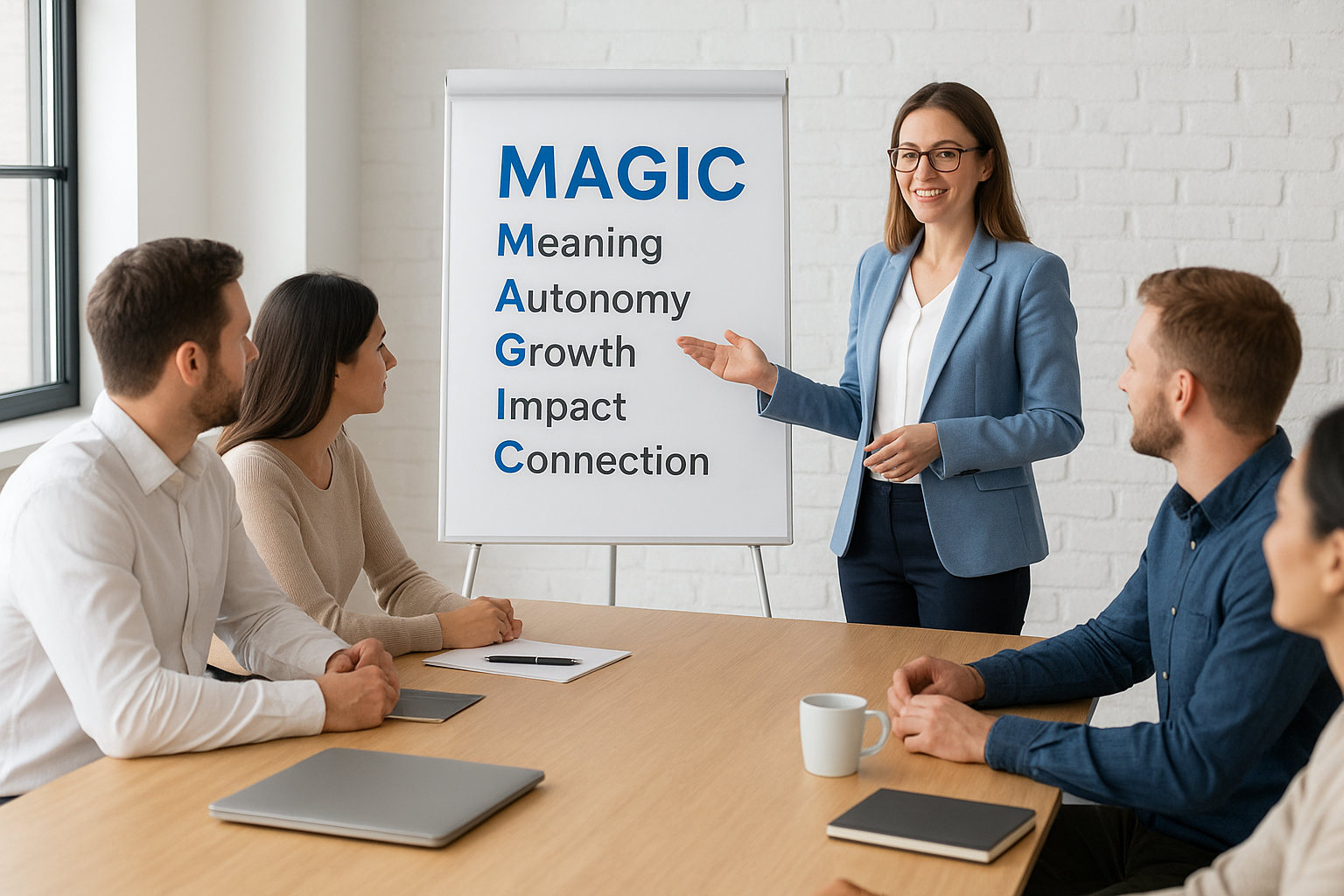
DecisionWise built its reputation on the MAGIC framework, a model spelled out in founder Tracy Maylett’s book Employee Engagement Magic, and the training program teaches managers to apply that model directly rather than just read about it. If your team responds better to a memorable acronym than a dense research citation, this program packages engagement theory into something managers can actually recall during a tough one-on-one.
What it covers
Sessions walk through the five MAGIC drivers: Meaning, Autonomy, Growth, Impact, and Connection, with each module tied to specific manager behaviors and diagnostic questions pulled from DecisionWise’s own engagement survey data. Facilitators use case studies and role-play exercises to show managers how to spot which MAGIC element is missing on their team, then apply targeted fixes instead of generic morale boosts.
A framework only sticks when managers can name the problem in five seconds, not five paragraphs.
Who it’s for
This suits mid-size to large organizations that want a licensable, repeatable model they can roll out across multiple departments or business units. It works especially well for HR teams that already use DecisionWise’s survey tools and want training that speaks the same language as their existing engagement data.
Format and duration
DecisionWise offers both certified facilitator training, where internal staff learn to teach the MAGIC model company-wide, and direct-to-employee workshops delivered live or virtually. Programs typically run as half-day to full-day sessions, with certification tracks extending across several days of instruction.
Cost
Pricing isn’t published; DecisionWise quotes based on cohort size, facilitator certification needs, and whether you bundle in their survey platform. Expect a sales consultation, with costs scaling from a few thousand dollars for a single workshop to five-figure contracts for full certification and licensing rights.
7. Harvard’s positive workplace course
Harvard’s continuing education arm offers a positive psychology-based course aimed at building healthier, higher-performing teams, drawing on research from Harvard’s own behavioral science faculty rather than corporate training consultants. It’s less a compliance-style seminar and more an academic deep dive into what actually predicts sustained engagement, backed by the same research base cited in Harvard Business Review.
What it covers
The curriculum covers positive organizational psychology, psychological safety, and the science of motivation, translating academic findings into workplace applications like structuring feedback, building autonomy into job design, and reducing burnout through better workload distribution. Case studies pull from real organizational research rather than generic scenarios, giving HR leaders a framework grounded in peer-reviewed findings instead of trend-driven advice.
A course built on research holds up under scrutiny long after the trend that inspired a competitor’s curriculum has faded.
Who it’s for
This program suits HR executives and senior L&D leaders who want a credentialed, research-backed foundation before rolling engagement initiatives out company-wide. It fits organizations that value academic rigor and want internal champions who can defend their engagement strategy with cited evidence, rather than frontline managers looking for quick behavioral scripts.
Format and duration
Delivery runs online through Harvard’s continuing education platform, typically structured as a self-paced course spanning several weeks, with recorded lectures, readings, and periodic assessments. Some cohorts include live discussion sessions for participants who want peer interaction alongside the coursework.
Cost
Pricing sits in the low four figures per participant, consistent with other Harvard professional certificate offerings, and is published upfront rather than requiring a sales call. Group or corporate enrollment discounts may be available depending on cohort size; check Harvard Professional Development directly for current pricing and enrollment windows.
8. eCornell’s strategic engagement course
eCornell brings Cornell University’s ILR School research into a certificate format built specifically for HR professionals who want an academic credential without a full semester commitment. The strategic engagement course sits inside eCornell’s broader HR certificate catalog, so you’re learning from the same faculty who teach Cornell’s resident graduate programs, just compressed into a corporate-friendly timeline.
What it covers
Modules walk through engagement strategy design, tying employee engagement directly to business outcomes like turnover cost and productivity metrics rather than treating it as a standalone HR initiative. You’ll work through case studies on diagnosing disengagement drivers, building a measurement plan, and presenting engagement data to executives in terms they actually act on, plus a capstone project applying the framework to your own organization.
A credential only matters if it changes how confidently you can walk into a budget meeting and defend your engagement strategy.
Who it’s for
This fits HR managers and senior generalists who want a resume-worthy credential alongside practical strategy skills, not just a completion badge. It suits professionals building a business case for bigger engagement investments, since the coursework trains you to speak the language finance and leadership expect, and it’s less suited to frontline managers looking for day-to-day coaching scripts.
Format and duration
Delivery is fully online and self-paced within a structured timeline, typically running two to three weeks per course with several courses bundled into the full certificate. Weekly deadlines keep cohorts moving together even though there’s no live classroom component, and the capstone project requires applying course concepts to a real workplace scenario before you receive the certificate.
Cost
eCornell publishes pricing upfront rather than requiring a sales call, with the full engagement certificate typically running in the low-to-mid four figures depending on current course bundling. Check eCornell’s HR certificate catalog directly for current pricing, since bundle discounts and enrollment windows shift by term.
9. LinkedIn Learning’s employee engagement courses
LinkedIn Learning takes the opposite approach from Harvard or eCornell: instead of one flagship credential, it offers dozens of short, focused video courses on engagement, manager effectiveness, and team culture, all bundled into a single subscription. If your team needs breadth and flexibility more than a single deep credential, this library format fills gaps other programs leave open.

What it covers
Courses range from "Employee Engagement" fundamentals taught by workplace consultants to narrower topics like recognition strategies, remote team culture, and manager one-on-one techniques. Content is produced by working practitioners and business school instructors rather than a single research institution, so quality and depth vary course to course. Most run 30 to 90 minutes, broken into short video segments with brief knowledge checks rather than graded assessments.
A subscription library works when managers actually watch it; without a nudge from HR, most courses sit unopened.
Who it’s for
This fits HR teams already paying for LinkedIn Learning through a company license, or organizations wanting a low-cost supplement to a bigger training initiative rather than a standalone engagement strategy, much like affordable upskilling options for small teams. It suits managers who prefer quick, on-demand lessons over multi-week coursework, and less suited to teams needing certification or accountability structures built into the program itself.
Format and duration
Everything runs fully self-paced through the LinkedIn Learning platform, on-demand and mobile-friendly, with most individual courses completed in under two hours. There’s no cohort, no live instructor, and no fixed schedule, which makes tracking completion your responsibility rather than the platform’s.
Cost
Access runs through a subscription, either individual (roughly $20 to $40 monthly, billed annually) or enterprise licensing priced per seat for companies bundling it with LinkedIn Recruiter or Sales Navigator. Check current pricing directly through LinkedIn Learning since enterprise rates shift with seat count and bundling.
10. SHRM’s employee engagement seminar
SHRM carries weight that most training vendors can’t match: it’s the professional body that certifies HR practitioners in the first place, so its engagement seminar doubles as both a skills course and a credibility signal on your resume. If you want a program that ties directly into SHRM-CP or SHRM-SCP recertification credits, this is the one on the list built specifically for that purpose.
What it covers
The seminar walks through engagement strategy fundamentals: linking engagement to retention and business outcomes, running and interpreting engagement surveys, and building action plans that survive past the initial rollout. Sessions also cover manager accountability structures and how to present engagement data to executives in language tied to turnover cost and productivity, not just satisfaction scores.
A credential only helps your team if the content behind it changes how managers act, not just what letters follow your name.
Who it’s for
This fits HR generalists and managers pursuing or maintaining SHRM certification who want engagement-specific coursework that counts toward recertification credits. It also suits HR leaders who want a program with an established professional body’s name attached when presenting a business case internally, rather than a lesser-known boutique vendor.
Format and duration
SHRM offers this seminar both in-person at select locations and as a live virtual session, typically structured as a single-day or two-day intensive rather than a multi-week course. SHRM also runs the content periodically at its annual conferences, giving attendees a chance to combine the seminar with broader networking and sessions on adjacent HR topics.
Cost
Pricing is published upfront on SHRM’s seminar catalog, generally running in the mid four figures per seat, with member discounts available for SHRM members. Group rates apply for organizations sending multiple HR staff to the same session; check SHRM’s seminar listings directly for current dates and pricing.
11. How to choose the right program for your team
Matching a program to your actual situation matters more than picking the highest-rated option on this list, the same way comparing platforms step by step beats picking the best-known vendor. Start with your budget ceiling, since that alone eliminates half these choices before you compare content. A five-figure custom engagement from LSA Global makes no sense for a 40-person company, just like a $20-a-month LinkedIn Learning subscription won’t satisfy a board asking for a documented, credentialed strategy.
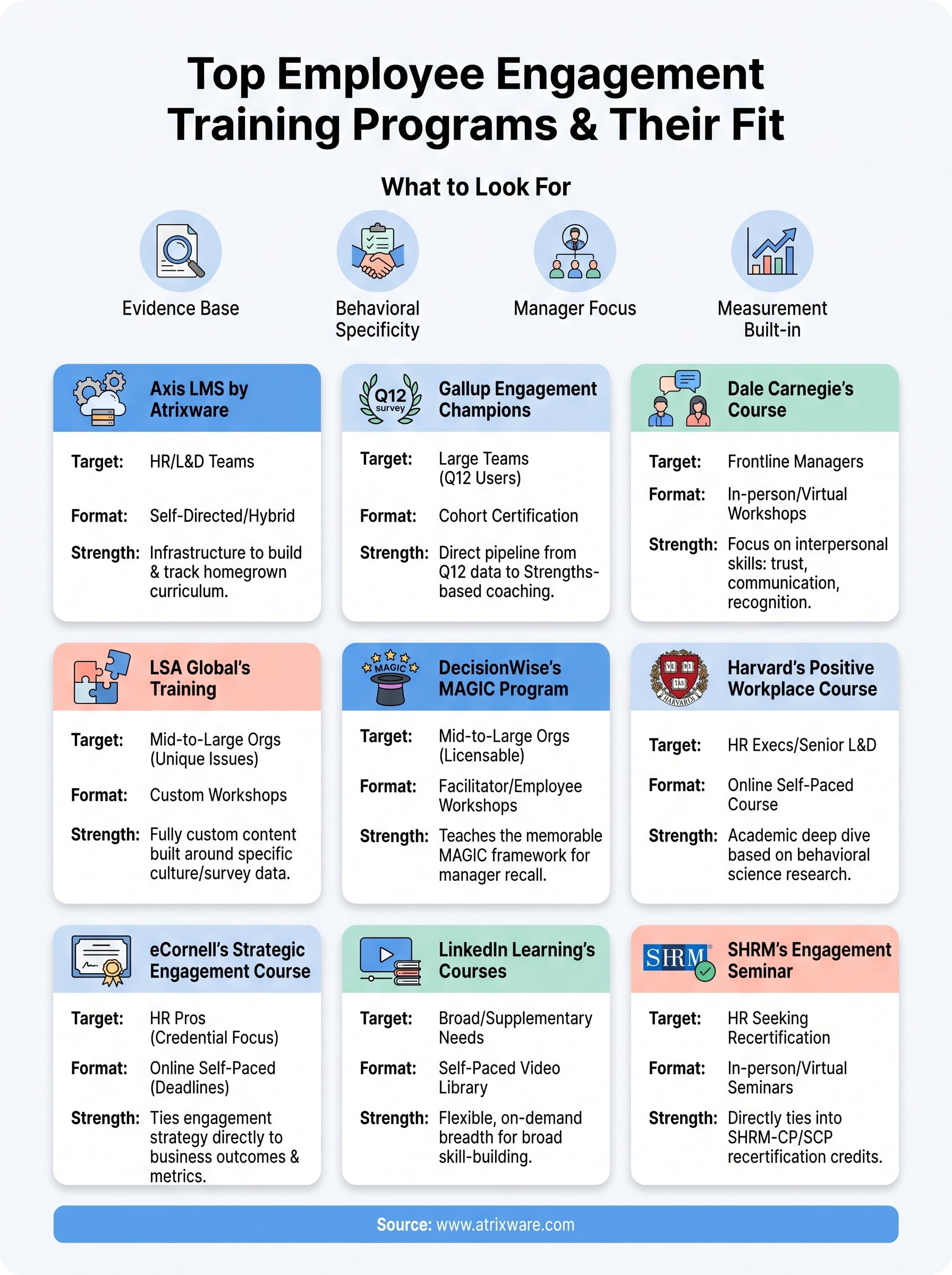
Consider who needs the training next. Frontline managers benefit most from behavioral, script-heavy programs like Dale Carnegie or DecisionWise’s MAGIC model, while HR leaders building an executive-facing business case get more mileage from Harvard, eCornell, or SHRM’s credentialed courses. Gallup fits best when you already run Q12 surveys and need internal staff certified to act on the results.
The best program isn’t the most prestigious one; it’s the one that matches who’s sitting in the room.
Think about delivery format against your team’s actual schedule. Distributed teams across time zones do better with self-paced options like eCornell or LinkedIn Learning, while co-located teams get more value from live cohort workshops where peer accountability keeps momentum going. Use this quick filter to narrow your shortlist:
| Your situation | Best-fit program type |
|---|---|
| Need infrastructure to build and track your own curriculum | Axis LMS |
| Already run Gallup Q12 surveys | Gallup Engagement Champions |
| Frontline manager coaching gaps | Dale Carnegie, DecisionWise |
| Unique culture problem, existing survey data | LSA Global |
| Need executive-facing credential | Harvard, eCornell, SHRM |
| Tight budget, broad coverage | LinkedIn Learning |
Ultimately, the right workplace engagement training choice depends on whether you’re solving a skills gap, a data gap, or an infrastructure gap, and honest answers to that question will narrow this list faster than any feature comparison chart.
12. Measuring the return on your training investment
Spending money on any of the programs above without a measurement plan is how engagement training earns its reputation as a soft, unprovable expense. Pre- and post-training surveys give you the cleanest baseline: run your Q12 or a comparable pulse survey before the program starts, then again 60 to 90 days after, and look for movement in the specific drivers the training targeted, not just an overall score bump. If a course promised better recognition habits, measure recognition frequency specifically, not general satisfaction.
Track behavior change alongside the survey data, since scores alone won’t tell you whether managers actually changed what they do. Manager behavior tracking through one-on-one completion rates, feedback frequency, or recognition logs gives you a leading indicator long before turnover numbers move. Tie these metrics to your LMS reporting and analytics so completions, quiz scores, and follow-up activity live in one dashboard instead of scattered spreadsheets nobody checks after month two.
If you can’t point to a specific number that moved after training, you didn’t measure the training, you measured attendance.
Business outcomes close the loop and justify next year’s budget. Watch these over a two- to four-quarter window:
- Voluntary turnover rate, especially in the departments that went through training
- Time-to-productivity for new hires if the training touched onboarding
- Internal promotion rate, a proxy for growth and development perception
- Absenteeism, which tends to drop when engagement improves
Calculating actual ROI means weighing the fully loaded training cost, including staff time away from work, against turnover cost savings, since replacing an employee typically runs 50 to 200 percent of their annual salary depending on role complexity, and that math is what you’ll need when presenting training ROI to your CFO. Compare that math every year, because the second and third rounds of training should cost less to deliver and produce faster results once managers already have the vocabulary and habits from round one.
13. Frequently asked questions about engagement training
How long does it take to see results from employee engagement training?
Most organizations notice early behavior shifts within 30 to 60 days, but measurable movement in engagement survey scores typically takes a full quarter. Managers need time to practice new habits, like structured one-on-ones or specific recognition, before those habits show up in survey responses. Expect a longer runway if your program includes certification, since rollout to the full manager population happens after the certified staff finish training themselves.
Can small businesses afford employee engagement training programs?
Yes, though the right fit differs from what a 5,000-person enterprise needs. Subscription options like LinkedIn Learning cost a few hundred dollars a year per seat, self-paced credentials from eCornell or Harvard run in the low four figures per participant without requiring a custom consulting engagement, and a blended approach to small business training can stretch the budget further. Skip the five-figure custom programs from firms like LSA Global unless you have a documented, complex culture problem that off-the-shelf content genuinely can’t address.
Do employee engagement training programs actually work?
Training changes engagement scores only when it changes what managers do between survey cycles, not just what they know during the course.
Research-backed programs with built-in behavior tracking, like Gallup’s Q12-based coaching or DecisionWise’s MAGIC framework, show consistently stronger results than one-off seminars without follow-up. Effectiveness depends less on the vendor’s name recognition and more on whether someone holds managers accountable for applying what they learned.
Should engagement training be mandatory or optional?
Generally, manager-facing engagement training works best as mandatory, since the people most responsible for team engagement shouldn’t self-select out of learning how to improve it. Optional supplementary content, like a LinkedIn Learning library, works fine as a voluntary add-on for employees who want extra development beyond the required curriculum.
Turning training into lasting engagement
None of the nine programs above fix disengagement by themselves. Employee engagement training programs only work when someone tracks what happens after the course ends: which managers ran their one-on-ones, which teams saw recognition frequency actually climb, which survey scores moved and which stayed flat. Pick the content that matches your team’s real gap, whether that’s Gallup’s data-driven coaching, Dale Carnegie’s people skills, or a credentialed course for your next budget meeting.
Then give that content a home where completions, quiz scores, and follow-up activity live in one place instead of scattered spreadsheets. That’s the infrastructure piece most vendors on this list assume you already have. If you don’t, build your own tracking system instead of hoping a certificate does the work for you. See how ready your organization is for an LMS before you commit another training budget to a program with no way to measure it.
