Poor communication costs companies more than money. It shows up as missed deadlines, confused customers, and teams that duplicate work because nobody said what they actually meant. If you’re researching corporate training communication courses right now, you already know the problem. What you need is a shortlist of programs that actually change how people talk, write, and listen at work, not another generic soft-skills seminar that gets forgotten by Friday.
This guide answers that search directly. We’ve pulled together nine courses for 2026 that cover the full range: executive presence training, cross-functional team communication, customer-facing scripts, and compliance-driven messaging for regulated industries. Each one includes what it’s built for, who should take it, and roughly what it costs, so you can match a course to your actual training gap instead of guessing.
We also look at how these programs fit into a broader training strategy. Buying a course is one step. Tracking completion, measuring skill improvement against business performance, and rolling communication training into onboarding or compliance programs is where an LMS like Axis LMS does the heavy lifting. Let’s get into the list.
1. Axis LMS by Atrixware
Most lists like this hand you a course and stop there. We’re starting somewhere different, because the real bottleneck in corporate training communication isn’t finding good content, it’s delivering that content consistently and proving it worked. Axis LMS is the platform we built to solve exactly that problem, and it’s why organizations pair it with the courses later in this list rather than treating training as a one-off event.

What it offers
Axis LMS lets you build, host, and use an LMS to develop soft skills like communication using your own content, licensed courses, or a mix of both. The drag-and-drop course authoring tools mean an HR manager can assemble a module on difficult conversations or customer messaging without touching code, while the virtual classroom support handles live workshops for executive presence coaching or team communication drills. Where Axis LMS pulls ahead of a standalone course provider is reporting: you get on-demand and automated dashboards showing who finished a module, who’s overdue, and how scores trended over time, which matters when communication training is tied to compliance or certification requirements. The platform also connects to the systems you already run, syncing user data with tools like BambooHR, Salesforce, and ADP, and supporting SSO through Okta or Azure so employees log in once and land in their training without a separate password to remember.
A communication course only changes behavior if you can prove people actually completed it and retained it, which is exactly what a dedicated LMS is built to track.
Who it’s for
Axis LMS suits mid-size and large organizations running communication training across multiple departments, especially where compliance officers or L&D teams need documented proof of completion. It also fits companies that sell training externally, since the built-in e-commerce functionality supports individual purchases and bulk seat licenses for channel partner and B2B training or customers. If your training program spans employee onboarding, customer education, and regulatory requirements like GDPR or FDA 21 CFR Part 11 all at once, this is the kind of breadth a single course subscription can’t replicate.
Pricing
Axis LMS pricing is quote-based and scales with user count and feature needs, covering everything from small teams to enterprise deployments with custom integrations. Atrixware offers a free trial of Axis LMS so you can test the course builder and reporting tools before committing, and the Axis LMS pricing page breaks down what’s included at each tier. Because pricing reflects your actual usage rather than a flat per-seminar fee, it tends to work out cheaper than buying repeat course licenses once you’re training more than a handful of people.
2. TrainSMART
TrainSMART has been running instructor-led workplace communication programs since the 1990s, and that longevity shows in how tightly their content maps to real corporate scenarios rather than generic public-speaking advice. The company builds its reputation on customized corporate training rather than off-the-shelf modules, which makes it a solid pick if your team’s communication gaps are specific to your industry or client base.
What it offers
TrainSMART’s catalog covers business writing, conflict resolution, active listening, and presentation skills, delivered through instructor-led workshops, virtual sessions, and train-the-trainer packages. What sets them apart is their willingness to rebuild a course around your company’s actual situations, so a workshop on difficult conversations training might use real (anonymized) examples pulled from your team’s support tickets or performance reviews instead of stock scenarios. That customization comes at the cost of speed. You’re working with a consultant to scope the engagement, not clicking
3. American Management Association
American Management Association, usually just called AMA, has been running professional development seminars since 1923, and communication sits at the core of its catalog. Unlike a boutique training firm, AMA operates its own physical training centers alongside a full slate of live online seminars, so you’re choosing from a menu that’s been refined over decades rather than a newer provider still testing its content.
What it offers
AMA’s communication lineup includes courses like "Effective Executive Speaking," "Assertiveness Training for Managers," and programs built specifically around business writing skills and interpersonal communication for supervisors. Sessions run as in-person seminars, live online classes, or self-paced modules, which gives you flexibility depending on whether you want a two-day intensive or something employees can work through between meetings. AMA also issues completion certificates and, for many seminars, continuing education credits, which matters if your industry tracks professional development hours.
A training provider with a century of iteration on its content has usually already fixed the mistakes a newer course is still making.
Who it’s for
AMA fits managers and mid-level professionals who need broad, credentialed communication skills rather than a niche fix for one specific problem. It’s a strong choice for organizations that value name recognition on a training record, since AMA’s brand carries weight with HR departments and hiring managers alike. Smaller teams looking for something highly customized to their industry will find AMA’s catalog more standardized than a boutique alternative like TrainSMART.
Pricing
Individual AMA seminars typically run $300 to $2,500 depending on length and delivery format, though an AMA membership discounts most course fees and includes access to research and networking events. Corporate group rates are available for teams enrolling multiple employees in the same program.
4. Dale Carnegie Training
Dale Carnegie built its name on public speaking confidence back in 1912, and the organization has spent over a century turning that original idea into a full corporate curriculum. Today the brand is nearly synonymous with interpersonal communication skills, and its "How to Win Friends and Influence People" philosophy still shapes how the courses approach conflict, persuasion, and leadership conversations.

What it offers
Courses run through instructor-led workshops, live online sessions, and a self-paced digital library, covering topics like public speaking, team communication training, and managing difficult workplace relationships. Dale Carnegie’s signature format leans heavily on practice and peer feedback rather than lecture, so participants spend most of the session rehearsing real conversations instead of watching slides. Programs are often sold as multi-week cohorts rather than one-off seminars, which suits skill-building better than a single afternoon workshop but requires a longer time commitment from participants.
Skills built through repeated practice with feedback stick longer than anything learned by watching a single seminar.
Who it’s for
This program fits companies looking for a name-brand, confidence-building course for managers and client-facing employees who need to present, negotiate, or lead meetings more effectively. It’s less suited to teams needing a quick, narrow fix, since the cohort format asks for sustained attendance over several weeks. Organizations investing in a leadership pipeline often lean on Dale Carnegie precisely because the brand recognition helps justify the budget internally.
Pricing
Dale Carnegie doesn’t publish flat rates online. Multi-week cohort programs typically land in the $1,500 to $3,000 per person range, with custom corporate packages priced separately through a sales consultation based on group size and delivery format.
5. LinkedIn Learning
LinkedIn Learning turned Lynda.com’s video library into a subscription service backed by LinkedIn’s own data on which skills employers actually want, and workplace communication skills sit near the top of that list every year. Because it’s owned by Microsoft, the platform integrates cleanly with Teams and Office 365, which matters if your company already lives inside that ecosystem.
What it offers
Expect a huge on-demand library rather than live coaching, which is worth weighing when you’re comparing e-learning methods for corporate training. Courses range from 20-minute crash courses on email etiquette to multi-hour paths on executive presence training, negotiation, and cross-cultural communication. Content is self-paced video with downloadable exercise files, and LinkedIn’s algorithm recommends follow-up courses based on what a learner finishes, which keeps people moving through a curated path instead of hunting the catalog themselves.
A library this size solves breadth, but nobody rehearses a hard conversation by watching a video alone.
Who it’s for
Organizations already paying for LinkedIn Learning through a business or enterprise LinkedIn plan get the most value here, since the per-user cost drops sharply at scale. It suits companies that want to give employees self-directed access to hundreds of communication topics rather than assigning one fixed curriculum, and it works well as a supplement to instructor-led programs rather than a replacement for them. Teams needing structured practice with feedback, like negotiation role-play or presentation coaching, will find the format thinner than a live workshop.
Pricing
Individual subscriptions run about $39.99 per month or roughly $239.88 billed annually. Business plans are quoted per seat and typically undercut the individual rate once you’re licensing more than a handful of employees, with volume discounts negotiated directly through LinkedIn’s sales team.
6. Pryor Learning
Pryor Learning built its reputation on the Fred Pryor Seminars brand, which has run public workshops on business skills since the 1970s, and it’s since folded that legacy into a subscription model built for companies that need training on tap rather than one seminar at a time. Its communication skills training catalog spans everything from email etiquette to managing up, and the sheer volume of topics makes it a practical fit for HR teams covering many departments with one contract.
What it offers
Pryor’s core product, Pryor+, gives you unlimited access to a library of live and on-demand courses, webinars, and certification tracks, with communication topics like assertive communication, business writing skills, and handling workplace conflict showing up across multiple formats. Live seminars run in-person or online with a real instructor, while the on-demand library covers the same ground for employees who can’t attend a scheduled session. That blend of live and self-paced content sets Pryor apart from a pure video library like LinkedIn Learning.
A subscription that covers dozens of communication topics beats buying one course at a time once you’re training more than a few people a year.
Who it’s for
Pryor Learning suits mid-size organizations that need broad corporate training communication coverage without negotiating a new contract every time a new topic comes up. It works especially well for companies training across multiple locations, since the live online format scales without travel costs. Smaller teams needing only one narrow skill fixed may find the subscription model overkill.
Pricing
Pryor+ subscriptions are quoted per organization based on user count, with published starting rates historically around $99 per user per year for smaller teams. Larger enterprise contracts get custom pricing through a sales consultation.
7. Coursera
Coursera partners with universities like the University of Michigan and companies like Google to publish structured courses, and its corporate communication training offerings sit inside broader specializations on leadership, negotiation, and organizational behavior. Unlike a vendor built solely around soft skills, Coursera’s strength is academic rigor: courses come with graded assignments, peer review, and a syllabus structure that feels closer to a college class than a corporate workshop.
What it offers
Businesses subscribe through Coursera for Business, which unlocks specializations like "Improving Communication Skills" from the University of Pennsylvania alongside standalone courses on workplace communication skills, public speaking, and cross-cultural collaboration. Content is video-based with quizzes and peer-graded projects, and most specializations run four to six weeks at a few hours per week. Completion earns a certificate you can attach to a LinkedIn profile, which appeals to employees who want a credential alongside the skill itself.
University-backed coursework gives communication training academic credibility that a standalone corporate seminar rarely offers.
Who it’s for
Coursera fits organizations that want employees learning at their own pace with academic-level structure, particularly technical or analytical teams who respond better to a syllabus than a workshop. It’s a strong supplement for team communication training programs that already include live coaching, since Coursera covers the conceptual groundwork without the cost of an instructor. Companies needing role-play practice or feedback on a specific difficult conversation will find the format too self-directed on its own.
Pricing
Coursera for Business is quoted per employee, with published enterprise plans generally starting around $399 per user per year for full catalog access. Individual specializations purchased outside a business plan typically run $49 to $79 per month until completed.
8. KnowledgeHut
KnowledgeHut built its name on tech bootcamps for coding and project management certifications, but its corporate training arm now covers soft skills training in the workplace, including communication, leadership, and collaboration for technical teams. If your workforce skews toward engineers, developers, or IT staff who need to communicate better with non-technical stakeholders, KnowledgeHut’s background in technical upskilling gives it a different flavor than the traditional communication vendors on this list.
What it offers
Courses run as instructor-led virtual bootcamps and self-paced modules, with communication offerings folded into broader tracks like "Effective Communication for IT Professionals" and leadership development paths built for engineering managers. Sessions emphasize practical scenarios common in tech environments, like translating technical updates for executives or running cross-functional standups without losing non-technical stakeholders in jargon. KnowledgeHut also bundles workplace communication skills into project management certification prep, since PMP and Agile courses require communication competency as part of the curriculum.
A communication vendor built for technical teams solves a different problem than one built for sales floors or call centers.
Who it’s for
This fits organizations with a heavy concentration of engineers, developers, or IT staff who need communication training tied to their existing technical certification paths rather than a standalone soft-skills course. It’s a weaker match for customer service teams or sales departments, since KnowledgeHut’s catalog leans toward technical audiences rather than customer-facing scripts or negotiation practice. Companies already sending employees through KnowledgeHut for certifications get the added benefit of bundling communication training into the same enrollment.
Pricing
Individual bootcamps and certification bundles that include communication modules typically run $400 to $1,500 per course, depending on length and certification level. Corporate and team pricing is quoted separately through a sales consultation based on headcount and course mix.
9. Radical Candor
Radical Candor started as a book by former Google and Apple executive Kim Scott, and the company built around it now sells a full feedback culture training program based on that same framework. Instead of teaching generic presentation or writing skills, Radical Candor focuses narrowly on one hard problem: how to give direct feedback without damaging the relationship, which makes it a sharper fit than broader vendors if feedback avoidance is your actual issue.

What it offers
Courses run as live virtual workshops, in-person sessions, and a self-paced digital course, all built around Scott’s core framework of caring personally while challenging directly. Content covers giving and receiving feedback, running one-on-ones, and correcting the two failure modes most managers default to: ruinous empathy and obnoxious aggression. Manager-focused cohorts also include role-play exercises and manager toolkits, so participants leave with scripts they can reuse rather than just a concept they nod along to.
Most corporate training communication programs teach people to speak better; Radical Candor teaches them to say the hard thing at all.
Who it’s for
Radical Candor suits companies building or refreshing a feedback culture, particularly for new and mid-level managers who avoid tough conversations with direct reports. It’s a poor match for organizations needing broad communication skills like public speaking or business writing, since the entire catalog orbits feedback and management conversations specifically. Teams that already run Dale Carnegie or AMA seminars often add Radical Candor as a focused supplement rather than a replacement.
Pricing
Radical Candor prices its manager training in the $500 to $2,000 per participant range depending on format and cohort size, with enterprise licensing for the self-paced course quoted separately through a sales consultation.
Finding the right fit for your team
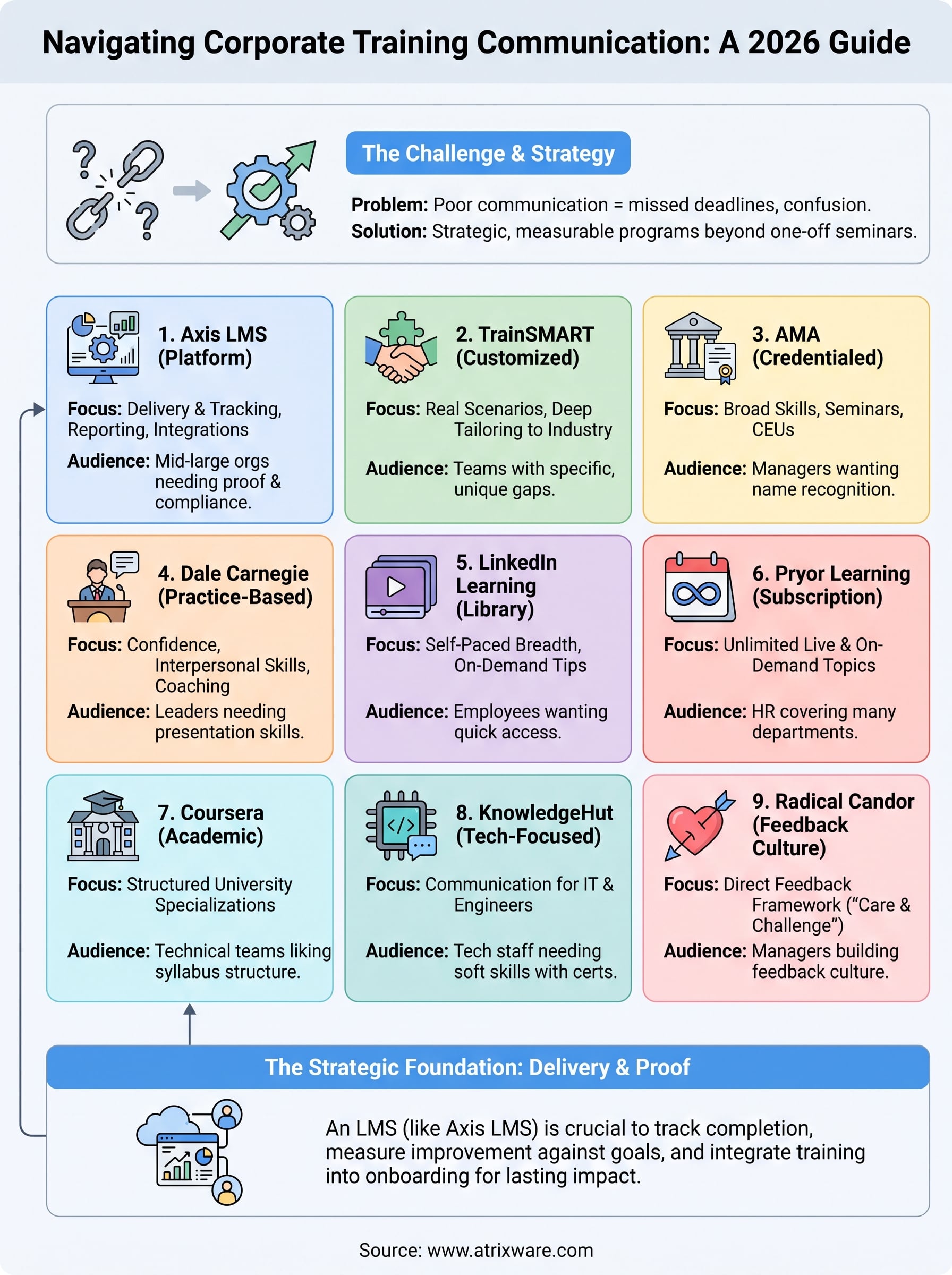
None of these nine courses fix a communication problem by themselves. AMA and Dale Carnegie build broad skills, Radical Candor sharpens one specific behavior, and Coursera or LinkedIn Learning give employees self-paced depth. What actually determines whether corporate training communication sticks is the system tracking who finished what, when they need a refresher, and whether the skill shows up in performance reviews later. Pick a course based on your actual gap, whether that’s executive presence, feedback culture, or technical teams struggling to translate jargon for stakeholders.
Once you’ve chosen, the harder question is delivery and proof. That’s where pairing your course choice with a platform built for tracking, reporting, and compliance pays off. If you’re not sure whether your current setup can handle that, find out how ready you are for an LMS and see where you actually stand before you buy anything else.
