If you’ve ever sat through a hiring process wondering why you were asked to complete a coding challenge or a personality quiz, you’ve already run into a skills assessment. These tools show up everywhere from job applications to internal training programs, and if you’re building or evaluating one, you need to know exactly what you’re dealing with before you pick a format or a vendor.
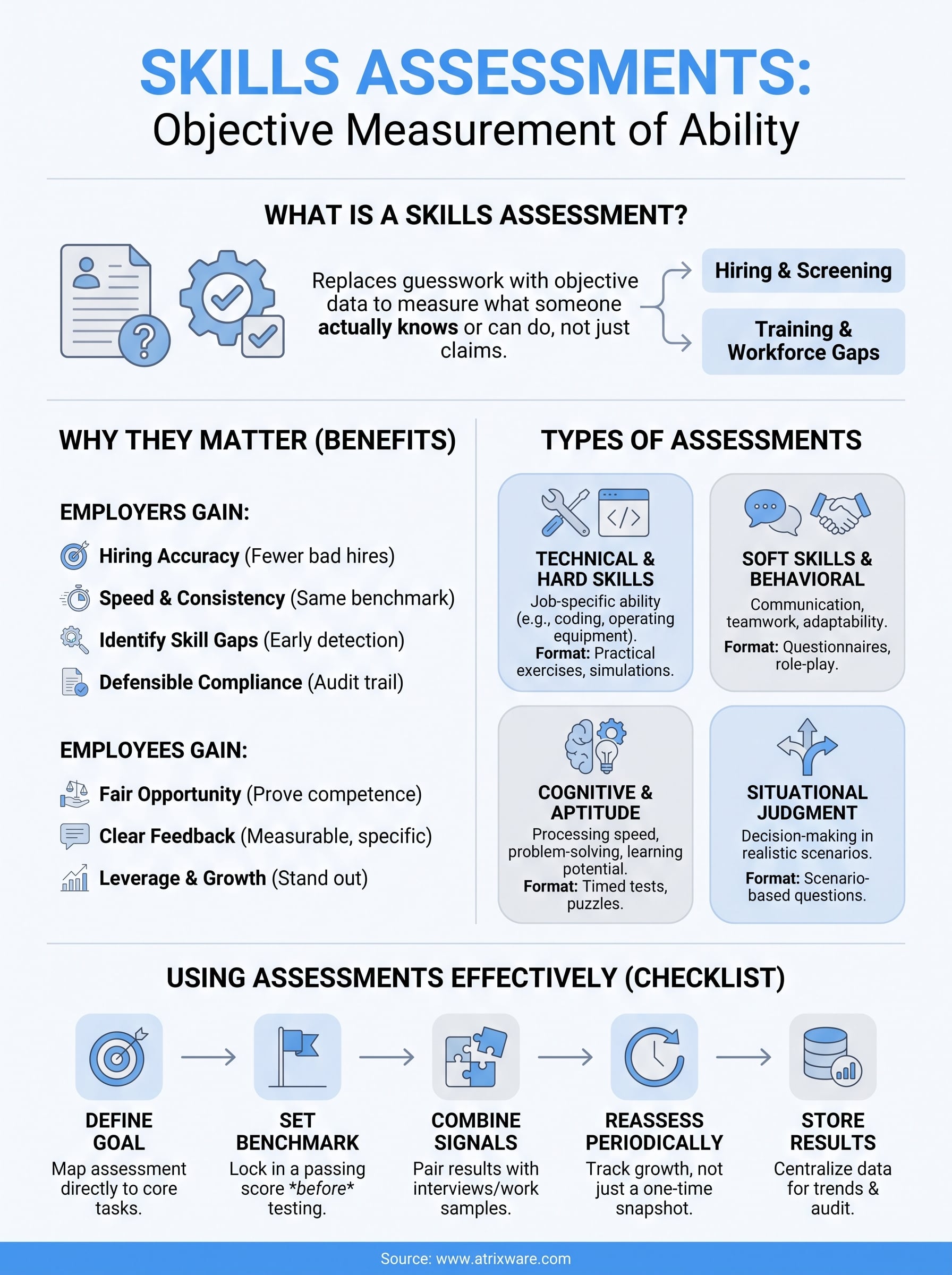
A skills assessment is a structured method for measuring what someone actually knows or can do, rather than what their resume claims. It replaces guesswork with objective data, whether you’re screening candidates, identifying gaps in your current workforce, or checking that employees met a training requirement. The format varies: timed tests, scenario-based simulations, practical exercises, even peer reviews, but the goal stays the same, get a real read on ability.
In this article, we’ll break down how these assessments work, walk through the main types you’ll encounter in hiring and workplace settings, and give you concrete examples so you can match the right tool to your situation. If you’re already running training programs, you’ll also see how assessments tie directly into tracking progress and proving competency over time.
Why skills assessments matter for employers and employees
Hiring based on resumes alone is a gamble. A polished resume tells you what someone claims to have done, not what they can actually deliver on day one. Skills assessments close that gap by giving both sides of the hiring table something concrete to work with: real evidence of ability instead of a list of job titles and buzzwords. For employees, that same evidence becomes leverage, a way to stand out from a stack of applicants who all say the same things about themselves.
What employers gain
Companies that build structured hiring around assessments make fewer bad hires, and bad hires are expensive. The U.S. Department of Labor has estimated that a poor hiring decision can cost as much as 30% of that employee’s first-year earnings. Assessments also speed up decision-making, since you’re comparing candidates against the same benchmark instead of relying on gut feel from an interview. Beyond hiring, they let you spot skill gaps across your existing workforce before those gaps turn into missed deadlines or compliance failures.
A skills assessment turns hiring and training decisions from guesswork into evidence.
What employees gain
Job seekers benefit too, even when it doesn’t feel that way in the moment. Assessments give candidates without traditional credentials, like a career changer or a self-taught developer, a fair shot at proving competence. Employees inside an organization gain something just as valuable: a clear picture of where they stand and what to learn next. Instead of vague performance reviews, they get specific, measurable feedback tied to actual tasks.
The cost of skipping assessments
Organizations that skip formal assessment and rely purely on interviews or resumes tend to see the consequences later, in turnover, retraining costs, and inconsistent performance. Here’s a quick comparison of what tends to happen with and without a structured assessment process:
| Factor | With skills assessment | Without skills assessment |
|---|---|---|
| Hiring accuracy | Based on demonstrated ability | Based on self-reported claims |
| Time to identify skill gaps | Early, before performance suffers | Late, often after mistakes occur |
| Compliance tracking | Documented and auditable | Informal, hard to prove |
| Training ROI | Measurable against baseline scores | Difficult to quantify |
Gaps like these matter most in regulated industries, where you can’t just take someone’s word that they understand a safety procedure or a data privacy rule. In those cases, an assessment isn’t a nice-to-have, it’s part of your audit trail. Learning platforms that track scores over time, tie results to specific courses, and flag employees who fall below a required threshold give compliance officers something they can actually defend if a regulator comes asking questions.
Types of skills assessments explained
Not every skills assessment measures the same thing, and picking the wrong type wastes everyone’s time. Broadly, they fall into four buckets: technical skills tests, soft skills evaluations, cognitive aptitude tests, and situational judgment exercises. Knowing which one fits your goal matters more than picking the most popular tool on the market.
Technical and hard skill tests
These measure job-specific ability: writing code, formatting a spreadsheet, troubleshooting a network, or operating equipment correctly. Employers use them heavily in IT, engineering, healthcare, and manufacturing roles where a wrong answer has real consequences. Practical exercises like live coding challenges or simulated troubleshooting scenarios tend to predict on-the-job performance better than multiple-choice quizzes.
Soft skills and behavioral assessments
Communication, teamwork, and adaptability don’t show up on a resume, so employers use structured questionnaires or role-play scenarios to surface them. These assessments matter most in client-facing roles or management positions, where technical skill alone won’t carry someone through a difficult conversation with a customer or a direct report.
The right assessment type depends entirely on what failure looks like in the role you’re hiring for.
Cognitive and aptitude tests
These gauge how quickly and accurately someone processes information, solves problems, or learns new material. They’re common in entry-level hiring, where candidates lack a long track record to evaluate, and they correlate strongly with training speed once someone’s on the job.
Situational judgment tests
Candidates read realistic workplace scenarios and choose how they’d respond. This format works well for roles involving judgment calls, like customer service escalations or safety-critical decisions, because it tests reasoning under pressure rather than memorized facts.
| Type | Best for | Format |
|---|---|---|
| Technical | IT, engineering, trades | Practical exercise, live test |
| Soft skills | Sales, management, support | Questionnaire, role-play |
| Cognitive aptitude | Entry-level, high-volume hiring | Timed multiple-choice |
| Situational judgment | Judgment-heavy, safety-critical roles | Scenario-based questions |
Most hiring processes combine at least two of these to get a fuller picture of a candidate’s readiness.
How to use skills assessments effectively
Buying a well-designed assessment tool doesn’t guarantee good decisions. How you use it determines whether you get better hires and stronger training outcomes, or just another data point nobody acts on.
Define what you’re measuring before you pick a tool
Start with the specific skill or behavior that predicts success in the role, not a generic checklist. A customer support hire needs conflict resolution and product knowledge tested directly, not a broad personality inventory that tells you little about how they’ll handle an angry caller. Vague goals produce vague assessments, and vague assessments produce results nobody trusts enough to act on.
Set a benchmark and stick to it
Decide your passing threshold before candidates or employees take the test, not after you see the scores. Without a fixed benchmark, you’ll unconsciously adjust standards to fit whoever you already like, which defeats the purpose of running an assessment at all.
An assessment only works if you commit to the benchmark before you see the results.
Combine results with other signals
No single skills assessment should make the final call on its own. Pair it with a structured interview, a reference check, or a short work sample so you’re triangulating ability from multiple angles. This matters even more in regulated fields, where a single score needs supporting documentation to hold up under review.
Reassess periodically
Skills decay or grow, so a one-time test at hiring doesn’t tell you much about performance two years later. Build recurring assessments into your training calendar, especially for compliance-driven roles, and track scores over time rather than treating each test as an isolated event.
A short checklist keeps this practical:
- Confirm the assessment maps directly to the role’s core tasks
- Lock in a passing score before testing begins
- Pair results with an interview or work sample
- Schedule follow-up assessments, not just a single snapshot
- Store results centrally so trends are visible over time
Examples of skills assessments in the workplace
Abstract definitions only go so far, so let’s look at how real companies put a skills assessment to work. Seeing what is a skills assessment in practice, rather than in theory, makes it easier to picture which format fits your own hiring or training situation.
Hiring a customer support rep
A call center hiring manager might give candidates a recorded scenario test: an angry customer script, and ask them to respond in writing or on a short video. The evaluator scores tone, accuracy, and resolution speed against a rubric set before interviews start. This single exercise often predicts on-the-job performance better than a standard interview question about "handling difficult customers."
Onboarding a new software developer
Engineering teams frequently run a live coding exercise during final-round interviews, then repeat a lighter version 90 days into employment to confirm the new hire ramped up as expected. Comparing the two scores gives managers a documented growth curve instead of a vague impression.
Verifying compliance training
In regulated industries, a compliance quiz tied to a specific course, say, a data privacy module under GDPR, gets logged with a timestamp, a score, and a pass/fail threshold. That record becomes part of the audit trail if a regulator asks for proof employees understood the material, not just that they clicked through slides.
A good assessment leaves a paper trail that holds up when someone asks for proof, not just an impression.
Comparing assessment examples side by side
| Scenario | Assessment used | What it proves |
|---|---|---|
| Support hiring | Scenario response test | Communication under pressure |
| Developer onboarding | Live coding exercise | Technical ability over time |
| Regulatory compliance | Scored quiz with logged results | Documented understanding |
| Sales team review | Role-play negotiation | Persuasion and objection handling |
Each example ties back to the same principle: measure the specific behavior that matters for that role, then keep a record you can point to later.
Putting skills assessments into practice
At its core, a skills assessment answers one question: can this person actually do the thing, not just claim they can. Whether you’re screening a new hire, checking a compliance box, or tracking growth on your existing team, the format matters less than the discipline behind it. Pick the assessment type that matches what failure looks like in the role, set your benchmark before you see any scores, and keep records you can point to later.
None of that happens by accident. You need a system that stores results, flags gaps, and ties scores back to specific training so the data actually drives decisions instead of sitting in a spreadsheet nobody opens again. If you’re already thinking about how to build that system for your own team, try the Axis LMS admin demo and see how assessment tracking works in practice.
