Every time someone fills out a form, completes an online course, or shares personal details with a company, they’re trusting that organization to handle their information responsibly. So what is data privacy, exactly? It’s the set of practices, laws, and principles that govern how organizations collect, store, use, and share personal information. It sounds straightforward, but the stakes are enormous, for individuals and businesses alike.
Get it wrong, and the consequences go beyond fines. Breached trust is hard to rebuild, and regulatory penalties under laws like GDPR and CCPA can cripple operations. Get it right, and you create a foundation of trust that strengthens every relationship your organization has, with employees, customers, and partners. For any company managing sensitive data (including the learner records, assessment results, and personal details that flow through training and compliance programs), data privacy isn’t optional. It’s a core business responsibility.
At Atrixware, we build Axis LMS with this reality front and center. Our platform helps organizations deliver and track training, including compliance training for regulations like GDPR and FDA 21 CFR Part 11, which means data privacy is woven into what we do every day. This article breaks down what data privacy means in practice, why it matters to your organization, the major laws you need to know, and real-world examples that bring the concept to life.
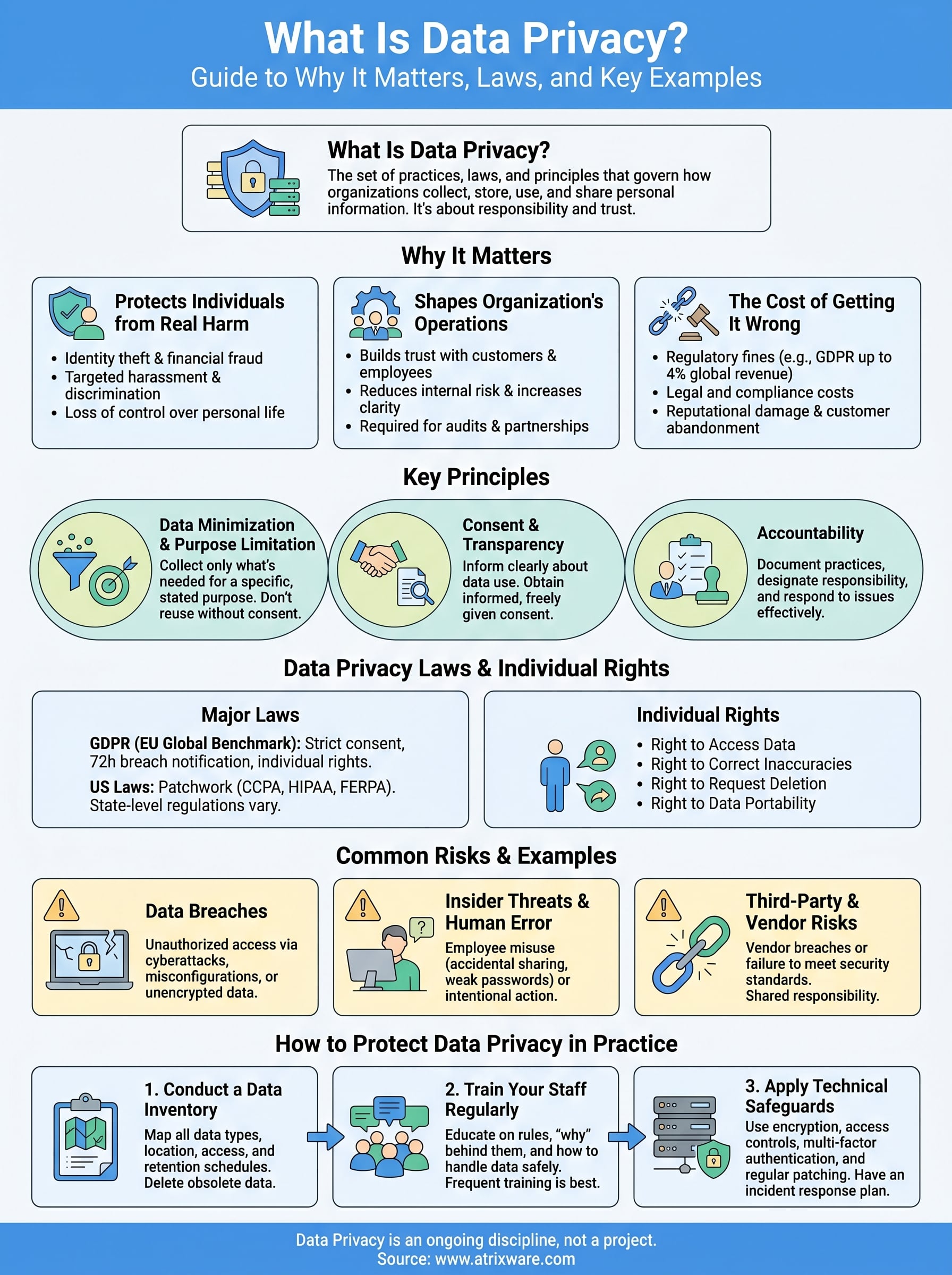
Why data privacy matters
Understanding what is data privacy goes hand in hand with understanding why it has become one of the defining challenges for modern organizations. Personal information, whether it’s a name and email address or detailed health and financial records, has real value. When organizations collect that data, they take on a responsibility to protect it. Fail that responsibility, and the damage reaches far beyond legal penalties. Individuals lose control over their own lives, and organizations lose the trust that took years to build.
It protects individuals from real harm
When personal data falls into the wrong hands, the consequences for individuals are immediate and concrete. Identity theft, financial fraud, and targeted harassment are not theoretical risks. They are documented outcomes of real data breaches. Someone whose health records are exposed may face discrimination from employers or insurers. A learner whose training records leak could have sensitive performance data used against them.
Data privacy isn’t just about regulations; it’s about protecting the people behind the data.
Beyond high-profile breaches, everyday misuse of data causes harm too. When organizations sell personal information to third parties without consent, or use it in ways people never agreed to, they strip individuals of their ability to make informed choices. That loss of control is itself a form of harm, even when no dramatic breach occurs.
It shapes how your organization operates
Data privacy doesn’t just affect your customers or learners. It shapes how you design your systems, write your policies, and train your staff. Organizations that treat privacy as an afterthought consistently find themselves scrambling to retrofit protections onto systems that were never built to support them. That is expensive, slow, and risky.
Building privacy into your workflows from the start is a different approach entirely. When your team knows what data you collect, why you collect it, and how long you keep it, you reduce internal risk and improve operational clarity. That discipline pays off in audits, in vendor negotiations, and in the confidence you give to employees and customers who trust you with their information.
The cost of getting it wrong
Regulatory fines under laws like GDPR can reach up to 4% of global annual revenue for the most serious violations. In the United States, state-level laws like the California Consumer Privacy Act (CCPA) add another layer of financial exposure. These numbers get attention in boardrooms, and rightly so. But the harder cost to quantify is reputational damage.
Research consistently shows that consumers abandon organizations after a data breach. In industries where trust is the product, such as healthcare, financial services, and professional training, that abandonment can be permanent. Your organization’s ability to attract new clients, retain existing ones, and compete for talent all depend on your reputation for handling data with care. One significant incident can unravel years of goodwill, and no fine schedule captures that loss in full.
Key concepts and principles
When you work through what is data privacy in the context of your organization, a handful of core principles come up repeatedly across different laws, frameworks, and industry standards. These principles aren’t abstract ideals. They are practical guidelines that shape how you collect data, communicate with the people whose data you hold, and respond when something goes wrong.
Data minimization and purpose limitation
Data minimization means you collect only the personal information you actually need for a specific, defined purpose. If you’re running a compliance training course and need to track completion, you don’t need a learner’s home address or financial history. Collecting more than you need creates unnecessary risk and signals to regulators and auditors that your data practices lack discipline.

Purpose limitation works alongside minimization. It means you use the data you collect only for the reason you stated when you collected it. If someone provides their email address to receive a training certificate, you shouldn’t add them to a marketing list without separate consent. These two principles work together to keep your data practices focused and defensible.
Consent and transparency
Transparency requires that you tell people clearly what data you collect, how you use it, how long you keep it, and who you share it with. You should communicate this in plain language, not in legal text that only a lawyer can parse. People make better decisions about sharing their information when they understand what they’re agreeing to.
Consent is only meaningful when the person giving it fully understands what they’re consenting to.
Informed consent means the individual actively agrees to the data collection before it happens, not buried in a checkbox at the bottom of a long form. In many jurisdictions, consent must be freely given, specific, and easy to withdraw.
Accountability
Accountability means your organization takes ownership of its data practices, not just on paper, but in how your systems are built, how your staff are trained, and how you respond when a problem surfaces. Designating clear responsibility for privacy decisions and documenting your processes is how accountability becomes real rather than theoretical.
Data privacy laws and individual rights
Any honest conversation about what is data privacy has to include the legal landscape. Governments around the world have passed binding regulations that define what organizations must do to protect personal information, and what rights individuals hold over their own data. Knowing these laws isn’t optional for your organization. Compliance is a legal requirement, and violations carry real financial and reputational consequences.
GDPR: The global benchmark
The General Data Protection Regulation (GDPR), enforced by the European Union since 2018, is the most influential data privacy law in the world. Even if your organization operates outside Europe, GDPR applies to you if you collect data from EU residents. It established strict requirements around consent, data minimization, breach notification, and individuals’ rights, setting a standard that many other laws have since followed.
The GDPR didn’t just create compliance obligations; it fundamentally shifted the expectation that individuals should control their own personal data.
Under GDPR, your organization must report certain data breaches to supervisory authorities within 72 hours of becoming aware of them. You must also appoint a Data Protection Officer in specific circumstances and document your data processing activities in detail.
U.S. privacy laws: A patchwork framework
Unlike the EU’s unified approach, the United States relies on a mix of federal sector-specific laws and state-level regulations. The California Consumer Privacy Act (CCPA), which took effect in 2020 and was strengthened by the California Privacy Rights Act (CPRA), gives California residents broad rights over their personal data, including the right to know what data you collect and the right to opt out of its sale.
Other U.S. laws target specific sectors. HIPAA covers health information, while FERPA protects student education records. Your compliance obligations depend heavily on your industry and the states where your customers or employees are located.
Individual rights under privacy law
Most modern privacy laws grant individuals a consistent set of rights. These typically include the right to access their data, the right to correct inaccurate information, and the right to request deletion. Some frameworks also include the right to data portability, which means individuals can ask for their data in a usable format and transfer it elsewhere.
Your organization needs clear processes for handling these requests within legally required timeframes. Failing to respond properly to a data subject request is itself a compliance violation.
Common data privacy risks and examples
Understanding what is data privacy in theory is one thing. Seeing where it breaks down in practice is what sharpens your organization’s response. Privacy risks don’t come from a single source, and most incidents trace back to a combination of technical gaps, human behavior, and vendor relationships that weren’t managed carefully enough. Knowing the most common categories helps you allocate your attention and resources where they actually matter.
Data breaches and unauthorized access
A data breach happens when unauthorized parties gain access to personal information your organization holds. High-profile examples include large-scale attacks on healthcare networks, financial institutions, and retail platforms, where millions of records, including names, Social Security numbers, and payment details, were exposed in a single incident. The result for affected individuals is often years of financial and identity consequences that are difficult to reverse.
The size of your organization doesn’t determine your exposure; how well you’ve secured your systems does.
Breaches don’t always involve sophisticated attacks. Many occur because access controls are misconfigured, outdated software creates exploitable vulnerabilities, or sensitive data is stored without encryption. Regular security audits and access management reviews reduce your exposure significantly.
Insider threats and human error
Not all privacy incidents come from outside your organization. Employees with legitimate access to personal data can misuse it, either intentionally or through careless handling. Sending a training report to the wrong email address, storing learner data on an unencrypted personal device, or sharing login credentials with colleagues are common examples that create real compliance exposure without any malicious intent.
Intentional insider threats are less frequent but more damaging. A departing employee downloading customer records, or a staff member accessing data outside the scope of their role, can trigger regulatory investigations and breach notification obligations.
Third-party and vendor risks
Your data privacy obligations don’t pause when you hand data to a vendor. If a supplier processes personal information on your behalf and suffers a breach, your organization shares responsibility. Reviewing vendor contracts, requiring data processing agreements, and confirming that third parties meet your security standards before you share data are non-negotiable steps in a sound privacy program.
How to protect data privacy in practice
Knowing what is data privacy is the starting point. Acting on that knowledge is what actually reduces your organization’s risk. Protection doesn’t come from a single policy document or a one-time audit. It comes from consistent, specific practices that your team applies across how you collect, store, and handle personal information every day.
Conduct a data inventory
You can’t protect data you don’t know you have. Start by mapping every category of personal information your organization collects, where it lives, who can access it, and how long you retain it. This inventory becomes the foundation for every other privacy decision you make, including what to keep, what to delete, and where to tighten controls.
Retention schedules matter here. Holding data longer than your stated purpose requires creates unnecessary risk and potential regulatory exposure. Delete what you no longer need as soon as your defined retention period ends.
Train your staff regularly
Human error causes a significant share of privacy incidents, which means staff training isn’t a compliance checkbox. It’s a core risk reduction activity. Your employees need to understand how to handle personal data in their specific roles, what to do if they suspect a breach, and why the rules you’ve put in place exist rather than just what they are.
Training people on the "why" behind privacy rules produces better judgment in situations no policy document anticipated.
Short, frequent training sessions outperform annual all-hands reviews for retention and behavioral change.
Apply technical safeguards
Encryption, access controls, and regular security patching form the technical baseline your organization needs to support sound privacy practices. Limit access to personal data to people who genuinely need it for their role, and review those permissions regularly as roles change.
Multi-factor authentication adds a meaningful layer of protection against unauthorized access, especially for systems that hold sensitive learner or employee records. Pair these controls with a documented incident response plan so your team knows exactly what steps to take if something goes wrong.
Final takeaways
Understanding what is data privacy puts you in a position to make better decisions across your entire organization. The core idea is straightforward: people who share their information with you deserve to have it handled with care, and your organization has both a legal obligation and a practical incentive to do exactly that. Privacy isn’t a project with a finish line. It’s an ongoing discipline that lives in your systems, your policies, and the habits of every person on your team.
The organizations that handle this well share a common approach. They know what data they hold, they limit what they collect, they train their people consistently, and they build accountability into their workflows rather than bolting it on after the fact. If your organization manages learner records or runs compliance training, those same standards apply directly to your LMS environment. Take the LMS readiness quiz to find out where you stand.
