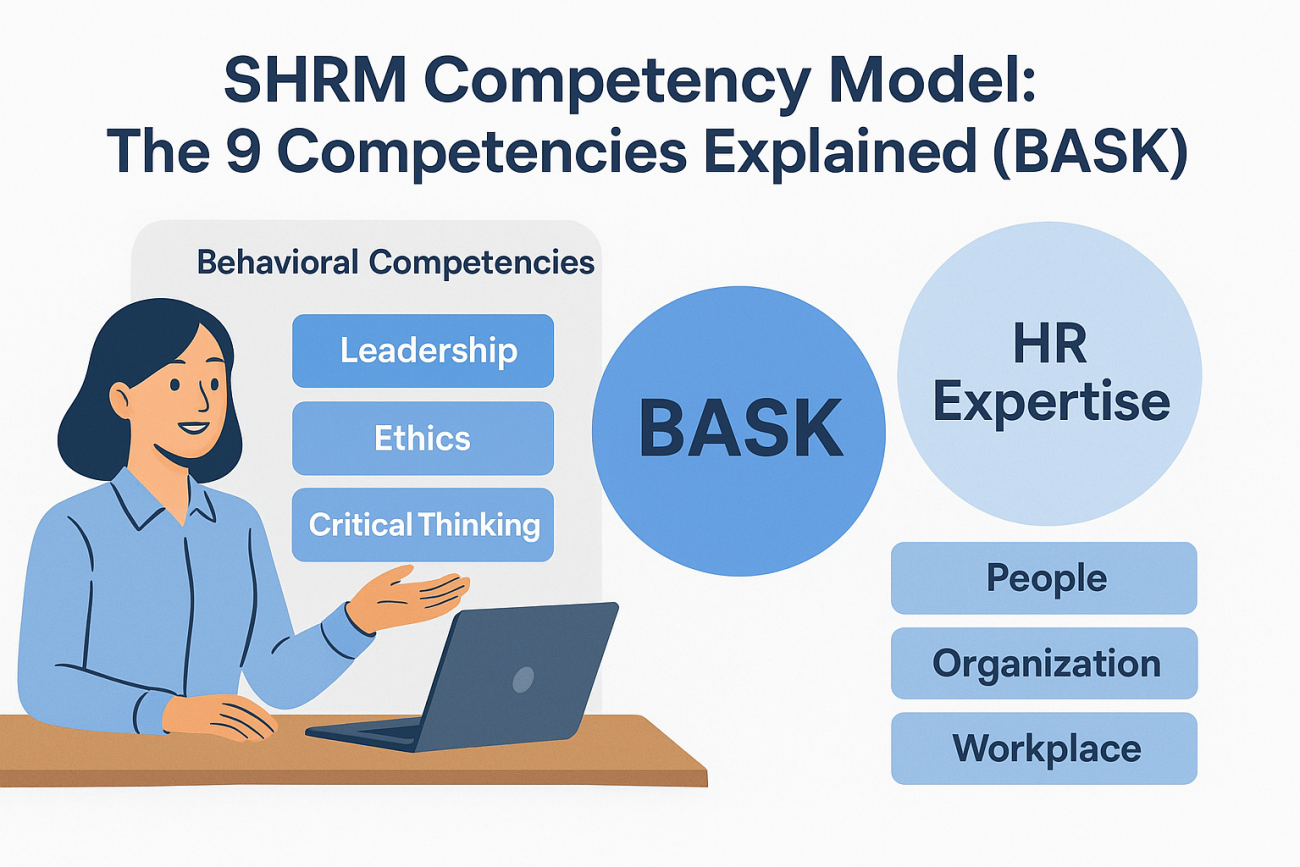
The SHRM Competency Model, rebranded as the SHRM Body of Applied Skills and Knowledge (BASK), defines what HR professionals need to know and do to be effective at every career stage. It outlines nine core competencies that blend behavioral skills like leadership and communication with technical knowledge areas like people management, workplace strategy, and employment law. Whether you’re preparing for SHRM-CP or SHRM-SCP certification, or simply building a roadmap for your HR team’s growth, understanding these competencies is the starting point.
For organizations investing in HR professional development, the model also serves as a practical training framework. It tells you exactly which skills to build programs around, and which gaps to close. That’s where a platform like Axis LMS from Atrixware fits in: it gives HR and L&D teams the tools to design, deliver, and track competency-based training that maps directly to frameworks like the SHRM BASK, complete with progress reporting, compliance tracking, and CEU management.
This article breaks down all nine competencies in the SHRM BASK, explains how they’re structured across behavioral and technical categories, and covers their role in SHRM’s certification exams. By the end, you’ll have a clear picture of what each competency involves and how it applies to real HR work.
What the SHRM competency model is
The SHRM Competency Model is a structured framework that defines the skills, behaviors, and knowledge HR professionals need to be effective across every stage of their career. SHRM developed it to give HR practitioners, employers, and educators a shared language for understanding what competent, capable HR work actually looks like. Over time, SHRM evolved the model into its current form: the SHRM Body of Applied Skills and Knowledge, or BASK.
From competency model to BASK
SHRM introduced the original competency model in 2012, and it quickly became a reference point for HR certification and professional development. In 2022, SHRM relaunched it as the SHRM BASK, updating the structure and terminology to better reflect how the HR profession had changed. The core shift was moving from a broad framework toward a more applied, role-specific model that connects behavioral skills directly to on-the-job performance.
The BASK is SHRM’s answer to a profession that needed a clearer, more actionable standard for what HR professionals should know and do at every career stage.
The BASK organizes everything into two main categories: behavioral competencies and a technical competency. Behavioral competencies cover the interpersonal and leadership skills that shape how HR professionals work with people and organizations. The technical competency, HR Expertise, covers the domain-specific knowledge that underpins day-to-day HR practice. Together, they form a complete picture of what HR professional capability looks like in practice.
How the model is structured
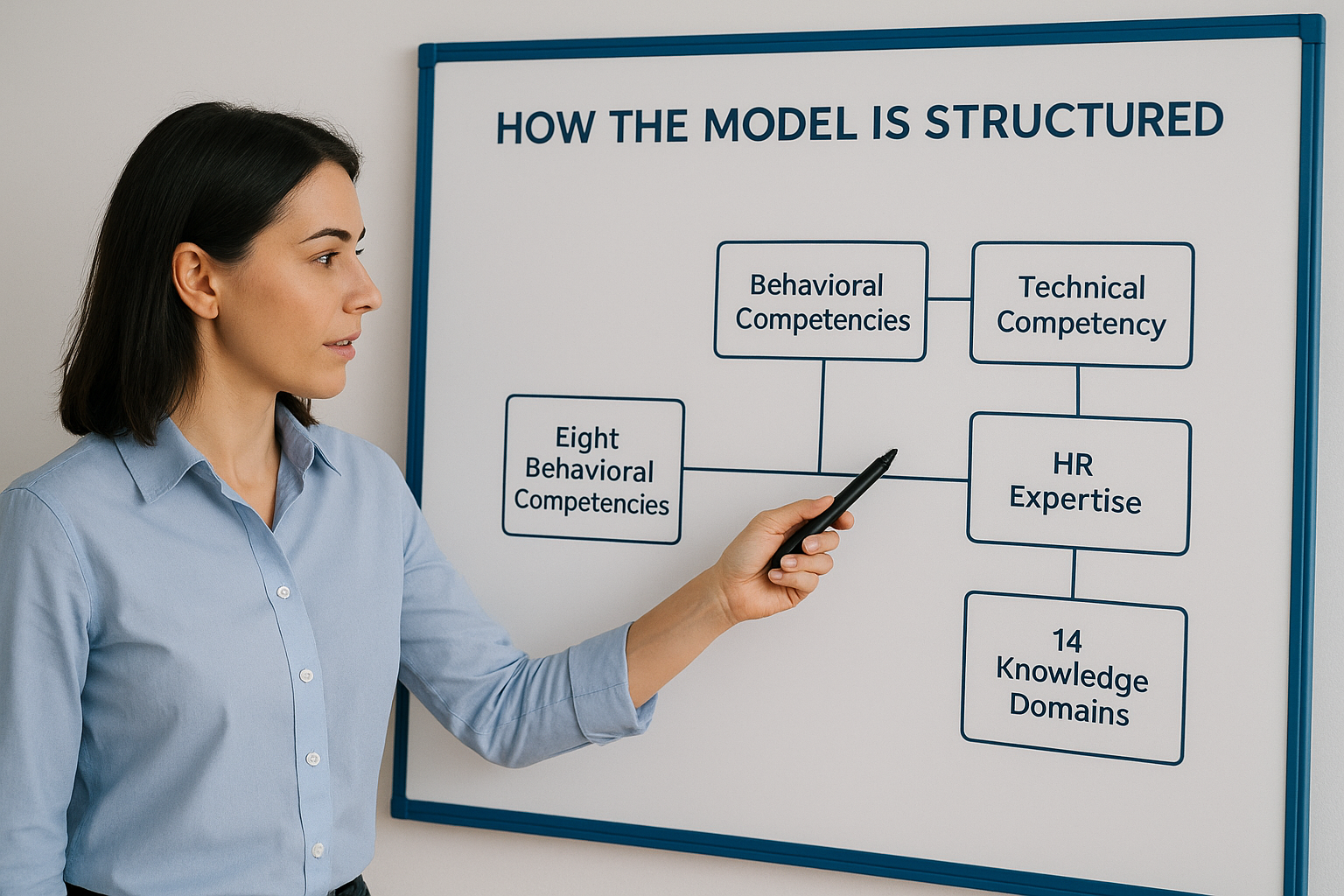
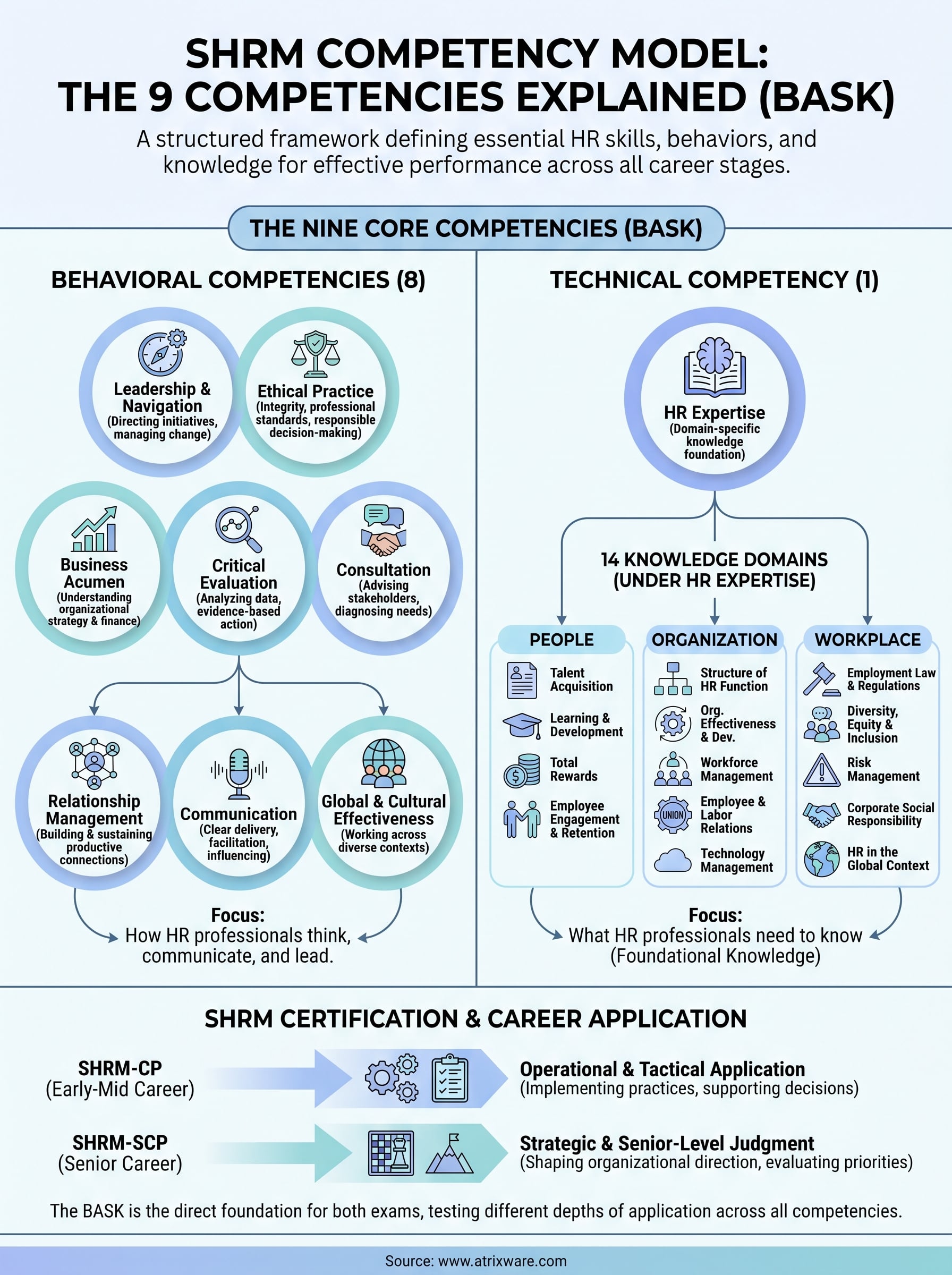
Nine total competencies make up the model: eight behavioral competencies and one technical competency. The technical competency branches into 14 knowledge domains covering everything from talent acquisition to total rewards and HR technology. Each domain breaks down further into specific topics, giving you a detailed map of what HR professionals are expected to know at each level.
SHRM also ties the model to career levels, ranging from early-career through executive. This means the model doesn’t apply uniformly across the board; the expected depth of knowledge and application shift depending on where someone sits in their career. A senior HR leader applies strategic leadership at a broader organizational level, while an early-career practitioner focuses on foundational skills and core knowledge areas. This layered approach makes the SHRM competency model useful beyond certification prep; it becomes a practical tool for building targeted development plans that reflect where each team member currently stands and where they need to go.
Why the SHRM model matters in HR work
The SHRM competency model matters because it moves HR professional development from vague goals to specific, measurable skills. Without a shared standard, organizations define HR effectiveness differently, and practitioners end up building careers around inconsistent expectations. The SHRM BASK removes that ambiguity by giving everyone, from individual HR professionals to L&D teams, a clear, agreed-upon picture of what capable HR work looks like at each career level.
A common language across the profession
One of the model’s biggest practical contributions is that it creates a consistent framework that works across industries, organization sizes, and career stages. When your HR team and your training function both refer to the same competency definitions, you eliminate the guesswork in performance reviews, hiring criteria, and development plans. You can identify exactly where someone excels and where a specific skill gap exists, rather than relying on general impressions.
This shared vocabulary is what makes the SHRM BASK useful well beyond certification prep; it functions as a professional standard that spans the entire HR career lifecycle.
A tool for building better training programs
For L&D teams and HR managers designing employee development programs, the BASK gives you a ready-made blueprint. Rather than building a training curriculum from scratch, you can map your courses directly to the nine competencies and their underlying knowledge domains. This approach ensures your programs are tied to recognized, industry-validated standards, which strengthens their credibility with both learners and leadership.
You can also use the model to prioritize where to invest training resources. If your compliance team shows gaps in business acumen or your HR generalists need stronger communication skills, the BASK tells you exactly what to target. That specificity makes training investments easier to justify and easier to measure.
The 9 behavioral competencies explained
The SHRM competency model organizes eight behavioral competencies within the BASK framework, covering the full range of skills HR professionals apply day to day. These competencies describe how HR practitioners think, communicate, and lead, rather than what technical knowledge they hold. Each one shows up differently depending on career level, but all eight are relevant across the profession.
Behavioral competencies are the skills that determine how effective an HR professional is in practice, not just on paper.
Leadership, ethics, and navigation
Leadership and Navigation focuses on your ability to direct HR initiatives, manage change, and move through organizational complexity without losing sight of priorities. Ethical Practice goes hand in hand with this: it covers your commitment to integrity, professional standards, and responsible decision-making. Together, these two competencies establish the professional foundation that everything else builds on.
Business and critical thinking skills
Business Acumen means understanding how your organization operates financially and strategically, and applying that knowledge to HR decisions. Critical Evaluation involves analyzing data, interpreting results, and using evidence to guide action rather than assumption. Consultation covers your ability to advise stakeholders, diagnose organizational needs, and recommend effective solutions. These three competencies push HR beyond administrative functions into a strategic advisory role.
People and communication skills
Relationship Management focuses on building and sustaining productive working relationships across the organization and beyond it. Communication addresses how clearly and effectively you deliver information, facilitate dialogue, and influence others. Global and Cultural Effectiveness rounds out the group by covering your ability to work across diverse cultural contexts and adapt your approach for different populations. Together, these three competencies shape how HR professionals connect with the people they serve, which ultimately determines how much impact the function delivers.
The technical competency and knowledge domains
The SHRM competency model includes one technical competency: HR Expertise. While the eight behavioral competencies define how HR professionals operate, HR Expertise covers what they need to know. It serves as the knowledge foundation that supports everything HR practitioners do, from hiring decisions to compliance management to workforce planning, and it connects directly to measurable, on-the-job performance.
HR Expertise is not a single subject area; it branches into 14 distinct knowledge domains that together cover the full scope of modern HR practice.
The 14 knowledge domains
Each of the 14 knowledge domains within HR Expertise maps to a specific functional area of HR. SHRM organizes these domains into three groups: People, Organization, and Workplace. Each domain breaks down further into subtopics, giving you a detailed picture of the knowledge expected at each career level.

| Domain Group | Knowledge Domains |
|---|---|
| People | Talent Acquisition, Learning & Development, Total Rewards, Employee Engagement & Retention |
| Organization | Structure of the HR Function, Organizational Effectiveness & Development, Workforce Management, Employee & Labor Relations, Technology Management |
| Workplace | Employment Law & Regulations, Diversity, Equity & Inclusion, Risk Management, Corporate Social Responsibility, HR in the Global Context |
Understanding these domains helps you identify exactly where your knowledge is strong and where you need to invest more time. For example, if your background is primarily in recruiting, you may have deep expertise in Talent Acquisition but limited exposure to Total Rewards or Risk Management. The domain structure gives you a precise, actionable map for both professional development planning and certification study, so you know which areas to prioritize and how much depth each one requires at your career level.
How SHRM uses BASK for SHRM-CP and SHRM-SCP
The SHRM competency model serves as the direct foundation for both SHRM certification exams. SHRM designs the SHRM Certified Professional (SHRM-CP) and SHRM Senior Certified Professional (SHRM-SCP) exams around the BASK, which means every question on either exam ties back to one or more of the nine competencies and their associated knowledge domains. Understanding the BASK is not optional if you want to pass; it is the content map.
How the two exams differ
Both certifications draw from the same BASK framework, but they test different depths of application. The SHRM-CP targets early- to mid-career HR professionals and focuses on applying competencies at an operational and tactical level. You answer questions about implementing HR practices, supporting organizational decisions, and managing day-to-day HR responsibilities effectively.
The SHRM-SCP, by contrast, tests your ability to think and act at a strategic level, applying competencies to shape organizational direction, not just execute within it.
The SHRM-SCP expects you to demonstrate senior-level judgment across the behavioral competencies and a broader command of the 14 knowledge domains. Questions at this level ask how you would evaluate competing priorities, lead through complexity, or advise executive leadership, not just what the correct policy or procedure is.
What this means for your exam prep
Knowing the BASK structure gives you a precise study roadmap. Rather than reviewing HR topics randomly, you can align your preparation directly with the competencies and knowledge domains that SHRM tests at your certification level. SHRM publishes the BASK publicly, so you can review the full breakdown of domains, proficiency levels, and behavioral indicators before you sit for the exam. Focus your study time on areas where your practical experience is thinnest, since those gaps are where exam questions are most likely to challenge you.
Where to go from here
The SHRM competency model gives HR professionals and the teams that support them a clear, structured standard for what competent HR work actually looks like. You now know how the nine competencies divide across behavioral and technical categories, how the 14 knowledge domains map to real HR functions, and how SHRM uses the BASK to design the SHRM-CP and SHRM-SCP exams at different depths of application.
If your next step is building training programs around these competencies, the right platform makes a significant difference. Axis LMS lets you design competency-based courses, track learner progress against specific skills, and manage CEUs for ongoing professional development, all in one place. You can structure your curriculum around the BASK domains and measure exactly where each team member stands. To see whether Axis LMS fits your organization’s training needs, take the LMS readiness quiz and get a clearer picture of where to start.
