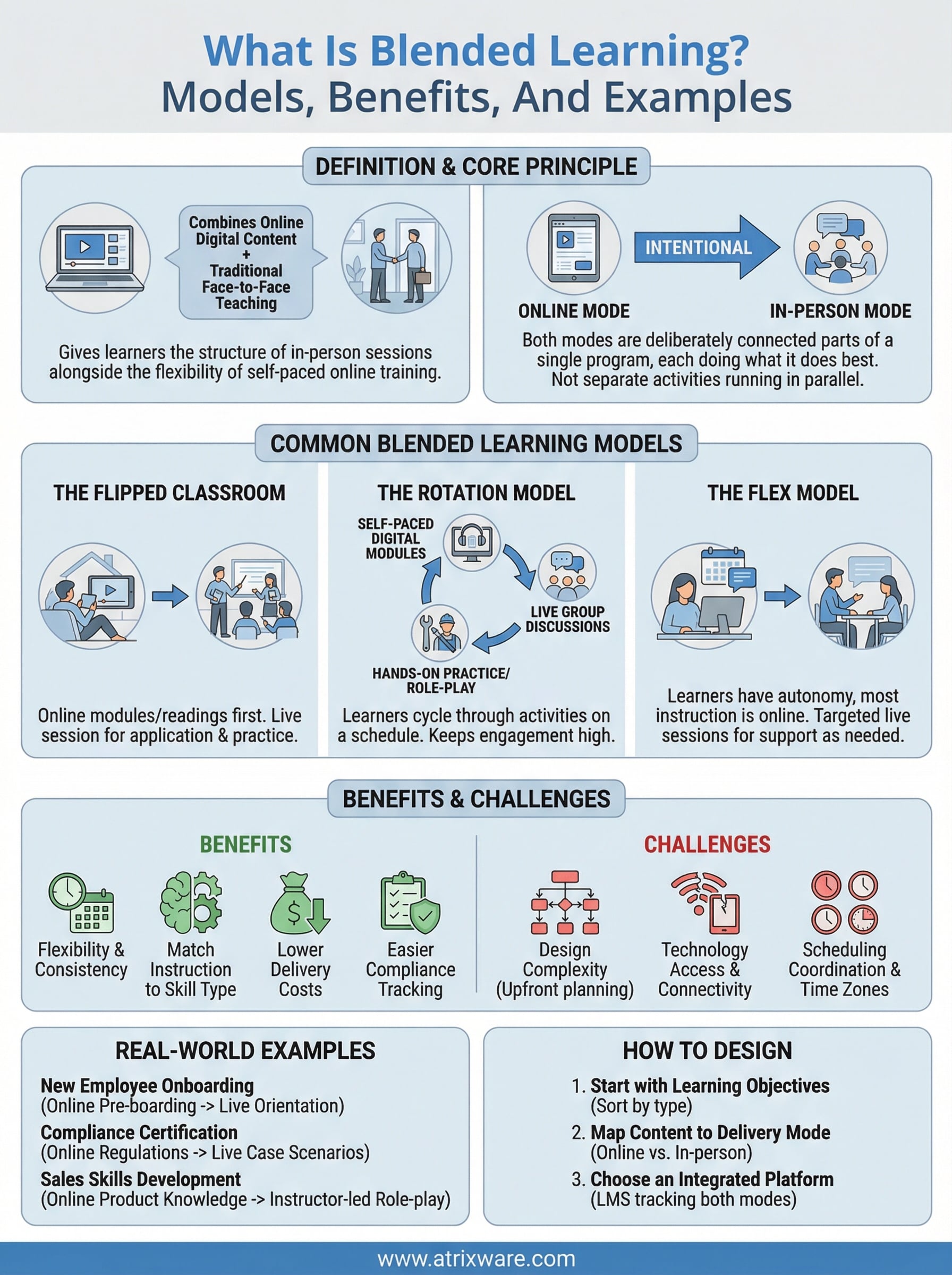
Not every training challenge can be solved by a video course alone, and not every lesson needs a physical classroom. What is blended learning? It’s an instructional approach that combines online digital content with traditional face-to-face teaching, giving learners the structure of in-person sessions alongside the flexibility of self-paced online training.
Organizations across industries are adopting blended learning because it meets learners where they are. Some concepts stick better through hands-on practice or live discussion; others are absorbed more effectively through interactive modules completed on a learner’s own schedule. When you combine both delivery methods intentionally, training becomes more adaptable, more engaging, and more effective. That’s exactly the kind of training experience Axis LMS by Atrixware is built to support, whether you’re onboarding employees, running compliance programs, or educating customers.
In this article, we’ll break down the core models of blended learning, walk through its practical benefits for businesses, and share real-world examples that show how it works. By the end, you’ll have a clear picture of how blended learning fits into a modern training strategy, and how to put it into action.
What blended learning is and what it is not
Blended learning gets applied as a label for almost anything that combines a screen with a room full of people. That loose usage creates real confusion when organizations try to design programs around it. Before you look at models or examples, it’s worth drawing a clear line between what the term actually means and what it doesn’t.
The definition of blended learning
When people ask what is blended learning, the most precise answer is this: it’s a structured instructional approach where learners experience both online and in-person delivery as deliberately connected parts of a single program, not as separate activities running in parallel. The online component is not a supplement tacked onto the end of a classroom course. The in-person session is not just a recap of what learners already watched. Both modes carry weight, and both are designed to do what the other cannot do as well.
Blended learning works best when the online and in-person components are planned together from the start, with each one doing what it does best.
The key word in that definition is intentional. A blended learning program maps out which skills or knowledge are better suited for self-paced digital modules and which require live interaction, hands-on practice, group problem-solving, or direct instructor feedback. That upfront design decision is what separates blended learning from simply assigning an online course and then scheduling a meeting to talk about it.
What blended learning is not
Knowing the definition also means recognizing what falls outside it. Several common misconceptions are worth addressing directly before you begin building or evaluating a program.
- It is not eLearning with a follow-up meeting. If learners complete an online course and then join a one-time webinar to ask questions, that’s supplemental training, not a blended learning program.
- It is not a hybrid work model. Hybrid work describes where employees do their jobs. Blended learning describes how instruction is structured, regardless of where learners are physically located.
- It is not technology for its own sake. Adding a video library or a discussion forum to a training initiative doesn’t make it blended learning unless those tools are woven into a coherent learning path with a clear instructional purpose.
- It is not a fixed format. There is no correct ratio of online to in-person time. The right balance depends on your learning goals, your audience, and your organizational context.
Blended learning also differs from fully asynchronous eLearning, where learners work entirely on their own schedule with no scheduled live interaction. It differs from traditional instructor-led training as well, where all delivery happens in real time inside a classroom or virtual session. Blended learning sits between those two approaches, drawing from both without being fully defined by either. That flexibility is what makes it useful across a wide range of training scenarios, from new hire onboarding to technical skills development to compliance certification.
Common blended learning models
When you explore what is blended learning in practice, you quickly find it isn’t a single fixed structure. Instructional designers have identified several distinct models, each balancing online and in-person time differently. Knowing which model fits your training goals helps you build a program that actually works rather than one that just checks a box.
The flipped classroom model
The flipped classroom is probably the most recognizable blended learning structure. Learners complete online modules, videos, or readings before a live session, arriving already familiar with the core concepts. The in-person or virtual classroom time then focuses on application, questions, and practice rather than basic introduction. This model works especially well for technical skills training or compliance topics where learners need time to absorb information before engaging meaningfully with an instructor.
Flipping the classroom shifts the instructor’s role from delivering information to helping learners apply it, which is a more productive use of live session time.
The rotation model
In a rotation model, learners cycle through a set of learning stations or activities on a schedule. This structure keeps learners active and engaged rather than sitting through a single extended format. Common station types in a workplace rotation include:
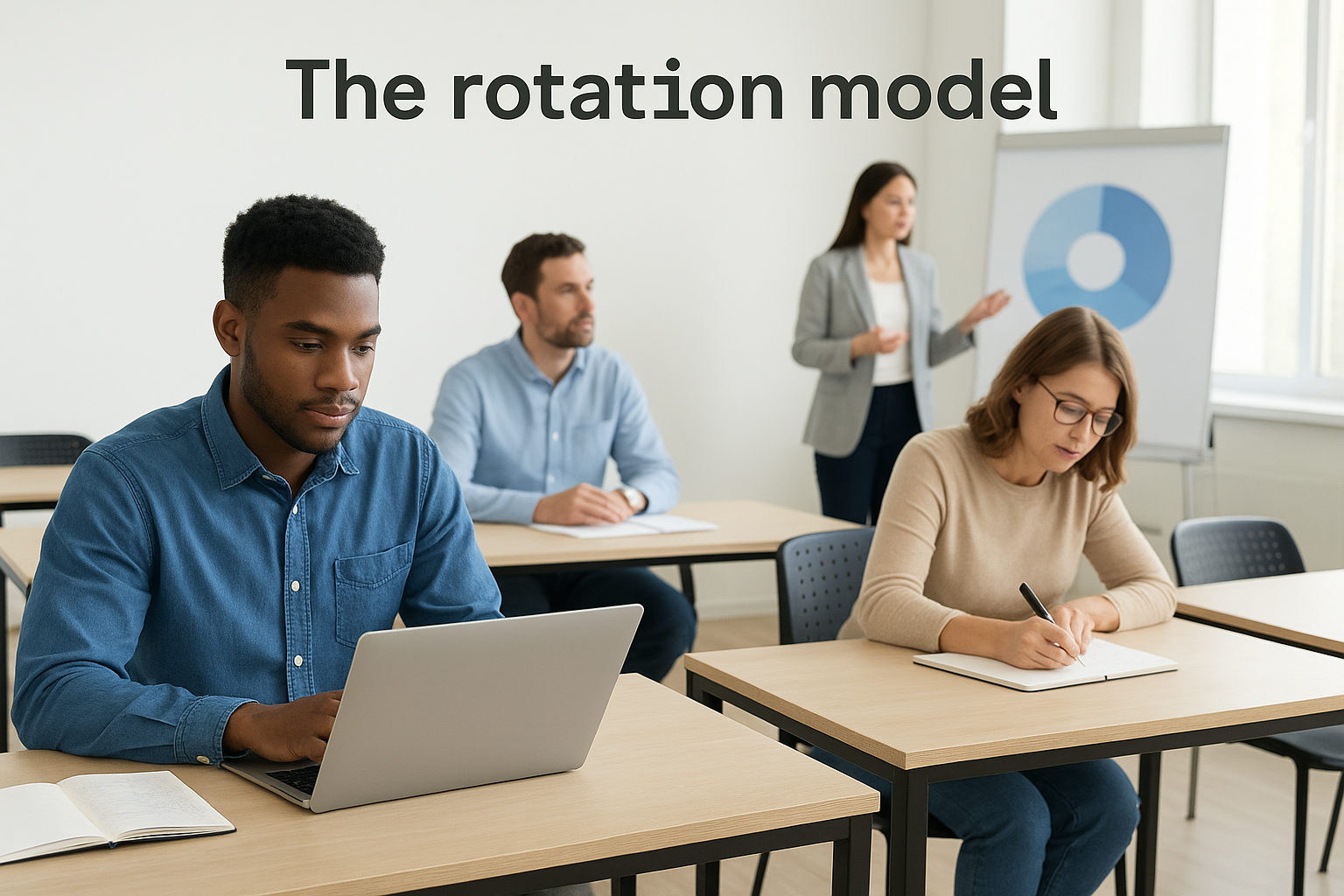
- Self-paced digital modules for concept delivery
- Live group discussions or instructor-led sessions for clarification and depth
- Hands-on practice or role-play exercises for skill application
Each station does specific work, and learners move through all of them within a defined block of time, such as a single training day.
The flex model
The flex model gives learners the most autonomy. Most instruction happens online at the learner’s own pace, while in-person support is available on an as-needed basis rather than on a fixed schedule. This model fits organizations where employees have varied schedules or work across multiple locations, since it removes the dependency on shared class time.
Managers or coaches step in to run targeted live sessions when a learner hits a difficult topic or when a skill genuinely requires direct feedback to develop correctly.
Benefits and challenges in workplace training
Understanding what is blended learning in theory is useful, but what matters for most organizations is what it actually delivers in a workplace context. The approach has real, measurable advantages, but it also comes with friction points you need to account for before you commit to it.
Benefits of blended learning in the workplace
Blended learning gives you the ability to match instruction to the type of skill being developed. Procedural knowledge, policy content, and foundational concepts transfer well through self-paced online modules. Complex skills that require judgment, feedback, or teamwork develop better through live practice. When you split delivery this way, learners spend in-person time doing work that actually requires a room, an instructor, or a group.
Blended learning reduces seat time in classrooms without reducing learning quality, which directly lowers training delivery costs for distributed teams.
Beyond cost, you gain flexibility and consistency at the same time. Remote employees and on-site staff can complete the same digital content on their own schedule, while live sessions bring everyone to the same level before moving forward. Compliance tracking also becomes easier because your LMS captures completion data from online modules automatically, giving managers a clear record without manual follow-up.
Challenges to plan for
The biggest challenge is design complexity. Building a blended program requires more upfront planning than creating a single course or scheduling a one-time workshop. You need to define how the online and live components connect, what each one covers, and how learners transition between the two without losing continuity.
Technology access creates a second obstacle. If some learners have unreliable internet connections or limited device access, the online component becomes a barrier rather than a benefit. You need to audit your audience before you build. Scheduling live sessions across time zones or shift schedules adds another layer of coordination. None of these challenges make blended learning the wrong choice, but each one requires a concrete plan before you launch.
Examples of blended learning programs
Looking at real programs helps clarify what is blended learning in practice. The following examples show how organizations apply the approach across different training contexts, each with a different balance of online content and live instruction.
New employee onboarding
New hire onboarding is one of the most common places organizations put blended learning to work. Pre-boarding digital modules cover company policies, systems access, and procedural content before the employee’s first day, so live orientation time focuses on team introductions, role-specific Q&A, and culture.
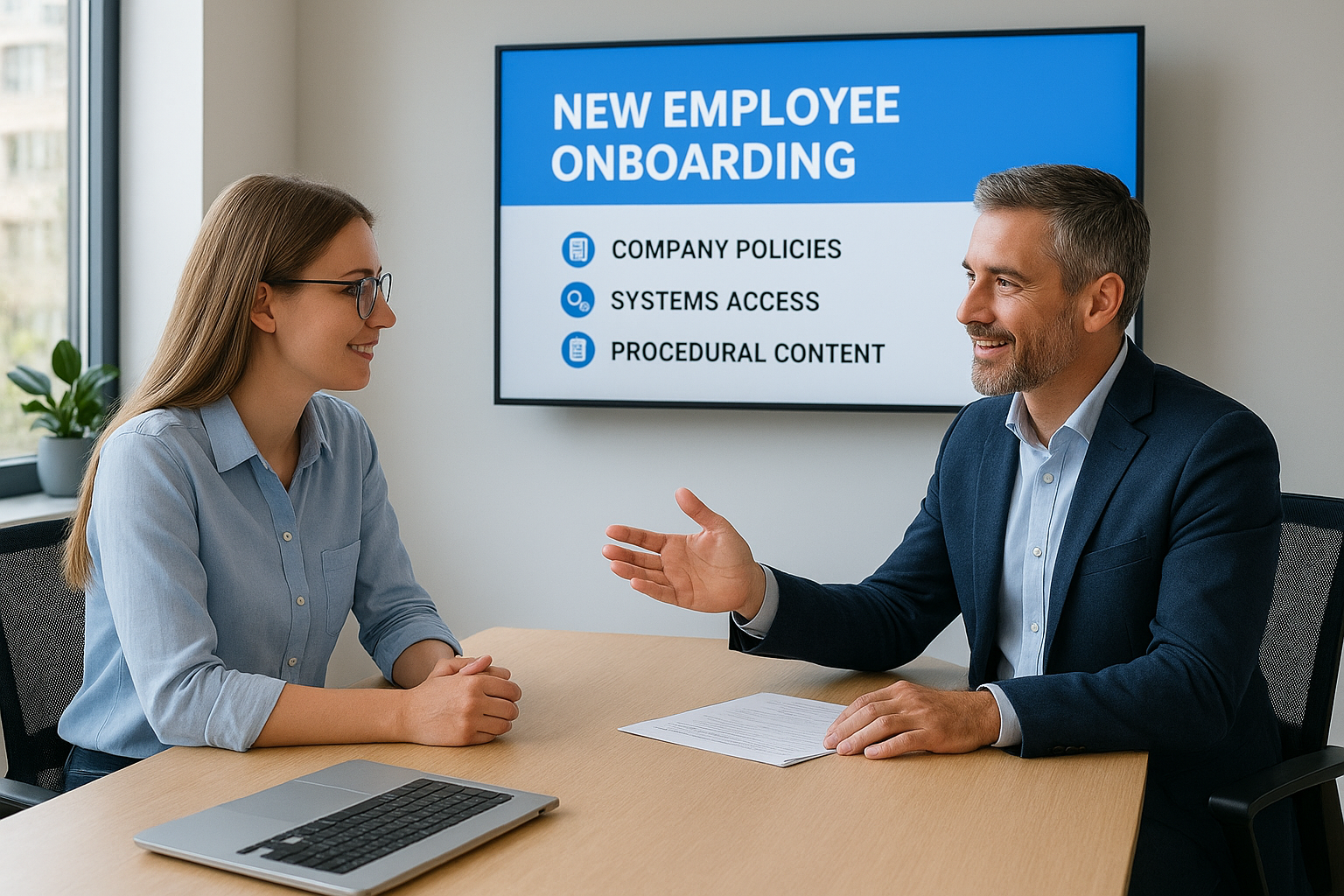
When new hires arrive already familiar with the basics, managers can use in-person time for what actually requires human interaction rather than repeating information a module already delivered.
A typical onboarding blend includes self-paced compliance courses in an LMS, a live virtual session with HR on day one, and a structured 30-day check-in schedule with a manager to reinforce what was covered online.
Compliance certification training
Regulatory and compliance training is a strong fit for blended delivery because it combines policy knowledge with applied judgment. Learners complete online modules covering the regulatory framework, definitions, and documentation requirements on their own schedule. A follow-up instructor-led session then works through case scenarios where learners practice identifying violations or making compliant decisions in realistic situations.
Your LMS tracking data from the online component also gives compliance officers a clean audit trail without additional administrative effort, which matters for industries like healthcare, finance, and manufacturing where regulatory accountability is a legal requirement.
Sales skills development
Sales training benefits from blending because product knowledge and competitive comparison content transfer well through online modules, while persuasion, objection handling, and discovery conversations need live practice to develop. Learners complete digital modules first, then join instructor-led role-play sessions where they apply those skills in coached scenarios.
Teams distributed across regions can complete the same digital content on their own schedule and then join a shared virtual practice session, keeping training consistent across locations without requiring travel budgets or coordinated schedules.
How to design a blended learning program
Putting what is blended learning into practice starts before you pick a platform or schedule a session. Good design begins with a clear understanding of what your learners need to do after training ends, not with the format. If you start with a delivery method rather than a learning goal, you’ll end up with a structure that doesn’t serve either component well.
Start with your learning objectives
Every decision in a blended program flows from your learning objectives. Write out specifically what learners should know, demonstrate, or apply by the end of the program. Then sort those objectives by type, because not all goals fit the same delivery mode equally well:
- Conceptual knowledge (policies, definitions, frameworks): best suited for self-paced online modules
- Behavioral skills (difficult conversations, equipment operation): require live practice and direct feedback to develop correctly
Matching each objective to the right delivery mode is the single most important design step, because it determines whether learners actually retain and apply what they’re taught.
Map content to delivery mode
Once you have your objectives sorted, assign each topic to either online or in-person delivery based on what each mode does best. Build a simple content map that shows the full sequence: what learners complete before a live session, what happens during it, and what follow-up they complete afterward. This structure keeps both components connected rather than running as separate, unrelated tracks.
Your content map should also identify checkpoints and assessments so you know whether learners are ready to progress before bringing them into a live session.
Choose a platform that supports both modes
Your LMS needs to handle course delivery, progress tracking, and communication in one place. Learners should complete digital modules, receive session reminders, and access post-session materials without switching between systems. An integrated platform like Axis LMS removes that friction and gives administrators a single dashboard for tracking completion across both delivery modes.
A platform built for blended delivery also simplifies compliance tracking, since online module completions log automatically alongside records from instructor-led sessions, giving managers a complete training picture without manual follow-up.
Key takeaways
What is blended learning at its core? It’s a structured approach that combines self-paced online instruction with intentional live interaction, where each delivery mode handles what it does best. You’ve seen how the flipped classroom, rotation, and flex models each distribute that balance differently depending on your audience and goals. You’ve also seen how real programs, from onboarding to compliance certification to sales training, apply the approach across different contexts.
Blended learning works because it gives you flexibility without sacrificing structure, and engagement without requiring every learner to be in the same room at the same time. The design process matters as much as the content itself. Start with clear objectives, match each topic to the right delivery mode, and choose a platform that tracks both components in one place.
If you’re ready to build a blended program, take the LMS readiness quiz to find out where to start.
