Not every training program fits neatly into a single format. Some skills are better taught face-to-face, while others click faster through self-paced online modules. That’s exactly why blended learning works, it combines both approaches so your team actually retains what they learn. But pulling it off well requires the right platform, and finding the best blended learning software can be the difference between a training program that drives results and one that falls flat on engagement.
Choosing a platform means weighing factors like course-building flexibility, reporting depth, integrations with your existing HR or CRM tools, and how easily learners can move between online and in-person sessions. At Atrixware, we built Axis LMS to handle exactly these challenges, giving businesses a scalable way to deliver, track, and manage blended training without the headaches.
Still, we know one size doesn’t fit every organization. This guide breaks down eight blended learning platforms worth considering, including what each does well and where they fall short. Whether you’re training employees, customers, or channel partners, you’ll walk away with a clear picture of your options and enough detail to make a confident decision.
1. Axis LMS by Atrixware
Axis LMS is built for businesses that need a flexible, scalable training platform and want full control over how they deliver it. Whether you’re running compliance training, onboarding new hires, or selling courses externally, Axis LMS handles all of these scenarios without requiring a collection of separate tools to fill the gaps.
How Axis LMS supports blended learning
With Axis LMS, you can combine online self-paced courses with virtual classroom sessions so learners move through training in the format that fits each topic. The platform lets you sequence online modules alongside instructor-led events inside structured learning paths, giving learners a clear progression from start to finish.

When your learners can move between online and in-person formats without friction, training completion rates improve significantly.
Best for
Mid-size to large businesses that need a full-featured LMS with strong compliance tools, deep branding customization, and the ability to sell training externally will get the most out of Axis LMS. It also suits organizations that require white-label environments or complex integrations with existing HR and CRM systems.
Standout features
Axis LMS includes a drag-and-drop course builder that makes rapid content creation accessible to non-technical administrators. You also get built-in e-commerce functionality to sell seat licenses or individual courses, which separates it from many competitors when you’re evaluating the best blended learning software that doubles as a revenue channel.
Integrations, automation, and admin controls
You get direct connections to HR and CRM systems like ADP, Salesforce, BambooHR, and Zoho right out of the box. The platform also supports over 5,000 integration options through its Integration Builder, plus REST API access, webhooks, and SAML SSO compatibility with platforms like Okta, Azure, and Ping Identity.
Reporting, compliance, and security
Automated and on-demand reports give you real-time visibility into learner progress, course completion rates, and overall training effectiveness. Axis LMS also supports GDPR and FDA 21 CFR Part 11 compliance, backed by world-class data security and configurable security settings at the platform level.
Pricing
Axis LMS uses a custom, quote-based pricing model that scales with your user count and feature requirements. You can contact Atrixware directly to build a package that fits your organization’s specific training scope and budget.
2. TalentLMS
TalentLMS is a cloud-based LMS that has built a strong reputation for being easy to set up and accessible for teams with limited technical resources. It works well for small to mid-size businesses that want a capable platform without a steep learning curve.
How TalentLMS supports blended learning
TalentLMS lets you combine online courses with instructor-led training (ILT) sessions within the same environment. You can schedule live classroom or virtual sessions directly alongside self-paced content, giving learners a structured path that mixes both formats.
When your platform handles both formats in one place, you spend less time managing logistics and more time improving content.
Best for
TalentLMS fits small to mid-size businesses and teams looking for a straightforward, budget-friendly LMS that covers core blended learning needs without extensive configuration.
Standout features
The platform includes a branch feature that lets you create separate training environments for different teams or customer groups. You also get a built-in video conferencing integration and ready-made course templates that speed up content development.
Integrations, automation, and admin controls
TalentLMS connects with tools like Salesforce, BambooHR, and Zapier for workflow automation. Admin controls are solid for its price range, though complex custom integrations may require third-party support.
Reporting, compliance, and security
You get standard compliance tracking and reporting dashboards, with support for SCORM and xAPI content. Security follows industry-standard practices, including SSO options.
Pricing
TalentLMS offers tiered subscription plans starting with a free option for up to five users. Paid plans scale by active user count, making it one of the more accessible pricing models among the best blended learning software options reviewed here.
3. Docebo
Docebo is an enterprise-grade LMS that focuses heavily on AI-driven learning personalization. It targets larger organizations that need a platform capable of scaling across thousands of learners in multiple regions without sacrificing a consistent learner experience.
How Docebo supports blended learning
Docebo combines [self-paced online content with instructor-led training (ILT)](https://www.training-central.net/2026/03/04/blended-learning-instructional-design/) by letting you schedule classroom and virtual sessions alongside digital modules in structured learning plans. Learners track their progress through both formats inside a single dashboard, reducing confusion about what comes next.
When your platform surfaces the right content to each learner automatically, blended programs run more smoothly at scale.
Best for
Docebo fits mid-to-large enterprises that need AI-powered content recommendations, multi-tenant environments, and the flexibility to train both internal employees and external audiences like customers or partners simultaneously.
Standout features
The platform’s AI content recommendations surface relevant courses based on each learner’s role and activity history. Docebo also includes a content marketplace with pre-built course libraries, which saves time when you need to fill gaps in your catalog quickly.
Integrations, automation, and admin controls
Docebo connects with major HR and CRM tools and offers a robust API for custom integrations. Automation rules handle enrollment triggers, notifications, and learning path progression without requiring constant manual input from admins.
Reporting, compliance, and security
Docebo provides advanced analytics dashboards and supports SCORM, xAPI, and AICC standards. The platform meets enterprise security requirements and offers audit trail features suited for regulated industries.
Pricing
Docebo uses a custom pricing model based on user count and selected features. You need to contact their sales team directly for a quote, which makes it less transparent than several other best blended learning software options on this list.
4. 360Learning
360Learning is a collaborative learning platform that focuses on letting subject matter experts inside your organization build and share courses quickly. It positions itself around peer-driven learning rather than top-down content delivery, which makes it a different fit compared to more traditional LMS platforms.

How 360Learning supports blended learning
360Learning supports blended learning by letting you combine self-paced online modules with live sessions in structured learning paths. You can schedule virtual or in-person sessions alongside digital content, giving learners clear guidance on what to complete independently and what requires group attendance.
When your internal experts drive content creation, you close knowledge gaps faster than relying solely on external course libraries.
Best for
360Learning works best for organizations that prioritize collaborative, peer-driven training and want to empower internal teams to contribute content rather than depending on a central L&D team to build everything from scratch.
Standout features
The platform includes built-in discussion tools and reaction features that keep learners engaged during course progression. Course creation is also fast, since the interface is designed so that non-instructional designers can build content without significant training.
Integrations, automation, and admin controls
360Learning connects with tools like Salesforce and BambooHR, and its API supports custom integrations. Automation handles enrollment and notification workflows, though advanced admin controls are less robust than enterprise-focused competitors.
Reporting, compliance, and security
You get standard learning analytics and SCORM support, though compliance features for regulated industries are more limited compared to the best blended learning software options built specifically for compliance-heavy environments.
Pricing
360Learning offers per-user monthly pricing starting around $8 per user, with custom enterprise pricing available for larger organizations.
5. iSpring Learn
iSpring Learn is a cloud-based LMS built around tight integration with iSpring Suite, the company’s PowerPoint-based authoring tool. That connection makes it a practical choice for teams that already create training content in PowerPoint and want a direct path from content authoring to delivery without switching tools.
How iSpring Learn supports blended learning
iSpring Learn lets you schedule instructor-led training (ILT) sessions alongside self-paced online courses inside structured learning tracks. Learners see both digital assignments and upcoming live sessions in a single view, which removes the need to manage separate calendars or communication threads for each format.
When your authoring tool connects directly to your LMS, you cut the time between building a course and getting it in front of learners.
Best for
iSpring Learn fits small to mid-size businesses looking for a simple, low-friction platform, especially teams that use or plan to use iSpring Suite for course creation.
Standout features
The tight pairing with iSpring Suite is iSpring Learn’s biggest differentiator among the best blended learning software options here. You also get mobile-ready course delivery so learners can complete modules on any device without extra configuration.
Integrations, automation, and admin controls
The platform connects with Salesforce and common HR systems, and handles basic enrollment automation and notifications. Admin controls cover user management and group assignments at a level that suits its core audience well.
Reporting, compliance, and security
Solid SCORM-compliant reporting dashboards give you clear visibility into completion rates and learner progress. The platform also includes SSO support and standard security practices for data protection.
Pricing
iSpring Learn uses per-user annual pricing that scales with your active user count. You can request a free trial directly to evaluate it before purchasing.
6. Cornerstone
Cornerstone is an enterprise learning and talent management platform built for large organizations that need to connect training directly to workforce development goals. It covers a wide range of talent processes beyond training, making it a heavier system than most businesses actually need.
How Cornerstone supports blended learning
Cornerstone lets you combine online modules with instructor-led training sessions inside structured learning paths. Admins can schedule virtual and in-person ILT events alongside digital content, giving learners a clear sequence that covers both formats.
When your training platform ties directly into your broader talent strategy, blended programs become easier to align with business outcomes.
Best for
Cornerstone fits large enterprises that need a comprehensive platform covering learning, performance management, and talent development together rather than a standalone LMS.
Standout features
The platform includes a content recommendation engine and a large content marketplace with thousands of pre-built courses. Its deep configuration options let large L&D teams build highly customized training experiences across different departments and regions.
Integrations, automation, and admin controls
Cornerstone connects with major HR systems and HRIS platforms, supports SSO, and offers extensive API access for custom integrations. Automation handles enrollment triggers and compliance reminders at scale.
Reporting, compliance, and security
You get detailed compliance tracking and audit trail features suited for regulated industries, along with robust security controls and support for SCORM and xAPI standards, which is a strong advantage when evaluating the best blended learning software for compliance-heavy environments.
Pricing
Cornerstone uses custom enterprise pricing based on your organization’s size and selected modules. You need to contact their team directly for a quote.
7. Absorb LMS
Absorb LMS is a cloud-based learning platform designed for businesses that want a polished learner experience paired with strong administrative efficiency. It targets organizations that need a clean, modern interface without sacrificing depth in reporting or course management.
How Absorb LMS supports blended learning
Absorb LMS lets you pair online self-paced content with instructor-led training sessions inside structured course paths. Admins can schedule both virtual and in-person sessions alongside digital modules, and learners track everything from a single dashboard that keeps the sequence clear.
When your blended program lives in one place, learners stay focused on completing training instead of tracking down what comes next.
Best for
Absorb LMS works best for mid-size to large organizations that prioritize a high-quality learner interface and need solid reporting without the complexity of a full talent management suite. It also suits businesses that want strong ecommerce capabilities for selling training externally.
Standout features
The platform includes a built-in ecommerce engine that lets you sell courses directly, which is a practical advantage when evaluating the best blended learning software that doubles as a revenue channel. You also get a dedicated mobile app for learners who prefer training on the go.
Integrations, automation, and admin controls
Absorb connects with Salesforce, BambooHR, and other HR platforms, and supports SSO. Automation rules handle enrollment, reminders, and path progression without heavy manual input from admins.
Reporting, compliance, and security
You get detailed reporting dashboards with SCORM and xAPI support, plus audit trail features for compliance tracking and enterprise-grade security standards.
Pricing
Absorb LMS uses custom pricing based on your user count and feature needs. Contact their team directly for a quote.
8. Adobe Learning Manager
Adobe Learning Manager (formerly Adobe Captivate Prime) is a cloud-based LMS that connects tightly with the broader Adobe ecosystem. It suits organizations already invested in Adobe’s creative and content tools and looking for a platform that extends that investment into structured learning delivery.
How Adobe Learning Manager supports blended learning
Adobe Learning Manager lets you combine self-paced online content with instructor-led training sessions inside structured learning paths. Learners access both formats from a single dashboard, and admins sequence digital modules alongside live virtual or classroom sessions without juggling separate systems.
When your LMS integrates with your existing content tools, building and updating blended programs takes significantly less time.
Best for
Adobe Learning Manager works best for mid-size to large enterprises already using Adobe products and teams that want a polished learner experience backed by strong content creation capabilities.
Standout features
The platform includes an AI-driven recommendation engine that surfaces relevant courses based on each learner’s role and activity. You also get a fluidic player that handles multiple content formats, including video, SCORM, and PDFs, in one consistent viewing experience.
Integrations, automation, and admin controls
Adobe Learning Manager connects with Salesforce and major HR systems, supports SSO, and offers API access for custom workflows. Automation handles enrollment triggers and learning path progression at scale.
Reporting, compliance, and security
You get solid xAPI and SCORM compliance tracking alongside enterprise-grade security, making it a credible option among the best blended learning software platforms for regulated industries.
Pricing
Adobe Learning Manager uses custom pricing based on user count and deployment needs. Contact Adobe directly for a quote.
What to do next
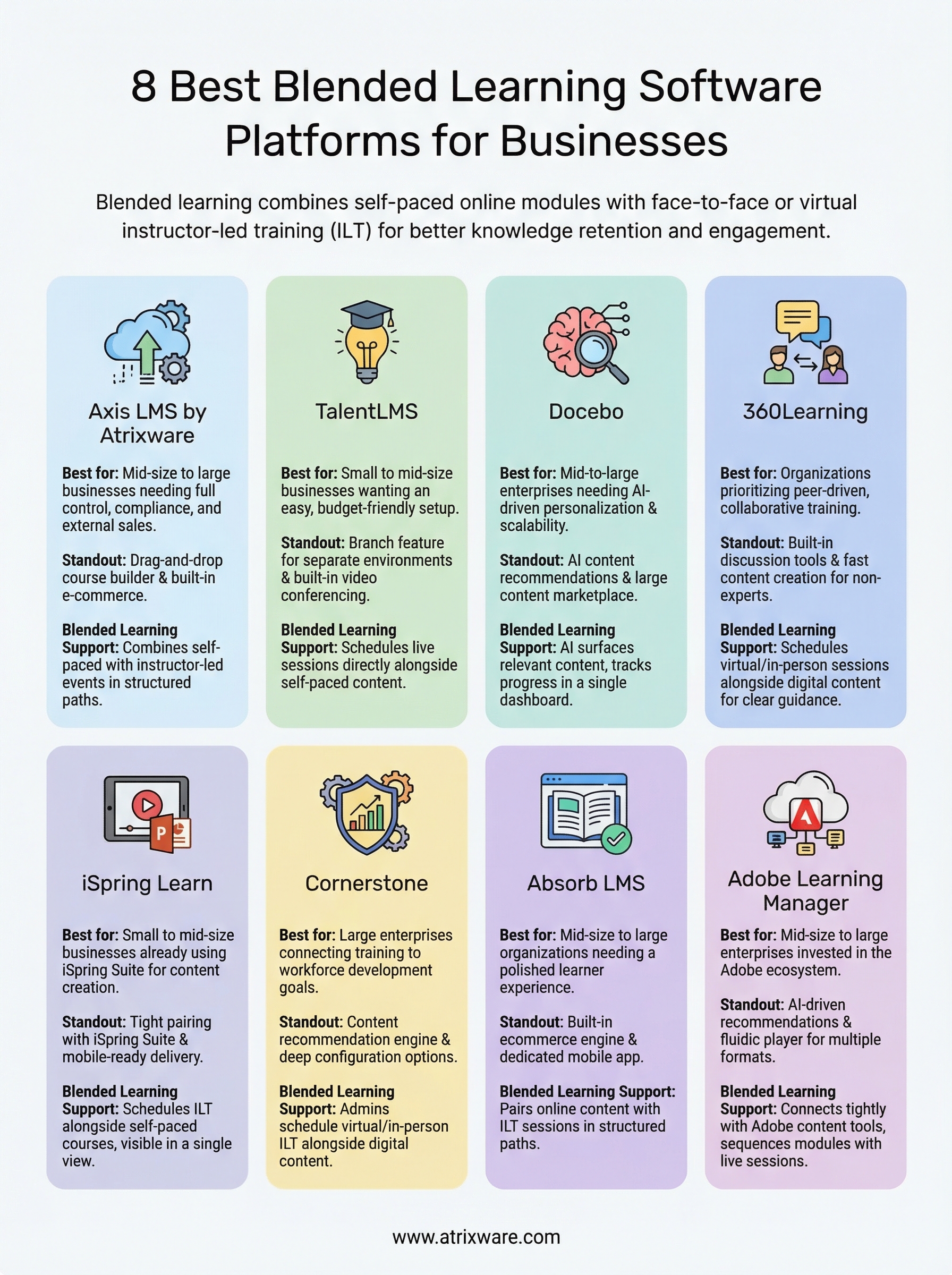
Each platform on this list brings a different set of strengths, so the right choice depends on your organization’s size, training complexity, and the integrations you already rely on. If you need deep compliance tracking, external course sales, and full branding control, Axis LMS covers more ground than most. If your team is smaller and budget-conscious, TalentLMS or iSpring Learn may serve you well. Either way, comparing your specific requirements against what each platform actually delivers will point you toward the best blended learning software for your situation faster than any single feature list.
Before committing to a platform, it helps to know where you stand in the buying process. Taking the LMS readiness quiz will give you a clear picture of what stage you’re at and what to prioritize next, so you walk into any product demo with the right questions already in hand.
